Van's Air Force

The definitive Van's Aircraft support community! Buying, building or flying an RV? Join our exclusive family of mentors and enthusiasts!

RV-10--How did you secure your EarthX battery?

tom_AZ

Well Known Member
Patron
I have quite some time before my C.I. is due, but at that point my Concorde RG-25XC will be 4 years old. It's still performing OK, but even though my engine is not electrically-dependent (E_mags), it has a glass panel, supported by a single battery and 2 alternators (PP primary :(, B&C standby :)) and I would rather replace it a little too soon than a little too late. Additionally, I wouldn't mind a little extra cranking speed at engine start. Thus, although I'm still mulling it over, I'm considering an EarthX as a replacement.

The Concorde fits nicely in the stock battery tray, and although the terminals are on top of the battery they are displaced toward the edge, so the hold-down bar doesn't create a potential conflict. In contrast, the EarthX terminals are along the center line, which would leave minimal vertical space between the terminal connections and the hold-down bar. I'd rather not have "Sparky" as my new nickname. EarthX makes "terminal adapters" which displace the terminal connections to the side, but there would still be minimal space between the bolt that secures the extenders and the hold-down bar. I'm thinking of three options as first thoughts, and am wondering if others have used one of them or have a different (better) design.

1) Cut a piece of 1/4" stock that would snugly fit into the battery tray. Make a cut-out to match the battery profile, thus preventing lateral movement of the smaller EarthX. Bias the cut-out toward the port side of the tray, such that the hold down bar is off-center, resting on the shoulder of the battery.

2) As above, but keep the cut-out centered. Use a piece of non conductive stock (?4" x 1.5" x 1"?) with a groove routered along the centerline to provide additional vertical space betwen the terminals and holddown bar.

3) As above, but rotate the cut-out 90 degrees, so that the battery sits sideways (IF cables are long enough to reach the furthest terminal). That would have the hold-down bar crossing the battery between the terminals rather than over them.


Lastly, I see that the EarthX900 is offered in a vented and non-vented configuration. The vented model (900-VNT) is indicated as appropriate for "in cabin installations". The stock battery tray isn't in the cabin of course, but air pressure may be slightly lower in the cabin v behind the bulkhead when in flight. My initial thoughts are that the vented model is probably unnecessary for my application. For those who have installed an EarthX behind the bulkhead, did you feel compelled to use the 900-VNT and if so, why?

Thanks in advance to those who have already gone down this road.
 
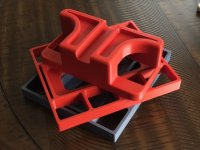
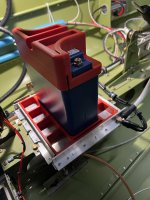
My father built the tray to fit one of the larger aircraft batteries (Concorde? Gill?). I wanted to use an EXT1200. I reached out to a gentleman through one of the Facebook groups. He designed and 3D printed a perfect adapter tray.

If you're interested, I can find his info and send it to you in a DM.


EarthX Battery Tray.jpeg EarthX Battery Tray.jpg
 
Last edited:
Lastly, I see that the EarthX900 is offered in a vented and non-vented configuration. The vented model (900-VNT) is indicated as appropriate for "in cabin installations". The stock battery tray isn't in the cabin of course, but air pressure may be slightly lower in the cabin v behind the bulkhead when in flight. My initial thoughts are that the vented model is probably unnecessary for my application. For those who have installed an EarthX behind the bulkhead, did you feel compelled to use the 900-VNT and if so, why?

Thanks in advance to those who have already gone down this road.
After talking with Cathy at Earth-X she convinced me that there was enough negative air pressure for an outgassing event if it were to occur not to be a factor. I went with 2 -1200's which don't come in a vented model. 4 years later no issues at all. Just one data point, however.
 
Thanks to both for the info.

A 3D printed adapter is intriguing. Yes, please send contact info.

Dmattmul—My understanding has been that the 900 was sufficient for a 540. Do you think that is incorrect (dual battery electrical system notwithstanding)?
 
Dmattmul—My understanding has been that the 900 was sufficient for a 540. Do you think that is incorrect (dual battery electrical system notwithstanding)?
Yes, even a 680 will start a 540 but the question is how much reserve do you want? Since I operate an electrical dependent engine and separate buses (One battery and alternator on each bus with diode protection on the essential bus) and each bus drawing ~ 14 amps after load shedding wanted at least an hour of flight time if needed so went with the 1200. It's only ~ 1.5 lbs. heavier and the 2 - 1,200 are still lighter than one AGM battery.

10's normally need weight in the tail to help with CG. Unless you have A/C replacing your AGM with a EarthX you will probably need to carry more weight in the baggage area so going with a 1200 probably helps this issue but check your W&B data to make sure.
 
Yes, even a 680 will start a 540 but the question is how much reserve do you want? Since I operate an electrical dependent engine and separate buses (One battery and alternator on each bus with diode protection on the essential bus) and each bus drawing ~ 14 amps after load shedding wanted at least an hour of flight time if needed so went with the 1200. It's only ~ 1.5 lbs. heavier and the 2 - 1,200 are still lighter than one AGM battery.

10's normally need weight in the tail to help with CG. Unless you have A/C replacing your AGM with a EarthX you will probably need to carry more weight in the baggage area so going with a 1200 probably helps this issue but check your W&B data to make sure.
Got it, thanks for clarifying. My ”travel bag” tool and parts kit, tow bar, cabin cover, etc… will keep me within CG limits. If my engine were electrically-dependent, I’d definitely have a similar e-system to yours. If I were designing for a new build, I’d probably do so even without an e-dependent engine.
 
I have quite some time before my C.I. is due, but at that point my Concorde RG-25XC will be 4 years old. It's still performing OK, but even though my engine is not electrically-dependent (E_mags), it has a glass panel, supported by a single battery and 2 alternators (PP primary :(, B&C standby :)) and I would rather replace it a little too soon than a little too late. Additionally, I wouldn't mind a little extra cranking speed at engine start. Thus, although I'm still mulling it over, I'm considering an EarthX as a replacement.

The Concorde fits nicely in the stock battery tray, and although the terminals are on top of the battery they are displaced toward the edge, so the hold-down bar doesn't create a potential conflict. In contrast, the EarthX terminals are along the center line, which would leave minimal vertical space between the terminal connections and the hold-down bar. I'd rather not have "Sparky" as my new nickname. EarthX makes "terminal adapters" which displace the terminal connections to the side, but there would still be minimal space between the bolt that secures the extenders and the hold-down bar. I'm thinking of three options as first thoughts, and am wondering if others have used one of them or have a different (better) design.

1) Cut a piece of 1/4" stock that would snugly fit into the battery tray. Make a cut-out to match the battery profile, thus preventing lateral movement of the smaller EarthX. Bias the cut-out toward the port side of the tray, such that the hold down bar is off-center, resting on the shoulder of the battery.

2) As above, but keep the cut-out centered. Use a piece of non conductive stock (?4" x 1.5" x 1"?) with a groove routered along the centerline to provide additional vertical space betwen the terminals and holddown bar.

3) As above, but rotate the cut-out 90 degrees, so that the battery sits sideways (IF cables are long enough to reach the furthest terminal). That would have the hold-down bar crossing the battery between the terminals rather than over them.


Lastly, I see that the EarthX900 is offered in a vented and non-vented configuration. The vented model (900-VNT) is indicated as appropriate for "in cabin installations". The stock battery tray isn't in the cabin of course, but air pressure may be slightly lower in the cabin v behind the bulkhead when in flight. My initial thoughts are that the vented model is probably unnecessary for my application. For those who have installed an EarthX behind the bulkhead, did you feel compelled to use the 900-VNT and if so, why?

Thanks in advance to those who have already gone down this road.
I have a IO-540 with 9:1 compression and have the 900 EarthX non vented. Works great with no issues. Go for the 3D printed adapter and that will be an easy fix.
 
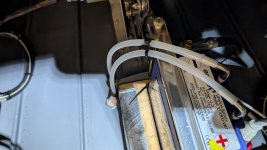
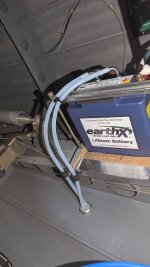
I went with the 900-VNT in the 10. and made a small wood spacer to take up the extra space in the tray. Maybe the VNT is overkill, but now I don't worry about it. and the cranking power is excellent.
 

Attachments

  • PXL_20250216_004922102.jpg
    PXL_20250216_004922102.jpg
    726.8 KB · Views: 87
  • PXL_20250216_004956778.jpg
    PXL_20250216_004956778.jpg
    926.3 KB · Views: 84
Since I operate an electrical dependent engine and separate buses (One battery and alternator on each bus with diode protection on the essential bus) and each bus drawing ~ 14 amps after load shedding wanted at least an hour of flight time if needed so went with the 1200. It's only ~ 1.5 lbs. heavier and the 2 - 1,200 are still lighter than one AGM battery.
I do understand trading weight for extra reserve, however the ETX 900 is rated at 15.6Ah. While it's not the 20Ah of the ETX 1200, it will still provide the more than an hour at your ~14A load. I have two of them and they work well.
 
After talking with Cathy at Earth-X she convinced me that there was enough negative air pressure for an outgassing event if it were to occur not to be a factor. I went with 2 -1200's which don't come in a vented model. 4 years later no issues at all. Just one data point, however.
Unsure on a 14, but in my 6, there is negative pressure at the canopy. This pulls air out of the plane under the canopy lip. Most of the air that supplies this action comes from the tail, presumably as it is a higher pressure area. My 10 is sealed very well at the doors and wing junction, so get almost no air movement. But my experience in the 6 tells me that if my doors or spar pass throughs leaked, I would get the same air flow from the tail and going out through those leaks.

This was easy to test in the 6 by placing tissue paper in various spots to observe air flow patterns. Suggest you do the same, as I don’t agree with cathys conclusions, at least not when the vents are closed. If yours get sealed up really well, than it is not an issue. But i went well beyond just good door seals to get that minimal air movement.
 
Last edited:
=
I do understand trading weight for extra reserve, however the ETX 900 is rated at 15.6Ah. While it's not the 20Ah of the ETX 1200, it will still provide the more than an hour at your ~14A load. I have two of them and they work well.
Well, no, you can have your own safety margins but for me I only want to plan on using 80% of my battery capacity and that would leave ~ 12.5 Ah left for a 15.6 Ah rating or 54 minutes and that is a new battery. (ETX900) For that reason, I want to start at 20 Ah (ETX 1200) rating for my electrical dependent ignition system. Starting at 20 Ah using 80% I'm at 16Ah. Now I have my one-hour flight time minimum and again that's with a new battery. Having added battery capacity is like extended range tanks for an electrical dependent engine. (My opinion) BTW every condition inspection I run an "ampacity" check on one of the batteries and see a gradual loss to the point that extrapolates to 80% capacity at the 4–5-year mark for the lower battery (runs 20 degrees hotter than the upper one) and 5-6 years for the upper battery. I've replaced the lower one once to date.
 
Last edited:
I do understand trading weight for extra reserve, however the ETX 900 is rated at 15.6Ah. While it's not the 20Ah of the ETX 1200, it will still provide the more than an hour at your ~14A load. I have two of them and they work well.
I recommend you take another look at the specifications of whatever battery you install. A rating of 15.6Ah does not mean it can provide 15.6 amps for an hour. The rating is for a much lower current draw over a longer period of time.

Anyone running an electrially dependent engine should have a dual battery design. While you can add an extra alternator (or three) the problem tends to be getting power to where you need it. For example if your engine gets power downstream of your master solenoid you are running an unnecessary risk of becoming a glider.

I don’t have an electrically dependent engine (pMags) but I do have two batteries feeding independent “avionic” busses with backup modes for redundancy. For me, I consider this a requirement for IFR flight.

Carl
 
I recommend you take another look at the specifications of whatever battery you install. A rating of 15.6Ah does not mean it can provide 15.6 amps for an hour. The rating is for a much lower current draw over a longer period of time.

Anyone running an electrially dependent engine should have a dual battery design. While you can add an extra alternator (or three) the problem tends to be getting power to where you need it. For example if your engine gets power downstream of your master solenoid you are running an unnecessary risk of becoming a glider.

I don’t have an electrically dependent engine (pMags) but I do have two batteries feeding independent “avionic” busses with backup modes for redundancy. For me, I consider this a requirement for IFR flight.

Carl
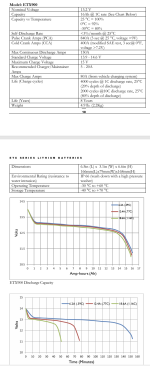
For the case of at least EarthX they do use a one-hour rating in their specs but if you look at faster and slower than 1C your point is valid:

Screenshot 2025-08-26 131944.png
 
2-emags, 2-alts, 2-680s. 24 AHr for the 680s vs 30 AHr capacity for the 900s. Each alt charges a batt and they can be paralleled manually and automatically on start. Recently flew a few local flts with just one batt. No problems, even on the hot starts. 900s are about one lb heavier but the same size as the 680s.

When I changed from the Odyssey 680 to EarthX in my RV6, 6 years ago, motor turned so fast I thought I could just do away with the gas tanks.
 
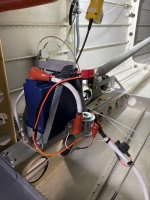
Here is a pic of my install with a sheet metal bracket. Had to remove the forward and aft U channels from the Vans battery tray.

batt tray.jpg
 
My father built the tray to fit one of the larger aircraft batteries (Concorde? Gill?). I wanted to use an EXT1200. I reached out to a gentleman through one of the Facebook groups. He designed and 3D printed a perfect adapter tray.

If you're interested, I can find his info and send it to you in a DM.


View attachment 95863 View attachment 95864
I’m certainly interested in the info for the 3-D printed adapter
 
Back
Top