

Van's Air Force
You are using an out of date browser. It may not display this or other websites correctly.
You should upgrade or use an alternative browser.
You should upgrade or use an alternative browser.
RV7 Mosaic eligibility
- Thread starter mr.sun
- Start date



WHO, is making this MOSAIC announcement? EAA? AOPA? FAA? DOT? or please tell exactly WHOM?Announcement comes at noon CT today

Sam Buchanan
been here awhile
Sean Duffy, FAA administrator.WHO, is making this MOSAIC announcement? EAA? AOPA? FAA? DOT? or please tell exactly WHOM?
https://avweb.com/aviation-news/mosaic-rule-expected-tuesday/

He’ll do.
Be sure to read carefully. New rule is for Vs1 (no flaps) and is in CAS (usually higher than IAS at low speeds).Because my 20 year old RV7 stalls at 58 knots, will a light sport pilot be able to fly it under the new rules?

You're missing the fact that 61 knots VS0 is the max stall speed for whether an airplane could be certified as an S-LSA/E-LSA. The max stall speed for whether a Sport Pilot can fly it is 59 knots VS1 (which, unfortunately, is quite a bit slower). Does Van's publish VS1 speeds for the -6 and -7?I fly a 6A so I’m interested in MOSAIC. I went to the Vans website and it shows 55 MPH for the 6 And 58MPH for the 7. Well below 61KTS CAS in MOSAIC. What am I missing?
You're missing the fact that 61 knots VS0 is the max stall speed for whether an airplane could be certified as an S-LSA/E-LSA. The max stall speed for whether a Sport Pilot can fly it is 59 knots VS1 (which, unfortunately, is quite a bit slower). Does Van's publish VS1 speeds for the -6 and -7?
OK, so it’s 66.6MPH for a light sport pilot. Vans shows different stall speeds for different weights (and based on my experience VSO). Who makes the determination of VS1?You're missing the fact that 61 knots VS0 is the max stall speed for whether an airplane could be certified as an S-LSA/E-LSA. The max stall speed for whether a Sport Pilot can fly it is 59 knots VS1 (which, unfortunately, is quite a bit slower). Does Van's publish VS1 speeds for the -6 and -7?
Edit; After doing the deep dive into 717 pages and reading Vans comments and the FAA logic that hopefully the 6 and 7 should fall just within the limits. Anyone from Vans on the list care to comment?
Thanks
Last edited:
BoydBirchler
Well Known Member
Sean Duffy is United States secretary of transportation, he oversees the FAA and the FAA administrator.
Impressive that he did the announcement...
Impressive that he did the announcement...
Final rule is max 59 KCAS S1 for sport pilots. The FAA comments explicitly address how you determine the CAS stall speed for your RV-7 and any other EAB cert aircraft.
Page 236: "FAA maintains published guidance with FAA-accepted methods for determining and documenting the VS1 CAS for an airplane in AC 90-89C, Amateur-Built Aircraft and Ultralight Flight Testing Handbook, including a method to determine CAS by conducting test flights."
What VAN's says is not necessarily your CAS or relevant - per the FAA, EAB must determine on a plane by plane basis per AC 90-89C accepted methods.
Page 236: "FAA maintains published guidance with FAA-accepted methods for determining and documenting the VS1 CAS for an airplane in AC 90-89C, Amateur-Built Aircraft and Ultralight Flight Testing Handbook, including a method to determine CAS by conducting test flights."
What VAN's says is not necessarily your CAS or relevant - per the FAA, EAB must determine on a plane by plane basis per AC 90-89C accepted methods.
Am I figuring it wrong? 59kts x 1.15= 67.85 I'm getting 67.85 mph.OK, so it’s 66.6MPH for a light sport pilot.
Nope. WWHunter had it right.Yes
Divide by not multiply. This key - /. Now you have me wondering if all that talk of us education falling in the global world could be true.
Regards,
Rob
sorry, thought he was going from mph to knots. Replied too quickly.Nope. WWHunter had it right.
Regards,
Rob

At what weight? Most likely the requirement is at your gross weight all though I have not seen that written anywhere. Those that have registered their -6 at 1800 lbs will have a higher Vs1 than those that use the Vans 1650 lbs.My -6 stalls at 52kts clean.
Also is that IAS or CAS? Do you have an indicated to calibrated correction?
As stated by talon167 above on how YOUR Vs1 is to be determined, some people may need to go back and do some flight testing.
Last edited:

Unless otherwise noted, all performance numbers are considered to be @ gross weight.At what weight? Most likely the requirement is at your gross weight all though I have not seen that written anywhere. Those that have registered their -6 at 1800 lbs will have a higher Vs1 than those that use the Vans 1650 lbs.
Also is that IAS or CAS? Do you have an indicated to calibrated correction?
As stated by talon167 above on how YOUR Vs1 is to be determined, some people may need to go back and do some flight testing.

kswanson
Active Member
1650 gross. Pretty much all RV's minus maybe 10 and 14 will now fit into the new requirements. Also keep in mind, they state 59 CAS. IAS and CAS are not always the same thing. Food for thoughtAt what weight? Most likely the requirement is at your gross weight all though I have not seen that written anywhere. Those that have registered their -6 at 1800 lbs will have a higher Vs1 than those that use the Vans 1650 lbs.
Also is that IAS or CAS? Do you have an indicated to calibrated correction?
As stated by talon167 above on how YOUR Vs1 is to be determined, some people may need to go back and do some flight testing.



Anyone gone up yet to test your CAS per the guidelines and what it comes in at?
I found that my IAS is accurate to within +/-1 knot over the range from 80 to 140 KIAS. GAP 26 pitot and Cleaveland static ports.
However, I didn't test mine at high angles of attack such as you'd see at the stall - not clear how you do that accurately without an air data boom.
MechaSteve
Well Known Member
AND most adverse CG location, typically the forward CG limit.Unless otherwise noted, all performance numbers are considered to be @ gross weight.
Theoretically, you could have a more complex edge case where you have a lower MGTOW at the forward CG limit, but I don’t think that is the case here.

I think the EAB, all the test information is logged in the airplane book. Just like the stall number a builder has to log and signed in the log to certify it was tested with a specific weight.What data will the FAA use in assessing whether or not your particular RV meets the new Vs1 requirement to be flown under Sport Pilot rules? Where will they get that information? Like…in the unlikely event of a ramp check?
CAFE Foundation testing of RV 8 yielded a clean stall at 1788 lbs to be 52.4 kcas. Perhaps the same info exists for the RV 7
This language is on page 236 of the "rule"What data will the FAA use in assessing whether or not your particular RV meets the new Vs1 requirement to be flown under Sport Pilot rules? Where will they get that information? Like…in the unlikely event of a ramp check
If the aircraft’s manual does not have a published VS1, FAA maintains published guidance with FAA-accepted methods for determining and documenting the VS1 CAS for an airplane in AC 90-89C, Amateur-Built Aircraft and Ultralight Flight Testing Handbook, including a method to determine CAS by conducting flight tests.
So, perhaps a log entry stating the stall speed as determined in accordance with the Advisory Circular?

You would be restricted to flight < 10k. I suspect it wouldn't be easy in Washington state.Because my 20 year old RV7 stalls at 58 knots, will a light sport pilot be able to fly it under the new rules?
Sam Buchanan
been here awhile
Or less than 2000' above terrain even if above 10K' which is a work-around to the 10K' limit.You would be restricted to flight < 10k. I suspect it wouldn't be easy in Washington state.
Last edited:

Hmmm...OK. I guess if the time ever comes when I need to fly under Sport Pilot, and in the unlikely event anyone asks me for proof of Vs1, I'll just use what the original builder published in the POH. My suspicion is that that FAA Enforcement Agent will just see that it's an RV-9A and assume that it's fine. I am curious now though...I'll have to rummage around in the logbook and construction documents and see if he documented that stuff.This language is on page 236 of the "rule"
If the aircraft’s manual does not have a published VS1, FAA maintains published guidance with FAA-accepted methods for determining and documenting the VS1 CAS for an airplane in AC 90-89C, Amateur-Built Aircraft and Ultralight Flight Testing Handbook, including a method to determine CAS by conducting flight tests.
So, perhaps a log entry stating the stall speed as determined in accordance with the Advisory Circular?
FWIW, I’ve flown around a bunch in Washington as a sport pilot (including crossing the Cascades a few times) and never found the 10k limit to be a significant constraint.You would be restricted to flight < 10k. I suspect it wouldn't be easy in Washington state.

The "clean" stall speed needs to be no higher than 59 knots.Because my 20 year old RV7 stalls at 58 knots, will a light sport pilot be able to fly it under the new rules?

Now that's a flashback. Hadn't thought about this report since published. A very nice refresher read. (There are also reports on the -4, -9A and -6A but I haven't read them.)CAFE Foundation testing of RV 8 yielded a clean stall at 1788 lbs to be 52.4 kcas. Perhaps the same info exists for the RV 7
CAFE Aircraft Performance Reports
Last edited:
Problematic when having to fly over weather.Or less than 2000' above terrain even if above 10K' which is a work-around to the 10K' limit.
I would guess/hope, that once the rule is published in the federal register, a list of airplanes will be listed that fall under the new rule, either by the kit manufacturer or the FAA. I'm sure all the kit manufacturers were involved in the petitioning for that VS1 number to make sure their product is within the scope.

Rule was published well over a week ago -fyiI would guess/hope, that once the rule is published in the federal register, a list of airplanes will be listed that fall under the new rule, either by the kit manufacturer or the FAA. I'm sure all the kit manufacturers were involved in the petitioning for that VS1 number to make sure their product is within the scope.
That, of courser, was the crux of my question. Not a hard question to answer for a type-certified airplane...they lend themselves to consistent cataloguing. E-AB's.....not so much.I would guess/hope, that once the rule is published in the federal register, a list of airplanes will be listed that fall under the new rule, either by the kit manufacturer or the FAA. I'm sure all the kit manufacturers were involved in the petitioning for that VS1 number to make sure their product is within the scope.
Rule was published well over a week ago -fyi
Edit: The rule was published but does not go into effect for 90 days.
Key dates and effective timelines
| Event | Date |
|---|---|
| Final rule submitted to Federal Register | July 18, 2025 (FAA signature date)In Flight USA+1 |
| Final rule published in Federal Register | July 24, 2025RedditGovInfo |
| Rule becomes effective | October 22, 2025 (90 days after publication)GovInfo |
| Some amendatory provisions effective later | July 24, 2026 (365 days after publication)GovInfo |
Last edited:
Wouldn't you think that the Van's brand would lend itself to grouping most under < 59kts VS1? How would the FAA ever police a ramp check?That, of courser, was the crux of my question. Not a hard question to answer for a type-certified airplane...they lend themselves to consistent cataloguing. E-AB's.....not so much.
Sam Buchanan
been here awhile
Flying as a Sport Pilot is not the best option when weather is a factor.Problematic when having to fly over weather.
Heh...if I knew the answer to either question I wouldn't have asked. Will they just assume that Van's design specs are accurate and rigorously adhered to in the build, or will they have to address the vivid imagination and wide variability that happens in the home-built world.Wouldn't you think that the Van's brand would lend itself to grouping most under < 59kts VS1? How would the FAA ever police a ramp check?
(it's a rhetorical question. I don't expect that anyone knows the actual answer, although I posted it out of curiosity hoping someone would)

I wondered about that too.Wouldn't you think that the Van's brand would lend itself to grouping most under < 59kts VS1? How would the FAA ever police a ramp check?
There's nothing in the ARROW docs that specifies an airplane is compliant with the <59 kts VS1 rule.
How would an FAA Inspector know the "Boogie Woogie 12345" is compliant?
Or a Vans RV7A?
Maybe I'm missing something.
Doesn't effect me now, but someday it may.
I suspect we will see further guidance on this from the faa, as there is no requirement for specifying Vs1 on eab. The builder must log the tested Vs0 speed in the logbook, along with Vx and Vy. Beyond that, there is no official speed. I can’t see how the faa can accept the kit makers numbers, as they are not the manufacturer of the plane and there is absolutely no guarantee that any given plane will match that speed, given the freedoms afforded to builders. The easy answer is for the faa to do a kit level approval, but really struggle to think they would do that.Heh...if I knew the answer to either question I wouldn't have asked. Will they just assume that Van's design specs are accurate and rigorously adhered to in the build, or will they have to address the vivid imagination and wide variability that happens in the home-built world.
(it's a rhetorical question. I don't expect that anyone knows the actual answer, although I posted it out of curiosity hoping someone would)
I suspect that in order to be eligible to fly an eab under these new rules, the faa will require that a airframe log entry be made defining Vs1. They will likely also point to an faa doc, dictating how the test is to be performed. Pretty sure they have a procedure for determining cas stall speeds in a current eab testing guide.
As written, it is almost unenforceable as there is no real way for a sport pilot to determine Vs1 on any eab other than a poh or markings on the indicator, neither of which is required to exist and if they do the numbers are all but guaranteed to be in ias.
Just my speculation here.
Last edited:
I hope not.I suspect that in order to be eligible to fly an eab under these new rules, the faa will require that a airframe log entry be made defining Vs1. They will likely also point to an faa doc, dictating how the test is to be performed. Pretty sure they have a procedure for determining cas stall speeds in a current eab testing guide.
This is fundamentally not a new issue. The exact speed threshold is changing, but for the past 21 years, sport pilots have been able to fly E-ABs as long as they meet various requirements including some airspeeds in CAS (and other things). There's no existing requirement for a log entry in that case, and I don't see why we would need one now.

TParker
Well Known Member
There's nothing in the ARROW docs that specifies an airplane is compliant with the <59 kts VS1 rule.
How would an FAA Inspector know the "Boogie Woogie 12345" is compliant?
Or a Vans RV7A?
59 KCAS VS1 is a pilot limitation, not an aircraft limitation. The question is not, "is this aircraft legal to fly?", but rather, "can you legally fly this aircraft?" The FAA should not, and I hope would not, add a requirement for aircraft (log book entry for VS1) based on a pilot limitation. This is no different from a perfectly airworthy tailwheel airplane being approached by a pilot without a tailwheel endorsement: plane is legal, pilot can't fly it.I suspect that in order to be eligible to fly an eab under these new rules, the faa will require that a airframe log entry be made defining Vs1. []
As written, it is almost unenforceable as there is no real way for a sport pilot to determine Vs1 on any eab other than a poh or markings on the indicator, neither of which is required to exist and if they do the numbers are all but guaranteed to be in ias.
The O in ARROW, or AROW is short hand, not the full requirement; that's 91.9:
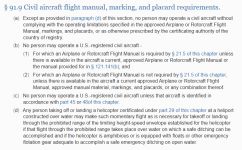
So, what flight manual, operating limitations, manual material, markings, or placards do you have for this aircraft that show you, as a sport pilot or a private pilot without a medical/BasicMed, are legal to fly it? If there's nothing available that documents VS1<= 59 KCAS then you're in violation and shouldn't be flying the aircraft, regardless of how closely the FAA is watching; that's how we as a community get a bad reputation, heavier enforcement and, maybe, privileges revoked. Poor (speeds only in indicated) or non-existent documentation on the aircraft side isn't permission to ignore the rule.
AC 23-8C, Flight Test Guide for Certification of Part 23 Airplanes, is quite descriptive on testing stall speeds, see the sections on 23.49 and 23.201. The EAB testing AC 90-89C is much less descriptive.They will likely also point to an faa doc, dictating how the test is to be performed. Pretty sure they have a procedure for determining cas stall speeds in a current eab testing guide.
The mosaic rules open things up for sport pilots allowing more EAB class planes.59 KCAS VS1 is a pilot limitation, not an aircraft limitation. The question is not, "is this aircraft legal to fly?", but rather, "can you legally fly this aircraft?" The FAA should not, and I hope would not, add a requirement for aircraft (log book entry for VS1) based on a pilot limitation. This is no different from a perfectly airworthy tailwheel airplane being approached by a pilot without a tailwheel endorsement: plane is legal, pilot can't fly it.
The O in ARROW, or AROW is short hand, not the full requirement; that's 91.9:View attachment 94386
So, what flight manual, operating limitations, manual material, markings, or placards do you have for this aircraft that show you, as a sport pilot or a private pilot without a medical/BasicMed, are legal to fly it? If there's nothing available that documents VS1<= 59 KCAS then you're in violation and shouldn't be flying the aircraft, regardless of how closely the FAA is watching; that's how we as a community get a bad reputation, heavier enforcement and, maybe, privileges revoked. Poor (speeds only in indicated) or non-existent documentation on the aircraft side isn't permission to ignore the rule.
AC 23-8C, Flight Test Guide for Certification of Part 23 Airplanes, is quite descriptive on testing stall speeds, see the sections on 23.49 and 23.201. The EAB testing AC 90-89C is much less descriptive.
Under these new rules, sport pilots will need to understand the Vs1stall speed of the EAB class airplanes that they were not previously allowed to fly in order to legally fly them. The rule seems clear that the aircrafts stall speed is a limitation for excersing priveleges.
Plane has tailwheel, cannot fly. Plane stalls over 59, cannot fly. Difference is that the tailwheel is obvious and the stall speed is not.
It remains unclear how they're going to be able to do that given that these speeds are typically not documented in EAB airplanes. The O in ARROW refers to operating handbooks, however EAB aircraft are not required to have these.
I certainly do not have the answers and did not mean to imply that I do. I was just providing some speculation in response to a question that seems relevant - "How does a sport pilot know the Vs1 of an EAB class aircraft he wants to fly, such that it is legal?" The answer cannot be to look in the POH, as these are often not available.
Last edited:
I suppose if it has been done this way for a long time, it may not be an issue. But it does raise the question as to the legality if speeds are not well documented. It seems to me that this rule leaves a lot of room for interpretation given that most EABs have no requirements for specifying Vs1. Without knowing how the FAA will interpret this leaves a risk for sport pilots IMHO. I was just speculating on how the FAA might respond to this ambiguity. The new rule opens things up pretty wide now, so expect flying EABs under this rule will greatly increase. At some point, one of these folks is going to get ramp checked.I hope not.
This is fundamentally not a new issue. The exact speed threshold is changing, but for the past 21 years, sport pilots have been able to fly E-ABs as long as they meet various requirements including some airspeeds in CAS (and other things). There's no existing requirement for a log entry in that case, and I don't see why we would need one now.
Last edited:
TParker
Well Known Member
Something less obvious then: flying a 210 HP aircraft without a high performance endorsement. A lot of EABs don't fully document their engine model, much less how much power it makes and you can't tell from the outside what that RV-7's got under the cowl.Plane has tailwheel, cannot fly. Plane stalls over 59, cannot fly. Difference is that the tailwheel is obvious and the stall speed is not.
I think the legality is very clear. If the answer to the question "What's the VS1, in KCAS, of this aircraft?" is "dunno" rather than a number less than or equal to 59, then it can't be flown by a sport pilot; VS1=? is no different than VS1=60 KCAS. Not only that, but because the rule is "since it's original certification", the documentation needs to exist since birth that the aircraft didn't have a non-compliant stall speed and then was subsequently modified to lower it, or vice-versa.But it does raise the question as to the legality if speeds are not well documented. It seems to me that this rule leaves a lot of room for interpretation given that most EABs have no requirements for specifying Vs1.
At the end of the day, if a pilot's answer to the question "How do you know you can legally operate this aircraft?" is, effectively, "I didn't know that I couldn't" then they're probably not going to have a good time if/when the FAA decides to start asking questions.
