Van's Air Force

The definitive Van's Aircraft support community! Buying, building or flying an RV? Join our exclusive family of mentors and enthusiasts!

How Hot the Pitot Line?

Ironflight

VAF Moderator / Line Boy
Mentor
If you’ve got a heated pitot tube, it probably came with aluminum tubes for pitot and AoA installed into the body, and they were probably a foot or more long. At some point, you probably want to transition from the metal one to nylon, poly, or silicone tube, just because it’s easier to work with. But…you wonder how hot the metal lines get and if you want to shorten them how short can they be and not melt your lines! I’m doing the pitot tube on the F1 Rocket project right now, and am planning to use tiny (1/8” OD) silicon tubing from the pitot to the wing root because it is light and easy to route. My pitot tube is a Piper blade with AN fittings screwed into the root, and brand new heating elements. I bent up some metal lines that fit my installation, and wanted to know where the transition can occur. Silicone tube is good for about 480 degrees F.

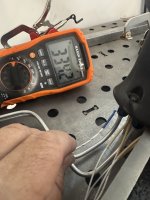
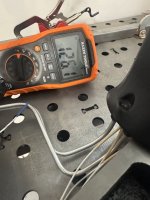
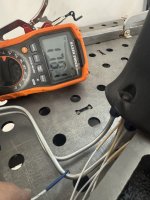
I powered up the pitot tube with my big 12 volt supply and set it up on the welding table, then let it reach steady state. Measuring temperature with a probe on my multimeter, the body of the blade stabilized at 500 degrees F. The bottom of the casting (where the AN fitting was located) was 334 degrees, the line 4” away was 178 degrees F, and the line temp at 9” was 126 degrees. this tells me that I COULD install the silicone right at the base….but I think I‘ll do it 4” away just to add margin and not take a chance on degrading the line after years of use. Note that I rarely use pitot heat unless I am operating in the clouds, and that is rare these days (I live in the desert).

Pictures to prove it happened….
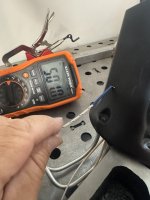
IMG_7291.jpegIMG_7290.jpegIMG_7289.jpegIMG_7288.jpeg
 
Wow that’s pretty hot, I suspect hotter than ‘normal’ due to lack of cooling airflow.
Agree - was surprised that the mast got that hot! I also suspect that it would be way cooler in a 170 knot breeze, but I also suspect that the base and lines (buried in the wing) will not cool down as much. However, the silicone tube is good to almost the temp of the blade surface, so there is probably plenty of margin with four or five inches of aluminum tube.

As always, I suggest folks test this with their own probes - this is a sample of ONE!
 
That's petty cool Paul. I never would've dreamed they get that hot.

You inspired me to use a piper blade on my RV. By the time I bought the heating elements,I didn't save much over the garmin, but as a Piper guy, I'm familiar with them and prefer the look.

Are you doing the static port AOA trick on the Rocket? Do you find the Piper blade to be dead on the stock pitot, or does it require some calibration/ adjusting?
 
As a side note to temp testing, checking the amp load as it heats up (unregulated). Basically when it's hot, the amps are like half of initial load, so made me feel much better about the 14 wire gauge I ran.
 
That's petty cool Paul. I never would've dreamed they get that hot.

You inspired me to use a piper blade on my RV. By the time I bought the heating elements,I didn't save much over the garmin, but as a Piper guy, I'm familiar with them and prefer the look.

Are you doing the static port AOA trick on the Rocket? Do you find the Piper blade to be dead on the stock pitot, or does it require some calibration/ adjusting?
I am using the Piper pitot for both Airspeed and AoA on both the RV-8 and the RV-3, and have been for twenty and thirteen years respectively - both gave accurate airspeeds right off the bat and ever since. Of course, AoA needs to be calibrated (as it does on all airplanes/systems), but works great once you complete that.
 
am planning to use tiny (1/8” OD) silicon tubing from the pitot to the wing root because it is light
Paul, given the surface tension of water, do you have any concerns about the silicone having an ID (1/8 OD) that is that small trapping water?
 
Paul, given the surface tension of water, do you have any concerns about the silicone having an ID (1/8 OD) that is that small trapping water?
I know quite a few folks that have used it for years without a problem, and I have used it for AoA systems for at least ten years - so nope, not worried.
 
Garmin has a note in GAP26 installation instructions to not cut the aluminum tubes shorter than 8" to make the transition to soft tube. Interesting that your piper unit is still kinda hot at that distance. I wonder if the Garmin unit maybe runs a bit cooler?
 
My gretz was similar. I think I put in 8” of metal tube before the nylon. I have to believe that the base will not get that hot in actual use. All of the heat generated is outside and with a 150 kt airflow a lot of it is getting shed before it can migrate internally. Your testing here makes me think hard about what might happen if it gets turned on when not moving.
 
. Your testing here makes me think hard about what might happen if it gets turned on when not moving.
Before my retirement, I was accustomed to 115 V AC powered pitot probes installed on aircraft that operated at speeds above that seen in the RV world. "Pitot Heat - ON" fell on the checklist at a point "After Cleared for Takeoff", and it was turned off after clearing the runway following landing.

During my post retirement A&P school, I had occasion to check the operation of the pitot heat on a Cessna 172. I wet six layers of shop towel, turned on the pitot heat, and checked the probe with the wet shop towels. No steam issued from the shop towels, but I heard a chuckle from my instructor. After getting down to two layers of shop towels, the pitot heat operation was confirmed. I'm still a rookie A&P.
 
The Dynon heated probe has a controller that limits the temp, and adds current as necessary to keep the probe warm enough to be effective. Not sure about the Garmin. The Piper and typical AN heated probes were not controlled.
 
My gretz was similar. I think I put in 8” of metal tube before the nylon. I have to believe that the base will not get that hot in actual use. All of the heat generated is outside and with a 150 kt airflow a lot of it is getting shed before it can migrate internally. Your testing here makes me think hard about what might happen if it gets turned on when not moving.
A quick story to make this point. I had a diode fail on my starter solenoid today, creating a failure to start. My trusty 25 watt soldering iron works very well on small wires in the garage. Had it at the plane today, trying to solder two wires together. After 10 minutes i gave up. With just 10 knots of breeze, the iron was completely incapable of holding enough heat to melt solder let alone get the wires hot.
 
The Dynon heated probe has a controller that limits the temp, and adds current as necessary to keep the probe warm enough to be effective. Not sure about the Garmin. The Piper and typical AN heated probes were not controlled.
Garmin offers a regulated and non- regulated version. Difference is about $100 iirc.
 
Garmin offers a regulated and non- regulated version. Difference is about $100 iirc.
When I asked Garmin at Airventure why would someone get a non-regulated vs. regulated heated pitot tube the answer came with a question. He asked what airplane it was going on. When I replied an RV he said go with the un-regulated (cheaper and simpler). He said the regulated is really for non-metal wings where you might worry about the max temp of the pitot tube damaging the wing (like on a composite airplane).

I would expect the worst case for the wing or the lines is if the pitot tube was accidentally on when on the ground and no airflow is going over the wing.
 
When I asked Garmin at Airventure why would someone get a non-regulated vs. regulated heated pitot tube the answer came with a question. He asked what airplane it was going on. When I replied an RV he said go with the un-regulated (cheaper and simpler). He said the regulated is really for non-metal wings where you might worry about the max temp of the pitot tube damaging the wing (like on a composite airplane).

That may be true as far as it goes, but the regulated version also provides a discrete output so you know the pitot temperature is sufficient to avoid icing, which is a nice feature. In my airplane this is set up to remind me to flip the switch when the air is cold and I haven't warmed up the pitot.
 
A quick story to make this point. I had a diode fail on my starter solenoid today, creating a failure to start. My trusty 25 watt soldering iron works very well on small wires in the garage. Had it at the plane today, trying to solder two wires together. After 10 minutes i gave up. With just 10 knots of breeze, the iron was completely incapable of holding enough heat to melt solder let alone get the wires hot.
OT,
Larry - what is/was the part number on the diode -- 1N400x, 1N54xx, ???

b
 
That may be true as far as it goes, but the regulated version also provides a discrete output so you know the pitot temperature is sufficient to avoid icing, which is a nice feature. In my airplane this is set up to remind me to flip the switch when the air is cold and I haven't warmed up the pitot.
...and you can "fake it" with the unregulated version -- when the OAT hits 5°C my G3X will remind me to turn on the pitot heat...
 
OT,
Larry - what is/was the part number on the diode -- 1N400x, 1N54xx, ???

b
forget the number. it was a 3A variety, iirc. Pressed the start button and nothing happened. Batt v was 13, but V at load side of start switch was close to 10 V. pulled wire off sol and got .5 ohms through switch. Wired batt directly to S term of sol, with diode removed, and cranked right over. installed new 3A diode and all works normal.

Either diode was leaking a good amount of power to grd, but not enough to trip breaker OR the solenoid intermittently failed. The latter doesn't make much sense, as I tried many times with no click and worked on first button press with new diode. solenoid was replaced a year or two ago, so not really ready to start failing.

That diode is on the engine side, so sees a lot of heat. plan to practively replace the master diode as well.
 
forget the number. it was a 3A variety, iirc. Pressed the start button and nothing happened. Batt v was 13, but V at load side of start switch was close to 10 V. pulled wire off sol and got .5 ohms through switch. Wired batt directly to S term of sol, with diode removed, and cranked right over. installed new 3A diode and all works normal.

Either diode was leaking a good amount of power to grd, but not enough to trip breaker OR the solenoid intermittently failed. The latter doesn't make much sense, as I tried many times with no click and worked on first button press with new diode. solenoid was replaced a year or two ago, so not really ready to start failing.

That diode is on the engine side, so sees a lot of heat. plan to practively replace the master diode as well.

Sounds like the diode failed and was passing more current in reverse bias than normal ( typically this is micro-amps, 1N4xxx is 5uA ) but not enough to pop the 3A breaker. Resistance when reverse biased would have been <1 ohm to get a 3V drop at < 3A.

I'm replacing these diodes with Snapjacks -- across all of the inductive loads, not just the activation coils in the Master & Starter Relays...
 
Sounds like the diode failed and was passing more current in reverse bias than normal ( typically this is micro-amps, 1N4xxx is 5uA ) but not enough to pop the 3A breaker. Resistance when reverse biased would have been <1 ohm to get a 3V drop at < 3A.

I'm replacing these diodes with Snapjacks -- across all of the inductive loads, not just the activation coils in the Master & Starter Relays...
thanks for the insight.
 
That may be true as far as it goes, but the regulated version also provides a discrete output so you know the pitot temperature is sufficient to avoid icing, which is a nice feature. In my airplane this is set up to remind me to flip the switch when the air is cold and I haven't warmed up the pitot.
I was planning the unregulated as I read somewhere that the regulated unit can be noisy. Any signs of this?
 
I was planning the unregulated as I read somewhere that the regulated unit can be noisy. Any signs of this?
No noise from mine that I can detect - and I’ve got it locally grounded as well. Only thing anywhere near it is the archer wingtip VOR - which is good for 100nm at 8k.
 
No noise from mine that I can detect - and I’ve got it locally grounded as well. Only thing anywhere near it is the archer wingtip VOR - which is good for 100nm at 8k.
Mine is grounded at the wing root so I don’t have to go up to 12 awg.
 
Back
Top