Van's Air Force

The definitive Van's Aircraft support community! Buying, building or flying an RV? Join our exclusive family of mentors and enthusiasts!

Mosaic Signed and Announced

Status
Not open for further replies.
First, to start with accurate facts, there is no 2 week course that is relevant to this discussion no matter how loosely you want to define terms. Based on the previous approved course at 120 hours it took 15 days of class, with federal guidelines that require days off it took 17 days. As to having the knowledge to doing a condition inspection, that's a matter of opinion or speculation. When I took the class there were a few "0 timers" in there, in my opinion some were competent at the and others were not. I spent 5 weeks in various types of aviation technical training last year and it included classmates that were just lowly LSRM like me up through IA. What I learned is that this 'some are competent and some aren't' idea applies to that entire spectrum. There were people fresh out of A&P schools that were completely clueless about GA aircraft. They were qualified to do your condition inspection, and could tell you all kinds of stuff about turbine engines but the Lycoming service info was going right over their heads. They were interested in learning more and I enjoyed learning along with them.

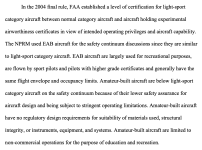
Something that you need to understand about the FAA perspective on safety, is that EABs sit below Light Sport on what they refer to as the 'safety continuum' (word search the rule for 'continuum' and you can learn more without needing to take my word for it). This concept plays heavily into a lot of the logic on MOSAIC. Light Sports are certificated and inspection is authorized at a higher level for LSAs than EABs. This may not seem intuitive or you could see it differently, but that's the data and structure that the FAA is working from. It is a tiered system were standard TC'ed aircraft sit above Light Sport, and Light Sport sits above EAB. This is why even a builder of an E-LSA had to get at least a 16 hour course and pass a test to maintain an aircraft that they build. What the FAA determined, after decades of data regarding safe LSA operation, was that the light sport criteria for inspection has a good track record and that it makes sense to extend the authorization to a lower tier of safety.


Making the judgement as to any individual being competent or not is difficult. If I think about the people I trained with, or the people I talk to doing professional maintenance, or the owners I listen to sharing their maintenance experiences it seems to me like it's all over the map. There are a lot of different motivations and experience levels out there. At the risk of going too far off on a tangent, consider that for an EAB the only requirement at all applies only to inspection. Anyone can do maintenance and modifications without any qualification at all. The 'trunk monkey' rule, says my 8 year old neighbor kid that has never touched an airplane can do anything they want to an EAB that anyone owns and if the CI is current it's legal to fly. If you're really concerned about safety risks that would probably be a much bigger hole to try and plug.
Sorry, I said 14 days and it was 17 days due to days off. I'm sure the days off helped make the training more complete than just 14 days. Ok, then, do you think that someone with 17 days...no wait, you already answered:

"When I took the class there were a few "0 timers" in there, in my opinion some were competent at the and others were not."

So my comments would be about those not competent, would an inspection by them be safe?

Then you mentioned "What I learned is that this 'some are competent and some aren't' idea applies to that entire spectrum. There were people fresh out of A&P schools that were completely clueless about GA aircraft. " , but all of those needed some experience to get signed off by the FAA to take the A&P tests, but that has nothing to do with the topic of MOSAIC so I won't comment on those.

"....they were qualified to do your condition inspection, and could tell you all kinds of stuff about turbine engines but the Lycoming service info was going right over their heads.", also nothing to do with MOSAIC but i think I'm I'm getting your point.

I guess your point is that lots of mechanics out there already are not the best so it doesn't matter if we add a whole lot more with 0, sorry, with 17 days experience to the mix because that won't make aviation less safe.

Then you said "...FAA perspective on safety, is that EABs sit below Light Sport..." and "...maintenance experiences it seems to me like it's all over the map..." , but your comment went into other things that are way beyond what my comment was about and if I address them it'll change the topic and I don't want to hijack this thread.


Then you said "...FAA perspective on safety, is that EABs sit below Light Sport..." and "...maintenance experiences it seems to me like it's all over the map..." , but your comment went into other things that are way beyond what my comment was about and if I address them it'll change the topic and I don't want to hijack this thread.
But in fact that is exactly what the FAA said. EAB aircraft are viewed as inherently less safe than light sport, so it makes little sense to require a higher level (A&P) of inspection on them than for Light Sport. If you own an EAB you should understand that you are taking on more risk in many areas, including but not limited to inspections. You are, of course, always free to hire an A&P, if that’s what you desire.
 
But in fact that is exactly what the FAA said. EAB aircraft are viewed as inherently less safe than light sport, so it makes little sense to require a higher level (A&P) of inspection on them than for Light Sport.
Do you have a source for this, a quote? Because that makes ZERO sense. A) "inherently less safe" sounds like a mischaracterization, and it's hardly rigorous, and B) even if something is "inherently" less "safe", the answer isn't to *reduce* mitigations like inspection rigor...it's to *increase* them.
 
Do you have a source for this, a quote? Because that makes ZERO sense. A) "inherently less safe" sounds like a mischaracterization, and it's hardly rigorous, and B) even if something is "inherently" less "safe", the answer isn't to *reduce* mitigations like inspection rigor...it's to *increase* them.
Here. Not saying I agree with them, but that's the FAA's position.
 
Do you have a source for this, a quote? Because that makes ZERO sense. A) "inherently less safe" sounds like a mischaracterization, and it's hardly rigorous, and B) even if something is "inherently" less "safe", the answer isn't to *reduce* mitigations like inspection rigor...it's to *increase* them.

The source has been mentioned here, it is embedded heavily in the logic of of the rule changes. It's documented and the FAA has data. Are you really asking for a source or just need to express your feelings and be heard?

Look at the rule. Search for 'continuum'. You will understand, even if you don't like it.
 
Do you have a source for this, a quote? Because that makes ZERO sense. A) "inherently less safe" sounds like a mischaracterization, and it's hardly rigorous, and B) even if something is "inherently" less "safe", the answer isn't to *reduce* mitigations like inspection rigor...it's to *increase* them.
 

Attachments

  • Screenshot 2025-07-24 at 4.12.05 PM.png
    Screenshot 2025-07-24 at 4.12.05 PM.png
    208.4 KB · Views: 18
Do you have a source for this, a quote? Because that makes ZERO sense. A) "inherently less safe" sounds like a mischaracterization, and it's hardly rigorous, and B) even if something is "inherently" less "safe", the answer isn't to *reduce* mitigations like inspection rigor...it's to *increase* them.
I absolutely disagree with this post. The AB in EAB stands for ‘amateur built’, It should not be surprising that amateur built aircraft have a worse accident record, a worse fatality record, than aircraft built under faa rules and regulations. The stated reason for EAB aircraft is for ‘the builder’s enjoyment or education’. There is no mention of safety. Remember that the second the person doing the condition inspection walks away, the owner is free to change almost anything he desires. Yes, some changes require returning to phase 1 but no one looks at the safety aspects. That’s why the E stands for experimental, and why the passenger warning placard is there. IMHO this rule change will have little impact on safety, compared to the present day situation. If you want increased safety, buy a spam-can.
 
I absolutely disagree with this post. The AB in EAB stands for ‘amateur built’, It should not be surprising that amateur built aircraft have a worse accident record, a worse fatality record, than aircraft built under faa rules and regulations. The stated reason for EAB aircraft is for ‘the builder’s enjoyment or education’. There is no mention of safety. Remember that the second the person doing the condition inspection walks away, the owner is free to change almost anything he desires. Yes, some changes require returning to phase 1 but no one looks at the safety aspects. That’s why the E stands for experimental, and why the passenger warning placard is there. IMHO this rule change will have little impact on safety, compared to the present day situation. If you want increased safety, buy a spam-can.
He mentions "rigor" a couple times and I think that's worth more serious comment than my direct reply. I'm getting a little short sometimes because it's obvious people want to comment without reading. Last couple days has shown a lot of 'I haven't read a single thing but here's my opinion on how the rule works and how it should work instead'.

I think one of the problems with people accepting things as this rule comes out, is that they have zero familiarity with the maintenance and inspection world for light sport. It's assumed that it's something like the 103 ULs, skydiving, or SCUBA...a complete free for all. The reality is that the maintenance and inspection is strictly regulated. There is documentation and training required that is well beyond anything for EAB, and in some aspects is more difficult to comply with than standard TC'ed aircraft.
 
  • Like
Reactions: RNB
But in fact that is exactly what the FAA said. EAB aircraft are viewed as inherently less safe than light sport, so it makes little sense to require a higher level (A&P) of inspection on them than for Light Sport. If you own an EAB you should understand that you are taking on more risk in many areas, including but not limited to inspections. You are, of course, always free to hire an A&P, if that’s what you desire.
I didn't say he was wrong or that the FAA didn't say it. I just said it has nothing to do with my original comment so I didn't want to hijack the thread, so if others keep talking about it, it's not on me.

The question I asked was if anyone thinks that a person with the total experience of 17 days (including days off) in a course, inspecting any e-ab they want, is making aviation safer.
 
.

Do you think that someone who has no previous training in maintenance and takes a 2 weeks course, has the knowledge to do a condition inspection and there's no risk to safety?
."
No. And while the faa is actively trying to help, i fear there could be consequences to this as they extend it to eab. Then again, this has been going on in the lsa world for a long time and we don’t seem to hear about poor safety stats there.

But then again anybody, including those with no previous experience AND no course completed, can do any maintenance on any EAB and has been this way since the beginning. While the ci is critical to catch problems before they hurt someone, doing poor maintenance can create even more dangerous safety issues. So, while I agree with your thoughts here, the faa is just further opening a door that has already been opened and we haven’t seen a bunch of planes falling out of the sky, though I believe the safety record is not on par with the certified stuf and am confident much of that is due to what i just mentioned.
 
Last edited:
Do you have a source for this, a quote? Because that makes ZERO sense. A) "inherently less safe" sounds like a mischaracterization, and it's hardly rigorous, and B) even if something is "inherently" less "safe", the answer isn't to *reduce* mitigations like inspection rigor...it's to *increase* them.
The faa makes us install a plaque in our eab, telling our passengers it is less safe. Where is the confusion.

The faa considers eab’s as experiments that are inherently less safe than other aircraft that must follow insanely rigorous standards in design, maintenance, parts and inspections. They even make us tell control towers that we are experiments, so they can treat use with extra caution. Their position is quite clear imho.
 
Last edited:
Excuse my ignorance, but what makes you believe that people can't learn and do the right thing? Not all of us have the same experience but we can learn and improve our knowledge.
 
Excuse my ignorance, but what makes you believe that people can't learn and do the right thing? Not all of us have the same experience but we can learn and improve our knowledge.
There is a whole generation of people who think that if things were tough for them, everyone that follows should suffer the same fate. There is a popular term for this group that I’ll refrain from using. You’re witnessing that here.
 
No. And while the faa is actively trying to help, i fear there could be consequences to this as they extend it to eab. Then again, this has been going on in the lsa world for a long time and we don’t seem to hear about poor safety stats there.

But then again anybody, including those with no previous experience AND no course completed, can do any maintenance on any EAB and has been this way since the beginning. While the ci is critical to catch problems before they hurt someone, doing poor maintenance can create even more dangerous safety issues. So, while I agree with your thoughts here, the faa is just further opening a door that has already been opened and we haven’t seen a bunch of planes falling out of the sky, though I believe the safety record is not on par with the certified stuf and am confident much of that is due to what i just mentioned.
Thank you for answering my question.

"Then again, this has been going on in the lsa world for a long time and we don’t seem to hear about poor safety stats there."

But aren't the majority of LSA built at the factory, disassembled, then assembled here in the States before selling them? They're hardly like an RV where you have to cut metal and make parts, most LSAs are more kit assembly than building.

"anybody, including those with no previous experience AND no course completed, can do any maintenance on any EAB and has been this way since the beginning. While the ci is critical to catch problems before they hurt someone, doing poor maintenance can create even more dangerous safety issues. "

You make my points. Yes, anyone can work on experimentals and yes the only time to catch any of those possible "dangerous safety issues" is during the condition inspection once a year. If that's not done correctly then nobody will catch any errors done during maintenance during the year.

My RV8 went 9 years with the builder doing the condition inspection every year. Since nobody else had put eyes on it during that time, I bought it and my first inspection we found it was missing a dozen bolts in the fuselage and wing area. That's why I consider the condition inspection should be left to those with experience enough to catch the issues, and not someone with 17 days experience. Just my opinion based on having my various aircraft inspected every year for over 4 decades by different people, and the next one sometimes catches what the previous one missed.
 
Last edited:
Just my opinion based on having my various aircraft inspected every year for over 4 decades by different people, and the next one sometimes catches what the previous one missed.
4 decades of inspections under the old paradigm with what I guess you would consider appropriately experienced mechanics, yet still things were being missed.

You’re so close to figuring this out!
 
Excuse my ignorance, but what makes you believe that people can't learn and do the right thing? Not all of us have the same experience but we can learn and improve our knowledge.
Don’t believe anyone said that. Most of us here started with no experience and ended up with great and safe planes and knowledgeable enough to help others do the same. We only said that a 16 hour course alone is not adequate to make a good inspector.

Some people are smart enough to know their own limitations and realize they need to do a lot more than take a 16 hour course to realistically inspect their plane safely and expect many will do just that. Sadly, some don’t realize their limitations and will take their certificate straight to the hanger and complete their CI, almost guaranteed to miss things they didn’t even think to look for. These are the planes you don’t want to fly to close to. I will never be convinced that someone with 0 experience attending a16 hour course is competent to adequately inspect an airplane and deem it safe. Conversely, i think most anyone who invests enough time learning CAN safely inspect their plane.
 
Last edited:
Don’t believe anyone said that. Most of us here started with no experience and ended up with great and safe planes and knowledgeable enough to help others do the same. We only said that a 16 hour course alone is not adequate to make a good inspector.

Some people are smart enough to know their own limitations and realize they need to do a lot more than take a 16 hour course to realistically inspect their plane safely and expect many will do just that. Sadly, some don’t realize their limitations and will take their certificate straight to the hanger and complete their CI, almost guaranteed to miss things they didn’t even think to look for. These are the planes you don’t want to fly to close to. I will never be convinced that someone with 0 experience attending a16 hour course is competent to adequately inspect an airplane and deem it safe. Conversely, i think most anyone who invests enough time learning CAN safely inspect their plane.

One problem may be a misunderstanding of what the short course is. They aren’t teaching hands on inspection skills and acting like the course “alone” is enough to inspect. It’s regs to verify you are legal to work on the subject aircraft, mfr documentation, and 43-13 appendix B. It’s meant to put people on the path to uses resources to do the job right. People build entire airplanes based on the advice in “section 5”, they can learn to use that along with similar resources to inspect. In fact, they have been for decades now.


The old rules really didn’t require anything more with respect to knowledge specific to any particular EAB for an A&P to inspect.

More experience is always better, but it’s a fallacy think any A&P is automatically well qualified to inspect every EAB and the expanded authorization for LSRM doesn’t change much in that regard.
 
A good CI is really taking time and going thru everything; looking for cracks in structural areas; reviewing all of Vans service bulletins to look for compliance; looking intently through the inspection panels; checking the timing and intake gaskets and spark plugs and wiring bundles. PMags and emags and magnetos need checking or sending off to the service center. Exhaust pipes need checking at the slip joints and having good suspension; see all of Vic's books for all the ways the rv's age with time. I think a good builder that does the 15 day courser would have some knowledge into what to look for. A nonbuilder probably won't. Vic has shown how terrible the planes can get over time. His books show how a regimented inspection can uncover alot of mischief. This is the sort of rigor a LSRM shoud aspire to. Just saying IMHO. It is a somewhat sllippery slope.
I doubt a nonbuilder will really get what to look for. Vic has done a great service in all his books in showing how dangerous things crop up over time. For a RV plane owner, this should all be required reading. Not anything about turbine engines or fiber cloth wing inspection. Very focused. Funny how the smallest of errors can make a bad outcome.
Cal
 
4 decades of inspections under the old paradigm with what I guess you would consider appropriately experienced mechanics, yet still things were being missed.

You’re so close to figuring this out!
You're trying so hard to make my point wrong that you're not even reading correctly, and again, conveniently leave out the part of my comment, just like previously you left out the question I asked you but never have answered.

I wrote:

"My RV8 went 9 years with the builder doing the condition inspection every year. Since nobody else had put eyes on it during that time, I bought it and my first inspection we found it was missing a dozen bolts in the fuselage and wing area. That's why I consider the condition inspection should be left to those with experience enough to catch the issues, and not someone with 17 days experience. Just my opinion based on having my various aircraft inspected every year for over 4 decades by different people, and the next one sometimes catches what the previous one missed."

Yes, some times one mechanic would find what the previous one didn't catch, but that proves my point that someone with more experience in my aircraft would find what the previous one didn't. That's why I wouldn't let a mechanic with 20 years experience in Cessna 172s inspect an RV8, and vice versa. Neither of them would know what to look for in the other plane so there's a bigger possibility of missing something.
 
Last edited:
... I think a good builder that does the 15 day courser would have some knowledge into what to look for. A nonbuilder probably won't. Vic has shown how terrible the planes can get over time. His books show how a regimented inspection can uncover alot of mischief. This is the sort of rigor a LSRM shoud aspire to. Just saying IMHO. It is a somewhat sllippery slope.
I doubt a nonbuilder will really get what to look for. Vic has done a great service in all his books in showing how dangerous things crop up over time. For a RV plane owner, this should all be required reading. Not anything about turbine engines or fiber cloth wing inspection. Very focused. Funny how the smallest of errors can make a bad outcome.
Cal
EXACTLY MY POINT !! And Vic is so experienced in RVs that when I asked him once to do an pre-purchase close to where he lives, he told me he couldn't because he didn't have experience with that airframe (wasn't an RV), and I fully appreciated his honesty..

And that's where my opinion comes from that there's no way someone who only has the 17 day course, even though the course is 14 days but apparently we must add the rest periods, has the experience to check any E-AB and do a complete, safe, job.
 
Last edited:
Here. Not saying I agree with them, but that's the FAA's position.
Well, I'll admit...you're right, they did say essentially that. Mea culpa. :)

I think what bothers me is that prior to this, there were two types of people who could conduct a CI on an EAB...the person who built the damned thing, or someone who actually was trained and qualified as an A&P. So this rule now allows someone with 2 weeks of training (vs. months or years of building, or years of training and education) to do a CI on any EAB? I just find that counterintuitive, but hey...I built mine and I got the Repairman's Certificate for it, so it's no skin off my nose. Have at it! :)
 
I’m an NBO of an RV-9A. My read of the new regs is that (a) if I take and pass a two-day course I can conduct the CI on my own RV, all by my lonesome, and (b) if I take and pass a 15-day course I can do CIs on literally any EAB that is single engine land.

Not sure if my read is correct.

If it is, then, in the words of Dirty Harry, “a man’s got to know his limitations.”

My flying buddy the mechanical engineer could likely do CIs safely with that training. But there’s no way I should be doing my own or other aircraft’s CIs, given my limitations, with that little training.

I fear there might be a lot of people like me, that some of them will not know or respect their own limitations, and that this will have bad effects on safety. I could be wrong about one or more of those things. I admit the experience thus far with LSAs appears to give us some room for hope.

One way to find out I suppose. 🤣
 
I’m an NBO of an RV-9A. My read of the new regs is that (a) if I take and pass a two-day course I can conduct the CI on my own RV, all by my lonesome, and (b) if I take and pass a 15-day course I can do CIs on literally any EAB that is single engine land.

Not sure if my read is correct.

If it is, then, in the words of Dirty Harry, “a man’s got to know his limitations.”

My flying buddy the mechanical engineer could likely do CIs safely with that training. But there’s no way I should be doing my own or other aircraft’s CIs, given my limitations, with that little training.

I fear there might be a lot of people like me, that some of them will not know or respect their own limitations, and that this will have bad effects on safety. I could be wrong about one or more of those things. I admit the experience thus far with LSAs appears to give us some room for hope.

One way to find out I suppose. 🤣

That is my read of things also. I will think of it a bit like my IFR, maybe legal but not proficient.

I plan to be onsite for my next CI and have thought to post to help other owners for free to gain experience and see what they see.
 
It would be nice if those of us who have a repairman's certificate for building our own plane could have that privilege extended to other similar EABs, now that somebody could get one by taking a two week class. I mean, 3000+ hours building the thing is probably at least as instructional as the class. Personally, I feel like the builder of an RV would be more qualified to inspect one than somebody whose only experience was a two week class.
 
It would be nice if those of us who have a repairman's certificate for building our own plane could have that privilege extended to other similar EABs, now that somebody could get one by taking a two week class. I mean, 3000+ hours building the thing is probably at least as instructional as the class. Personally, I feel like the builder of an RV would be more qualified to inspect one than somebody whose only experience was a two week class.
At a minimum you would know where to look for issues, compared with a "2 week wonder".
 
At a minimum you would know where to look for issues, compared with a "2 week wonder".
But that has never been the minimum. A&Ps all over the country have been authorized to perform CIs on homebuilts that they know nothing about, yet that is being held up as the safety standard that is suddenly being breached.

What we can agree on is that it's best if the individual doing the inspection can obtain knowledge and experience about every make/model they inspect. Unfortunately this has never been satisfied by regulations and probably never will. This is satisfied by taking an interest, asking questions, working with mentors, etc.
 
A&Ps all over the country have been authorized to perform CIs on homebuilts that they know nothing about...
Wait, what? What part of an RV is sooooo exotic that a licensed A&P, with a couple of years of training or OJT, isn't at least familiar with standard inspection techniques? It's an all-metal, riveted construction with pushrods and bellcranks, fixed gear, rudder cables, and on and on. IF there's something so weird on a particular RV that a qualified A&P is befuddled, it's probably going to have an equally confounding effect on the guy with 2 days of training, no?

Other models of homebuilt, I couldn't tell you, but again...if it's so out of the mainstream that an average A&P can't understand it or sort it out, then it's hard to see how anyone who didn't build it but took a weekend intro class to maintenance will.
 
Wait, what? What part of an RV is sooooo exotic that a licensed A&P, with a couple of years of training or OJT, isn't at least familiar with standard inspection techniques? It's an all-metal, riveted construction with pushrods and bellcranks, fixed gear, rudder cables, and on and on. IF there's something so weird on a particular RV that a qualified A&P is befuddled, it's probably going to have an equally confounding effect on the guy with 2 days of training, no?

Other models of homebuilt, I couldn't tell you, but again...if it's so out of the mainstream that an average A&P can't understand it or sort it out, then it's hard to see how anyone who didn't build it but took a weekend intro class to maintenance will.
Look, you guys can’t have it both ways. One guy is arguing that you need a specialist who knows about specific issues to look for while the other is saying an RV is a basic and standard inspection. I happen to agree with you, it’s not exotic and requires no special skills.

I also was being clear that the correct experience is not established by regulations. People get an A&P a lot of different ways. I know several who interned with a private jet outfitter and are IA now, but will quickly admit they have no expertise and very limited experience with a single piston ga airplane like the RV. That individual meets the regulatory requirement to do the inspection, but not the “minimum” that someone else mentioned about knowledge of known issues on an RV.
 
Look, you guys can’t have it both ways. One guy is arguing that you need a specialist who knows about specific issues to look for while the other is saying an RV is a basic and standard inspection. I happen to agree with you, it’s not exotic and requires no special skills.

I also was being clear that the correct experience is not established by regulations. People get an A&P a lot of different ways. I know several who interned with a private jet outfitter and are IA now, but will quickly admit they have no expertise and very limited experience with a single piston ga airplane like the RV. That individual meets the regulatory requirement to do the inspection, but not the “minimum” that someone else mentioned about knowledge of known issues on an RV.
No, I'm saying that currently, two classes of people are licensed to do CIs on EABs: the guy who built it (and therefore presumably knows a great deal about all the construction, systems, etc., for THAT airplane), and an A&P (who would have had to have demonstrated and been examined on a wide variety of things, including metal construction and repair, fiberglass construction and repair, tube and fabric, electrical systems, electronics, old-style steam gauges, control systems of various kinds, pushrods, cable systems, turnbuckles, rod ends, bearings and races, piston engine maintenance, turbine engine maintenance, and on and on and on). If an A&P is unfamiliar with or has little expertise in piston singles, and has "specialized" his business to corporate turbines, then he's right to pass on the job (it's his license at stake, after all).

But I just can't see any way that a 2 day or even a 2 week course designed for generic LSA inspections can possibly be thorough enough to either a) cover any specific model of EAB which the newly minted cert holder might decide to inspect and sign off on, or b) be broad enough in scope to equate to an A&P license.

Think about it...a guy could go take the 2-week course, and suddenly he's licensed to inspect and sign off on anything from a bone stock RV to Paul's jet.

But hey, we're here now, so time will tell if this works out or ends up getting some people killed.
 
Think about it...a guy could go take the 2-week course, and suddenly he's licensed to inspect and sign off on anything from a bone stock RV to Paul's jet.

I thought about it. They can't. You're taking a leap over some important regulations, and I think this is an important thing for the people panicking about the new rules to understand. No mechanic, whether it is an A&P or a LSRM with either of the ratings, is allowed to perform work that they have not previously demonstrated successfully. You can't perform the necessary inspection steps on the turbine unless you have had some instruction and/or experience. You currently won't get that in any of the current LSRM courses, and the instructors make the limitations very clear.

As someone else mentioned, whether we're under the old rules or the new rules, people need to know their limitations. This is a matter of character and it's not resolved by any level certification. This forum has lots of threads with horror stories from people who took their RV to the local FBO for maintenance. I don't think MOSAIC will make it any better or worse, the track record for LSA maintenance supports that.
 
But that has never been the minimum. A&Ps all over the country have been authorized to perform CIs on homebuilts that they know nothing about, yet that is being held up as the safety standard that is suddenly being breached.

What we can agree on is that it's best if the individual doing the inspection can obtain knowledge and experience about every make/model they inspect. Unfortunately this has never been satisfied by regulations and probably never will. This is satisfied by taking an interest, asking questions, working with mentors, etc.
Again, those A&Ps had to show an FAA Inspector that they had the minimum experience to even take the test. Not even close to a 2 week wonder who just goes and takes the course and comes out like 007 !
 
No, I'm saying that currently, two classes of people are licensed to do CIs on EABs: the guy who built it (and therefore presumably knows a great deal about all the construction, systems, etc., for THAT airplane), and an A&P (who would have had to have demonstrated and been examined on a wide variety of things, including metal construction and repair, fiberglass construction and repair, tube and fabric, electrical systems, electronics, old-style steam gauges, control systems of various kinds, pushrods, cable systems, turnbuckles, rod ends, bearings and races, piston engine maintenance, turbine engine maintenance, and on and on and on). If an A&P is unfamiliar with or has little expertise in piston singles, and has "specialized" his business to corporate turbines, then he's right to pass on the job (it's his license at stake, after all).

But I just can't see any way that a 2 day or even a 2 week course designed for generic LSA inspections can possibly be thorough enough to either a) cover any specific model of EAB which the newly minted cert holder might decide to inspect and sign off on, or b) be broad enough in scope to equate to an A&P license.

Think about it...a guy could go take the 2-week course, and suddenly he's licensed to inspect and sign off on anything from a bone stock RV to Paul's jet.

But hey, we're here now, so time will tell if this works out or ends up getting some people killed.
As soon as I saw the word JET, I knew he'd jump on that. Remove the word JET and your comment is spot on.
 
As soon as I saw the word JET, I knew he'd jump on that. Remove the word JET and your comment is spot on.
Quick, change the comment to something else so there is some remaining avenue to argue even though the point would be lost! :ROFLMAO: Should I apologize for being familiar with the regulations and being willing to push back when people get them wrong or imagine their own version?

I don't know what else there is to say. The rule change is what it is. I'm sorry that you guys are scared that the government is no longer protecting EAB passengers.
 
https://pages.eaa.org/index.php/ema...Ovk73MbTwuupjSfqDkK7krCwkOSn2QbDYZ3SYol0EFFzg

"For current sport pilots, that means you have an expanded choice of existing and new aircraft to fly and more privileges you can obtain. For private pilots, you can fly many existing airplanes instantly with a drivers license medical. If you’ve dreamed of becoming a pilot, doing so just became infinitely easier."
Yes, but with a ppl, you can’t fly with more than 2 people & not over 10k.
 
I asked the questioned at the MOSAIC forum.
As a PPL pilot flying under basic med, how do the changes affect me. BTW, Charlie Becker was in attendance & they both concur.
If I choose to fly under LSA using a Drivers license medical, I can’t fly above 10k & only with 2 souls. So, bottom line, if you’re flying under basic med, don’t give it up.
Sorry if this has been repeated in the previous threads, but TLDR.
 
I thought about it. They can't. You're taking a leap over some important regulations, and I think this is an important thing for the people panicking about the new rules to understand. No mechanic, whether it is an A&P or a LSRM with either of the ratings, is allowed to perform work that they have not previously demonstrated successfully. You can't perform the necessary inspection steps on the turbine unless you have had some instruction and/or experience. You currently won't get that in any of the current LSRM courses, and the instructors make the limitations very clear.

As someone else mentioned, whether we're under the old rules or the new rules, people need to know their limitations. This is a matter of character and it's not resolved by any level certification. This forum has lots of threads with horror stories from people who took their RV to the local FBO for maintenance. I don't think MOSAIC will make it any better or worse, the track record for LSA maintenance supports that.
OK, I'll bite again...what regulation under the new rules for an LSRM-I states this?
 
OK, I'll bite again...what regulation under the new rules for an LSRM-I states this?
You moved the goalpost. LSRM-I isn't what you said. To be fair we are pretty deep in the nitty gritty but when you said 'inspect Paul's jet', you were made reference to the 2 week course. Nevermind that a 2 week course doesn't even exist, I'll stipulate to understanding what you meant. The 2 week course is the LSRM-M.

(Separately, the Inspection and Maintenance ratings have stupid names and don't make any of this any easier to follow)

Think about it...a guy could go take the 2-week course, and suddenly he's licensed to inspect and sign off on anything from a bone stock RV to Paul's jet.

The regulation is existing and is not be changed by the new rules. It is 65-107 subpart D.

(d) The holder of a repairman certificate (light-sport aircraft) with a maintenance rating may not approve for return to service any aircraft or part thereof unless that person has previously performed the work concerned satisfactorily. If that person has not previously performed that work, the person may show the ability to do the work by performing it to the satisfaction of the FAA, or by performing it under the direct supervision of a certificated and appropriately rated mechanic, or a certificated repairman, who has had previous experience in the specific operation concerned. The repairman may not exercise the privileges of the certificate unless the repairman understands the current instructions of the manufacturer and the maintenance manuals for the specific operation concerned.
 
Quick, change the comment to something else so there is some remaining avenue to argue even though the point would be lost! :ROFLMAO: Should I apologize for being familiar with the regulations and being willing to push back when people get them wrong or imagine their own version?

I don't know what else there is to say. The rule change is what it is. I'm sorry that you guys are scared that the government is no longer protecting EAB passengers.
Again reading skills aren't your best. The meaning of what I wrote was that by just removing the word JET, his comment would still keep his intent and point valid, but you went after that word and ignored everything else. You pick and choose what parts of people's comments to edit but don't answer simple questions. I'm out, too much wasted time already.
 
Again reading skills aren't your best. The meaning of what I wrote was that by just removing the word JET, his comment would still keep his intent and point valid, but you went after that word and ignored everything else. You pick and choose what parts of people's comments to edit but don't answer simple questions. I'm out, too much wasted time already.
Nah, you’re cooked. His point was people take a two week course and can work on anything, like a jet. But they can’t. I provided the regulation.

I answer the questions, they just don’t fit your world view of hero inspectors.
 
I answer the questions, they just don’t fit your world view of hero inspectors.
No, you haven't answered :

Do you think that someone who has no previous training in maintenance and takes a 2 weeks course (or 17 days so you don't grab on to that to avoid the simple question), has the knowledge to do a condition inspection and there's no risk to safety?

No need to add a million words, it's a simple YES or No question.
 
No, you haven't answered :

Do you think that someone who has no previous training in maintenance and takes a 2 weeks course (or 17 days so you don't grab on to that to avoid the simple question), has the knowledge to do a condition inspection and there's no risk to safety?

No need to add a million words, it's a simple YES or No question.

Uhh. No.

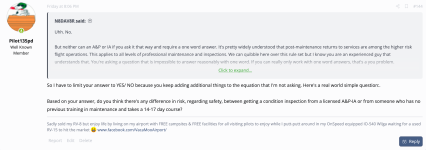
But neither can an A&P or IA if you ask it that way and require a one word answer. It's pretty widely understood that post-maintenance returns to services are among the higher risk flight operations. This applies to all levels of professional maintenance and inspections. We can quibble here over this rule set but I know you are an experienced guy that understands that. You're asking a question that is impossible to answer reasonably with one word. If you can really only work with one word answers, that's a you problem.

What I'm saying in this thread is that some people, for some aircraft, can perform a quality condition inspection after nothing more than the long course. More importantly, the course isn't meant to be the end of the road for training. It's an authorization to perform what you have been taught, and to add more by learning. A&P schools work the same way.
 
Uhh. No.

But neither can an A&P or IA if you ask it that way and require a one word answer. It's pretty widely understood that post-maintenance returns to services are among the higher risk flight operations. This applies to all levels of professional maintenance and inspections. We can quibble here over this rule set but I know you are an experienced guy that understands that. You're asking a question that is impossible to answer reasonably with one word. If you can really only work with one word answers, that's a you problem.

What I'm saying in this thread is that some people, for some aircraft, can perform a quality condition inspection after nothing more than the long course. More importantly, the course isn't meant to be the end of the road for training. It's an authorization to perform what you have been taught, and to add more by learning. A&P schools work the same way.
So I have to limit your answer to YES/ NO because you keep adding additional things to the equation that I'm not asking. Here's a real world simple question:.

Based on your answer, do you think there's any difference in risk, regarding safety, between getting a condition inspection from a licensed A&P-IA or from someone who has no previous training in maintenance and takes a 14-17 day course?
 
No mechanic, whether it is an A&P or a LSRM with either of the ratings, is allowed to perform work that they have not previously demonstrated successfully.
Please show us where that is stated in the regs. As I understand it, even the A&P rating is not comprehensive, meaning you DO NOT demonstrate EVERYTHING that you might do in the future with that rating. Once you have the A&P rating, you can do whatever you want, at least in GA (can't speak to unique turbine requirements). The system is based upon faith that the mechanic will seek out the knowledge necessary to perform such work and likely the FAA presumes that behavior is learned in either 2 years of school or 30 months of mentorship.
 
Last edited:
Please show us where that is stated in the regs. Even the A&P rating is not comprehensive, meaning you DO NOT demonstrate EVERYTHING that you might do in the future with that rating. Once you have the rating, you can do whatever you want. The system is based upon faith that the mechanic will seek out the knowledge necessary to perform such work.
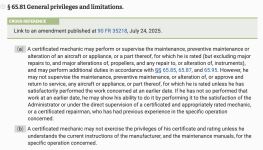
I provided the applicable regulation for the LSRM-M 3 posts above. Please refer to that. For the A&P The regulation is 65.81 part a. Very little difference in the language used for the two ratings, other than the addition of the supervision privilege which does not apply to LSRM.

Screenshot 2025-07-27 at 9.37.05 AM.png
 
I provided the applicable regulation for the LSRM-M 3 posts above. Please refer to that. For the A&P The regulation is 65.81 part a. Very little difference in the language used for the two ratings, other than the addition of the supervision privilege which does not apply to LSRM.

View attachment 93511
This is not consistent with what you stated. It says that the A&P MAY perform ANY maintenance for which he is rated, excluding major repairs or alterations. The limitation related to previous experience is ONLY for surpervising such work performed by others. So, as I stated, the A&P can pretty much do whatever he wants and the system trusts that he won't do so without obtaining the knowledge necessary to do so.

The LSRM is more restrictive, based upon the regs you posted.
 
Last edited:
This is not consistent with what you stated. It says that he MAY perform ANY maintenance for which he is rated, excluding major repairs or alterations. The limitation related to previous experience is ONLY for surpervising such work performed by others.
Ok. You are ignoring the use of "or" for each item listed, and the limitation to return to service an aircraft or any part of an aircraft. When a mechanic signs a logbook that is returning to service.
 
I provided the applicable regulation for the LSRM-M 3 posts above. Please refer to that. For the A&P The regulation is 65.81 part a. Very little difference in the language used for the two ratings, other than the addition of the supervision privilege which does not apply to LSRM.

View attachment 93511
This is why I make my questions to you as YES or NO questions, because you like to add things not asked in order to obfuscate the topic. Larry didn't ask for A&P regs. He asked a specific question based on your comment, that you didn't answer and added something he didn't ask for. The time it took to post the additional info not requested, you could have answered his question.

That's why you STILL haven't answered his comment or my question, that are both based on your claims:

"Based on your answer, do you think there's any difference in risk, regarding safety, between getting a condition inspection from a licensed A&P-IA or from someone who has no previous training in maintenance and takes a 14-17 day course?"
 

Attachments

  • Screenshot 2025-07-27 at 11.43.36 AM.png
    Screenshot 2025-07-27 at 11.43.36 AM.png
    351 KB · Views: 1
Ok. You are ignoring the use of "or" for each item listed, and the limitation to return to service an aircraft or any part of an aircraft. When a mechanic signs a logbook that is returning to service.
have no idea what you are referring to here. "or" is inclusive not exclusive. To me, the regs are very clear that an A&P can do work even if he has not previously demonstrated such work to the faa. The same way that a pilot can do a loop, eventhough he didn't demonstrate that to the faa during his checkride.

We'll have to agree to diagree on this one. Though you did raise a point that i didn't understand about the lsrm restrictions. so thanks for that.
 
Status
Not open for further replies.
Back
Top