Van's Air Force

The definitive Van's Aircraft support community! Buying, building or flying an RV? Join our exclusive family of mentors and enthusiasts!

Dispelling the myths around "lithium" battery fires

Status
Not open for further replies.
People lump all the "lithium" batteries together. They are far different. LiFe batteries are the most stable of the lithium label. LiPo, Lithium Polymer, can be the most unstable. I use the Lipo batteries for many of my RC planes. Although I haven't had any problems, I have 3 friends that have suffered fires at the their houses. One a total loss and two lost garages. LiFe batteries can and will swell up but are not likely to combust. Always good to get educated on the batteries types, proper charging and proper storage.
 
People lump all the "lithium" batteries together. They are far different. LiFe batteries are the most stable of the lithium label. LiPo, Lithium Polymer, can be the most unstable. I use the Lipo batteries for many of my RC planes. Although I haven't had any problems, I have 3 friends that have suffered fires at the their houses. One a total loss and two lost garages. LiFe batteries can and will swell up but are not likely to combust. Always good to get educated on the batteries types, proper charging and proper storage.
Perfect explanation.. LiFe vs LiPo totally different chemistry, LiPo being the fire risk if mishandled. Automotive applications use LiFe chemistry which is very safe
 
Actually, many of the domestic models don't unfortunately. Including most Tesla models.
Tesla uses Lithium Ion batterys, not Lithum Polymer, the later being the chemistry that's volitile. Tesla batteries are quite safe.
 
Last edited:
Tesla uses Lithium Ion batterys, not Lithum Polymer, the later being the chemistry that's volitile. Tesla batteries are quite safe.
There are several types of "Lithium Ion" batteries:
- Lithium Iron Phosphate (LifePO4 or LFP)
- Lithium Cobalt Oxide (LCO)
- Lithium Manganese Oxide (LMO)
- Lithium Nickel Manganese Cobalt Oxide (NMC)
- Lithium Nickel Cobalt Aluminum Oxide (NCA)
- Lithium Titanate (LTO)

Most Tesla models (including all Model S and model X) use NCA batteries although they have made some variants of the Model 3 and Y with LiFePO4. NCA batteries can experience thermal runaway. LiFePO4 can not.
 
There are several types of "Lithium Ion" batteries:
- Lithium Iron Phosphate (LifePO4 or LFP)
- Lithium Cobalt Oxide (LCO)
- Lithium Manganese Oxide (LMO)
- Lithium Nickel Manganese Cobalt Oxide (NMC)
- Lithium Nickel Cobalt Aluminum Oxide (NCA)
- Lithium Titanate (LTO)

Most Tesla models (including all Model S and model X) use NCA batteries although they have made some variants of the Model 3 and Y with LiFePO4. NCA batteries can experience thermal runaway. LiFePO4 can not.
Right, but that doesn't mean that they are dangerous. They won't explode and Tesla has developed a very safe BMS. Out of 2 million Teslas on the road there's been maybe 3-4 verified reports of thermal runaway, only 2 in the last 10 years. Most Tesla fires that make the news are 12-volt fires, the news always neglects to mention that almost 200 gasonline cars burn up from 12-volt fires every day. My point is, Tesla battery packs are quite safe.
 
There are several types of "Lithium Ion" batteries:
- Lithium Iron Phosphate (LifePO4 or LFP)
- Lithium Cobalt Oxide (LCO)
- Lithium Manganese Oxide (LMO)
- Lithium Nickel Manganese Cobalt Oxide (NMC)
- Lithium Nickel Cobalt Aluminum Oxide (NCA)
- Lithium Titanate (LTO)

Most Tesla models (including all Model S and model X) use NCA batteries although they have made some variants of the Model 3 and Y with LiFePO4. NCA batteries can experience thermal runaway. LiFePO4 can not.
So, we agree EarthX uses a "safe" type of battery chemistry, and we do not need to worry about thermal runaway. (I've been saying that for almost 10 years), let's move on and let Walt start installing these. :giggle:
 
So, we agree EarthX uses a "safe" type of battery chemistry, and we do not need to worry about thermal runaway. (I've been saying that for almost 10 years), let's move on and let Walt start installing these. :giggle:
Yes, for sure. Sorry, I'm so used to dealing with misinformation about batteries and Teslas it's my default.

Love EarthX batteries myself.
 
Most fires I deal with are from damaged batteries (electric cars in accidents; usually erupt in impound yard hours after accident), and knock-off (Chinese?) batteries and chargers. FWIW I never leave unattended in my hangar or garage a battery tender or charger on any type of battery.
 
Let's not use anything in our airframes that begins with Li to be safe, I can think of a few we have been using for decades. Same rational.
Most new experimentals are built with EarthX installed, there's a lot of EarthX batteries out there and we aren't seeing many failures.
 
Honestly I don’t see the advantage other than saving a few pounds which I’m not that concerned about.
They cost 2x as much and the BMS may decide to shut down, why do I need a computer in the battery?
Of course I still keep a magneto and mechanical FI to make sure the fan keeps turning.
 
Most new experimentals are built with EarthX installed, there's a lot of EarthX batteries out there and we aren't seeing many failures.
Manufacturers do this to save weight, makes the usefull load numbers look better.
 
With the lower weight you also get considerably more cold cranking amps, longer life, wider temperature operating range, and active monitoring with a warning indicator for your EFIS.
Never needed a ‘fault’ monitor on my good ole lead acid/AGM batteries. The fact that you need that should give you pause!
 
With the lower weight you also get considerably more cold cranking amps, longer life, wider temperature operating range, and active monitoring with a warning indicator for your EFIS.
All true. But with a conventional battery, I don't need active monitoring or a warning indicator. I continue to hold out for Sodium Ion batteries which seem to be a happy midpoint of weight savings and robust operating parameters without needing a BMS.
 
All true. But with an conventional antique battery, I don't need active monitoring or a warning indicator.
I fixed that for you! :p Better to have it and not need it than need it and not have it. I didn't know lead acid batteries never fail, ever.

But I do see the value in "if it ain't broke don't fix it".

Edit: Just a data point, the BMS warning is an indicator that something may be brewing, it's not always an indicator the battery has failed. It also does double duty by providing overcharge protection and makes sure the cells are balanced.
 
With the lower weight you also get considerably more cold cranking amps, longer life, wider temperature operating range, and active monitoring with a warning indicator for your EFIS.
We all respect Walt's technical abilities and the fact he is able to donate his time to VAF we all appreciate, I do. This new chemistry that has now years of use and millions of hours has proven itself. It's not just a few lbs. but in a dual battery airframe 20. We would work and scheme day and night to safe 5 lbs. but 20? Can't just say there is one in a billion this chemistry MIGHT be an issue so don't use. So far for me 8 years of GA and almost 20 years using this chemistry it has performed perfect.
 
We all respect Walt's technical abilities and the fact he is able to donate his time to VAF we all appreciate, I do. This new chemistry that has now years of use and millions of hours has proven itself. It's not just a few lbs. but in a dual battery airframe 20. We would work and scheme day and night to safe 5 lbs. but 20? Can't just say there is one in a billion this chemistry MIGHT be an issue so don't use. So far for me 8 years of GA and almost 20 years using this chemistry it has performed perfect.
I believe Dick V. solution to reduce weight was ‘go on a diet’ !
 
I believe Dick V. solution to reduce weight was ‘go on a diet’ !
You know what’s funny I wanted bigger tires on my new build so I went in a diet and upped my exercise to compensate for the weight difference, lol.
 
Yeah, I thought folks might actually watch the video and learn something. Silly me.
Yea I actually did watch the video, I learned I still don’t want one 😂
It may not catch fire, but if it starts venting in the cabin you’re done for.
 
Yea I actually did watch the video, I learned I still don’t want one 😂
It may not catch fire, but if it starts venting in the cabin you’re done for.
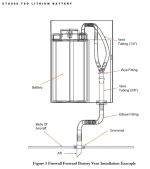
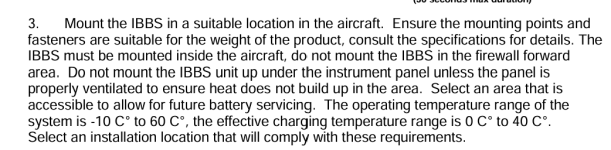
And what about the IBBS batteries? As an advertised Garmin G3X dealer/installer, haven't you confidently installed plenty of these behind the panel without venting? They use the same Li-Fe-PO4 chemistry and the instructions are pretty clear not to place in front of the firewall.

1752117384525.png

1752117122726.png
 
And what about the IBBS batteries? As an advertised Garmin G3X dealer/installer, haven't you confidently installed plenty of these behind the panel without venting? They use the same Li-Fe-PO4 chemistry and the instructions are pretty clear not to place in front of the firewall.
Yes I do use/install the TCW 3AH/6AH backup batteries. These batteries IMO offer an additional layer of redundancy in glass panel installations without the need for a fully redundant dual battery system.

However, their design with small 3AH or 6AH battery, fully enclosed metal case, and carefully managed charging circuit with fused output offer a considerable safety margin compared to a large 16AH firewall mounted battery with charging limited only by alternator output capacity. So I guess it’s about risk mitigation or perceived risk vs redundancy for IFR equipped aircraft.

Like many folks I carry an IPad an iPhone most of the time also, but along with the single fan up front I understand there’s always ‘some’ level of risk when I go fly but I prefer to limit risk whenever possible just the same. The old risk-vs-reward decision.
 
Last edited:
Let's not use anything in our airframes that begins with Li to be safe, I can think of a few we have been using for decades.
Right. And to make sure we keep safety at the forefront, lets also get rid of those newfangled injection thingy-ma-bobs and stick with good old carbs, they never give any problems. And don't even get me started on the fancy props that twist the blades in flight, they are just waiting for a chance to fall apart.
 
Never needed a ‘fault’ monitor on my good ole lead acid/AGM batteries. The fact that you need that should give you pause!
Fair, but if you did have a fault monitor, maybe there would be fewer cancelled flights due to "weak battery, won't crank, replace it." You didn't know those batteries were dying because they didn't tell you - learning about it early is not a bad thing.
 
. . . I understand there’s always ‘some’ level of risk when I go fly but I prefer to limit risk whenever possible just the same. The old risk-vs-reward decision.
That makes perfect sense, and I agree that just as each pilot should know his or her limitations, so, too, does each hold different margins of safety, and I certainly respect yours. My own plane would probably be cringe-worthy by your standards, and that's okay. When I switched over to the EarthX from the Odyssey, it was an enormous upgrade to my electrical system and absolutely worth whatever risk might be perceived with the newer technology. But as so many others say here, "YMMV," and I appreciate that your margin of safety exceeds mine. (y)
 
I think the theme that's developing here is that some of us perceive modern technologies can reduce risk where some see them as introducing additional risk.

How can we get another 50 years of data from all the relatively new stuff if it doesn't get used? It's possible some of it may actually be better.

Also, 100% agree that my oven doesn't need WiFi, I'm a technology guy but not at the expensive of reliability and usefulness.
 
With the logic of not using any "Li" in your plane, do you leave your cell phone, laptop, hand held, etc...radio behind? I'm a proud conservative Tesla owner and it always infuriates me when people bring up the EV's causing all the problems with the world of lithium with disposal. In fact, all of the EV's have a recycle program. Where as when the Roomba battery takes a dump, the domestic engineer is not likely to properly dispose of it. A couple of facts, there are over 16 Billion cell phones in use with millions being sold daily. Guess what they are powered by. Every household in the US has at least 12 devices powered by lithium batteries, mostly LiPo's. I've had two EarthX batteries. The first one, early version, went bad, swelled a little and was replaced. The current one is in my 7 and still cranks very rapidly at 5 years. The 10 I just bought also has EarthX. I'm confident in their use, care and feeding. BTW, most lithium eruptions occur from using the wrong charging device or wrong setting on a device.
 
Fair, but if you did have a fault monitor, maybe there would be fewer cancelled flights due to "weak battery, won't crank, replace it." You didn't know those batteries were dying because they didn't tell you - learning about it early is not a bad thing.
Not sure about everyone else but it usually becomes apparent, using our normal sensory inputs, (eyes/ears) that the battery is getting weak.
When I switched over to the EarthX from the Odyssey, it was an enormous upgrade to my electrical system and absolutely worth whatever risk might be perceived with the newer technology. But as so many others say here, "YMMV," and I appreciate that your margin of safety exceeds mine. (y)
"Upgrade to electrical system"? NO
What you did was mask other issues like current hungry PM (crap) starter, contactor resistance, less than ideal wiring/grounding, etc...
It appears that the real love affair with Li batteries is "it cranks better", and I don't have to worry about that diet anymore :oops:
(Same thing for EI with electronic FI, the biggest benefit everyone touts and will spend big $$ for, it starts easier.)
 
Last edited:
Not sure about everyone else but it usually becomes apparent, using our normal sensory inputs, (eyes/ears) that the battery is getting weak.

"Upgrade to electrical system"? NO
What you did was mask other issues like current hungry PM (crap) starter, contactor resistance, less than ideal wiring/grounding, etc...
It appears that the real love affair with Li batteries is "it cranks better", and I don't have to worry about that diet anymore :oops:
(Same thing for EI with electronic FI, the biggest benefit everyone touts and will spend big $$ for, it starts easier.)
Reminder this is just a friendly debate, this is pure curiosity as I want to hear your thoughts: What's wrong with wanting the airplane to start easier and handle hot starts better?
 
My AGM is not expensiveve, works awesome.. dont need no tesela battery in my plane, or truck.. look at the destroyed small towns that used to be great places to live, now ruined by battery plants
 
My AGM is not expensiveve, works awesome.. dont need no tesela battery in my plane, or truck.. look at the destroyed small towns that used to be great places to live, now ruined by battery plants
You can get a Tesla battery for an airplane? Didn't know that. The small towns I see destroyed have been by Walmart and Sams Club. Also, where do you think that AGM battery was made? Most are from China, is that better?
 
You can get a Tesla battery for an airplane? Didn't know that. The small towns I see destroyed have been by Walmart and Sams Club. Also, where do you think that AGM battery was made? Most are from China, is that better?
If you have a Dynon Skyview Backup battery in your aircraft, it has the same 18650 Li-on cells that Tesla uses in their batteries. I recently replaced an 8-year-old EarthX battery due to some case swelling, the battery still works fine and has been retired to ground vehicle use. On the list of things that can go wrong with my experimental airplane, battery fires are way down the list.
 
If you have a Dynon Skyview Backup battery in your aircraft, it has the same 18650 Li-on cells that Tesla uses in their batteries. I recently replaced an 8-year-old EarthX battery due to some case swelling, the battery still works fine and has been retired to ground vehicle use. On the list of things that can go wrong with my experimental airplane, battery fires are way down the list.
Just a data point, 18650 (18mm x 650cm) is the container size, doesn't denote chemestry.
 
Reminder this is just a friendly debate, this is pure curiosity as I want to hear your thoughts: What's wrong with wanting the airplane to start easier and handle hot starts better?
I'm always friendly but I know, not everybody thinks so, and I'll admit I'm a bit opinionated.

Nothing wrong with wanting your bird to start easier, but I'll suggest that a good starter 'system' and knowing the difference between a flooded engine and one that needs fuel is what makes the difference usually, not the chemistry of your battery or a fancy EI/EFI. (would rather spend those $$ on gas).
PS: the Enersys SBS batteries are made in MO, USA (or so they claim).
 
Last edited:
In fairness, the incidents in this article are referring to consumer electronics, which mostly use LiPo's, things like laptop batteries, portable chargers, phones, etc. None of these use LiFe batteries.
Correct, LiPo chemistry can be dangerous when mishandled (LiFe safe) long ago some laptops were experiencing thermal runaways. I don't know what type lithium batteries they use.. I'm going to stop posting on this thread, beating a dead horse maybe??
 
I think the theme that's developing here is that some of us perceive modern technologies can reduce risk where some see them as introducing additional risk.

How can we get another 50 years of data from all the relatively new stuff if it doesn't get used? It's possible some of it may actually be better.

Also, 100% agree that my oven doesn't need WiFi, I'm a technology guy but not at the expensive of reliability and usefulness.
Yeah, you can lead or you can follow…
 
My AGM is not expensiveve, works awesome.. dont need no tesela battery in my plane, or truck.. look at the destroyed small towns that used to be great places to live, now ruined by battery plants
By that logic, will you cease using the internet, search engines, AI, cloud storage?
Data centers have been migrating to lower costs areas for some time now.

Sticking with AGMs? Lead never ruined any town or part of the local environment.

It’s an open market inside of a free country. You get to spend your money in the manner you see fit. I respect your feelings and rights regarding such.
 
lets also get rid of those newfangled injection thingy-ma-bobs and stick with good old carbs, they never give any problems.
Agree completely. I mean, at least you can hot start a carbureted engine. One of my favorite pastimes is reading the various techniques for hot starting FI Lycomings. 🤣 (ducking…)
 
Dunno. Due to the extra voltage of the little aft mounted EarthX the lightweight Skytec PM starter spins the IO360 M1B like a top when it’s hot and the Pmag lights it of in two seconds.
 
Last edited:
Status
Not open for further replies.
Back
Top