Van's Air Force

The definitive Van's Aircraft support community! Buying, building or flying an RV? Join our exclusive family of mentors and enthusiasts!

Charging Airflow Systems AC System

Dad's RV-10

Well Known Member
Sponsor
I'm finally ready to get some refrigerant in the AC system. I don't have the Dial-A-Charge, vacuum pump or leak detector called for in the installation manual, so I'll have to find someone who does.

Any tips or advice on charging the system? Lessons learned? Mistakes to avoid?

The manual calls for a minimum of 4 pounds of R-134a. Should I buy several small cans for the auto parts store? Or source elsewhere?
 
I'm finally ready to get some refrigerant in the AC system. I don't have the Dial-A-Charge, vacuum pump or leak detector called for in the installation manual, so I'll have to find someone who does.

Any tips or advice on charging the system? Lessons learned? Mistakes to avoid?

The manual calls for a minimum of 4 pounds of R-134a. Should I buy several small cans for the auto parts store? Or source elsewhere?
Small cans are fine. It's more expensive but I put in a can with dye to detect leaks.
 
Small cans are fine, but you'll still need a vac pump.. the best way to to commission the system is to pressure test with nitrogen first, then vac, add oil (if needed) and then add refrigerant. Any car shop that does A/C will have the equipment and R134a, it shouldn't cost too much to have someone come out and do the whole lot for you..
 
..........The manual calls for a minimum of 4 pounds of R-134a. Should I buy several small cans for the auto parts store? Or source elsewhere?
The below assumes you have an Airflow Systems system.

Refrigerant charge amount depends on which condenser and which evaporator you have installed. Bill has updated each of those over the years. There are parallel-flow and tube-and-fin (with copper tubing) designs and different combinations of each take different charge levels. Best to call Airflow Systems to get the latest charge recommendation for the parts that you have.
 
Some of your local auto parts stores rent the tools you need.
Good set of gauges and vacuum pump.
You can always leak search with soapy bubbles once you have pressure on it.
Guessing the weight will get you pretty close since I think the small bottles of ref are 12 OZ or 16 oz.
The vacuum is very important to get any humidity and air out of the system. Don't short cut that. Rent a vacuum gauge if they have one. Don't trust the analog gauges to show a good vacuum.
 
The below assumes you have an Airflow Systems system.

Refrigerant charge amount depends on which condenser and which evaporator you have installed. Bill has updated each of those over the years. There are parallel-flow and tube-and-fin (with copper tubing) designs and different combinations of each take different charge levels. Best to call Airflow Systems to get the latest charge recommendation for the parts that you have.

I did not install the system myself. I am trying to figure out exactly which components I have.

I originally purchased the system in June 2022. At that time, the installation manual Bill provided wasn't 100% up to date. Bill said the evaporator install section wasn't current.

About a year passed without getting the system installed. During that time, Bill continued to update the system. In November of 2023, prior to installation, I purchased an "evaporator upgrade kit." The system was ultimately installed in early 2024.

There was a problem with the relay box that took some time to resolve, hence the reason it hasn't yet been charged.

Given that the manual I'd received in 2022 was already dated, I'm lost as to which components I have. Especially since I purchased some updated items.

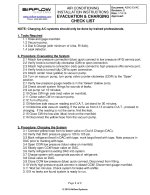
The attached page is from the manual I received in 2022.

I've emailed Bill to try to gain some clarity.

Charge AC System.jpg
 
Last edited:
I also have an RV-10, based in Tampa, FL, that needs the Airflow A/C system charged. Maybe we could split the cost of tools and get together one weekend to have an A/C recharging party haha. Let me know what you find out.

Alex M - 239-776-6593
 
Yeah, was afraid of that. 4 lbs with parallel-flow condenser/evap is WAY too much refrigerant. With your mix-n-match components, really don't have an exact amount of charge to give you.

As to reaching Bill, best way is to call. He recently sold off the aircon part of his business to a company in Chandler, AZ, but he will still provide tech support. That said, I doubt he knows exact refrigerant charge with those components either.

The best way to charge a 'frankenstein' system like this is via condenser subcooling and evaporator superheat. Google those terms to learn more about that. Most A/C-refrigeration companies will have the tools to measure those values in real-time. I fine-tuned the charge level in my PlaneKool system using these bluetooth probes: https://trutechtools.com/JL3KH6. I had initially charged via observed pressures on a manifold-gauge set, but turns out I had left significant performance on the table without knowing superheat/subcooling.

Values you're looking for are ~5 deg F condenser subcooling and 5-10 deg F evap superheat. Weigh in the charge so that you'll know in the future how much refrigerant your system takes. Best if you take the refrigeration tech on a flight and measure/charge while airborne. Not enough condenser airflow on the ground to get meaningful results.

And, because there are so many variations of AS systems out there now, you can't just charge to some level that's been published. With the original, copper round-tube systems, okay, but you don't have that.

 
So, I fell for the instruction to use the Dial-a-charge device with ~4lbs of R134a. Read the manual again. In another chapter it say to use if I remember correctly about 1.5lbs of R134a. With mine I was only able to get 3lbs, 12oz of R134a before it wouldn't take anything else. I called Bill to tell him I couldn't get the 4lbs stated and he told me about the other smaller specification. I would reference the spec, but I'm currently traveling and don't have access to my reference books. DON'T ATTEMPT TO CHARGE IT TO 4LBS. Read the manual again.

6. Installation – Evacuation & Charging
**Important** steps 6.1 thru 6.2 should only be completed by a qualified individual with proper
equipment to avoid injury and/or damage to system and aircraft.
6.1 Refer to Evacuation Charging & Checklist document (ASAC-EVAC) for complete steps.
Charge the system with 1.5 lbs. of R134A refrigerant. Check for leaks again using a sniffer. If no
leaks are found the system may be activated. With the aircraft engine running, turn on the air
conditioning and verify cool air is coming from the vents.
6.2 Complete a new Weight and Balance for the aircraft. Verify that C.G. of aircraft is within
manufacturer’s limits before returning aircraft to service.
 
So, I fell for the instruction to use the Dial-a-charge device with ~4lbs of R134a. Read the manual again. In another chapter it say to use if I remember correctly about 1.5lbs of R134a. With mine I was only able to get 3lbs, 12oz of R134a before it wouldn't take anything else. I called Bill to tell him I couldn't get the 4lbs stated and he told me about the other smaller specification. I would reference the spec, but I'm currently traveling and don't have access to my reference books. DON'T ATTEMPT TO CHARGE IT TO 4LBS. Read the manual again.

6. Installation – Evacuation & Charging
**Important** steps 6.1 thru 6.2 should only be completed by a qualified individual with proper
equipment to avoid injury and/or damage to system and aircraft.
6.1 Refer to Evacuation Charging & Checklist document (ASAC-EVAC) for complete steps.
Charge the system with 1.5 lbs. of R134A refrigerant. Check for leaks again using a sniffer. If no
leaks are found the system may be activated. With the aircraft engine running, turn on the air
conditioning and verify cool air is coming from the vents.
6.2 Complete a new Weight and Balance for the aircraft. Verify that C.G. of aircraft is within
manufacturer’s limits before returning aircraft to service.
Yeah I know what you mean.. I've seen the 4lb reference and in the other section mine say 2lbs.
I think the intent is to have more than enough in the DAC to charge the system and having a pro
that is able to accurately measure how much they are putting in.

Bill also confirmed for me yesterday, that it should be 1.75lbs and certainly no more than 2lbs to charge the system.
 
Small cans are fine. It's more expensive but I put in a can with dye to detect leaks.

I read that some compressor oil already has dye in it.

I wish I had the make and model of the compressor here. The Airflow Systems "Bill of Materials" doesn't have ANY brand names/makes/models listed. It simply has internal company "Item Numbers." The compressor identification in the documentation is nothing more than "RV-10-013."

Does anyone know if the compressor shipped with the Airflow Systems AC kits has dye already in the compressor oil?
 
I read that some compressor oil already has dye in it.

I wish I had the make and model of the compressor here. The Airflow Systems "Bill of Materials" doesn't have ANY brand names/makes/models listed. It simply has internal company "Item Numbers." The compressor identification in the documentation is nothing more than "RV-10-013."

Does anyone know if the compressor shipped with the Airflow Systems AC kits has dye already in the compressor oil?
if you can see dye, you can get a leak detector probe in the same area. These are pretty inexpensive these days and can sniff freon in areas that you can't see dye. If you haven't charged it yet, just pull out the Schrader valve, pour in a bit of dye, and continue.

Are you sure your compressor even came with oil? Some do, but they are filled specific to the system they are to be installed in,but confident this compressor would have been built for an auto application. Does airflow even prefill their compressors. Better find out before running it. Oil volume is typically specified based upon internal system surface area.
 
Last edited:
Are you sure your compressor even came with oil? Some do, but they are filled specific to the system they are to be installed in,but confident this compressor would have been built for an auto application. Does airflow even prefill their compressors. Better find out before running it. Oil volume is typically specified based upon internal system surface area.

I'm attempting to find out. Once again, the documentation is completely lacking. The only mention of oil in the entire manual is below, which implies there is already oil in the compressor:

**Important** Do not uncap compressor fittings until ready for final installation. When uncapping compressor fittings, oil may run out. Any oil MUST be caught in a clean container and returned to the system before the hoses are installed. Install the supplied binary switch on receiver drier only after all hoses are connected.
 
I'm attempting to find out. Once again, the documentation is completely lacking. The only mention of oil in the entire manual is below, which implies there is already oil in the compressor:

**Important** Do not uncap compressor fittings until ready for final installation. When uncapping compressor fittings, oil may run out. Any oil MUST be caught in a clean container and returned to the system before the hoses are installed. Install the supplied binary switch on receiver drier only after all hoses are connected.
Brad,

Assuming you have the same compressor from Airflow as I do for my RV-10, the compressor comes with 5 ounces of oil.
 
I read that some compressor oil already has dye in it.

I wish I had the make and model of the compressor here. The Airflow Systems "Bill of Materials" doesn't have ANY brand names/makes/models listed. It simply has internal company "Item Numbers." The compressor identification in the documentation is nothing more than "RV-10-013."

Does anyone know if the compressor shipped with the Airflow Systems AC kits has dye already in the compressor oil?
I have not seen anyone mention that you must ensure that you have the correct amount of PAG [synthetic A/C oil for use with R-134A Freon] oil. PAG oil comes in several viscosities. Most common is PAG 100. Not having sufficient PAG oil will cause the bearings in the compressor to fail quickly. To much oil will reduce the system's cooling efficiency.
General rule of thumb is 1oz of oil for the condenser, 2 oz for the evaporator. Compressor oil volume is generally specified with the compressor [generally 5 - 8 oz]
 
I have not seen anyone mention that you must ensure that you have the correct amount of PAG [synthetic A/C oil for use with R-134A Freon] oil. PAG oil comes in several viscosities. Most common is PAG 100. Not having sufficient PAG oil will cause the bearings in the compressor to fail quickly. To much oil will reduce the system's cooling efficiency.
General rule of thumb is 1oz of oil for the condenser, 2 oz for the evaporator. Compressor oil volume is generally specified with the compressor [generally 5 - 8 oz]

PAG oil is specifically what I was searching for in the manual.

There is no mention of it, that I could find.
 
Compressors typically come pre-charged with enough oil for the entire system. No need to add additional oil.


The problem with oil is IF you have to replace the compressor after the system has been in use. The oil naturally circulates with the refrigerant, but some of it remains within the major components (evaporator, condenser, receiver-drier, and compressor).

Because the compressor comes with enough oil for the entire system, if you replace the compressor without first draining it of excess oil, you will have too much oil in the system which reduces refrigeration capacity, since the excess oil displaces refrigerant.

The way this is typically handled is by draining the oil from the old compressor and measuring the amount, and then draining the new compressor and then replacing the same amount as the old compressor had, plus maybe an extra ounce.
 
I couldn't find anyone with a Dial-a-Charge, so we had to charge the system with the engine running.

In the Florida heat, it took three engines runs spread over two days to get the system fully charged. We shut down when the oil temp reached 220.

It took roughly 1.75lbs of R-134A (maybe a bit more). Glad to finally have the system functioning!
 
Back
Top