Van's Air Force

The definitive Van's Aircraft support community! Buying, building or flying an RV? Join our exclusive family of mentors and enthusiasts!

Dimple oops…

Craig J

Member
Hello everyone, new RV-10 builder. A lot of great experience on here. Grateful for all your thoughts.

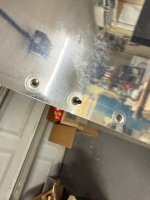
Had a slip when dimpling my Horizontal stab skins. Always grateful for a safe lesson in humility, but this one made me swear a little…lol. The correct hole is a full and proper dimple. The second hole just stabbed through the skin, didn’t misshape or dimple again off center.

I’ve read the technique about flattening/filling/ dimple and rivet on either side. That would work, assuming I have enough room on that rib. (Still need to check that.) However, what do you think about riveting as normal, then filling the extra stab hole with jb weld or the like? Not as strong with some missing material on the one side, but with the jb weld filling the hole after, I’m thinking that may work. What are your thoughts?

Thanks everyone!
 

Attachments

  • IMG_0600.jpeg
    IMG_0600.jpeg
    2.3 MB · Views: 326
You don’t have the edge distance between the “good” hole and the accident hole. In fact you don’t have any distance. The acceptable repair is a rivet on each side, with proper edge distance from those holes. You can then flatten and fill after deburring the old holes. After paint, you’ll never see it.
The repair you describe might work, but it isn’t a repair that meets AC43-13-1b.
 
I doubt if anybody will agree with me but I'd replace the skin. If I made a mistake like that on a part that didn't have 50 other parts riveted to it and it didn't take 3 weeks to assemble, I'd just replace it. The rare 100% perfect fix. But then again, I'm kinda OCD.
 
I doubt if anybody will agree with me but I'd replace the skin. If I made a mistake like that on a part that didn't have 50 other parts riveted to it and it didn't take 3 weeks to assemble, I'd just replace it. The rare 100% perfect fix. But then again, I'm kinda OCD.
After patch and paint, you'll barely notice the extra rivets, but I get the sentiment! Trying to balance my own perfectionist attitude with finishing the plane during my lifetime! lol
 
I’ll go out on a limb and guess this was a pneumatic squeezer error? We see that often here.
The old school “c” frame or hand squeezer made these mistakes much less likely.
Just a guess so please correct me if I am wrong.

I would never argue against replacing that skin by the way. It’s hard to back up and you’re right in that you will never see that repair down the line…. No wrong answer, just a choice.
 
I’ll go out on a limb and guess this was a pneumatic squeezer error? We see that often here.
The old school “c” frame or hand squeezer made these mistakes much less likely.
Just a guess so please correct me if I am wrong.

I would never argue against replacing that skin by the way. It’s hard to back up and you’re right in that you will never see that repair down the line…. No wrong answer, just a choice.
It was with the DRDT-2 dimplier. Don't ask how i did it, still not sure myself! I think i was just moving to fast and slipped.
 
It was with the DRDT-2 dimplier. Don't ask how i did it, still not sure myself! I think i was just moving to fast and slipped.
Gotcha. Sorry for the assumption.
Ya, it’s easy to get in “production” mode when you start cooking along.
Not sure with the DRDT but with a C-frame, building a small table or surface around the tool at the level of the bottom die supports the sheet. It makes it much more obvious when the male die is in the hole. You also need two hands on the c frame so it’s kind of a must.
Do folks do that with the DRDT ? More curious than anything.
 
...building a small table or surface around the tool at the level of the bottom die supports the sheet....Do folks do that with the DRDT ?
Yep. I have my DRDT2 sandwiched between two 8'x2' carpeted tables. The bottom die is level with the tables. This has worked well for me but when you get to the larger skins or skins that are curved, it's still a challenge to hold the skin flat on the die. After dimpling 99% of the holes in my build, I'm actually kind of surprised I didn't "double-punch" a hole.
 
You don’t have the edge distance between the “good” hole and the accident hole. In fact you don’t have any distance. The acceptable repair is a rivet on each side, with proper edge distance from those holes. You can then flatten and fill after deburring the old holes. After paint, you’ll never see it.
The repair you describe might work, but it isn’t a repair that meets AC43-13-1b.
If I made that mistake and If I contacted Vans, their repair would be as Jon describes above.
If anyone asks, I never made that error.

The other option is replacing a skin. I never replaced a side skin either.
:ROFLMAO:
 
I do believe that these types of accidents occur more often now with some of the “modern”, or more widely used conveniences like the DRDT and pneumatic squeezers.
My entire build was done with a C frame, hand squeezer, and gun. The interface to your work is more tactile. It’s harder to make this mistake. All of the holes I could reach, like skin edges, were dimpled with a hand squeezer.
However, I remember the damage my hands received from these repetitive tasks. Pain and swelling and I was a young man with no arthritis. I do not believe I could get through squeezing and pounding a scratch build today by hand.
There were no damaged skins, replaced skins, or oops rivets in my builds. Much of that is luck, but also the hand tools played a role.
I would take a mistake here and there for these conveniences.
 
Gotcha. Sorry for the assumption.
Ya, it’s easy to get in “production” mode when you start cooking along.
Not sure with the DRDT but with a C-frame, building a small table or surface around the tool at the level of the bottom die supports the sheet. It makes it much more obvious when the male die is in the hole. You also need two hands on the c frame so it’s kind of a must.
Do folks do that with the DRDT ? More curious than anything.
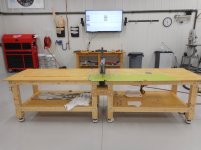
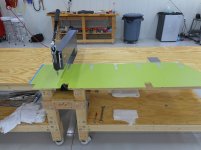
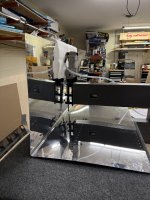
Yes, some OCD folks build a table for the DRDT dimpler. I built the table below.

I agree with Brian (bertschb) that it's still a challenge to dimple certain pieces. Example would be the rounded portion of the rear top fuse/emp of the -14. However, the table is a great help instead of having to wait for somebody to show up to hold an end while I dimpled a dozen holes. Like Brian, I was lucky not to punch a not to double-punch any holes in my project.

DRDT Table 1.jpg


Close-up

DRDT Table 2.jpg
 
Last edited:
Yes, some OCD folks build a table for the DRDT dimpler. I built the table below.

I agree with Brian (bertschb) that it's still a challenge to dimple certain pieces. Example would be the rounded portion of the rear top fuse/emp of the -14. However, the table a great help instead of having to wait for somebody to show up to hold and end while I dimpled a dozen holes. Like Brian, I was lucky not to punch a not to double-punch any holes in my project.

View attachment 91863


Close-up

View attachment 91864
That’s a good looking set up.
 
Although it depends on the cost involved, my choices would be, ranked,

1. Replace the skin and then no worries.
2. Call Van's and follow their advice.

There are no other choices, in my opinion.

Dave
 
If it were my build, I'd ask: Do I have a week's worth of other build stuff I can work on while I wait for a new skin? If yes, I'd replace the skin. If no, I'd do the repair per AC43-13-1b. I know it's not very logical, but that's how my thought process would be.
 
Hello everyone, new RV-10 builder. A lot of great experience on here. Grateful for all your thoughts.

Had a slip when dimpling my Horizontal stab skins. Always grateful for a safe lesson in humility, but this one made me swear a little…lol. The correct hole is a full and proper dimple. The second hole just stabbed through the skin, didn’t misshape or dimple again off center.

I’ve read the technique about flattening/filling/ dimple and rivet on either side. That would work, assuming I have enough room on that rib. (Still need to check that.) However, what do you think about riveting as normal, then filling the extra stab hole with jb weld or the like? Not as strong with some missing material on the one side, but with the jb weld filling the hole after, I’m thinking that may work. What are your thoughts?

Thanks everyone!
As every builder learns, mistakes happen. A big part of building is learning how to fix mistakes.
VAN's is the final go to for big mistakes but many small errors do not need their buy in, but you have to be the one deciding whether to call them or not. As you progress, you will get better at figuring these things out.
You do not say which edge of the skin this is and I can't tell from the picture. Is it the inboard edge, top or bottom? If it is an inboard edge, it will get covered by the empennage fairing and will never be seen. If it's on the bottom, same thing. If it is on the top, well its possible that both sides of the HS are the same so you may be able to put it on the bottom by flipping it and moving it to the other side of the plane. Im not an RV10 expert, so take it as offered, a suggestion.
The other suggestions about riveting on both sides and filling the hole are good ones.
Remember, its only one rivet.
Another suggestion above, about waiting a bit before you try to fix something is a good one. If you hurry to try to fix something you often make it worse since you are upset about it. Waiting a day can sometimes make a big difference about how you attack something.
Good luck
 
If it were my build, I'd ask: Do I have a week's worth of other build stuff I can work on while I wait for a new skin? If yes, I'd replace the skin. If no, I'd do the repair per AC43-13-1b. I know it's not very logical, but that's how my thought process would be.
Sounds logical to me.
 
Gotcha. Sorry for the assumption.
Ya, it’s easy to get in “production” mode when you start cooking along.
Not sure with the DRDT but with a C-frame, building a small table or surface around the tool at the level of the bottom die supports the sheet. It makes it much more obvious when the male die is in the hole. You also need two hands on the c frame so it’s kind of a must.
Do folks do that with the DRDT ? More curious than anything.
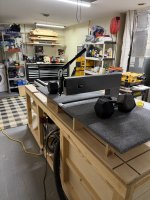
Yes, I made a set of tables for the dimpler. Helps a lot. Plus a bonus is I use them flipped over to support spars and other pieces while drilling or machine countersinking. Came in very handy for the long HS spars.
 

Attachments

  • IMG_0313.jpeg
    IMG_0313.jpeg
    3.1 MB · Views: 52
As every builder learns, mistakes happen. A big part of building is learning how to fix mistakes.
VAN's is the final go to for big mistakes but many small errors do not need their buy in, but you have to be the one deciding whether to call them or not. As you progress, you will get better at figuring these things out.
You do not say which edge of the skin this is and I can't tell from the picture. Is it the inboard edge, top or bottom? If it is an inboard edge, it will get covered by the empennage fairing and will never be seen. If it's on the bottom, same thing. If it is on the top, well its possible that both sides of the HS are the same so you may be able to put it on the bottom by flipping it and moving it to the other side of the plane. Im not an RV10 expert, so take it as offered, a suggestion.
The other suggestions about riveting on both sides and filling the hole are good ones.
Remember, its only one rivet.
Another suggestion above, about waiting a bit before you try to fix something is a good one. If you hurry to try to fix something you often make it worse since you are upset about it. Waiting a day can sometimes make a big difference about how you attack something.
Good luck
That's a good point, it may be covered by a fairing, I'll have to check when i get home this weekend. Probably best I'm away for work right now, a few days to consider my options will be good.
 
Yep, I got into “production mode" and didn't get properly lined up when dimpling one of the holes at the bottom of the front spar (VS-702) of the vertical stabilizer where a "doubler" (VS-01401) is attached. Naturally, I made the error in the spar rather than the doubler which could have been easily replaced with a small piece of carefully selected and trimmed scrap.

How large a replacement rivet may be used? If the plan calls for a AN426AD3-3.5, can you use a AN426AD6-3.5? Larger? (Do larger diameters inAN426ADx-x exist?) With a doubler already part of the design, can you add another reinforcement piece?

How do you know if the damage is too great and a piece needs replaced?
 
Update…
Well, after thinking it over I decided to just replace the skin. Easy enough just to redimple the replacement and not worry about a repair.

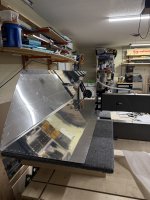
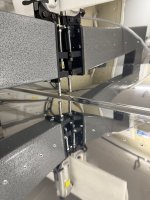
One thing I did change is the dimpler. I was having trouble in my limited garage space both supporting the skins with my tables, and giving enough clearance to pull the handle on the DRDT2 without bumping the skin. Especially on the inside holes close to the leading edge. So I got this conversion kit from clemsonaeronautics. It lets you mount your squeezer to the DRDT2 and just pull the trigger instead of pulling the long handle. Works great. I found myself not wrestling the skin as much, and much less risk of a dimple whoops without the spring loaded handle.
 

Attachments

  • IMG_0770.jpeg
    IMG_0770.jpeg
    3.1 MB · Views: 85
  • IMG_0775.jpeg
    IMG_0775.jpeg
    2.6 MB · Views: 103
  • IMG_0772.jpeg
    IMG_0772.jpeg
    2.9 MB · Views: 87
Update…
Well, after thinking it over I decided to just replace the skin. Easy enough just to redimple the replacement and not worry about a repair.

One thing I did change is the dimpler. I was having trouble in my limited garage space both supporting the skins with my tables, and giving enough clearance to pull the handle on the DRDT2 without bumping the skin. Especially on the inside holes close to the leading edge. So I got this conversion kit from clemsonaeronautics. It lets you mount your squeezer to the DRDT2 and just pull the trigger instead of pulling the long handle. Works great. I found myself not wrestling the skin as much, and much less risk of a dimple whoops without the spring loaded handle.

Do you have a link to the conversion kit?
 
Yes, some OCD folks build a table for the DRDT dimpler. I built the table below.

I agree with Brian (bertschb) that it's still a challenge to dimple certain pieces. Example would be the rounded portion of the rear top fuse/emp of the -14. However, the table is a great help instead of having to wait for somebody to show up to hold an end while I dimpled a dozen holes. Like Brian, I was lucky not to punch a not to double-punch any holes in my project.

View attachment 91863


Close-up

View attachment 91864
Where could I find those Wheels?
 
Update…
Well, after thinking it over I decided to just replace the skin. Easy enough just to redimple the replacement and not worry about a repair.

One thing I did change is the dimpler. I was having trouble in my limited garage space both supporting the skins with my tables, and giving enough clearance to pull the handle on the DRDT2 without bumping the skin. Especially on the inside holes close to the leading edge. So I got this conversion kit from clemsonaeronautics. It lets you mount your squeezer to the DRDT2 and just pull the trigger instead of pulling the long handle. Works great. I found myself not wrestling the skin as much, and much less risk of a dimple whoops without the spring loaded handle.

It’s hard to tell from the pics but I’d take a close look at those dimples and make sure they aren’t under dimpled. I see a lot of light distortion. Check out this video if you haven’t already (disregard the compressor going off for 2 minutes in the middle):
 
Craig,

The conversion kit is nice and makes for quick, quiet, foot operated work, for me, I was never satisfied with the results I got from my pneumatic dimpler. Just because the rivets fit well doesn't mean the hole is dimpled properly. The squeezer just didn't put enough pressure on the die to make me happy (I used Cleveland Springback dies).

While I used a DRDT for the majority of my airplane, there a many folks here that will tell you that a C-Frame is the only way to go. I used the DRDT because I developed tendonitis using the C-Frame. The video Ben posted above is good information. I'm not saying that you can't get good dimples with your squeezer, I'm saying that I never could get dimples that were acceptable to me with mine. YMMV.

You're going to have a lot of time invested in this airplane and each of us has a different standard of what's acceptable. Just make sure the dimples made with the squeezer are something can live with.

Good luck,

Fred
 
Where could I find those Wheels?
Short version. I found them on e-bay, went to buy them, and found that there were shipping from a location about 10 minutes from where I live so I ran down and purchased them....about 9 years ago. I have them on 5 benches

I went to buy 4 more a couple of years ago and found that the place is out of business. The wheels swivel and have leveling hard rubber feet. The feet are used to keep the bench from moving and you can get it perfectly level with little effort. They have a painted cast iron body and the rubber feet extend and retract using a simple threaded rod turned with your finger (hard to describe).

The wheels don't have a brand name on them, but as I recall they were made off shore. Wish I could be more help, I've been looking for them all over the place. Apologies for the thread drift....just answering a question.
 
Craig,

The conversion kit is nice and makes for quick, quiet, foot operated work, for me, I was never satisfied with the results I got from my pneumatic dimpler. Just because the rivets fit well doesn't mean the hole is dimpled properly. The squeezer just didn't put enough pressure on the die to make me happy (I used Cleveland Springback dies).

While I used a DRDT for the majority of my airplane, there a many folks here that will tell you that a C-Frame is the only way to go. I used the DRDT because I developed tendonitis using the C-Frame. The video Ben posted above is good information. I'm not saying that you can't get good dimples with your squeezer, I'm saying that I never could get dimples that were acceptable to me with mine. YMMV.

You're going to have a lot of time invested in this airplane and each of us has a different standard of what's acceptable. Just make sure the dimples made with the squeezer are something can live with.

Good luck,

Fred
When setting up the squeezer with the conversion kit, I extended the ram so that I got the same about of deflection on the DRDT’s frame as I had when using the spring loaded handle. So to me, the same pressure is being applied. I’ve never tried the C-frame dimpler, so I have no way to compare.
The video makes a good point though. More pressure is best. We just have to adjust our setups appropriately to achieve that.
 
Short version. I found them on e-bay, went to buy them, and found that there were shipping from a location about 10 minutes from where I live so I ran down and purchased them....about 9 years ago. I have them on 5 benches

I went to buy 4 more a couple of years ago and found that the place is out of business. The wheels swivel and have leveling hard rubber feet. The feet are used to keep the bench from moving and you can get it perfectly level with little effort. They have a painted cast iron body and the rubber feet extend and retract using a simple threaded rod turned with your finger (hard to describe).

The wheels don't have a brand name on them, but as I recall they were made off shore. Wish I could be more help, I've been looking for them all over the place. Apologies for the thread drift....just answering a question.
These?


jxgzyy 4 Pcs Leveling Machine Casters Heavy Duty Retractable Workbench Caster Steel Plate 360 Degree Swivel Lifting Casters with Nylon Wheel and Rubber Feet GD-80F https://a.co/d/huuieg8
 
Back
Top