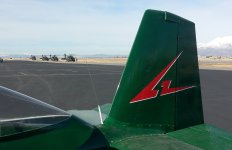
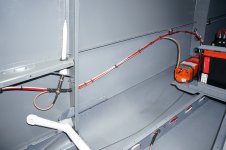
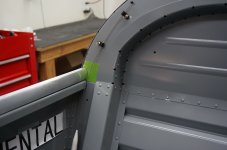
My current 406 ELT antennae is mounted vertically on the sidewall of the cockpit vertically at the center rollbar bulkhead (a 15" antennae). I am about to replace the ELT with a newer ARTEX, which has a 23 inch antennae which makes this position more complicated. I have been using ChatGPT for other technical discussions with some success (taken with about a tablespoon of salt), so I decided to query it about 406 antennae position options on an RV8. And this is the interaction: (Somewhat of a long response.. so sorry in advance. (Short answer if you don't want to read it all... Vertical cockpit mount -may- be better than horizontal under the fairing)
Me to ChatGPT:
On the installation of a 406/121.5 ELT 23.5 inch whip antennae, it is recommended that the antennae be mounted vertically on the exterior skin. On an RV8 this is not possible. One option is mounting it horizontally under the fiberglass tail fairing at the junction of the horizontal and vertical stabilizer where there would be obvious shadowing to one side. Another option is to mount it vertically inside the cockpit at the side of the fuselage mounted to a flange that is about 12 inches below the cockpit sill. In this configuration the thick rubberized stub cannot see the horizon, but the metal whip section can. What is the better mounting choice?
ChatGPT said:
When installing a 406 MHz/121.5 MHz ELT whip antenna on an RV-8 where the ideal exterior vertical mounting is not feasible, you’re balancing
antenna visibility (radiation pattern and line-of-sight),
structural constraints, and
installation survivability.
Let’s break down your two options and assess which is better from a
signal performance and survivability standpoint:
 Option 1:
 Pros:
Pros:
- Exterior mounting location = less structural shielding
- Fiberglass is mostly transparent to RF signals at 121.5 and 406 MHz
- Mounts close to the aircraft’s tail — away from human occupants and wiring
- Likely to remain intact during a crash, especially if forward impact
 Cons:
Cons:
- Horizontal orientation seriously degrades antenna performance at both 406 and 121.5 MHz (these are vertically polarized signals)
- The pattern becomes broadside, resulting in poor radiation upward (where satellites are)
 Bottom line:
Good external location, but
wrong orientation. The radiation lobe is directed sideways, not upward to the satellites or rescuers.
Option 2:
Pros:
- Maintains correct vertical orientation for optimal radiation pattern
- Whip section may have partial line-of-sight above fuselage metal
- No exposure to weather or damage from airflow or bird strikes
- Better upward radiation for satellite reach
Cons:
- Interior metal (fuselage, instrument panel) will cause partial shadowing and reflection
- Possible interference with occupants or equipment
- Might be compromised in a crash (especially if fuselage deformation occurs)
Bottom line:
Correct orientation, but
some signal shadowing. RF losses will occur, but the
main lobe points upward, which is what matters most for 406 MHz satellite ELTs.
Final Recommendation:
Between the two:
- Option 2 (interior vertical mount) is the better choice.
- Vertical orientation is more critical than having the antenna outside, especially at 406 MHz where COSPAS-SARSAT satellite detection depends on strong upward transmission.
- The partial view from the whip section above the sill is sufficient to radiate a detectable signal in most orientations post-impact.
 Additional Notes:
- If you're concerned about crash survivability, consider mounting slightly aft of the cockpit, as long as the antenna can remain vertical.
- Some builders place antennas under the turtledeck or canopy fairing — if that’s fiberglass, it may allow better vertical performance than deep inside the fuselage.
Would you like illustrations or radiation pattern comparisons to visualize this?
You said:
no thanks. but additionally , the cockpit mount is positioned at the reinforced structural bulkhead that the central rollbar is attached to so the whip is actually protruding through the Y junction of the steel rollbar, which I suspect may also impact the radiation pattern. There is no space in the aft section of the fuselage because the RV8 has a sliding canopy that sweeps the aft fuselage back to the tail fairing when open. The rollbar is situated between the front and aft pilot in a tandem configuration.
ChatGPT said:
Thanks for the clarification — that
specific geometry helps a lot in evaluating the cockpit mount.
With the antenna vertically mounted at the
reinforced structural bulkhead where the
rollbar Y-junction exists (in a tandem-seat RV-8), here’s how it affects things:
 Effect of the Rollbar Y-Junction on Antenna Performance
 The steel rollbar structure:
- Will partially block or reflect the signal in the directions shadowed by the steel (mostly laterally and slightly aft)
- Acts as a conductor, meaning it will distort the local EM field near the whip base (which is the high-current portion of the antenna)
- However, the tip of the whip (which is responsible for a large portion of the 406 MHz far-field radiation) is likely above and unobstructed, maintaining upward visibility to satellites
 Net Result:
- Some azimuthal pattern distortion, especially laterally
- Elevation lobe remains mostly intact, meaning you retain good upward radiation — which is the most important aspect for ELT satellite detection
 Context of RV-8 Limitations
Given:
- The canopy sweeps back = no good external vertical option
- The under-fairing location forces horizontal mounting (a major compromise)
- The steel rollbar is not a complete Faraday enclosure, just a partial obstruction
Final Verdict (Reaffirmed):
Your cockpit-mounting location, despite the Y-junction steel rollbar, is still
the best compromise available on the RV-8:
- You preserve vertical polarization
- You maintain reasonable upward visibility
- You avoid mounting the antenna horizontally, which would cripple satellite detection performance
If you're aiming for COSPAS-SARSAT compliance and real-world post-crash effectiveness, this configuration — although imperfect — is acceptable and
likely within tolerance for ELT certification intent.
If needed, you can run a ground test later (e.g., via a 406 MHz test beacon with a service monitor or SDR) to characterize the radiation lobe and verify performance.