Van's Air Force

The definitive Van's Aircraft support community! Buying, building or flying an RV? Join our exclusive family of mentors and enthusiasts!

MA4-5 upgrade?

Aden Rich

Well Known Member
Sponsor
Friend
I am sure its on here somewhere but what is the carb upgrade that better distributes or atomizes fuel? I've seen the post before about someone doing a mod to them so you get more even EGTs. RIght now, I have about 150-175 degree split between #2 and #3 cylinders. Like to see if I can even that up a bit.

Thank you,
Aden
 
Curious as well, also have a dramatic split at full throttle. I've backed slightly off of full throttle and got my Gami spreads from 1.0 to 0.1, so this is a nice fix. Not sure what can be done at the carb itself to improve the spread?
 
Curious as well, also have a dramatic split at full throttle. I've backed slightly off of full throttle and got my Gami spreads from 1.0 to 0.1, so this is a nice fix. Not sure what can be done at the carb itself to improve the spread?
Backing off full throttle on a carb cuts of the enriching ports therefore less fuel.
 
Curious as well, also have a dramatic split at full throttle. I've backed slightly off of full throttle and got my Gami spreads from 1.0 to 0.1, so this is a nice fix. Not sure what can be done at the carb itself to improve the spread?
I did a little research decades ago on just that effect you describe. It wasn't hard to figure out.

So, I thought this thing, cause and effect was well known now about Lycs with carbs. But maybe not.

Here goes. The MA-whatever carb at full throttle produces a mixture column up into the mixture distribution "spider" in the engine. From there the mixture, fuel and air, splits in four directions to each cylinder.
On the way to the spider, however, the mixture stream passes by the throttle blade. At this point, the mixture is far from uniform since fuel is dumped into the center of the air stream just before the throttle blade. The blade will steer the fuel fog and droplets fore or aft, depending on the exact position of the throttle blade at or near full throttle causing this mixture difference between fore and aft cylinders.

Tinkering with the full throttle stop casting feature might be worth doing to get near a low injector spread mixture distribution as SwimmingDragon518 has done by manual throttle position.

Almost all lycs with carbs will run rear cyl lean if run slightly off full throttle. So I suspect SwimmingDragon518's setup has a lean front mixture difference full throttle. This could be the case if the stop permits the blade to go slightly past vertical, cured by a position slightly off the full throttle stop.
ron
 
I did a little research decades ago on just that effect you describe. It wasn't hard to figure out.

So, I thought this thing, cause and effect was well known now about Lycs with carbs. But maybe not.

Here goes. The MA-whatever carb at full throttle produces a mixture column up into the mixture distribution "spider" in the engine. From there the mixture, fuel and air, splits in four directions to each cylinder.
On the way to the spider, however, the mixture stream passes by the throttle blade. At this point, the mixture is far from uniform since fuel is dumped into the center of the air stream just before the throttle blade. The blade will steer the fuel fog and droplets fore or aft, depending on the exact position of the throttle blade at or near full throttle causing this mixture difference between fore and aft cylinders.

Tinkering with the full throttle stop casting feature might be worth doing to get near a low injector spread mixture distribution as SwimmingDragon518 has done by manual throttle position.

Almost all lycs with carbs will run rear cyl lean if run slightly off full throttle. So I suspect SwimmingDragon518's setup has a lean front mixture difference full throttle. This could be the case if the stop permits the blade to go slightly past vertical, cured by a position slightly off the full throttle stop.
ron
I think you are combining MA4-5 carbs with fuel injection? With the carb, there is no spider, just a single fuel line from the pump to the carb.
 
Curious to what the group thinks, but that much of a CHT spread would suggest baffling tuning before carb work? I just ran dwn this gambit on my 0-360 fix pitch, however I did richen the carb first "mooney mod" before the baffle work, which made the carb essentially a 4164, this lowered all cyl apox 15f, but #3 was still running fairly hot - 415f on climb out, after installing a cooling duct on #3 and air ramp in front of #1, all my chts are within 10-15f, now #2 is the hottest, but I dont go over 375f with an aggressive climb in florida summer wx.
 
I’m curious about this too. I have the modified carb, making it a 4164 (O-360) and I also have the cooling duct on #3. What do you mean by the “air ramp in front of #1”? My #1 is my second hottest cylinder, next to #4, in climb, but in cruise it runs the coolest. In cruise #1,2,& 3 are all within 5-6* of each other (O-360A1A, Sensi GA fixed pitch) #4 is 15-20* hotter than the rest. I’ve been anal about my baffling, and it’s tight. I’ve done the induction leak tests to see if #4 is running lean. It isn’t, as far as I can tell - although I haven’t been unable to convince one of my airport bums to stand next to my running engine and spray starter fluid at my #4 cylinder - so maybe there’s a leak somewhere, but I don’t think so. Other tests didn’t indicate that.

Good post, hope to learn something.

 
I think you are combining MA4-5 carbs with fuel injection? With the carb, there is no spider, just a single fuel line from the pump to the carb.
Leo - The intake distribution which divides the single stream to the four cylinders is internal to the lyc. On a continental four it is in the open. It has four leg and was often referred to as "the spider". With the now common fuel injection the fuel distribution nugget on top of the engine is also called a spider, though it only divides fuel, not mixture.
BTW, I am an A&P and have been wrenching planes since an A&P was called an A&E. A&P then was just a big grocery chain.

ron
 
This thread has some OT tangents.

OP says he has big EGT temp diff 2/3 didn't mention CHT.
Some one then says use a wetter carb. That cures a temp split?
Another says enrichment jet. that cant relate to a mixture/temp EGT split either.
Then it degenerates into cylinder cooling details. Cooling doesn't effect EGT much.
--------
Best strategy with a carb for balance at full throttle:
1. Get the EGT 1-2/3-4 split down 1st,
2. Deal with CHT level and diffs with cooling.
 
Last edited:
This thread has some OT tangents.

OP says he has big EGT temp diff 2/3 didn't mention CHT.
Some one then says use a wetter carb. That cures a temp split?
Another says enrichment jet. that cant relate to a mixture/temp EGT split either.
Then it degenerates into cylinder cooling details. Cooling doesn't effect EGT much.
--------
Best strategy with a carb for balance at full throttle:
1. Get the EGT 1-2/3-4 split down 1st,
2. Deal with CHT level and diffs with cooling.
Exactly how do you sort out #1 with a carb? I thought this was effectively the biggest reason to switch to fuel injection, where the injector can be tuned for each cylinder, thereby obtaining the same FF and hence EGT at each cylinder.
 
Exactly how do you sort out #1 with a carb? I thought this was effectively the biggest reason to switch to fuel injection, where the injector can be tuned for each cylinder, thereby obtaining the same FF and hence EGT at each cylinder.
You are right about #1. The most common way is to switch to fuel injection. I suggested in my 1st post that adjusting the precise position of the throttle at full power to get the fuel even between the front and rear cylinders.

The throttle blade at full power definitely does steer the fuel fore or aft toward the base of the "spider" divider of the intake manifold if its angle is not ideal.

I leave it up to the rest of this clever crowd to divine their particular method to accomplish this angle adjustment. In the case of SwimmingDragon516, he just backed off the throttle stop a bit to get almost perfect results. Adding a shim to the FT stop might be in order in that case to eliminate having to fuss with the throttle in flight.
In the opposite case, filing the FT stop/arm slightly might work if the front cylinders are richer/rears leaner.

BTW, at an inch or 2 of manifold pressure below FT, the throttle blade stalls producing turbulence, and more uniform distribution. So this throttle position effect is pretty much gone.


ron
 
Last edited:
You are right about #1. The most common way is to switch to fuel injection. I suggested in my 1st post that adjusting the precise position of the throttle at full power to get the fuel even between the front and rear cylinders.
The throttle blade at full power definitely does steer the fuel fore or aft at the base of the "spider" divider of the intake manifold if its angle is not ideal.
I leave it up to the rest of this clever crowd to divine their particular method to accomplish this. In the case of SwimmingDragon516, he just backed off the throttle stop a bit to get almost perfect results. Adding a shim to the FT stop might be in order in that case to eliminate having to fuss with the throttle in flight.

ron
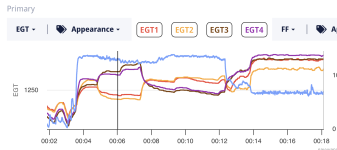
I have experimented to great end with this. Some pictures below. You can clearly see when the front two vs rear two cylinders are richer/leaner with different throttle position. Oddly, when settling down at cruise my #2 is about 100 degrees lower than the other 3, which even out. If I climb high enough to stay below 65% power at WOT, I can crack it just a bit and get them all just about the same, however.

1750267216402.png
 
Backing off full throttle on a carb cuts of the enriching ports therefore less fuel.
Reading into this a bit more, it doesn't appear my carburetor has an enrichment circuit unless I'm missing something. There's an accelerator pump, but I don't think there is any additional fuel flow at WOT vs backed off slightly. This makes me wonder if I can bring my takeoff CHTs down with a partially cracked throttle -- e.g. enriched cylinders 3, 4?
 
I’m curious about this too. I have the modified carb, making it a 4164 (O-360) and I also have the cooling duct on #3. What do you mean by the “air ramp in front of #1”? My #1 is my second hottest cylinder, next to #4, in climb, but in cruise it runs the coolest. In cruise #1,2,& 3 are all within 5-6* of each other (O-360A1A, Sensi GA fixed pitch) #4 is 15-20* hotter than the rest. I’ve been anal about my baffling, and it’s tight. I’ve done the induction leak tests to see if #4 is running lean. It isn’t, as far as I can tell - although I haven’t been unable to convince one of my airport bums to stand next to my running engine and spray starter fluid at my #4 cylinder - so maybe there’s a leak somewhere, but I don’t think so. Other tests didn’t indicate that.

Good post, hope to learn something.

My #1cyl was running very cool (in climb and cruise) so I installed a simple aluminum "air ramp" in front of cyl #1to move inlet air up and around the cyl. Quite a common approach to warm a cold cylinder. This doesnt seem the case on your engine - 1cyl running cool.
Maybe you've done this, but a sanity check of your thermocouples is never a bad idea, you can check them in hot oil.
 
My #1cyl was running very cool (in climb and cruise) so I installed a simple aluminum "air ramp" in front of cyl #1to move inlet air up and around the cyl. Quite a common approach to warm a cold cylinder. This doesnt seem the case on your engine - 1cyl running cool.
Maybe you've done this, but a sanity check of your thermocouples is never a bad idea, you can check them in hot oil.
Rodney,
Yep,I’ve done that “sanity check” on the CHT probe, and it appears that the indications are pretty accurate. I removed the blocker piece of aluminum in front of #1 (stock baffle piece) during phase 1, and that didn’t make much difference during climb. Maybe I should reinstall it and see if it does anything in cruise.
 
Back
Top