Van's Air Force

The definitive Van's Aircraft support community! Buying, building or flying an RV? Join our exclusive family of mentors and enthusiasts!

Stuck Fuel Float?

rockitdoc

Well Known Member
Patron
Apparently, my right wing fuel float is stuck. After lots of troubleshooting this seems so.
Besides adding 10 gals and rocking the plane or thumping the bottom of the wing or sticking a clothes hangar through the exit hole, what other ootiins do I have short of removing the float?
 
Apparently, my right wing fuel float is stuck. After lots of troubleshooting this seems so.
Besides adding 10 gals and rocking the plane or thumping the bottom of the wing or sticking a clothes hangar through the exit hole, what other ootiins do I have short of removing the float?
I haven’t tried this, so take it for what it’s worth. If you can get a small enough boroscope through the fuel drain, and if the fuel pickup isn’t covering the hole, you might be able to see up in there. This might give you a clue.
What did you do to come to the stuck float conclusion?
I assume you have tested the sender with an ohm meter disconnected from your guage. My guess is your sender has failed and the float isn’t really stuck. Same symptoms, but far more common. Floats also can get compromised and fill with fuel but that’s really rare with the SW senders.
Good luck.
 
If it is stuck in the up position, it is likely that the bends in the rod were off a bit and the float is getting caught on something. Freeing it up is a short term fix, as it will likely hang up again. There is really nothing in the float mechanism that can stick, so it is likely the arm or float hitting a stiffener in the tank and getting stuck there. So at some point you are likely going to have to pull it to address the issue.
 
I have run into the odd sender unit that was stiff in the hinge, or was binding in the resistor windings, the only solution was to use another unit.
I also have run into the odd unit during tank repairs that had been inadvertently contaminated with a bit of Proseal during construction, making the float arm stick.
I’d attempt to free it up by cleaning what I could or just replace if that failed.
 
I haven’t tried this, so take it for what it’s worth. If you can get a small enough boroscope through the fuel drain, and if the fuel pickup isn’t covering the hole, you might be able to see up in there. This might give you a clue.
What did you do to come to the stuck float conclusion?
I assume you have tested the sender with an ohm meter disconnected from your guage. My guess is your sender has failed and the float isn’t really stuck. Same symptoms, but far more common. Floats also can get compromised and fill with fuel but that’s really rare with the SW senders.
Good luck.
We measured the resistance from the sender terminal to ground and got 426 ohms no matter the amount of fuel in the tank. A full tank of fuel gives 17 ohms from sender terminal to ground. While trying to calibrate in the Dynon system, we get 5 volts no matter the fuel quantity.
 
We measured the resistance from the sender terminal to ground and got 426 ohms no matter the amount of fuel in the tank. A full tank of fuel gives 17 ohms from sender terminal to ground. While trying to calibrate in the Dynon system, we get 5 volts no matter the fuel quantity.
I am not at the hangar with my documents but perhaps someone else can chime in.
I believe the sender max resistance is something like 240 ohms. If that’s correct, you have a bad sender.
I’ll see if I can find the sender specs unless somebody has them handy.
 
So, a while back when I finished my tanks I decided to check the senders with my ohmeter. Panic. Was getting erroneous readings, called Stewart Warner and talked with someone in engineering. He was awesome. This was on a Saturday when he called me back. Told me to make up a wire that I could install through the return line and manipulate the float. I was able to move it to full position. 25. All good. As I was lowering it to empty around half it jumped to a bad reading. He was on the phone with me as I was doing it and I’ll never forget his question, “is your ohmmeter auto ranging”.
Silence.
 
You are not alone, several 14 pilots have this issue. I have a 14A with the same problem. Right wing with a stuck fuel indicator. Had it replaced 2 times with same result. Vans knows this and sent instructions to fix the problem. But it’s always hit or miss with the same type of indicator. From talking with A/P mechanics and other 14 pilots they recommended a different manufacturer. I have purchased a set of fuel indicators from Cies inc. Bend Oregon. They are not cheap but we need instruments to work properly all the time…The new fuel indicators arrived yesterday and will be installed in 2 weeks. Look at the website and call customer service. They are aware of the Vans product and have an answer for you. I will let you know in a week or 2.
 
I am not at the hangar with my documents but perhaps someone else can chime in.
I believe the sender max resistance is something like 240 ohms. If that’s correct, you have a bad sender.
I’ll see if I can find the sender specs unless somebody has them handy.
My dislexia croppong up again. Resistance was 246 full, 17 empty.
 
My dislexia croppong up again. Resistance was 246 full, 17 empty.
Well, that’s good, or bad depending on how you look at it. I will tell you from experience, as crappy as it is to pull the sender when the wings are attached, it really isn’t that hard of a job. Sounds like you’re headed that way….
Lots of good posts on doing this. Just do a search if you get to that point.
 
You are not alone, several 14 pilots have this issue. I have a 14A with the same problem. Right wing with a stuck fuel indicator. Had it replaced 2 times with same result. Vans knows this and sent instructions to fix the problem. But it’s always hit or miss with the same type of indicator. From talking with A/P mechanics and other 14 pilots they recommended a different manufacturer. I have purchased a set of fuel indicators from Cies inc. Bend Oregon. They are not cheap but we need instruments to work properly all the time…The new fuel indicators arrived yesterday and will be installed in 2 weeks. Look at the website and call customer service. They are aware of the Vans product and have an answer for you. I will let you know in a week or 2.
What instructions did Vans send out to "fix the problem"? Since the 10 has the same wing and same senders is this airframe effected? I have 650 hrs. on my 14 and 50 hrs. on my 10 and to date never had an issue with the fuel senders.
 
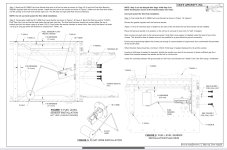
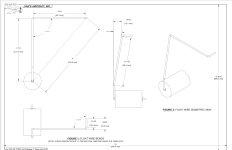
Many of the float problems were caused when Vans decided to not use the gaskets that came with the float units and substitute Pro Seal without changing the float wire geometry. The difference between the thickness of the gasket material and the Pro Seal resulted in the float assembly contacting the inboard rib. That is exactly what happened on both tanks on our 14A. Removing the float assembly is a PITA but can be easily accomplished with patience. The latest iteration (and there have been several) is covered under Revisions and Changes to the plans, April 17 2025 Float Wire Geometry. We have modified both and they work as advertised now. Good luck!
 
What instructions did Vans send out to "fix the problem"? Since the 10 has the same wing and same senders is this airframe effected? I have 650 hrs. on my 14 and 50 hrs. on my 10 and to date never had an issue with the fuel senders.
I am not at the hangar now but I believe In the revised plans from Vans it says bend the fuel gauge rod. Which was done and still a stuck indicator. Moving on to a different unit.
 
Many of the float problems were caused when Vans decided to not use the gaskets that came with the float units and substitute Pro Seal without changing the float wire geometry. The difference between the thickness of the gasket material and the Pro Seal resulted in the float assembly contacting the inboard rib. That is exactly what happened on both tanks on our 14A. Removing the float assembly is a PITA but can be easily accomplished with patience. The latest iteration (and there have been several) is covered under Revisions and Changes to the plans, April 17 2025 Float Wire Geometry. We have modified both and they work as advertised now. Good luck!
So Pro Seal results in a "thinner" spacing than the gasket and decreases the baffle clearance? This would result in the tanks getting stuck ~ half full? Appreciate the input.
 
Last edited:
We measured the resistance from the sender terminal to ground and got 426 ohms no matter the amount of fuel in the tank. A full tank of fuel gives 17 ohms from sender terminal to ground. While trying to calibrate in the Dynon system, we get 5 volts no matter the fuel quantity.
If the resistance is not changing with fuel level either the float is stuck, the wiper arm on the sender is not making contact, or the float itself is no longer properly physically connected to the sender unit. In any event it will require draining and removing the tank to make a repair. I don't understand your statement above (even though you revised it later) because you are indicating it is always one fixed resistance no matter the fuel level and then it another resistance when full. It can't be both ways?
With the fuel drained, it may be possible to remove the drain and get a small borescope inside. It might also be possible to get a bent piece of wire in to try to push the float up. I have used both of these investigative methods but eventually had to open the tank access plate to put in a new sender unit. Good luck on the fix.
 
Scott is a friend and I've been trying to help.
Has anyone swapped the Vans float sender for a Princeton Capacitive? Which one?
How did it work.
 
What instructions did Vans send out to "fix the problem"? Since the 10 has the same wing and same senders is this airframe effected? I have 650 hrs. on my 14 and 50 hrs. on my 10 and to date never had an issue with the fuel senders.
I helped a builder (no names…) who built his entire tank before bending up his senders. I suspect it is common.
Obviously you have no chance of guaranteeing a snag free install if done like this. All quick builds I assume have this problem as they don’t come with senders installed.
I’m confident that the senders bent, trial fitted and adjusted IAW the plans are foolproof.
I doubt it’s anything to do with the gasket either. Vans has explicitly said to throw the gasket in the trash and use proseal for at least 20y.
At a guess I’d say that the percentage of tanks that are quick build is going up and therefore senders are being bent via plans rather than tweaked and adjusted to get it spot on before tanks are closed up.

Vans has probably modified the geometry to guarantee no snags but at the obvious expense of full range of motion and therefore accuracy across the range.

Changing sender brand dosent fix this.
 
Last edited:
Apparently, my right wing fuel float is stuck. After lots of troubleshooting this seems so.
Besides adding 10 gals and rocking the plane or thumping the bottom of the wing or sticking a clothes hangar through the exit hole, what other ootiins do I have short of removing the float?

I also had a sticky right float sender in my RV-7 during the tank calibration. Unfortunately, you'll have to remove the sender from the tank.

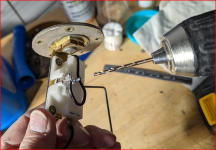
I fixed the problem by removing the float wire from the sender unit and enlarging the float wire hole that goes through the sender.

I don't remember what size drill bit I used, maybe a #30 or whatever was the next size up in my drill bit set (1/64" increments) that didn't go through the hole, if that makes sense. It wasn't much but it fixed the stickiness in the float travel.

That was about 3-1/2 years ago and I haven't had a problem since.

YMMV

Sender Drilling.png
Remove the float wire and enlarge the hole slightly.
 
^^^^^ This! ^^^^^
Since the 14 has a return fuel line put the borescope in and look around. Better yet place a string in through this access hole and lift the float before pro-sealing the sender in place.
 
I helped a builder (no names…) who built his entire tank before bending up his senders. I suspect it is common.
Obviously you have no chance of guaranteeing a snag free install if done like this. All quick builds I assume have this problem as they don’t come with senders installed.
I’m confident that the senders bent, trial fitted and adjusted IAW the plans are foolproof.
I doubt it’s anything to do with the gasket either. Vans has explicitly said to throw the gasket in the trash and use proseal for at least 20y.
At a guess I’d say that the percentage of tanks that are quick build is going up and therefore senders are being bent via plans rather than tweaked and adjusted to get it spot on before tanks are closed up.

Vans has probably modified the geometry to guarantee no snags but at the obvious expense of full range of motion and therefore accuracy across the range.

Changing sender brand dosent fix this.
There is a way. I used a string through one of the screw holes to pull the arm up and down for interference testing. Had to make a few tweaks to the bends to get good clearance.
 
There is a way. I used a string through one of the screw holes to pull the arm up and down for interference testing. Had to make a few tweaks to the bends to get good clearance.
Sure but all that does is verify it doesn’t catch. It does nothing to make sure you aren’t 1/2” off the top of the bottom at each extreme.
I guess if you were dedicated you could borescope at the same time but I think we all know how many builders go to the trouble of doing that.
Hence the plan revision to fix a problem that never existed for 20y up until now.
 
Sure but all that does is verify it doesn’t catch. It does nothing to make sure you aren’t 1/2” off the top of the bottom at each extreme.
I guess if you were dedicated you could borescope at the same time but I think we all know how many builders go to the trouble of doing that.
Hence the plan revision to fix a problem that never existed for 20y up until now.
I could distinctly hear the float hit the upper and lower skin. I also measured the mechanism outside of the tank and knew exactly how many ohms would be read at the top and bottom positions of the float. So did measurements in the tank to confirm. So, yes, it is possible to get this right on assembled tanks.
 
I could distinctly hear the float hit the upper and lower skin.
But they aren’t supposed to hit the skin.
That’s the whole point of the convoluted bending and fiddling to get it right.
Getting the floats to swing from skin to skin is trivial if you allow them to touch.
 
Last edited:
I agree with lr172.. even if the float is stuck and you free it, the anomaly will return. If you are able to move the float up and down watch the ohm meter, If you don't see smooth increases and decreases replace the sender.
 
You are not alone, several 14 pilots have this issue. I have a 14A with the same problem. Right wing with a stuck fuel indicator. Had it replaced 2 times with same result. Vans knows this and sent instructions to fix the problem. But it’s always hit or miss with the same type of indicator. From talking with A/P mechanics and other 14 pilots they recommended a different manufacturer. I have purchased a set of fuel indicators from Cies inc. Bend Oregon. They are not cheap but we need instruments to work properly all the time…The new fuel indicators arrived yesterday and will be installed in 2 weeks. Look at the website and call customer service. They are aware of the Vans product and have an answer for you. I will let you know in a week or 2.
I ordered the Cies units. Are they plug and play with Dynon avionics? I know they need power, but is there anything else?

I’ll be happy to have fuel gauges that read all the way to 25 gals. The SW units only read up to 20. Van’s told me that’s normal and not to expect to see readings until below 20 gals. Pretty lame imho. After 4200 hrs building this bird I expect everything to work properly.
 
Btw, I opened up the filter orifice and stuck a boroscope in. Then, snuck a wire inside to move the float. Ohm reading changed from 246 to 201 ohms. Closed it up and added fuel 2 gals at a time to see result. Nada. No change. Float was stuck at 201 ohms. Not good. Decided to 86 the SW float and get something reliable. I hear Princeton makes good units, too. So, the research begins.
 
Van’s told me that’s normal and not to expect to see readings until below 20 gals. Pretty lame imho.
Even more lame to get rid of the wings dihedral just so you could see readings above 20 IMHO. Vans designed these planes to be affordable. Specifying a $500 sender instead of a $20 version is counter to that goal. We should accept these planes for what they are.
 
I ordered the Cies units. Are they plug and play with Dynon avionics? I know they need power, but is there anything else?

I’ll be happy to have fuel gauges that read all the way to 25 gals. The SW units only read up to 20. Van’s told me that’s normal and not to expect to see readings until below 20 gals. Pretty lame imho. After 4200 hrs building this bird I expect everything to work properly.
So, you are going with 2 units per tank? That's the only way I know of to see the full 0-25 vs the 0 - 21 you should get now with properly installed and bent floats. If 4 are used now you are up to 4 * $ 665.00 plus shipping and tax. :unsure: I've never missed the top 4 gals as others have noted fuel totalizer works great. Once they start reading accurately (at 21 gals a side) you have 4 hours to contemplate what to do. Normally I stop for a bladder break at 3 to 4 hours anyway.

BTW since one can set gals used vs time as a reminder to switch tanks, I set my switch reminder at 5 gals that way I perform one switch per side and now can accurately see exactly fuel remaining in my tanks for the next 8 tank switches.
 
Last edited:
Even more lame to get rid of the wings dihedral just so you could see readings above 20 IMHO. Vans designed these planes to be affordable. Specifying a $500 sender instead of a $20 version is counter to that goal. We should accept these planes for what they are.
Yeah, but maybe there’s a solution between $20 and $660 that would not cause so much consternation? I just think poorboying something like fuel level output considering overall cost and time invested in a project like this is ill conceived. Just my $0.02.
 
So, you are going with 2 units per tank? That's the only way I know of to see the full 0-25 vs the 0 - 21 you should get now with properly installed and bent floats. If 4 are used now you are up to 4 * $ 665.00 plus shipping and tax. :unsure: I've never missed the top 4 gals as others have noted fuel totalizer works great. Once they start reading accurately (at 21 gals a side) you have 4 hours to contemplate what to do. Normally I stop for a bladder break at 3 to 4 hours anyway.

BTW since one can set gals used vs time as a reminder to switch tanks, I set my switch reminder at 5 gals that way I perform one switch per side and now can accurately see exactly fuel remaining in my tanks for the next 8 tank switches.
Wow! I see this is a sensitive issue. Sorry I unwittingly poked the hornets nest.

But, I will report how the install goes. And, hopefully, I’ll at least get piece of mind knowing one less piece of hardware is likely to fail. Well worth the 1.3 AMUs imho.
 
Yeah, but maybe there’s a solution between $20 and $660 that would not cause so much consternation? I just think poorboying something like fuel level output considering overall cost and time invested in a project like this is ill conceived. Just my $0.02.
Understood. On the flip side, most of us have fuel totalizers and know with good accuracy how much fuel we have remaining. Honestly in 1800 hours across two rv’s, i have never found a situation where it bothered me that I couldn’t see the fuel level with mostly fuel tanks. I really only cared about individual tank level once down to around 5 gallons in a tank. We are all different and want for different things I suppose.
 
Wow! I see this is a sensitive issue. Sorry I unwittingly poked the hornets nest.

But, I will report how the install goes. And, hopefully, I’ll at least get piece of mind knowing one less piece of hardware is likely to fail. Well worth the 1.3 AMUs imho.
Interested to hear of your endeavors here. While this thread is related to a sender failure, i do not believe that is very common. Been here a while and don’t see too many posts about this. Sure, they pop up occasionally like all sorts ot other stuff, but this not on the scale of pp alternators. On balance, they are pretty reliable and I am not sure the ones you are looking at are going to be more so. Some parts are just more prone to failure. This is just a wiper sliding across a thin carbon patch bathed in gasoline. They are not going to have insanely low failure rates. They fail just as often in cars that use the exact same thing. None that i know of have moved to elaborate tech to avoid it.
 
Btw, I opened up the filter orifice and stuck a boroscope in. Then, snuck a wire inside to move the float. Ohm reading changed from 246 to 201 ohms. Closed it up and added fuel 2 gals at a time to see result. Nada. No change. Float was stuck at 201 ohms. Not good. Decided to 86 the SW float and get something reliable. I hear Princeton makes good units, too. So, the research begins.
Let us know what you find out and what you decide to switch to.

Did it freak you out to stick a boroscope in a tank with fuel still in it? I know it's a fiber-optic and the light/power source is outside the tank but......... 😬 :oops:
 
Let us know what you find out and what you decide to switch to.

Did it freak you out to stick a boroscope in a tank with fuel still in it? I know it's a fiber-optic and the light/power source is outside the tank but......... 😬 :oops:
Actually, you are sending either 5 or 12 volts into that fuel sender sitting inside a bath of gasoline every time you turn your plane on. And most borescopes are not fiber optic. They have a camera/light chip on the end very similar to the one on your phone.
 
Interested to hear of your endeavors here. While this thread is related to a sender failure, i do not believe that is very common. Been here a while and don’t see too many posts about this. Sure, they pop up occasionally like all sorts ot other stuff, but this not on the scale of pp alternators. On balance, they are pretty reliable and I am not sure the ones you are looking at are going to be more so. Some parts are just more prone to failure. This is just a wiper sliding across a thin carbon patch bathed in gasoline. They are not going to have insanely low failure rates. They fail just as often in cars that use the exact same thing. None that i know of have moved to elaborate tech to avoid it.
Exactly. There are tens if not hundreds of millions of them in service and have been for decades. We reap the benefit of the massive economies of scale to have a well tested, reliable, accurate and cheap sender.
Failure is vanishingly rare.

On the other hand. We have a newish to market product which is built for certified aircraft where those who chose to install it are reaping the exact reverse. Paying for the egregious costs of certification and limited production. Or the other way to look at it is a 95% gross margin business. Does anyone seriously believe that the half a dozen electronic components in a sender is worth the same as an iPhone?
Maybe they are qualified for space flight.

Aviation is the poster boy for why money has limited correlation to quality, performance, safety or reliability.
Indeed it’s why experimental exists in the first place.
 
Last edited:
Has anyone swapped the Vans float sender for a Princeton Capacitive? Which one?
How did it work.
Not that I think a properly installed kit-supplied sender won't work fine; I'd be interested in knowing about the capacitive option. I've heard of RV-14s using it, but never can find the details.
 
Not that I think a properly installed kit-supplied sender won't work fine; I'd be interested in knowing about the capacitive option. I've heard of RV-14s using it, but never can find the details.
Check out:

https://vansairforce.net/threads/rv-14-options-i-havent-thought-about.162858/#post-1278255, Under Capacitive fuel probes.

E is a good friend and an awesome hands-on engineer and great at documentation. He discusses the Princeton Probes and others who have used capacitance probes. This is the only fuel sender I know of that using only one will give the the quantity of the entire tank or at least close. (0-~23 gals vs 0-21 gals) It's not for the faint of heart.
 
Back
Top