Van's Air Force

The definitive Van's Aircraft support community! Buying, building or flying an RV? Join our exclusive family of mentors and enthusiasts!

Tiedowns

DanH

Legacy Member
Benefactor
Advertiser
Mentor
As we move toward another Oshkosh, dare I mention a pet peeve? Yeah, dare I will....

At OSH, tiedowns protect the other airplanes. We park close together, and post-thunderstorm, long-timers have seen more than one upside down on another. If you park next to my airplane with some kind of crappy tiedown rig, expect to be chastised, finger pointed, tarred and feathered, and generally despised.

Seriously folks, we all have $50,000 to $350,000 invested, and often 1000's of hours of labor. You're welcome to be cavalier with your own stuff, but have some respect for your fellows. Invest in some serious tiedowns. Serious doesn't include the Claw (seen too many broken) and d@## sure doesn't include dog ties.

Let's talk. My veterans are solid aluminum stakes, 3/4" D and about 20" long, with 6" x 6" steel spades near the top and a welded rope ring. I've been using them almost 30 years. Don't recall where I got them, but the bare stake was probably military in origin. When driven so the spades are below the surface and rigged to pull perpendicular, they are very solid, even in sandy soil like Lakeland. The downside is they can be a lot of work to hammer into the ground, and I've camped a few places I couldn't get them into the ground due to rock content.

I recently purchased a set of Big Screw tiedowns, which are driven much like the aluminum stakes, so they pull perpendicular. The driver is a Dewalt DCF891B impact wrench with a six-point socket. It's the mid size impact; the large one (DCF900) weighs nearly twice as much. Here the overall package weighs about the same as the stakes with spades and the required large hammer. Pirep for the combo is good so far. I've driven them into the hard packed clay soil of the driveway in front of my shop, and a few weeks ago into the dirt at Trigger Gap AR, a place with a very high rock content. For sure it's less labor than a hammer, and very fast. I have no reservations about how well them will hold at OSH, but I'll reserve judgement about Lakeland until I can drive them there and get a feel for pull resistance in sandy stuff.
 
Last edited:
As we move toward another Oshkosh, dare I mention a pet peeve? Yeah, dare I will....

At OSH, tiedowns protect the other airplanes. We park close together, and post-thunderstorm, long-timers have seen more than one upside down on another. If you park next to my airplane with some kind of crappy tiedown rig, expect to be chastised, finger pointed, tarred and feathered, and generally despised.

Seriously folks, we all have $50,000 to $350,000 invested, and often 1000's of hours of labor. You're welcome to be cavalier with your own stuff, but have some respect for your fellows. Invest in some serious tiedowns. Serious doesn't include the Claw (seen too many broken) and d@## sure doesn't include dog ties.

Let's talk. My veterans are solid aluminum stakes, 3/4" D and about 20" long, with 6" x 6" steel spades near the top and a welded rope ring. I've been using them almost 30 years. Don't recall where I got them, but the bare stake was probably military in origin. When driven so the spades are below the surface and rigged to pull perpendicular, they are very solid, even in sandy soil like Lakeland. The downside is they can be a lot of work to hammer into the ground, and I've camped a few places I couldn't get them into the ground due to rock content.

On trial right now, I have a set of Big Screw tiedowns, driven much like the aluminum stakes, so they pull perpendicular. The driver is a Dewalt DCF891B impact wrench with a six-point socket. It's the mid size impact; the large one (DCF900) weighs nearly twice as much. Here the overall package weighs about the same as the stakes with spades and the required large hammer. Pirep for the combo is good so far. I've driven them into the hard packed clay soil of the driveway in front of my shop, and a few weeks ago into the dirt at Trigger Gap AR, a place with a very high rock content. For sure it's less labor than a hammer, and very fast. I have no reservations about how well them will hold at OSH, but I'll reserve judgement about Lakeland until I can drive them there and get a feel for pull resistance in sandy stuff.
For those that want to heed Dan’s advice….Abe’s Tie Downs are the best money can buy ( I have no financial interest in theses)
 
For those that want to heed Dan’s advice….Abe’s Tie Downs are the best money can buy ( I have no financial interest in theses)

Note you need the double tie setup to get the good pull numbers, but yep, spades get'er done. Watch the Aviation Consumer video.

My old setup incorporates similar sized spades, but as noted, they're on much larger and longer stakes, so I use them as singles. They've never budged anywhere, any time.
 
Back in 2011 when my RV was destroyed at SNF I observed several tiedown straps with hooks that were bent open. Since then I use steel carabiners.
When a high wind event hit Boulder Airport in '81 or '82, several of the dozen or so upside-down airplanes laying around had hook tiedowns that were intact but disconnected. In such a storm, the airplanes can start bouncing or rocking, and they can - and some will - fall off.

Dave
 
+1 on the tie-down speech. Over the years I've done aircraft parking I've seen all manner of poor tie downs, and unfortunately some times the aftermath... You owe it to your neighbors.

I'll second Dan's recommendation on The Big Screw. I've been using these at Oshkosh and other flyins for half a dozen years now. I put them in using a 3/4" drive socket wrench with a piece of 7/8 tube over the handle for an extension. It is a little bit of work but saves the need to carry an impact wrench along.

I don't agree with Dan's assessment of The Claw. These need to be installed correctly (vertically) in order to work correctly. Every year I see many of these being installed in exactly the wrong way, which could lead to failure (and has.) Installed properly, they work as advertised.
 
+1 on the tie-down speech. Over the years I've done aircraft parking I've seen all manner of poor tie downs, and unfortunately some times the aftermath... You owe it to your neighbors.

I'll second Dan's recommendation on The Big Screw. I've been using these at Oshkosh and other flyins for half a dozen years now. I put them in using a 3/4" drive socket wrench with a piece of 7/8 tube over the handle for an extension. It is a little bit of work but saves the need to carry an impact wrench along.

I don't agree with Dan's assessment of The Claw. These need to be installed correctly (vertically) in order to work correctly. Every year I see many of these being installed in exactly the wrong way, which could lead to failure (and has.) Installed properly, they work as advertised.
Jeff,
I think the Point (pun intended, lol) of Dan’s comment about the Claw would be in conjunction with your Point (there it is again, lol) about proper installation.

I was also at the SunNFun tornado. Although my plane was not destroyed it was damaged. I was using the Claw tie-downs. I had them installed directly under the wing tie-down rings under the wing. In that sandy soil they came right out. In reality, I am not sure any tie-downs could really withstand a tornado. However, if anyone is going to use the Claw tie-downs it will be important to have the rope extend directly down from the tie-down ring on the wing. This ensures the pulling force is 90 deg from the angled stakes in the ground.

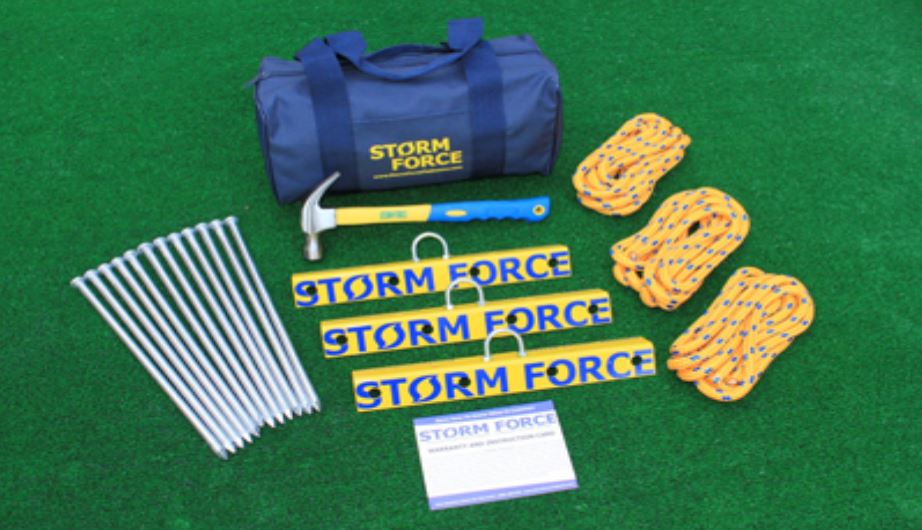
After the SunNFun tornado I stopped using the claw. One of the difficulties with using it with our low wings involves swinging a hammer directly underneath the wing in order to get that 90 deg angle. The risk of hitting the wing as one swings the hammer did not sit well with me. I think with high wing airplanes they are fine. I switched to the StormForce tie-downs and have not regretted the move.

 
As we move toward another Oshkosh, dare I mention a pet peeve? Yeah, dare I will....

At OSH, tiedowns protect the other airplanes. We park close together, and post-thunderstorm, long-timers have seen more than one upside down on another. If you park next to my airplane with some kind of crappy tiedown rig, expect to be chastised, finger pointed, tarred and feathered, and generally despised.

Seriously folks, we all have $50,000 to $350,000 invested, and often 1000's of hours of labor. You're welcome to be cavalier with your own stuff, but have some respect for your fellows. Invest in some serious tiedowns. Serious doesn't include the Claw (seen too many broken) and d@## sure doesn't include dog ties.

Let's talk. My veterans are solid aluminum stakes, 3/4" D and about 20" long, with 6" x 6" steel spades near the top and a welded rope ring. I've been using them almost 30 years. Don't recall where I got them, but the bare stake was probably military in origin. When driven so the spades are below the surface and rigged to pull perpendicular, they are very solid, even in sandy soil like Lakeland. The downside is they can be a lot of work to hammer into the ground, and I've camped a few places I couldn't get them into the ground due to rock content.

I recently purchased a set of Big Screw tiedowns, which are driven much like the aluminum stakes, so they pull perpendicular. The driver is a Dewalt DCF891B impact wrench with a six-point socket. It's the mid size impact; the large one (DCF900) weighs nearly twice as much. Here the overall package weighs about the same as the stakes with spades and the required large hammer. Pirep for the combo is good so far. I've driven them into the hard packed clay soil of the driveway in front of my shop, and a few weeks ago into the dirt at Trigger Gap AR, a place with a very high rock content. For sure it's less labor than a hammer, and very fast. I have no reservations about how well them will hold at OSH, but I'll reserve judgement about Lakeland until I can drive them there and get a feel for pull resistance in sandy stuff.
Thanks for getting this thread going again! I mumbled (BI#&%@ED) about the 'doggie ties' a while back and OSH doth fast approach! At least (hopefully) it will make people THINK!!
 
Thanks for getting this thread going again! I mumbled (BI#&%@ED) about the 'doggie ties' a while back and OSH doth fast approach! At least (hopefully) it will make people THINK!!
a couple years ago was parked next to a 10 using those. Had to leave a day early, as i was unwilling to ride out a forecasted TS while parked next to him. I am sure they work fine for a 40 lb dog, but figured there was no way they would hold a 2000 lb plane. you would think that is common sense, but seems sensibility is no longer common.

I had to vacat my hanger a week ago for a month due to a construction project. the guy next to me has a 10 and he used that cheap hardware store rope that looks like 12 braid, but really is not much stronger than shoee laces. I just don't understand the ignorance of some people; He tied down a $300K airplane with rope rated for 110 lbs.
 
Last edited:
what kind of soil is at OSH?
Do they aerate the soil?
Why shouldn't I use the Claw?
If I use the Claw does that mean I'll have extra camping room from folks avoiding me?
 
Jeff,
I think the Point (pun intended, lol) of Dan’s comment about the Claw would be in conjunction with your Point (there it is again, lol) about proper installation.

I was also at the SunNFun tornado. Although my plane was not destroyed it was damaged. I was using the Claw tie-downs. I had them installed directly under the wing tie-down rings under the wing. In that sandy soil they came right out. In reality, I am not sure any tie-downs could really withstand a tornado. However, if anyone is going to use the Claw tie-downs it will be important to have the rope extend directly down from the tie-down ring on the wing. This ensures the pulling force is 90 deg from the angled stakes in the ground.

After the SunNFun tornado I stopped using the claw. One of the difficulties with using it with our low wings involves swinging a hammer directly underneath the wing in order to get that 90 deg angle. The risk of hitting the wing as one swings the hammer did not sit well with me. I think with high wing airplanes they are fine. I switched to the StormForce tie-downs and have not regretted the move.

Not sure these are still available? No stock at Amacrap and no phone/email on their website.
 
That Big Screw looks interesting - will have to take a look at them at OSH!

We have always had great success (at Oshkosh) with the EAA Homebuilder tiedowns, which uses a surface plate and three stakes driven through it at angles. It works really well in the Oshkosh soil - have never been able to use it in the rocky soils/dirt/rock out west. The lesson being that different regions have different requirements - what works at SnF might not work in Oshkosh…and vice versa.

I’m modifying one of our sets of EAA Tiedowns with Titanium stakes right now. Why? Because I got a good ear on three 3’ lengths of 1/4” titanium on E-Bay, that’s why. Cut them into manageable lengths of course. Took me DAYS to cut threads on the end of each one for nuts. They’ll be trick, and won’t bend like my steel takes that have been pretty abused over the years.

My annual reminder on spiral dog-stakes. Absolutely do NOT use them to tie down next to me if you bought them from any big box, pet, or sporting goods store - the triangle at the top will pull right out. But…. Years ago, a fellow sold sets of them made from Titanium, and they are heck-for-stout … and don’t weigh much. There are still a number of them in use, one set that we carry in our RV-3. So before you go medieval on someone for using what looks like a dog stake, you might complement them on having one of the few sets of titanium ones, and if they accept the compliment and tell you how great they are, you’re good…and if they give you a funny look, then you know they bought steel ones at Walmart. Move your plane somewhere else…..
 
<snip> But…. Years ago, a fellow sold sets of them made from Titanium, and they are heck-for-stout … and don’t weigh much. There are still a number of them in use, one set that we carry in our RV-3. So before you go medieval on someone for using what looks like a dog stake, you might complement them on having one of the few sets of titanium ones, and if they accept the compliment and tell you how great they are, you’re good…and if they give you a funny look, then you know they bought steel ones at Walmart. Move your plane somewhere else…..
I still have my set. They're awesome. Nobody has complained (at least to my face), but I could see someone having an objection thinking they're Walmart stakes. Probably only a matter of time.

I should probably go test them them with a hoist, but problem is finding a grass spot to test them on my field that's all asphalt.

Laird
 
Big Screw looks interesting

Bought a set at KOSH in 22 when I visited, and they certainly held plenty in the ensuing storm that damaged more than one rudder...
In the meantime I improved on my EAA tie-downs buying 2' Ti stakes from CN. I also sold the big screw, which was way too bulky and heavy for my nimble little -6.9i. Also they were almost impossible to screw into dry earth, gravel and such...
As I already wrote, unfortunately there is no tie-downs system I know of working in all types of terrain
 
Not sure these are still available? No stock at Amacrap and no phone/email on their website.
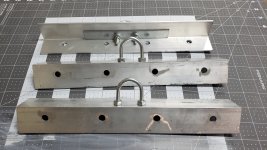
Did not know they were no longer available. They work very well. The reality is they would be easy to make though. They are basically a piece of angle aluminum with holes drilled in one side, a u bolt attached on the other side, long galvanized steel stakes, rope, and a hammer.
 
--- snip ---

But…. Years ago, a fellow sold sets of them made from Titanium, and they are heck-for-stout … and don’t weigh much. There are still a number of them in use, one set that we carry in our RV-3. So before you go medieval on someone for using what looks like a dog stake, you might complement them on having one of the few sets of titanium ones, and if they accept the compliment and tell you how great they are, you’re good…and if they give you a funny look, then you know they bought steel ones at Walmart. Move your plane somewhere else…..
I have used my set for about two decades and still have them. Have used a homemade version of the "Storm Force" the last several times at Oshkosh AirVenture.
 
Claw you had one job... saw others other where the castings broke where the spike is attached.
Bob,

What is the story behind this one? The Claw look to still be intact, minus the spikes. Did they fall out? Pull out of sandy soil? Someone forgot to pound them in?
 
what kind of soil is at OSH?
Do they aerate the soil?
Why shouldn't I use the Claw?
If I use the Claw does that mean I'll have extra camping room from folks avoiding me?
From the State of Wisconsin:

Region I. Forested, red, clayey or loamy soils. Near Lake Michigan and Lake Winnebago, Kewaunee, Manawa, and Poygan soils have developed in thin (<15 in.), silty materials that overlie calcareous, red, clay till or lake deposits. Where up to 18 in. of loamy materials overlie the same type of clay till, Briggsville soils occur. If up to 20 in. of silts overlie somewhat coarser-textured red till (clay loam, silty clay loam, and loam), Hortonville soils occur. Oshkosh and Winneconne soils formed in calcareous, red, clay lake deposits. Near Lake Superior, soils with clayey surfaces that overlie calcareous, red, clay till include Hibbing and Pickford . Clay soils developed in lacustrine basins include Ontonagon and Berglund.

https://wgnhs.wisc.edu/pubshare/M123.pdf

About half of your neighbors will be using the Claw so you'll be in good company. They remain pretty popular.
 
My annual reminder on spiral dog-stakes. Absolutely do NOT use them to tie down next to me if you bought them from any big box, pet, or sporting goods store - the triangle at the top will pull right out. But…. Years ago, a fellow sold sets of them made from Titanium, and they are heck-for-stout … and don’t weigh much. There are still a number of them in use, one set that we carry in our RV-3. So before you go medieval on someone for using what looks like a dog stake, you might complement them on having one of the few sets of titanium ones, and if they accept the compliment and tell you how great they are, you’re good…and if they give you a funny look, then you know they bought steel ones at Walmart. Move your plane somewhere else…..
Yep - I have a set of the Titanium ones from 20 years ago (when the Soviet Union was selling off their stores of Titanium). They lock together for easy storage and are very light and strong, so don’t yell at me…

Carl
 
Bob,

What is the story behind this one? The Claw look to still be intact, minus the spikes. Did they fall out? Pull out of sandy soil? Someone forgot to pound them in?
Pulled out of ground, one side was broken. Caravan flipped over. Sandy soil. As I recall.
 
As we move toward another Oshkosh, dare I mention a pet peeve? Yeah, dare I will....

At OSH, tiedowns protect the other airplanes. We park close together, and post-thunderstorm, long-timers have seen more than one upside down on another. If you park next to my airplane with some kind of crappy tiedown rig, expect to be chastised, finger pointed, tarred and feathered, and generally despised.

Seriously folks, we all have $50,000 to $350,000 invested, and often 1000's of hours of labor. You're welcome to be cavalier with your own stuff, but have some respect for your fellows. Invest in some serious tiedowns. Serious doesn't include the Claw (seen too many broken) and d@## sure doesn't include dog ties.

Let's talk. My veterans are solid aluminum stakes, 3/4" D and about 20" long, with 6" x 6" steel spades near the top and a welded rope ring. I've been using them almost 30 years. Don't recall where I got them, but the bare stake was probably military in origin. When driven so the spades are below the surface and rigged to pull perpendicular, they are very solid, even in sandy soil like Lakeland. The downside is they can be a lot of work to hammer into the ground, and I've camped a few places I couldn't get them into the ground due to rock content.

I recently purchased a set of Big Screw tiedowns, which are driven much like the aluminum stakes, so they pull perpendicular. The driver is a Dewalt DCF891B impact wrench with a six-point socket. It's the mid size impact; the large one (DCF900) weighs nearly twice as much. Here the overall package weighs about the same as the stakes with spades and the required large hammer. Pirep for the combo is good so far. I've driven them into the hard packed clay soil of the driveway in front of my shop, and a few weeks ago into the dirt at Trigger Gap AR, a place with a very high rock content. For sure it's less labor than a hammer, and very fast. I have no reservations about how well them will hold at OSH, but I'll reserve judgement about Lakeland until I can drive them there and get a feel for pull resistance in sandy stuff.
+1 for the Big Screw. I opted to leave the electric driver at home and use a Gear Wrench ratchet wrench, worked great.
 
Last edited:
Jeff,
I think the Point (pun intended, lol) of Dan’s comment about the Claw would be in conjunction with your Point (there it is again, lol) about proper installation.

I was also at the SunNFun tornado. Although my plane was not destroyed it was damaged. I was using the Claw tie-downs. I had them installed directly under the wing tie-down rings under the wing. In that sandy soil they came right out. In reality, I am not sure any tie-downs could really withstand a tornado. However, if anyone is going to use the Claw tie-downs it will be important to have the rope extend directly down from the tie-down ring on the wing. This ensures the pulling force is 90 deg from the angled stakes in the ground.

After the SunNFun tornado I stopped using the claw. One of the difficulties with using it with our low wings involves swinging a hammer directly underneath the wing in order to get that 90 deg angle. The risk of hitting the wing as one swings the hammer did not sit well with me. I think with high wing airplanes they are fine. I switched to the StormForce tie-downs and have not regretted the move.

To get the claw installed without hitting the wing, measure the distance between your tie downs, install the claw with the proper spacing then push your airplane into place. There are several youtube videos testing a variety of tie downs. Big Screw worked very well, dog tiedown worked about as well as the rest. The top "handle" distorted buy not enough for it to fail. Disadvantage is they are about impossible to get into hard soil. I am using the claw with upgraded climbing rope and caribiners.
 
Dan,
Great write up.

My buddy uses the BIG SCREW in Florida to tie his boat down for Hurricane season.

When I saw them 2 years ago I said I would use these for airplane tie downs instead of the claw
setup.

Boomer
 
Last edited:
+1 on the tie-down speech. Over the years I've done aircraft parking I've seen all manner of poor tie downs, and unfortunately some times the aftermath... You owe it to your neighbors.

I'll second Dan's recommendation on The Big Screw. I've been using these at Oshkosh and other flyins for half a dozen years now. I put them in using a 3/4" drive socket wrench with a piece of 7/8 tube over the handle for an extension. It is a little bit of work but saves the need to carry an impact wrench along.

I don't agree with Dan's assessment of The Claw. These need to be installed correctly (vertically) in order to work correctly. Every year I see many of these being installed in exactly the wrong way, which could lead to failure (and has.) Installed properly, they work as advertised.
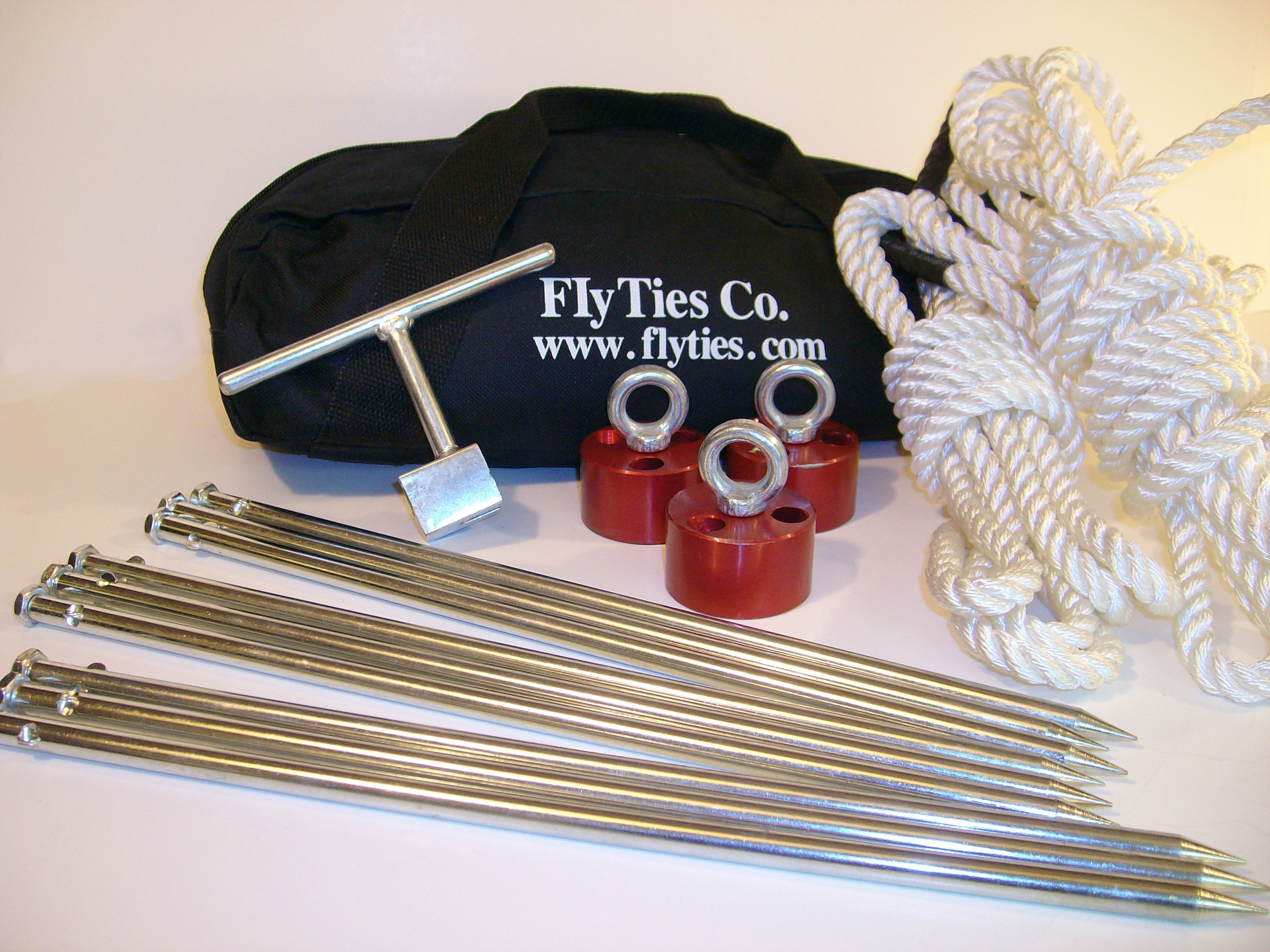
Some years ago, the company that makes FlyTies did a comparison pull test with a variety of other tie-down products, including the Claw. Both the Claw and the FlyTies go into the ground directly under your airplane tie-down ring, and pull straight upward. They both utilize three spikes driven in at an angle. During their tests, the Claw broke at the casting (aluminum) right where the spikes go through. The failure load was only about 350 lbs. Loaded the same way, the FlyTies never broke but did pull out of the ground, bringing a big clod of dirt with it, and the load was something like 1500 lb IIRC (and I may not - maybe it was 1200) Anyway, it was way stronger than the Claw. The FlyTies is also the only system besides long stakes driven at an angle that can be installed in a variety of soil conditions, including mostly rock. I have found nothing that screws in that can be driven into mostly rock conditions.
 
To get the claw installed without hitting the wing, measure the distance between your tie downs, install the claw with the proper spacing then push your airplane into place. There are several youtube videos testing a variety of tie downs. Big Screw worked very well, dog tiedown worked about as well as the rest. The top "handle" distorted buy not enough for it to fail. Disadvantage is they are about impossible to get into hard soil. I am using the claw with upgraded climbing rope and caribiners.
See my post #29
 
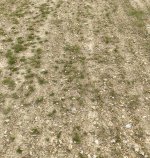
Pirep. This is the soil type at Trigger Gap (17A)...mostly small rocks mixed with smaller grit, and really hard packed. Didn't have any difficulty driving Big Screw anchors, but to be fair I'll add two notes.

First, I think it would have been a different story if driving with a ratchet wrench, as compared to the big battery powered impact.

Two, I ground a flat on one side of the screw tip for about the first 2". Think of a self-drilling sheet metal screw and you have the general idea. The edge of the flat would tend to hook and push small rocks out of the way.

ScreenHunter_2802 Jun. 05 06.55.jpg

Opinions ;)

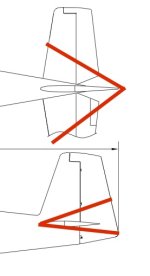
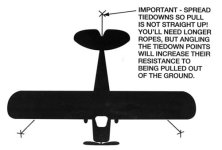
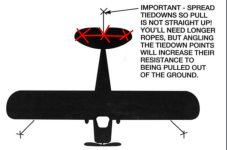
Someone asked about why I don't think much of the Claw. Two reasons. First the premise of only loading them straight up is unrealistic. When the wind blows on an airplane, it tends to rotate the airframe unless the wind is coming straight over the nose, and that immediately angles the load on any vertical tiedown. Two, there is no excuse for a tiedown to break or straighten until the applied load is way past whatever would pull it out of the soil.

Below, from an old EAA publication. I absolutely agree.

ScreenHunter_2803 Jun. 05 07.23.jpg

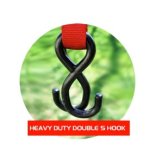
The Big Screw kits with straps have open hooks. No way Jose. That's just stupid. Like Bob said, use closed carabiners, or tie a knot in a rope.

ScreenHunter_2804 Jun. 05 07.33.jpg
 
Last edited:
I had the "unique" experience of watching my airplane get clobbered thru a service door window in one of the exhibitor buildings while wondering if the roof was going to blow off. The one thing that stood out was watching the tails of airplanes move around which loosened the rest of the tiedowns. Once that happened the wind buffeting hammered out the weaker tiedowns as the ropes became loose from wing rocking. I remember all this like it was yesterday.

The big takeaway (for me) was to really secure the tail tiedown.

In the case of a tailwheel airplane you tie down immediately under the tailwheel spring.

In the case of a nosewheel airplane you actually want two anchors at the tail. This is how I tie down my Comanche when going to the big shows.

I use a pretty simple homemade three point landscaping spike setup made with hardware store chain, two steel locking carabiners, and motorcycle straps rated at 1500 lbs. They are 20ft long so I double loop them.

1749130319199.png
 
We have always had great success (at Oshkosh) with the EAA Homebuilder tiedowns, which uses a surface plate and three stakes driven through it at angles. It works really well in the Oshkosh soil

Or, Flyties, if you don’t want to roll your own (EAA plans).
 
If you park next to my airplane with some kind of crappy tiedown rig, expect to be chastised, finger pointed, tarred and feathered, and generally despised.
I was parked between you and @scrollF4 a few years ago in HBC. I used the claw.

Happily none of those negative outomes occured. You were a pleasent neighbor. Maybe having your (I think) Grandson with you enhanced your mellow. That or I did a proper install of the claw.

But this thread is valuable. Please everyone, take head, protect your investment and ours.
 
Last edited:
Pirep. This is the soil type at Trigger Gap (17A)...mostly small rocks mixed with smaller grit, and really hard packed. Didn't have any difficulty driving Big Screw anchors, but to be fair I'll add two notes.

First, I think it would have been a different story if driving with a ratchet wrench, as compared to the big battery powered impact.

Two, I ground a flat on one side of the screw tip for about the first 2". Think of a self-drilling sheet metal screw and you have the general idea. The edge of the flat would tend to hook and push small rocks out of the way.

View attachment 89441
This is the soil type I was referring to -- where most any screw-in type tiedown won't work. Think of a deep layer of super-compacted base-rock material used for road building (3/4"-minus). The fact that Dan was able to get his big screws driven into this is encouraging. As he mentioned, the impact wrench is key. No way you are going to be able to get them in with a ratchet wrench.

The system that works well for this type of soil is a pair of 1/2" rebar stakes driven at an angle, and crossing right at the ground. The tiedown rope goes around both stakes where they cross. You can pull that assembly in any direction you want. We put empty soda cans over the raw ends of the rebar sticking out of the ground so people don't trip over them. Where Dan's big screws would really pay off is when it is time to take them out. It is pretty tough to get the rebar stakes out of the ground.
 
The one thing that stood out was watching the tails of airplanes move around which loosened the rest of the tiedowns. Once that happened the wind buffeting hammered out the weaker tiedowns as the ropes became loose from wing rocking Bob. It's why vertical pull tiedowns

Dead on Bob. Too many folks think the tiedowns are there to keep the airplane from lifting like a hovering helicopter. The real strains tend to be in the yaw axis.

In the case of a tailwheel airplane you tie down immediately under the tailwheel spring.

I generally go about foot behind. Main thing is to keep the tail wheel firmly planted in the ground so the lock can fixate the rudder. I also use a double tail wheel arm, and the rope routing (over the arm, under the spring, and over the other arm) further locks things.

In the case of a nosewheel airplane you actually want two anchors at the tail. This is how I tie down my Comanche when going to the big shows.

I really like that idea!

 
Some years ago, the company that makes FlyTies did a comparison pull test with a variety of other tie-down products, including the Claw. Both the Claw and the FlyTies go into the ground directly under your airplane tie-down ring, and pull straight upward. They both utilize three spikes driven in at an angle. During their tests, the Claw broke at the casting (aluminum) right where the spikes go through. The failure load was only about 350 lbs. Loaded the same way, the FlyTies never broke but did pull out of the ground, bringing a big clod of dirt with it, and the load was something like 1500 lb IIRC (and I may not - maybe it was 1200) Anyway, it was way stronger than the Claw. The FlyTies is also the only system besides long stakes driven at an angle that can be installed in a variety of soil conditions, including mostly rock. I have found nothing that screws in that can be driven into mostly rock conditions.
I looked all over but I couldn't find that video. It would make interesting viewing, although I'd factor in that it was clearly not an unbiased experiment. I find it odd that they would break where the spikes go through, as the weak point seems to be where the arms pivot about the center, which is why they are intended to be installed vertically.

This gives rise to a question- how strong do tie downs need to be? I'm no engineer, but I understand the concept of "just strong enough" and wonder how that would apply in this case. Any stronger than "just strong enough" is just extra weight to be carried around. So, how strong is "just strong enough?"
 
....This gives rise to a question- how strong do tie downs need to be? I'm no engineer, but I understand the concept of "just strong enough" and wonder how that would apply in this case. Any stronger than "just strong enough" is just extra weight to be carried around. So, how strong is "just strong enough?"
Figure standard seal level conditions with 70 kts. That can give you an idea of the lifting force. Don't forget to subtract the airplane's empty weight with fuel and whatever baggage you expect to have inside.

That gives the vertical force. Ideally, your tiedowns are not directly under the ring, so you'll need to do the calculation to include the angle the tiedown rope has.

Then you'll be close.

Dave
 
One more thing we haven’t discussed. A friend tied his Cessna 414 down at Denver Space port. He used the chains that were attached to the ground rings. Overnight winds were strong enough to crack the wing spar. Are we better off with ropes that have a little give in them versus chains or straps?
 
Figure standard seal level conditions with 70 kts. That can give you an idea of the lifting force. Don't forget to subtract the airplane's empty weight with fuel and whatever baggage you expect to have inside.

That gives the vertical force. Ideally, your tiedowns are not directly under the ring, so you'll need to do the calculation to include the angle the tiedown rope has.

Then you'll be close.

Dave
Oh is that all there is to it? I thought it would be complicated. :)

If you could go ahead and do all that math for us non-engineers, yeah, that'd be great...
 
Main thing is to keep the tail wheel firmly planted in the ground so the lock can fixate the rudder. I also use a double tail wheel arm, and the rope routing (over the arm, under the spring, and over the other arm) further locks things.
You bring up a good point about pinning down the tailwheel. On the nosegear airplanes it would be beneficial to have a tiedown in the front for the same reason. Later model 172's have a tiedown ring next to the nosegear strut.
 
Pirep. This is the soil type at Trigger Gap (17A)...mostly small rocks mixed with smaller grit, and really hard packed. Didn't have any difficulty driving Big Screw anchors, but to be fair I'll add two notes.

First, I think it would have been a different story if driving with a ratchet wrench, as compared to the big battery powered impact.

Two, I ground a flat on one side of the screw tip for about the first 2". Think of a self-drilling sheet metal screw and you have the general idea. The edge of the flat would tend to hook and push small rocks out of the way.

View attachment 89441

Opinions ;)

Someone asked about why I don't think much of the Claw. Two reasons. First the premise of only loading them straight up is unrealistic. When the wind blows on an airplane, it tends to rotate the airframe unless the wind is coming straight over the nose, and that immediately angles the load on any vertical tiedown. Two, there is no excuse for a tiedown to break or straighten until the applied load is way past whatever would pull it out of the soil.

Below, from an old EAA publication. I absolutely agree.

View attachment 89442

The Big Screw kits with straps have open hooks. No way Jose. That's just stupid. Like Bob said, use closed carabiners, or tie a knot in a rope.

View attachment 89443
Thanks Dan- I have known about the proper angle for something around 68 years. The straight up tiedown caused the loss of the very rare Pheasant biplane that was supposed to be in the Wittman Hangar at Pioneer Airport. EAA "management" repurposed that hangar "for the greater good". The Wittman Buttercup, V Witt and Olds powered Tailwind and the one of a kind Pobjoy Special were tied down the same way.
 
One more thing we haven’t discussed. A friend tied his Cessna 414 down at Denver Space port. He used the chains that were attached to the ground rings. Overnight winds were strong enough to crack the wing spar. Are we better off with ropes that have a little give in them versus chains or straps?
My humble (physics-trained) opinion: YES, absolutely! Chains have NO give and can be like a jack hammer if put on loose. They are difficult to tie as well: I've been to some airports where there was nothing to hook the chains to the airplane. Tying a knot in a chain?........huh......... Nope: Ropes for me. Never leave home without them! (Can you imagine the force necessary to crack the spar on a 414?? :oops: :oops: :oops: I wonder what made them look to make sure the spar was OK.......:unsure:)
 
My humble (physics-trained) opinion: YES, absolutely! Chains have NO give and can be like a jack hammer if put on loose. They are difficult to tie as well: I've been to some airports where there was nothing to hook the chains to the airplane. Tying a knot in a chain?........huh......... Nope: Ropes for me. Never leave home without them! (Can you imagine the force necessary to crack the spar on a 414?? :oops: :oops: :oops: I wonder what made them look to make sure the spar was OK.......:unsure:)
The skin was rippled under the wing. You could see the crack through the inspection plate. They put a doubler on it. I use Space Port, but I take my ropes.
 
16x3/8 spikes (12)
1/4x20 SAMSON ROPE–WarpSpeed™ II Dyneema®
No idea if they will work. Probably not this year.
View attachment 89414
Larry,

I made similar tiedowns. I considered the U-bolt connection to the angle stock the weak point (I see that you've reinforced yours). Instead of U-bolts, I used lengths of the same rope that was being used for the tiedowns. The rope passes through holes were drilled just outboard of the center two spike holes. The rope ends are joined with a Fisherman's Knot/Bend. They nest better in my tiedown bag than the ones with the U-bolts, and leave more room for cowl plugs, etc.
 
Last edited:
Back
Top