Van's Air Force

The definitive Van's Aircraft support community! Buying, building or flying an RV? Join our exclusive family of mentors and enthusiasts!

Cracked Airbox Plate

DanH

Legacy Member
Benefactor
Advertiser
Mentor
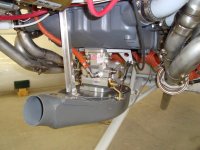
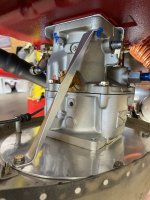
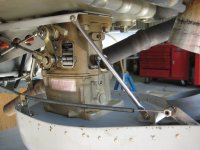
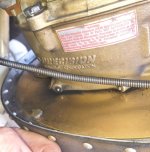
I assume all pilots and owners know the updraft airbox top plate must be checked for cracking on a regular basis.

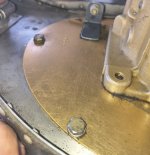
That said, here's an interesting observation from the underside of a plate. Note the origin of the cracks. They didn't start at the 0.250" holes. They all started at the perimeter of a star washer, where the point of a star dug into the material, creating a stress riser. I think the lesson here is no star washers please. Use smooth washers, drilled head bolts, and safety wire.
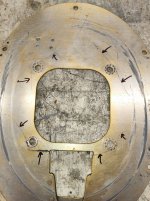
Airbox Plate.jpg
 
I assume all pilots and owners know the updraft airbox top plate must be checked for cracking on a regular basis.

That said, here's an interesting observation from the underside of a plate. Note the origin of the cracks. They didn't start at the 0.250" holes. They all started at the perimeter of a star washer, where the point of a star dug into the material, creating a stress riser. I think the lesson here is no star washers please. Use smooth washers, drilled head bolts, and safety wire.

View attachment 88766
Never understood the star lock washers … internal vs external ??? I don’t get it 😂
Good catch Dan 👍
 
I have dealt with the plates cracking multiple times in identical fashion with no star washers but with safety wired coarse thread bolts and regular washers. Agree star washers should't be used at least without thin backing washer. Solved the problem with a 0.125" thick plate I cut on my CNC mill. I have the .dwg for the plate which was provided to me by someone at Van's.
 
I assume all pilots and owners know the updraft airbox top plate must be checked for cracking on a regular basis.

That said, here's an interesting observation from the underside of a plate. Note the origin of the cracks. They didn't start at the 0.250" holes. They all started at the perimeter of a star washer, where the point of a star dug into the material, creating a stress riser. I think the lesson here is no star washers please. Use smooth washers, drilled head bolts, and safety wire.
No star washers on mine - it cracked at the edge of a normal washer. My take was the flexing of the plate against the edge of the washer created a nick which developed into a crack.
 
I just Tfound mine cracked this morning and made a new one of slightly thicker material. The old one was 19 years old. Not bad.
 
.050 4130 and never looked back. Tried a thicker aluminum plate and it just delayed the inevitable.
 
I don't believe those cracks are caused by the star washers. The plate everywhere outboard of those carb mounting bolts are subjected to the engine/cowl movement and general engine vibrations so far from the crank center line.
On some replacement plates I rivetted .063 doublers in stress (cracked) areas, doublers shaped to not interfere with carb mounting to maintain airbox alignment forward with inlet. Some re-cracked so I did a second solution.
Round 2, I just doubled the whole plate & adjusted the inlet alignment as needed, now my preferred fix.
 
Last edited:
First build (8A) the plate cracked. Added doublers and they eventually cracked as well. Replaced the aluminum plate with a piece of 0.015” SS and it has been good for 12+ years.

Second build I added a forward support. 13 years and no cracks.
Carl
 

Attachments

  • RV-10 air box.jpeg
    RV-10 air box.jpeg
    211.9 KB · Views: 205
I have the FM150 servo. My attempt at avoiding cracking has been to make a spacer between the plate and the servo that has a 1/4” rasious on the edge that contacts the plate. Under the plate mounting bolts I used radiused washers. They have the OD radiused to the flat on one side. The radiuses reduce point loading at the edges. 600 hrs so far so good on the standard thickness plate.
 
No star washers on mine - it cracked at the edge of a normal washer. My take was the flexing of the plate against the edge of the washer created a nick which developed into a crack.
That was my thought as well. The concentration of flexing at the edge of the servo flange or the washer is where I would expect a crack to start.
 
I have dealt with the plates cracking multiple times in identical fashion with no star washers but with safety wired coarse thread bolts and regular washers. Agree star washers should't be used at least without thin backing washer. Solved the problem with a 0.125" thick plate I cut on my CNC mill. I have the .dwg for the plate which was provided to me by someone at Van's.
I just riveted on another sheet of .063 , matched drilled the holes and cut and sanded the edges to match. 1400 hours on it so far. Just an option for those without a mill.
 
Were the cracks obvious when checking and cleaning the filter during condition inspections? I have not been specifically looking for cracks in this plate so now thinking I may need to drop the cowl (real pain) and check.
Figs
 
Were the cracks obvious when checking and cleaning the filter during condition inspections? I have not been specifically looking for cracks in this plate so now thinking I may need to drop the cowl (real pain) and check.
Figs

Generally no need to drop the airbox and look at the underside, although it can't hurt. Cracking at the forward carb bolts is obvious. Need to look a little closer around the rear bolts, as the area is hidden under the float bowl.

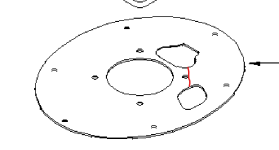
Illustration below, photos from this prebuy report.

BTW, I agree with the concept of stress concentration at the carb flange edge and the edge of plain plain washers. Gouging from star washers adds major insult to injury, so to speak.

Stiff baffle material at the inlet connection, with little gap between the cowl inlet glass and the end of the airbox, is a major source of stress. It's common to find the standard glass reinforced baffle material age-hardened to something like a truck tire. More gap and soft silicone might do a lot to extend plate life.

Cracks2.jpg

Cracks1.jpg
 
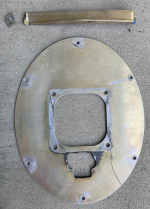
and here's my original cracked mounting plate... and the cracked brace. Discovered at the 1K hr mark.
On top of the flimsiness, the anodising treatment might have altered the material itself.

cracked.png
 
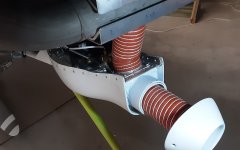
I suspect (opinion) that the root cause of the cracking is the shaking of the engine and FAB against the fixed cowl in the contact zone. The local solution is to use a length of SCAT for ram air, rather than the baffle seal structure. The advantage of the SCAT is that it is flexible and it also makes the bottom cowl half easier to fit and remove.
Any stresses that are transferred via the flat plate can also cause loosening of the carb bolts (experienced here) and cracking of support brace as per the post above.

20240915_091650.jpg
 
Last edited:
Scoped it and may have cracks, thinking of going the carbon fiber route as note above, is the correct bolt with the drilled head an AN74A3 or AN74A4 (MA20074-04-03 or 04). I have standard carbureted 0-360.
Figs
 
I suppose star washers are an aggravating factor, but the root cause here is the plate flexing up and down, right up to the edge of the area that is clamped/constrained against the carburetor face.
I suppose overly stiff coupling to the cowl is an aggravating factor, but the real issue is just too much mass attached along the outer edge of that plate, getting shaken around. The problem is inertial. A bracing tube or two would go a long way to preventing the cracking by putting the inertial load through the diagonal brace tube into the carb.

A titanium or steel plate would solve the problem too. Much higher fracture toughness and an endurance limit where the fatigue life is infinite below a certain threshold load.
 
Well Dan thanks for the heads up, pulled the plate today and while it did not look bad from the top it was cracked almost across the whole rear under the float bowl. Another repair job before Oshkosh :mad:
Figs
 
Working on my condition inspection today I found my .063 Aluminum airbox plate cracked again (2nd time so far -- 485 hrs.) in the exact same place as the last time. (Red line on diagram)
I'd be willing to try the 3mm carbon fiber plate if it will be stronger than Aluminum and is less likely to crack... are there downsides or potential issues with carbon fiber here? (buying and working with titanium isn't really an option... I suppose I could try steel but that sounds like a lot of work too)
airboxcrack.png
 
If I recall.. star lock washers are OK but 1: are meant for one-time use only, and 2: must rest on top of a plain washer. Am I remembering that right?
 
Working on my condition inspection today I found my .063 Aluminum airbox plate cracked again (2nd time so far -- 485 hrs.) in the exact same place as the last time. (Red line on diagram)
I'd be willing to try the 3mm carbon fiber plate if it will be stronger than Aluminum and is less likely to crack... are there downsides or potential issues with carbon fiber here? (buying and working with titanium isn't really an option... I suppose I could try steel but that sounds like a lot of work too)
View attachment 92530
I wouldn’t reinvent the wheel here. Many of us have had luck with switching to steel, 4130, and it’s easy to find and fabricate. Mine is .050, ‘cause that’s what I had laying around some 18 years ago…..
 
I'm routinely seeing stiff fiberglass reinforced baffle rubber being used to connect the cowl inlet to the nose of the airbox. Sometimes it's brick hard. Consider the stress on the airbox when the engine rotates on its mounts, particularly during the start shake.

Anyone had a plate failure after replacing those stiff seals with soft unreinforced sheet silicone?
 
I have the FM-150 servo in an updraft configuration. Between the FM-150 flange and the airbox plate, I have a phenolic spacer with radiused edges and corners. No sharp edges are in contact with the plate. I use bolts with radiused edged washers and safetied the bolts. In 800 hrs no cracks, fingers crossed. This is a basic fatigue reduction technique for attachment of the plate.
 
Back
Top