Van's Air Force

The definitive Van's Aircraft support community! Buying, building or flying an RV? Join our exclusive family of mentors and enthusiasts!

Mattituck TMXO360 & CS prop compatibility

zoot

Member
Patron
Hi all

I'm considering two RV7s on the market with 0360 Mattituck engines. I understand from my research and posts on VA that they're highly regarded engines.

Both aircraft have FP props, but one has a governor plate on the back, which indicates the possibility of CS prop compatibility, which I am interested in. The seller of that aircraft has supplied me with quite a lot of data, but not quite enough to confirm for certain, whether I'm in luck.

Some handy breadcrumbs:
  1. A governor plate exists on the back top right-hand-side of the engine case.
  2. In a pre-sales email from Mahlon Russell there was a mention of it being an "O-360-A1D equivalent".
  3. On the engine test page of the final engine delivered, with several S/N details for the magnetos and other accessories, there is no mention of the crankshaft P/N.
  4. Despite the mention of the O-360-A1D in item 2 above, the engine conformity certificate mentions the O-360-A4M.
  5. Another possible hint at CS prop support is indicated on the first line of the engine work log stating: "This TMXO360 constant speed engine was assembled and tested at Teledyne Mattituck Services on 22 Oct 2004 under W.O. XXXXX"
Obviously, a pre-purchase inspection would reveal the critical crankshaft detail, but at this stage it would be helpful to find out before justifying travel to another country, or hiring an independent AP to assess the aircraft..

Short of asking whether anyone might be able to put me in touch with Mahlon Russell, I'd appreciate any insight into what I've shared above.

Thanks
Dale
 
Last edited:
  1. Despite the mention of the O-360-A1D in item 2 above, the engine conformity certificate mentions the O-360-A4M.
Hmmm ....


"The crankcase you have pictured is for an A4 type solid crankshaft engine"

... might be out of 🍀

I shall be poring over the above thread ...
 
Hi all

I'm considering two RV7s on the market with 0360 Mattituck engines. I understand from my research and posts on VA that they're highly regarded engines.

Both aircraft have FP props, but one has a governor plate on the back, which indicates the possibility of CS prop compatibility, which I am interested in. The seller of that aircraft has supplied me with quite a lot of data, but not quite enough to confirm for certain, whether I'm in luck.

Some handy breadcrumbs:
  1. A governor plate exists on the back top right-hand-side of the engine case.
  2. In a pre-sales email from Mahlon Russell there was a mention of it being an "O-360-A1D equivalent".
  3. On the engine test page of the final engine delivered, with several S/N details for the magnetos and other accessories, there is no mention of the crankshaft P/N.
  4. Despite the mention of the O-360-A1D in item 2 above, the engine conformity certificate mentions the O-360-A4M.
  5. Another possible hint at CS prop support is indicated on the first line of the engine work log stating: "This TMXO360 constant speed engine was assembled and tested at Teledyne Mattituck Services on 22 Oct 2004 under W.O. XXXXX"
Obviously, a pre-purchase inspection would reveal the critical crankshaft detail, but at this stage it would be helpful to find out before justifying travel to another country, or hiring an independent AP to assess the aircraft..

Short of asking whether anyone might be able to put me in touch with Mahlon Russell, I'd appreciate any insight into what I've shared above.

Thanks
Dale
The plate on the upper right hand side of the accessory housing is for the vacuum pump drive not the governor drive. The governor drive is located on the lower right hand side of the accessory housing. If the drive is still installed the engine, with it's associated plumbing going to the front right side of the engine, is definitely constant speed capable. If the drive was removed for weight consideration and the accessory housing has a plate where the drive would attach to it the accessory housing is cs capable. If you look at the crankcase and there is a pipe plug facing down on the right half above the alternator where the prop governor plumbing would attach then the crankcase is cs capable. if you look at the nose of the crankshaft and you see a welch plug there then the shaft is CS capable. if the shaft is a solid forging where the welch plug would go its a solid shaft and not cs capable. From what you have described in the log entries it should be cs capable. Unfortunately, I don't have access to any records of the engines we built. So, information by work order or engine s/n isn't available to me. Pictures of the upper right front of the crankcase and of the accessory housing underneath the right mag and if the prop gov drive is missing, a pic of the crankshaft nose with the spinner removed through the hole in the center of the prop mounting flange will answer a lot of questions. not to difficult for the seller to snap a few pics with their phone and send them on. Good Luck, Mahlon
 
Be sure to check if the motors have ECI cylinders that might be effected by the AD. The Mattituck built IO-320 that came with my RV-9A project had them and I had to replace them. Not too bad back when I did that, around $6000 for a set of new Superior power assemblies at the time. My guess is the price has probably skyrocketed since then over the last few years. Find out if they are effected by the AD, and use that as a negotiation tool if you decide to proceed with the purchase.
 
The plate on the upper right hand side of the accessory housing is for the vacuum pump drive not the governor drive. The governor drive is located on the lower right hand side of the accessory housing. If the drive is still installed the engine, with it's associated plumbing going to the front right side of the engine, is definitely constant speed capable. If the drive was removed for weight consideration and the accessory housing has a plate where the drive would attach to it the accessory housing is cs capable. If you look at the crankcase and there is a pipe plug facing down on the right half above the alternator where the prop governor plumbing would attach then the crankcase is cs capable. if you look at the nose of the crankshaft and you see a welch plug there then the shaft is CS capable. if the shaft is a solid forging where the welch plug would go its a solid shaft and not cs capable. From what you have described in the log entries it should be cs capable. Unfortunately, I don't have access to any records of the engines we built. So, information by work order or engine s/n isn't available to me. Pictures of the upper right front of the crankcase and of the accessory housing underneath the right mag and if the prop gov drive is missing, a pic of the crankshaft nose with the spinner removed through the hole in the center of the prop mounting flange will answer a lot of questions. not to difficult for the seller to snap a few pics with their phone and send them on. Good Luck, Mahlon

Wonderful, thanks for replying Mahlon!

Who better to clarify ...

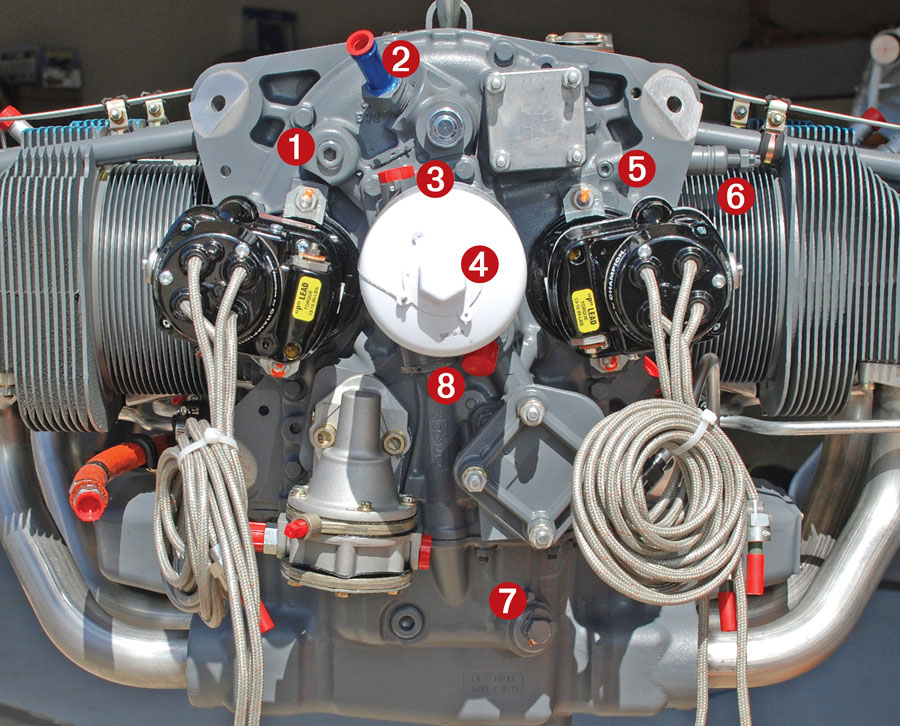
Here's a schematic I found:


This page on Kitplanes was also helpful - 3rd photo:


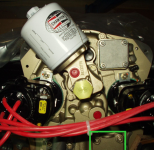
Here's the only photo I have of the engine's accessory housing at this point in time:

TMX0360_accessory_housing.png

Given your description and the schematic before the above photo, am I correct in assuming the plate I've highlighted with the green square border would be where the governor would attach to? Let's hope so.

If insufficient evidence, I'll ask the seller to take more photos.

Thanks again for your thorough post on how to identify the components.
 
Last edited:
Be sure to check if the motors have ECI cylinders that might be effected by the AD. The Mattituck built IO-320 that came with my RV-9A project had them and I had to replace them. Not too bad back when I did that, around $6000 for a set of new Superior power assemblies at the time. My guess is the price has probably skyrocketed since then over the last few years. Find out if they are effected by the AD, and use that as a negotiation tool if you decide to proceed with the purchase.

Thanks David, I'll be sure to check this too.
 
My RV7 has/had a Mattituck O-360-A4M. I converted it to an IO and changed the solid crank to a hollow crank, at 500 hours, so that I could run a constant speed prop and IO keep the engine running while inverted. Maybe I was/am crazy to have converted and majored a perfectively good engine at 500 Hours but 750 hours later, I'm still glad I did.
 
Last edited:
Wonderful, thanks for replying Mahlon!

Who better to clarify ...

Here's a schematic I found:


This page on Kitplanes was also helpful - 3rd photo:


Here's the only photo I have of the engine's accessory housing at this point in time:

View attachment 88558

Given your description and the schematic before the above photo, am I correct in assuming the plate I've highlighted with the green square border would be where the governor would attach to? Let's hope so.

If insufficient evidence, I'll ask the seller to take more photos.

Thanks again for your thorough post on how to identify the components.
That accessory case will work CS. You will need to get the complete governor drive pad and gears. Can you get a picture of the right front of the crankcase to provide proof that the case is machined to accept the plumbing from the governor drive pad? It should be but best to make sure. Also, you need to make sure there is a plug in the front of the crankshaft and that it isn't a solid forging as mentioned previously. Good Luck, Mahlon
 
That accessory case will work CS. You will need to get the complete governor drive pad and gears. Can you get a picture of the right front of the crankcase to provide proof that the case is machined to accept the plumbing from the governor drive pad? It should be but best to make sure. Also, you need to make sure there is a plug in the front of the crankshaft and that it isn't a solid forging as mentioned previously. Good Luck, Mahlon
Excellent, thanks Mahlon.

I've asked the seller to assist with additional photos, to assess the remaining points you've highlighted.
 
My RV7 has/had a Mattituck O-360-A4M. I converted it to an IO and changed the solid crank to a hollow crank, at 500 hours, so that I could run a constant speed prop and IO keep the engine running while inverted. Maybe I was/am crazy to have converted and majored a perfectively good engine at 500 Hours but 750 hours later, I'm still glad I did.
Thanks for this - all these details will be helpful, if I proceed. Fuel injection is also something I would ideally prefer.

The motivation behind my interest in a CS prop, is that I'd prefer the enhanced thrust and RPM control for various flight envelopes, including dives when doing (approved) aerobatics. I do however know of skilled RV pilots who say they don't believe a CS prop is necessary for safer aerobatics, just appropriate adaptation, such as powering back appropriately while descending in a dive.

Like most of us here, we want more enhanced setups and think of all those details, but the piggy bank will ultimately decide :ROFLMAO:
 
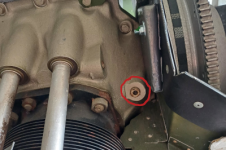
I have another photo, which seems to confirm where the prop governor pipe would enter the front of the crankcase?

propeller_governor_oil_line_entry.png

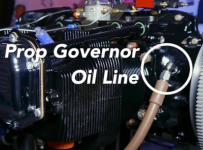
Here's a frame from the Aero Sport YouTube video walk-around of an engine of theirs:

propeller_governor_oil_line_1b.png

I guess removing the spinner for the last check for a hollow crankshaft might be too involved to ask the seller at this point? Best to be done during a pre-purchase inspection?
 
Last edited:
Back
Top