Van's Air Force

The definitive Van's Aircraft support community! Buying, building or flying an RV? Join our exclusive family of mentors and enthusiasts!

Airspace issue

Dugaru

Well Known Member
Sponsor
Friend
Here’s a random airspace safety problem I’ve seen, and I strongly suspect I have blundered into this myself once or twice at some point.

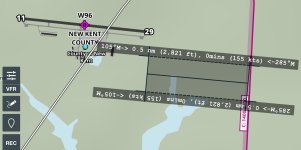
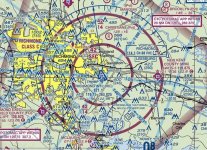
Operating out of New Kent International Aerodrome, it is not uncommon to have a “close encounter” with aircraft that are circling around the Class C. New Kent is right up against the edge of the Class C, and people like to fly right next to that edge, often (for some reason) at or near pattern altitude.

What I suspect is happening is that the transiting aircraft are paying very close attention to avoiding the C boundary, and therefore don’t think too much about what is inside this boundary. And of course they’re generally not talking on the New Kent CTAF.

Had a close encounter just the other day, and before ADS-B days I once got really up close and personal with a King Air. Why he was bombing around at 1,000 feet I’ll never know. 🤣

IMG_2338.jpeg

Look out below! Sometimes airspace isn’t the only thing you might want to avoid.


IMG_2337.jpeg
 
I have heard many times that this drives ATC crazy. Their service area generally goes will beyond the boundaries of depicted airspace, and those aircraft flying into those big airports also don't magically drop in from above. When I was in Tampa, several times I heard airline traffic into TPA have to get vectored around VFR traffic just outside the class B, but right in the middle of the approach to TPA. ATC WANTS to talk to you.
 
I have heard many times that this drives ATC crazy. Their service area generally goes will beyond the boundaries of depicted airspace, and those aircraft flying into those big airports also don't magically drop in from above. When I was in Tampa, several times I heard airline traffic into TPA have to get vectored around VFR traffic just outside the class B, but right in the middle of the approach to TPA. ATC WANTS to talk to you.
This has been my experience as well. Milwaukee approach has said to me on numerous ocassions, please call us up when in the area, we would like talk with you and provide flight following. They have given me altitudes and headings to avoid inbounds. Seems like it is safer for everyone. It would seem to me that having folks flying around just outside the airspace, talking to no one is an unnecessary risk for everyone.
 
This has been my experience as well. Milwaukee approach has said to me on numerous ocassions, please call us up when in the area, we would like talk with you and provide flight following. They have given me altitudes and headings to avoid inbounds. Seems like it is safer for everyone. It would seem to me that having folks flying around just outside the airspace, talking to no one is an unnecessary risk for everyone.
So you are for more regulation? How big would you make the volume of the controlled airspace? Would you require an instrument rating and flight plan?

Point is, no matter how big you make the airspace, there will always be a boundary, unless you make ALL of the airspace controlled; I don't think anyone wants that.
 
So you are for more regulation? How big would you make the volume of the controlled airspace? Would you require an instrument rating and flight plan?

Point is, no matter how big you make the airspace, there will always be a boundary, unless you make ALL of the airspace controlled; I don't think anyone wants that.
I didn't say that at all. I only shared my opinionj that atc at the C airports are happy to talk with you and actually prefer that you do. In contrast to B airports where their space is big enough and as long as you stay out of it, they would rather not speak with you. I also believe safety increases when every one is communicating with one another. That is toatally unrelated to asking for more regs and didn't suggest we mandate it. I also believe that folks should announce their position and intentions at untrowered airports. the handfull of near misses I have encountered were with folks refusing to do so or worse, giving position reports or altitudes that are inaccurate, causing you to look in all the wrong places. That said, I would not advocate for a rule change in that regard either. I am a firm believer in incrementalism in the govt and would never give them an inch if i had a choice.

Our system works, but that doesn't mean that we can't improve it via our choices.
 
Last edited:
Just to note, neither New Kent nor other traffic at/near pattern altitude are ‘up against’ the class C boundary, they’re below class C. Why the King Air pilot would want to hug that magenta line is a mystery to me. But I agree, flying at pattern altitude so close to any airport, regardless of airspace, does not seem to be good risk management.
 
I didn't say that at all. I only shared my opinionj that atc at the C airports are happy to talk with you and actually prefer that you do. In contrast to B airports where their space is big enough and as long as you stay out of it, they would rather not speak with you. I also believe safety increases when every one is communicating with one another. That is toatally unrelated to asking for more regs and didn't suggest we mandate it. I also believe that folks should announce their position and intentions at untrowered airports. the handfull of near misses I have encountered were with folks refusing to do so or worse, giving position reports or altitudes that are inaccurate, causing you to look in all the wrong places. That said, I would not advocate for a rule change in that regard either. I am a firm believer in incrementalism in the govt and would never give them an inch if i had a choice.

Our system works, but that doesn't mean that we can't improve it via our choices.
Can't disagree with you, as long as it's our choice. I will say I tend not to talk to ORD unless I have to be on an IFR flight plan. I am always outside of their airspace when VFR but even with flight following, they always vector me well out of their way...
 
Just to note, neither New Kent nor other traffic at/near pattern altitude are ‘up against’ the class C boundary, they’re below class C. Why the King Air pilot would want to hug that magenta line is a mystery to me. But I agree, flying at pattern altitude so close to any airport, regardless of airspace, does not seem to be good risk management.
The Class C floor there is 1400, so it’s a little less than 500 feet above pattern altitude. Maybe they’re worried about popping up into it. But I suspect their thought process just ends at “stay out of circle.”🤣
 
I didn't say that at all. I only shared my opinionj that atc at the C airports are happy to talk with you and actually prefer that you do. In contrast to B airports where their space is big enough and as long as you stay out of it, they would rather not speak with you. I also believe safety increases when every one is communicating with one another. That is toatally unrelated to asking for more regs and didn't suggest we mandate it. I also believe that folks should announce their position and intentions at untrowered airports. the handfull of near misses I have encountered were with folks refusing to do so or worse, giving position reports or altitudes that are inaccurate, causing you to look in all the wrong places. That said, I would not advocate for a rule change in that regard either. I am a firm believer in incrementalism in the govt and would never give them an inch if i had a choice.

Our system works, but that doesn't mean that we can't improve it via our choices.
Lr172,
I fly this airspace. When you call the class C, they kick you to Potomac Approach.
Potomac Approach may be quite busy (class B).
They can and will talk, but it may be a few minutes.

Usually going around Dugaru's space 2-3 miles further east and 3500-4500 ft.

Daddyman58
 
Controllers aren't always happy to talk to you.

Been flying Socal airspace for 30 years, and over the past few years I've seen more and more instances where a concise, professional call to ATC for that purpose will be met with "Aircraft calling unable VFR services remain clear of Class Charlie airspace". More and more airports don't want you doing pattern work, practice approaches, or anything involving loitering or training. They'll even have it on the ATIS. Which of course forces that traffic into smaller airspace, fewer airports, and stresses the controllers there even more. Not to mention generating more noise complaints for those airports.

I'm sure a lot of this has to do with the volume of traffic and the reduced number of controllers. But more and more, I see a disconnect between what people say ATC wants and what they actually want when I'm airborne. I've tried working with students early in the morning, or at night, and even then it can be tough to get the bare minimum done to accomplish what they need.

Just my experience.

--Ron
 
Can't disagree with you, as long as it's our choice. I will say I tend not to talk to ORD unless I have to be on an IFR flight plan. I am always outside of their airspace when VFR but even with flight following, they always vector me well out of their way...
I am based under the ord bravo. They really would rather not talk to you if vfr. I generally get great service from atc when vfr. The only exception is Chicago approach. Even when they accept flight following requests, the service is poor . i have flown a half mile from traffic and not a peep from approach. In fairness, they are highly qualified and give me great service when ifr. They just feel that talking to vfr pilots is beneath them i think.
 
Controllers aren't always happy to talk to you.

Been flying Socal airspace for 30 years, and over the past few years I've seen more and more instances where a concise, professional call to ATC for that purpose will be met with "Aircraft calling unable VFR services remain clear of Class Charlie airspace". More and more airports don't want you doing pattern work, practice approaches, or anything involving loitering or training. They'll even have it on the ATIS. Which of course forces that traffic into smaller airspace, fewer airports, and stresses the controllers there even more. Not to mention generating more noise complaints for those airports.

I'm sure a lot of this has to do with the volume of traffic and the reduced number of controllers. But more and more, I see a disconnect between what people say ATC wants and what they actually want when I'm airborne. I've tried working with students early in the morning, or at night, and even then it can be tough to get the bare minimum done to accomplish what they need.

Just my experience.

--Ron
I think you're right that this really has to do more with volume and resources than with ATC. Sometimes there just isn't enough physical airspace, or radio airtime, to fit in much more traffic. I think if most controllers had the choice, they would prefer to have the time and resources to talk to you if you may present a conflict with traffic they are controlling. That just makes their job easier. I made a habit of talking to or at least listening to Tampa approach when flying just outside the Class B. On multiple occasions, them knowing my intentions saved them from having to vector incoming airline traffic to avoid me, or I was able to speak up as that "VFR traffic" they were calling out and then stay clear.

For those that like podcasts, Opposing Bases is an awesome aviation/ATC podcast with two controllers/pilots and they talk about this very subject frequently.


Chris
 
Lr172,
I fly this airspace. When you call the class C, they kick you to Potomac Approach.
Potomac Approach may be quite busy (class B).
They can and will talk, but it may be a few minutes.

Usually going around Dugaru's space 2-3 miles further east and 3500-4500 ft.

Daddyman58
Thanks. I am sure my experience is limited and good to hear of others experiences. Like any organization, their approach generally flows down from the leadership, so expect there are significant differences from place to place.
 
Controllers aren't always happy to talk to you.

Been flying Socal airspace for 30 years, and over the past few years I've seen more and more instances where a concise, professional call to ATC for that purpose will be met with "Aircraft calling unable VFR services remain clear of Class Charlie airspace". More and more airports don't want you doing pattern work, practice approaches, or anything involving loitering or training. They'll even have it on the ATIS. Which of course forces that traffic into smaller airspace, fewer airports, and stresses the controllers there even more. Not to mention generating more noise complaints for those airports.

I'm sure a lot of this has to do with the volume of traffic and the reduced number of controllers. But more and more, I see a disconnect between what people say ATC wants and what they actually want when I'm airborne. I've tried working with students early in the morning, or at night, and even then it can be tough to get the bare minimum done to accomplish what they need.

Just my experience.

--Ron
I think i can understand that. If i am a controller bringing in 10 - 15 jets an hour, I wouldn’t want a bunch of 172’s doing pattern work either. That would be a nightmare. I get frustrated with how slow they fly the pattern and how many miles out they go on base and that is just me in my rv. I get stuck behind sone of these guys that almost get outside the delta before turning base. I could only imagine what it is like trying to mix in jets doing 120 kts on approach with a bunch of 172s doing 70. Even worse when they are doing approaches. The ones i have been stuck behind are doing 70 from well outside the faf. I don’t know about you guys, but i do not like the way the rv6 handles approaches when that slow.

My experience with atc in charlies has been flying through to land at nearby airports. I can’t imagine ever going to a c airport to do pattern work. Again i was just offering my limited experience. I apologize if it seemed as though i pitching atc as being more than they are.
 
I don’t know about you guys, but i do not like the way the rv6 handles approaches when that slow.
Me either. Too slow. Although at least I could extend the flaps in my -9A at that speed. 🤣
 
Controllers aren't always happy to talk to you.

Been flying Socal airspace for 30 years, and over the past few years I've seen more and more instances where a concise, professional call to ATC for that purpose will be met with "Aircraft calling unable VFR services remain clear of Class Charlie airspace". More and more airports don't want you doing pattern work, practice approaches, or anything involving loitering or training. They'll even have it on the ATIS. Which of course forces that traffic into smaller airspace, fewer airports, and stresses the controllers there even more. Not to mention generating more noise complaints for those airports.

I'm sure a lot of this has to do with the volume of traffic and the reduced number of controllers. But more and more, I see a disconnect between what people say ATC wants and what they actually want when I'm airborne. I've tried working with students early in the morning, or at night, and even then it can be tough to get the bare minimum done to accomplish what they need.

Just my experience.

--Ron
im a new pilot out here in socal. i agree i dont have the time or experince you do, however the little i do have i get this feeling often. which is why i fly at night often.
 
This is HUGELY safer than hugging the edge of the C at 1200.

2 to 3 miles outside the C at 3500 to 4500? Nope. Not a good place to be.

The point of a C or B is "safe space", i.e. controlled airspace for the Part 121 operations. That means arrivals and departures.

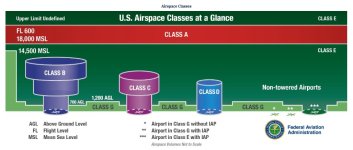
Consider the problem three-dimensionally. Big reality here...the actual airspace is not shaped like the training material depictions.

ScreenHunter_2773 May. 07 09.39.jpg

It's much more flat. Here's the actual shape of the KRIC Class C in cross section, to exact scale:

ScreenHunter_2775 May. 07 10.59.jpg

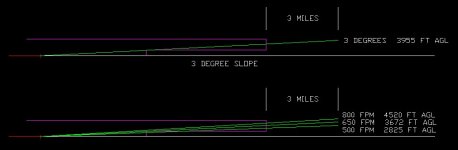
Plot the approach slopes for an RJ900 at 140 knots on descent to a touchdown point 1000 ft from the threshold, in degrees, or rate:

ScreenHunter_2774 May. 07 10.59.jpg

When crossing a Class C, I'll argue the safest place is directly over the top center, at 90 degrees to the runway alignment...unless it's a spaceport.

I'll further argue 3500 to 4500 at 3 miles outside the C is the worst place, particularly across the runway path.


Had a close encounter just the other day, and before ADS-B days I once got really up close and personal with a King Air. Why he was bombing around at 1,000 feet I’ll never know.
Because he was a pro. If he needed to be low, he made sure he was low enough to be well under the typical approach slope to the primary runway.
 
Because he was a pro. If he needed to be low, he made sure he was low enough to be well under the typical approach slope to the primary runway.
He was not interfering with the approach or departure paths at any of the RIC runways. But this pro was literally crossing the final for W96 at pattern altitude, apparently oblivious to his location.

A few miles further out, a few thousand feet higher - he’s not interfering with anything in the C or with W96.

My post was about the fact that there is sometimes more to worry about in a class C than the “primary runway” at the Class C.
 
I can’t imagine ever going to a c airport to do pattern work.

I learned to fly at a busy Class C airport. Private, instrument, commercial, tailwheel, HP, aerobatics. And then taught there for many years. I'd turn guys loose for their first solo in the Pitts or Extra at that airport. I did my first solo as a student pilot with 757s landing on a parallel runway.

It's not a bad place to learn. Quite the opposite. When you learn at an airport where the pattern is a mix of airliners, Cubs, helicopters, antiques, turboprops, and military, you end up with the skills and experience required to be comfortable flying anywhere. You get quite good with wake turbulence avoidance procedures, for example.

I'm not sure the airspace itself tells you much about whether you'd want to fly there. For example, Teterboro, NJ is a class delta airport, but I'd never go there in my RV6. Last time I landed there in a Gulfstream it took over an hour just to get onto the FBO ramp due to the congestion.

--Ron
 
Sounds like there are class B and C facilities who do and don't want to talk to you outside their airspace. Around PDX class C they definitely do want you to be in communication especially near the approach/departure paths.
Can't disagree with you, as long as it's our choice.

Well... typical E-AB OLs have a prohibition on flying in congested airways unless otherwise directed by ATC. Of course "congested airspace" is not clearly defined by FAA, but if there were a forcing incident I suspect the decision would not come down in our favor. I used to be a bit more cavalier about it but these days I tend to call them if it seems like "congested" might be a factor.
 
He was not interfering with the approach or departure paths at any of the RIC runways. But this pro was literally crossing the final for W96 at pattern altitude, apparently oblivious to his location.

A few miles further out, a few thousand feet higher - he’s not interfering with anything in the C or with W96.

My post was about the fact that there is sometimes more to worry about in a class C than the “primary runway” at the Class C.
If you’re on final, haven’t you already descended below pattern altitude?
 
If you’re on final, haven’t you already descended below pattern altitude?
Not if you’re shooting a practice instrument approach. Not if you’re flying the B-52 pattern I see so often.

I say again, this guy was crossing the final approach path at 1,000 feet, maybe a mile from the runway, at an airport with a TPA of 920. Hauling the mail and not talking to anybody local. Call that pro if you want, and it was certainly legal, but I think it was a Stupendously Bad Idea.
 
Back
Top