


Van's Air Force

The definitive Van's Aircraft support community! Buying, building or flying an RV? Join our exclusive family of mentors and enthusiasts!

F 440 Pushrod

ECAM

Member
Hello ,

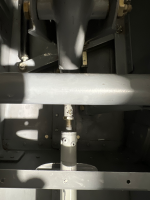
I purchased the RV 4 in December and I am still detailing and updating. Getting close to the end. Yesterday I discovered the rod ends of the small diameter elevator push rod F 440 have allot of exposed threads. ( aprox. 13 threads) . Both threaded ends are deep enough to cover the witness holes. One end has the jam nut opposite to where it should be. Looks like it has been migrating. I will recenter both ends and fix the jam nut. Good reminder why we do a complete inspection before and after buying a used plane.
My question?
Is there a reference spec for rod end thread exposure. I keep thinking the pushrod should be a 1/4 longer , hoping I am wrong.
I am not at the hangar to take measurements of how long the exposed threaded rod is.

Thanks
Phil
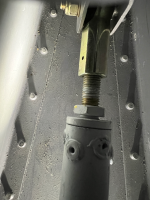

image0.jpegimage1.jpeg
Sent from my iPad
 
Good find. I'm recalling something about making the pushrods long enough so that they allow for some adjustment, but are so long that in the worst case loosening scenario the ends cannot completely unscrew, ie, are fail safe. Is that possible in this case?
 
Good find. I'm recalling something about making the pushrods long enough so that they allow for some adjustment, but are so long that in the worst case loosening scenario the ends cannot completely unscrew, ie, are fail safe. Is that possible in this case?
Good question , I had planned to check that exact scenario tomorrow , I read the same info in the kit planes magazine.
Thanks
 
Hello ,

I purchased the RV 4 in December and I am still detailing and updating. Getting close to the end. Yesterday I discovered the rod ends of the small diameter elevator push rod F 440 have allot of exposed threads. ( aprox. 13 threads) . Both threaded ends are deep enough to cover the witness holes. One end has the jam nut opposite to where it should be. Looks like it has been migrating. I will recenter both ends and fix the jam nut. Good reminder why we do a complete inspection before and after buying a used plane.
My question?
Is there a reference spec for rod end thread exposure. I keep thinking the pushrod should be a 1/4 longer , hoping I am wrong.
I am not at the hangar to take measurements of how long the exposed threaded rod is.

Thanks
Phil


Sent from my iPad
Good find. I'm recalling something about making the pushrods long enough so that they allow for some adjustment, but are so long that in the worst case loosening scenario the ends cannot completely unscrew, ie, are fail safe. Is that possible in this case?
I believe you're over thinking it but that's not a bad thing. For this application if the witness holes are full, you're good. As a starting point and to maintain the most "adjustability", count the number of turns between the witness hole fill and bottoming out (32 full turns? been a while). Put each bearing end half way the do complimentary adjustment turns on each side.

I'm sure it's fine but examine both threads on the side with the loose jam nut. The JN is not only intended to maintain the position of the two pieces. Additionally, it's intended to maintain the thread loading in one direction (tension) to prevent thread failure; that which could be catastrophic. The aforementioned exam would be free, quick, and good for peace of mind.
 
The rod ends should be past 1/2 total length. That way if the jam nuts loosen on both ends, and the rod rotates, it will "stop" at less than half travel to the one side and pull out less than half on the other side. So it isn't the number of threads, it it 1/2 of the thread length in the rod. If getting this makes this rod shorter, perhaps one of the other rods in the mechanism has some give to be longer to make up for it.
 
In your pix I see that the witness hole location is less than 1/2 the length of the male threaded rod that is showing. If you are adjusted just to the witness hole, a second jam nut at each end will limit the travel required to bottom thus eliminating the possibility of the bearing back off.
 
I believe you're over thinking it but that's not a bad thing. For this application if the witness holes are full, you're good. As a starting point and to maintain the most "adjustability", count the number of turns between the witness hole fill and bottoming out (32 full turns? been a while). Put each bearing end half way the do complimentary adjustment turns on each side.

I'm sure it's fine but examine both threads on the side with the loose jam nut. The JN is not only intended to maintain the position of the two pieces. Additionally, it's intended to maintain the thread loading in one direction (tension) to prevent thread failure; that which could be catastrophic. The aforementioned exam would be free, quick, and good for peace of mind.
Thank you
 
I fussed over it tonight , both ends have the same thread exposure , both ends are past the witness holes and the jam nuts are tight and both rod ends are aligned in the same plane

Thank you for your help
Phil
 
Back
Top
