Van's Air Force

The definitive Van's Aircraft support community! Buying, building or flying an RV? Join our exclusive family of mentors and enthusiasts!

Cleaning lead deposit from valve stem

ve0kog

Well Known Member
Patron
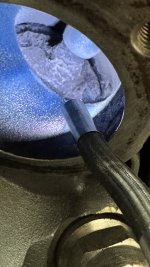
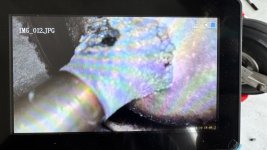
while changing the intake gaskets i noticed some lead build up on the intake valve stem in the area which stays outside of the guide. i always lean on the ground and in flight.

does it look like this may be causing any issue down the road and what is the best to clean this up?

i would appreciate advice. first time doing an owner assist CI and learning..
IMG_0579.jpegIMG_0585.jpeg
 
Last edited:
That is not lead. It is deposits that form when the fuel evaporates or burns and leave the solid additives behind. Normal. No need to clean it off unless looking to maximize every fraction of a percent of power available.
 
It is deposits that form when the fuel evaporates or burns and leave the solid additives behind.
1,2,3 have the build up. I assumed it’s lead because it’s gray and seem relatively soft.

#4 has a very clean tan colored surface with just a small amount carbon on the stem only.
 
1,2,3 have the build up. I assumed it’s lead because it’s gray and seem relatively soft.

#4 has a very clean tan colored surface with just a small amount carbon on the stem only.
The fuel additive deposits are very soft and the colors range from off white to grey and sometimes yellow or beige. Really depends on whether or not oil is getting mixed in. lead tends not to adhere to anything.
 
Is the proliferation of cheap borescopes a good thing? I'm not sure. Anyway, wait until you have 1500 hours on your engine. The inside of the cylinders looks like hell.. which is normal.
 
Looks ok, but remember to check valve/guide clearance about every 200hrs.. lots of info on the search engine. Sticky valves can ruin the cam
I don't measure it - instead I've committed to valve removal and clean up one cylinder every oil change, rotating through the cylinders, one at a time. That way each exhaust valve and guide gets cleaned every 50 hours or so.
 
Let me see if I understand you... you're planning to remove a valve on one cylinder at every oil change??? Assuming you do 2-3 oil changes a year... wow. Sorry, admittedly I am NOT an expert and will defer to them but I can't see how this is in anyway necessary. Mike Busch warns about unnecessary maintenance getting
one into more trouble than it protects one from. Just my thoughts.
 
Is the proliferation of cheap borescopes a good thing?
they are like home blood pressure monitors. Can give anxiety any time the yellow LEDs light up. :)

you're planning to remove a valve on one cylinder at every oil chang
In the worst case scenario I'm not sure how I can get this done without pulling the jugs and soft blasting the back of the valve to remove this build up. The valve cannot be completely taken out any other way?

I hope you are all right that it's looking normal at 450 hrs.
 
they are like home blood pressure monitors. Can give anxiety any time the yellow LEDs light up. :)


In the worst case scenario I'm not sure how I can get this done without pulling the jugs and soft blasting the back of the valve to remove this build up. The valve cannot be completely taken out any other way?

I hope you are all right that it's looking normal at 450 hrs.
You may want to give MMO a try, at least a couple of tanks full and check the result to see if there has been any cleaning done. I have started using MMO since my last sticky valve and many people swear by it.
 
Is the proliferation of cheap borescopes a good thing? I'm not sure. Anyway, wait until you have 1500 hours on your engine. The inside of the cylinders looks like hell.. which is normal.
I’m not sure - I’ve scoped inside 1000hr engines before that look like new.
 
I should have stated a better suite of misinterpreted information. The information isn’t necessarily bad in and of itself.
There are folks who do believe scopes, oil analysis, engine data logging, frequent inspection of the filter and oil screen etc, bring no real value. I see lead build up on all valves, except on the hottest cylinder. may be that tells something..
 
There are folks who do believe scopes, oil analysis, engine data logging, frequent inspection of the filter and oil screen etc, bring no real value. I see lead build up on all valves, except on the hottest cylinder. may be that tells something..
It tells you that heat burns off many deposits. That is how yopur sparkplugs stay clean, assuming they run hot enough. On the flipside, heat can create deposits, like the coked oil in the exhaust valve guides.

If your valve is running hot enough to have no deposits in the intake stem, I would consider that abnormal. May want to look for incomplete contact between valve face and seat. Intake valves are bathed in 100* air, while the exh valves get 1600-2000* air. They should look different, especially on the non combustion side.
 
Last edited:
If your valve is running hot enough to have no deposits in the intake stem, I would consider that abnormal. May want to look for incomplete contact between valve face and seat.
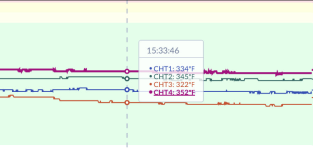
this is a bit counter intuitive but interesting point. The clean valve back is sand/tan color. this is the hottest CHT but by no means excessively hot. It's over 350F while the rest are cooler. Here is a cruise picture at 11000 feet and 32F OAT.

#4 has no deposits

1745269190041.png
 
My cub engine had zero compression on the number two cylinder. . Pulling the prop I could hear a swish of air coming,out of the exhaust valve. I added a pint of Avblend to the oil, flew the airplane and after about 3 hours the compression is up in the 70’s
The bottle says it cleans the valves of carbon and lead. It worked so well on the cub, that I added a pint to the RV7.
 
this is a bit counter intuitive but interesting point. The clean valve back is sand/tan color. this is the hottest CHT but by no means excessively hot. It's over 350F while the rest are cooler. Here is a cruise picture at 11000 feet and 32F OAT.

#4 has no deposits

View attachment 85801
A hot valve is not the same as high chts. The face of the valve collects heat from combustion. When the valve is seated on the seat, it sheds heat to the seat/head. If only 75% of the valve touches the seat, only 75% of the heat is transferred. Sometimes you get a bad valve job and get less than 100% contact. If this happens on an exhaust valve, you see the burn pattern on the face, but the intake is so much cooler, it doesn’t make a mark.

Just an idea on why the one is different.
 
Back
Top