Van's Air Force

The definitive Van's Aircraft support community! Buying, building or flying an RV? Join our exclusive family of mentors and enthusiasts!

Engine break & SDS EFI

CJT

Well Known Member
I have a new Lycoming 540 Thunderbolt engine with Dual SDS EFI in my RV10
Reading through the manual, I came across this statement Limit timing to 20 degrees for parallel valve engines. Adjust your RPM accordingly.
can someone throw light on the exact programming steps to achieve this?
also, after break in, what values to enter, to return to normal
Thanks
 
I have a new Lycoming 540 Thunderbolt engine with Dual SDS EFI in my RV10
Reading through the manual, I came across this statement Limit timing to 20 degrees for parallel valve engines. Adjust your RPM accordingly.
can someone throw light on the exact programming steps to achieve this?
also, after break in, what values to enter, to return to normal
Thanks
The SDS literature has instructions for setting up the mapping of the unit. You really should become familiar with that.
 
The SDS literature has instructions for setting up the mapping of the unit. You really should become familiar with that.
I did read and watched the video, but still feel if you could explain in details please. Thanks
 
From my neighbor -

"CJ, if you want, I can fly over to Synergy and walk you through the setup on your SDS equipped RV-10. Mine is similarly equipped and I have about 80 hours of experience with SDS. Recently upgraded to EM-6. Allen knows how to get in touch with me."
 
From my neighbor -

"CJ, if you want, I can fly over to Synergy and walk you through the setup on your SDS equipped RV-10. Mine is similarly equipped and I have about 80 hours of experience with SDS. Recently upgraded to EM-6. Allen knows how to get in touch with me."
 
I have a new Lycoming 540 Thunderbolt engine with Dual SDS EFI in my RV10
Reading through the manual, I came across this statement Limit timing to 20 degrees for parallel valve engines. Adjust your RPM accordingly.
can someone throw light on the exact programming steps to achieve this?
also, after break in, what values to enter, to return to normal
Thanks
With your documentation you should have a printout of the current programming. Will include values for timing as well as fuel for every RPM and MP point on the map. This is your baseline that you will return to after break in. Not sure of the context of this “20 degree” limitation but if taken at face value, it’s easy to go into to programmer and simply limit the max advance to to 20 degrees. no matter what the MAP or RPM, just enter 20 for the value in that slot. This will ensure the timing fires at 20 no matter what.

That said, I broke my engine in with the “as delivered“ programming from SDS with no issues.
 
With your documentation you should have a printout of the current programming. Will include values for timing as well as fuel for every RPM and MP point on the map. This is your baseline that you will return to after break in. Not sure of the context of this “20 degree” limitation but if taken at face value, it’s easy to go into to programmer and simply limit the max advance to to 20 degrees. no matter what the MAP or RPM, just enter 20 for the value in that slot. This will ensure the timing fires at 20 no matter what.

That said, I broke my engine in with the “as delivered“ programming from SDS with no issues.
Thanks, very informative and reassuring
 
Here is a hint from someone that has done plenty of SDS installs and actually has experience watching the effects of timing on the GAMI engine test facility in Ada OK. If your engine is plated for 25 degrees (most parallel valve except high CR) set the timing to a flat 23 degrees from about 1500 RPM upwards. The LOP advance shit set that to 3 degrees and no more.

If you have a 20 degree, just drop two and make it 18. Unless you have internal cylinder pressure monitoring and crank angle sensing to calculate ThetaPP, and the knowledge to understand it and work with it, stay within those boundaries and all will be good in the world.

Cautionary note. A well known Canadian engine builder plated an angle valve with 25 dbtdc and then the owner set up a lighspeed on it, and the engine suffered probably 26+ degrees at high MAP and more when advanced with reducing MAP. The long term damage was cases and components that were beyond salvage in some cases. The final straw was the LS went spaz and reignited for several minutes destroying the engine. About the only thing left usable was the cam shaft. It was lucky this did not kill him. So take careful note of things and if something is not seeming right....get good advice, not just hangar buddy advice. And we have seen brand new G58 Barons with mags set 8-10 degrees advanced too. So anything can happen.
 
Gonna necro this thread since I've now run my engine and am about to venture into break-in and then tuning...

I already went through and verified the fuel and ignition mapping are per the default settings in the manual except I capped the RPM IGN at 20° and set all the adv/ret to 0° per the break-in advice for parallel valve engines. First start a couple weeks ago was fine though she ran a lot better with just a tiny bit of throttle. Haven't run the engine since then as I was finishing a few other things but it's on the list for Monday.

Two Three things I'm puzzling over right now...

1) The manual notes that "There should not be large changes in adjacent values in RPM Fuel, rather smooth transitions." But looking at the default fuel map the RPM fuel values are a constant 165 from 500rpm up to 2500rpm, then jump to 200 above that. This seems to contradict the idea of "smooth transition" between values. Or is this a "don't bother with it right now as long as the engine runs ok, tune it after break-in" sort of thing?

2) I have provisioned for an O2 sensor and plan to eventually run mogas. The sensor is not installed right now because I didn't see the point of trashing the sensor doing ground runs and break-in running rich on leaded fuel; I planned to install it once that's over and I've started actual engine tuning. Is this reasonable?


3) Any other tips for the first few hours, beyond standard break-in procedures? Mainly I'm wwondering about keeping temps under control to start. With ignition fixed at 20° I'd expect any such problems to manifest as high/rapidly-increasing CHTs due to lean mixture, and addressing them with mixture, power reduction, and then landing if necessary.
 
Great questions and I’ll very interested in any inputs as I’ll be following suit in the not too distant future.
 
Agree with Toolbuilder.

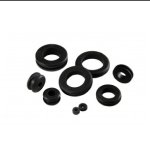
Another tip: Add a small elastic grommet under the mixture knob. This will give the knob a little friction and help with fine tuning.
IMG_0251.jpeg
 
Gonna necro this thread since I've now run my engine and am about to venture into break-in and then tuning...

I already went through and verified the fuel and ignition mapping are per the default settings in the manual except I capped the RPM IGN at 20° and set all the adv/ret to 0° per the break-in advice for parallel valve engines. First start a couple weeks ago was fine though she ran a lot better with just a tiny bit of throttle. Haven't run the engine since then as I was finishing a few other things but it's on the list for Monday.

Two Three things I'm puzzling over right now...

1) The manual notes that "There should not be large changes in adjacent values in RPM Fuel, rather smooth transitions." But looking at the default fuel map the RPM fuel values are a constant 165 from 500rpm up to 2500rpm, then jump to 200 above that. This seems to contradict the idea of "smooth transition" between values. Or is this a "don't bother with it right now as long as the engine runs ok, tune it after break-in" sort of thing?

2) I have provisioned for an O2 sensor and plan to eventually run mogas. The sensor is not installed right now because I didn't see the point of trashing the sensor doing ground runs and break-in running rich on leaded fuel; I planned to install it once that's over and I've started actual engine tuning. Is this reasonable?

For #1 - this functions exactly the same as the "enrichment circuit" on a standard carburetor. The idea is to make the mixture a bit richer during full power operations (max rpm) to ensure you don't encounter any detonation and runaway CHT's. This is normally only used during takeoff and go-arounds, both are times when the pilot can become task-saturated and might not notice a rapidly rising CHT.

#2 and #3, yeah, you got this.
 
wrt to "steps" in the fuel map (and ignition map) the processor interpolates between the RPM and MAP set points, it's not a step. So, if you're at a midpoint between two RPM settings you're also at the midpoint between the two fuel or ignition values. I'm 99% sure its a simple linear interpolation so there is a singularity of sorts right at the step point but insignificant. Maybe more advanced ECUs do a more advanced cure fit algorithm, I doubt it but it's been a while since I looked.
 
wrt to "steps" in the fuel map (and ignition map) the processor interpolates between the RPM and MAP set points, it's not a step. So, if you're at a midpoint between two RPM settings you're also at the midpoint between the two fuel or ignition values.
Nope. It’s a step. For example, If you are right on the ragged edge with a fixed pitch prop and looking for EXACT LOP numbers and you get some good air that results in a touch more speed and RPM the next step of ignition advance may kick in and corrupt the tuning. Often, this results in a lower airspeed which drives a lower RPM and the advance shifts back to the prior step. For most people, this is not even perceptible, but for those looking for bleeding edge tuning, it can result in a maddening “do loop”. If you know the step is there, it’s easy to tune for. But if you have to find it out on your own it’s a frustrating learning experience.
 
Nope. It’s a step. For example, If you are right on the ragged edge with a fixed pitch prop and looking for EXACT LOP numbers and you get some good air that results in a touch more speed and RPM the next step of ignition advance may kick in and corrupt the tuning. Often, this results in a lower airspeed which drives a lower RPM and the advance shifts back to the prior step. For most people, this is not even perceptible, but for those looking for bleeding edge tuning, it can result in a maddening “do loop”. If you know the step is there, it’s easy to tune for. But if you have to find it out on your own it’s a frustrating learning experience.
Maybe the SDS is that poorly conceived, I kind of doubt it. It's certainly not been my experience with even the cheapest after market ECUs dating back decades.

I have a really hard time believing its that bad.
 
wrt to "steps" in the fuel map (and ignition map) the processor interpolates between the RPM and MAP set points, it's not a step. So, if you're at a midpoint between two RPM settings you're also at the midpoint between the two fuel or ignition values. I'm 99% sure its a simple linear interpolation so there is a singularity of sorts right at the step point but insignificant. Maybe more advanced ECUs do a more advanced cure fit algorithm, I doubt it but it's been a while since I looked.
There is no linear interpolation. There jump occurs half way in the bracket In the case of the 2500 rpm / 200 factor - it starts at 2451 rpm.
 
It is definitely a step, not linearly (or otherwise) interpolated.

I discovered this by accident one day with my RPM running right at 2550 - mid way between the "standard" fuel setting at 2500 rpm and the "enrichment" fuel setting at 2600 rpm. I had just leveled from initial climb into high altitude and the rpm was set to 2500 but as my oil cooled from the climb the prop governor creeps up, and it settled at around 2550 and I didn't tweak it back down to 2500 as I usually do. I noticed the slightest "surge" in the engine back and forth, with seemingly no cause for it, except I could see it in my AFR reading from the O2 sensor. I went to the SDS programmer to look at the PWM output duty cycle for the injectors, and sure enough I could see it there too. Initially I thought the SDS brainbox was flaking out on me - took me a while to realize it was doing exactly what it had been programmed to do, as the RPM was crossing that magic line back and forth at 2550, going from the "cruise map" at 2500 rpm to the "full power" map at 2600. I was running LOP at the time so the extra fuel represented extra power, thus the "surge" in the engine.

The effect was subtle but real - in level smooth cruise I picked up on it.
 
Last edited:
It is definitely a step, not linearly (or otherwise) interpolated.

I discovered this by accident one day with my RPM running right at 2550 - mid way between the "standard" fuel setting at 2500 rpm and the "enrichment" fuel setting at 2600 rpm. I had just leveled from initial climb into high altitude and the rpm was set to 2500 but as my oil cooled from the climb the prop governor creeps up, and it settled at around 2550 and I didn't tweak it back down to 2500 as I usually do. I noticed the slightest "surge" in the engine back and forth, with seemingly no cause for it, except I could see it in my AFR reading from the O2 sensor. I went to the SDS programmer to look at the PWM output duty cycle for the injectors, and sure enough I could see it there too. Initially I thought the SDS brainbox was flaking out on me - took me a while to realize it was doing exactly what it had been programmed to do, as the RPM was crossing that magic line back and forth at 2550, going from the "cruise map" at 2500 rpm to the "full power" map at 2600. I was running LOP at the time so the extra fuel represented extra power, thus the "surge" in the engine.

The effect was subtle but real - in level smooth cruise I picked up on it.
very surprised it works that way and that's one illustration of maybe why it wouldn't, but.....I guess it does
 
There is a similar effect with the “safety feature” programmed into the LOP function: if one has the LOP feature active, the mixture goes lean and ignition advances to your selected values. However, this feature is automatically disabled above a hard coded MAP level. The reason is in case one forgets to deactivate the LOP function on approach and has to grab a bunch of power on a go around - this feature defaults to the best power map and saves the engine from a too lean condition. One can safely select the LOP function at any time during flight without worry of engine damage, but the “step” in MAP when the function activates results in a dramatic change in FF. I have not seen a massive surge in power when flying right on the edge of this safety feature, but just a touch of additional MAP (either from added throttle or a descent to lower air) will often show an immediate 5+ GPH increase in FF once you cross that MAP threshold. Curious, but not operationally significant.
 
There is a similar effect with the “safety feature” programmed into the LOP function: if one has the LOP feature active, the mixture goes lean and ignition advances to your selected values. However, this feature is automatically disabled above a hard coded MAP level. The reason is in case one forgets to deactivate the LOP function on approach and has to grab a bunch of power on a go around - this feature defaults to the best power map and saves the engine from a too lean condition. One can safely select the LOP function at any time during flight without worry of engine damage, but the “step” in MAP when the function activates results in a dramatic change in FF. I have not seen a massive surge in power when flying right on the edge of this safety feature, but just a touch of additional MAP (either from added throttle or a descent to lower air) will often show an immediate 5+ GPH increase in FF once you cross that MAP threshold. Curious, but not operationally significant.
The MAP point where this occurs is user-settable, but yes.
 
Back
Top