


Van's Air Force

The definitive Van's Aircraft support community! Buying, building or flying an RV? Join our exclusive family of mentors and enthusiasts!

Where to mount transponder diversity (top) antenna?

vfa192

Member
I'm having some difficulty figuring out where to mount the top antenna for my diversity transponder (Flying in Canada). Here's the challenge; the right wingtip has the magnetometer and the left wing tip has the VOR antenna. The GPS antenna is mounted just forward of the firewall under the cowling. All the documentation I've read so far says to keep each of these antennas far from one another (at least 3'). There's no room on top of the aft fuselage since the canopy rail slides across the entire surface.

Any thoughts? Perhaps I should just bite the bullet and mount it in the left wing with the VOR antenna.
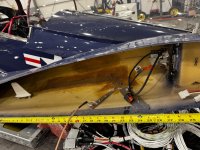
N184MR Left Wing Tip Antennas.jpg
 
Maybe ask the manufacturer if it could possibly be mounted on top rib of the vertical stab.
Also ask them if the down facing antenna mounted on the belly would cause ghosting with the top facing antenna in the wingtip.
Another question- assuming the wingtip (up) location is fine, what size ground plate requirements would be needed.
 
I've been thinking about his with my -14A as well, but don't have the same problem with the slider. I agree that maybe top rib of the vertical stabilizer under the fairing could work, but I wasn't sure if the ground plane would be large enough. You could also swap the top antenna for a stubby type to save some space if that's where you decide to mount it.
 
After discussion with my avionics supplier, I have pre-wired a RAMI AV-22 rod type XPDR antenna on the top rib of my vertical stabilizer under the fiberglass tip. They assure me that there is sufficient ground plane. As far as I know, the belly mounted antenna and the top mounted antenna do not transmit simultaneous signals from the diversity XPDR so "ghosting" should not be a problem
 
If the transponder is designed for diversity, i.e., has two antenna connections, there should be no issue with ghosting (not even sure what that is?) or interference.

Not sure which transponder you're using but if the box itself is fuselage-mounted, you'll likely have significant RF loss over that run through the wing unless you use heavy, expensive coax. Does the txp manufacturer give a max coax run length from the box to antennas?

HTH

Dave
 
Last edited:
After discussion with my avionics supplier, I have pre-wired a RAMI AV-22 rod type XPDR antenna on the top rib of my vertical stabilizer under the fiberglass tip. They assure me that there is sufficient ground plane. As far as I know, the belly mounted antenna and the top mounted antenna do not transmit simultaneous signals from the diversity XPDR so "ghosting" should not be a problem
The ideal ground plane diameter in a 1/4 antenna is going to be roughly 2x the length of the center radiator and set at a 132° from the radiator/center conductor. A ground plane at 90° to the center conductor will result in lower impedance ~36ohms vs the desired of 50ohms. Further, If you change the shape of the ground plane from a circle or large square into a boat shape, the radiation pattern will not be the desired omni-directional half "donut" toroid with a null at the top-dead center. More loss at the front/rear at the horizon than at the sides.

Of course, verify the above with a VSWR meter, or VNA to observe the effect on VSWR, S-parameters (i.e. S11).
 
Last edited:
On my Rocket I mounted the top antenna on top of the fuse just forward of the vertical stabilizer. Bottom one is in the middle of the fuse under the forward seat. Made sure I had enough cable length per Garmin. PAPR tested out fine. Using a 330D/ES.
 
On my Rocket I mounted the top antenna on top of the fuse just forward of the vertical stabilizer. Bottom one is in the middle of the fuse under the forward seat. Made sure I had enough cable length per Garmin. PAPR tested out fine. Using a 330D/ES.
In would try *only* mounting the antenna here, no belly-mounted antenna at all. Then fly, and get a PAPR or equivalent NavCanada report. I predict you'll pass with flying colours.
 
In would try *only* mounting the antenna here, no belly-mounted antenna at all. Then fly, and get a PAPR or equivalent NavCanada report. I predict you'll pass with flying colours.
https://www.navcanada.ca/en/air-traffic/space-based-ads-b/public-ads-b-performance-report.aspx

or put it on the bottom and do the same.

Someone has likely read the regs closer that me, but as I understand it, the requirement is that the transponder radiates up and down.

The down part is assumed by virtue of the TSO, the up part is performance based so if you pass the test you are golden. For little airplanes I've had no trouble passing with the antenna on the belly.

I'd be nervous about using the wing time since the fuse will shadow satellites that are low on the horizon, but since the satellite can see the belly antenna anyway it may not matter. The satellites are low orbit so they will spend a lot more time low in the sky than overhead.

Of course TC/Nav Can can change their mind at any time at which point the antenna wire to the tail would be very nice to have.

Derek
 
Last edited:

I'm not so sure that's an equally good option.

Any ground-based receiving station will be a lot closer to you than any satellite, so it makes more sense to me that you'd want to maximize the signal to the satellites by orienting the majority of the signal "up". The signal that escapes to the sides will be enough to reach the much closer ground stations.

Regardless of how the reg is written, the intent is for your aircraft to be seen reliably. If that's happening, you're probably good.
 
I'm not so sure that's an equally good option.

Any ground-based receiving station will be a lot closer to you than any satellite, so it makes more sense to me that you'd want to maximize the signal to the satellites by orienting the majority of the signal "up". The signal that escapes to the sides will be enough to reach the much closer ground stations.

Regardless of how the reg is written, the intent is for your aircraft to be seen reliably. If that's happening, you're probably good.
I agree from a performance perspective only on only top is very likely the best answer. The question that pushed me to the bottom was needing / wanting / worried TC would make me comply with the TSO installation instructions that say is has to be on the bottom.

I'm not setup to establish if I have an equivalent/sufficient performance to ground based stations. On the other hand, the current performance based testing system takes care of the up coverage.

Derek
 
Just a crazy thought here...
What if the ADSB and/or XPNDR antenna(s) were moved from the belly to the top for sattelite view?
Dynon SV-XPNDR-261 transponder and dual band SV-ADSB-472
 
On my Rocket I mounted the top antenna on top of the fuse just forward of the vertical stabilizer. Bottom one is in the middle of the fuse under the forward seat. Made sure I had enough cable length per Garmin. PAPR tested out fine. Using a 330D/ES.
Great suggestion however the aft end of the canopy skirt on the RV-8 just about touches the leading edge of the vertical stabilizer fairing so there's no room there. I even thought to put the antenna under the vertical stabilizer fairing but no room there either.
 
I'm not so sure that's an equally good option.

Any ground-based receiving station will be a lot closer to you than any satellite, so it makes more sense to me that you'd want to maximize the signal to the satellites by orienting the majority of the signal "up". The signal that escapes to the sides will be enough to reach the much closer ground stations.

Regardless of how the reg is written, the intent is for your aircraft to be seen reliably. If that's happening, you're probably good.
Totally agree. I fly back and forth between the US and Canada regularly and, without exception, as soon as I'm about 15NM north of the border, Montreal center loses me and asks me to cancel IFR. I'm flying into Ottawa and, even within Ottawa approach airspace, they only get a primary target. Flying back into the US, Wheeler-Sack approach picks me up right away. Good ADS-B signal too. I may be wrong about this but it seems Canadian ground stations have probably been decommissioned and ADS-B is only interrogated via satellite.
 
Just a crazy thought here...
What if the ADSB and/or XPNDR antenna(s) were moved from the belly to the top for sattelite view?
Dynon SV-XPNDR-261 transponder and dual band SV-ADSB-472
Yea. That's what I have now and it definitely doesn't work in Canada.
 
The ideal ground plane diameter in a 1/4 antenna is going to be roughly 2x the length of the center radiator and set at a 132° from the radiator/center conductor. A ground plane at 90° to the center conductor will result in lower impedance ~36ohms vs the desired of 50ohms. Further, If you change the shape of the ground plane from a circle or large square into a boat shape, the radiation pattern will not be the desired omni-directional half "donut" toroid with a null at the top-dead center. More loss at the front/rear at the horizon than at the sides.

Of course, verify the above with a VSWR meter, or VNA to observe the effect on VSWR, S-parameters (i.e. S11).
Jeez Brian. Thanks for the thorough response. Way over my head technically but I'll study what you said to educate myself on this.
 
Back
Top
