Van's Air Force

The definitive Van's Aircraft support community! Buying, building or flying an RV? Join our exclusive family of mentors and enthusiasts!

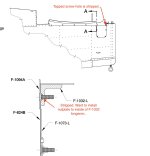
Stripped screw hole on longeron at rear inspection plate.

DCBrown198

Well Known Member
Patron
The paint shop got a bit aggressive reinstalling an F824-B inspection plate at the rear of the empennage (below elevator). There are a couple of 507C-6 screws that screw into the longeron itself. The tapped longeron hole got stripped. I'd like to rivet a nutplate to the longeron to accept the screws as a more permanent solution, but that would require drilling some #40 holes in the longeron to attach the nutplate.

Seems innocuous enough at first glance, but was curious if any others have found the need to do the same?

See pic.
 

Attachments

  • Stripped longeron screw hole..jpg
    Stripped longeron screw hole..jpg
    68.7 KB · Views: 149
As much trouble with the product I have at work, a Clickbond nutplate might be the answer
You could fill the hole with JB Weld and then re-drill and tap. If you use Clickbond make sure things are extremely clean, they can sometimes become loose then you will be in worse shape. As mentioned a number 8 screw is also a good idea. If going to a #8 don't drill out the existing hole, just gently tap the hole to the proper size, it is too easy to end up with a blotched hole.
 
The RV14 uses nut plates on the longeron. I know its a bit newer design, but I am surprised to hear it was taped on the RV10. However, looking at the attached diagram, it is more different then I would have thought. The RV14, has a "U" shape longeron in the area of the inspection cover plate. There are two nutplates installed in the center of the "U".
 
Last edited:
We broke off a tap in one of these holes. Spent quite some time trying to get it out and finally ordered a special tap extractor which did the trick. I was surprised that we were being asked to tap something that would be very difficult to replace at that step in the assembly process.
 
You could fill the hole with JB Weld and then re-drill and tap. If you use Clickbond make sure things are extremely clean, they can sometimes become loose then you will be in worse shape. As mentioned a number 8 screw is also a good idea. If going to a #8 don't drill out the existing hole, just gently tap the hole to the proper size, it is too easy to end up with a blotched hole.
The Clickbond nutplate idea is good, as it would not weaken the longeron. JB Weld or other epoxy solutions would not be nearly as strong or permanent. Riveted nutplates would require creating more holes in the longeron, which would weaken the longeron in that area. Using a larger screw means you no longer have matching hardware sizes [no longer idiot proof] for the cover. 2nd choice to the Clickbond nutplate would be to use a HeliCoil insert [none of the other "larger diameter thread repair inserts, like TimeSerts, as they would greatly enlarge the hole.]
 
If you want to use a nutplate but you don't want to drill additional holes in the longeron to mount it, you could always do this:

1. Drill out one existing rivet on either side of where the screw hole will be
2. Rivet a nutplate to a small piece of aluminum that's wide enough to cover all three holes
3. Rivet the whole deal to the longeron through the holes you drilled out in #1
 
If you want to use a nutplate but you don't want to drill additional holes in the longeron to mount it, you could always do this:

1. Drill out one existing rivet on either side of where the screw hole will be
2. Rivet a nutplate to a small piece of aluminum that's wide enough to cover all three holes
3. Rivet the whole deal to the longeron through the holes you drilled out in #1
Since there is an inspection panel, there are no skin to longeron rivets under the inspection cover. Your idea [even using 1 rivet to hold the nutplate] only works if the spacing is correct, [which I doubt] between the nearest skin/longeron horizontal rivet, & the #6 screw hole.
 
Since there is an inspection panel, there are no skin to longeron rivets under the inspection cover. Your idea [even using 1 rivet to hold the nutplate] only works if the spacing is correct, [which I doubt] between the nearest skin/longeron horizontal rivet, & the #6 screw hole.
No problem, just make the mounting tab even longer! It only has to be solid enough to get the screw in.

Or - check the edge distance and bang a couple more rivets in there, and build on!
 
No problem, just make the mounting tab even longer! It only has to be solid enough to get the screw in.

Or - check the edge distance and bang a couple more rivets in there, and build on!
OK, I think I understand your idea now.
 
Guess I’m a little bit “cornfused”. Why can’t you just use a little bit longer #6 screw and put a nut on the backside? No need to enlarge the hole and since the threads are stripped, just run it in as much as you can and install the nut. Plus - it’s at the trailing end of that structural longeron, so very little load on it. Drilling a couple #40 holes for a platenut won’t sacrifice anything.

Can’t get your hand in there to hold the nut because the inspection plate is in the way? If you can’t reach around to hold the nut from above, then how about cutting off the joggle in the inspection plate where the hole is and install the nut with the inspection plate off at first. You don’t need that hold down point to secure the inspection plate anyway.

OK, so I can’t see the application here, but if that doesn’t work because of access, then just JB weld a nut in place on the back side of that hole with the screw in place holding the nut - with the inspection plate off - and let it cure. After cure, remove the screw, and you essentially have a platenut. How often do you have to remove that screw? Well….. never if you’ve removed the aft screw joggle in the inspection plate (not needed) to get the inspection plate off for your condition inspection. If you want to maintain the integrity of the inspection plate with all its screws, then fine. The JB weld should hold anyway. If it doesn’t, then just re-glue it, but this time clean it up better and rough up the area to make the glue hold better. I think you have enough advice here on this post to come up with a fix. Neither one of those things that this screw holds is critical. Both will stay put if that screw falls out.

 
I think that whole tapping the longeron thing is a lame design from the get go. I tapped mine for a #6 per print, but when they get loose, which they will if somebody gets too enthusiastic with a screwdriver, I plan to install a click bond nut plate there.

The other simple option is to just take the intersection fairing off and reach in from the back side with a nut. Arguably, the only time that those covers need to come off is during the condition inspection and you have the intersection fairing off then anyway.
 
in my experience single riveted nut plates are as temporary as the tapped holes in the longeron. very easy to bent one of these nutplates. put a nut on, use a clickbond nutplate or use a nutplate with 2 rivits.
 
I use the blue loctite in these tapped holes to prevent the screws from backing out. They remained tight every time I unscrewed them to perform condition inspection. I think one day I will have to install nut plates to make it more permanent
 
Back
Top