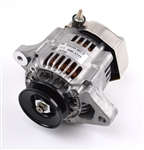
I'm getting ready to hang the engine, which means shopping for more goodies. I'm pretty well sold on B&C as a company and will be going with their alternators. I contacted them to ask them about their newer internally regulated alternators. Probably useful for others who are shopping, since they still don't have these listed on their website. From an email from them:
In terms of "pro's" ... the SilverFlite units are simpler from an installation standpoint, for example, with fewer electrical connections to be made — two circuits (output, and enable) are all that are required to hook one up. They are also intended to be a budget-friendly alternator, with a lower initial cost. In terms of "con's" ... the intentional simplicity of the SilverFlite alternators means that there are certain features that are not present, such as adjustable regulated voltage (it is fixed) or active low-voltage warning capability (your PFD or EFIS would need to supply that). The lower cost also means that these alternators are available with fewer ordering options (there is only one installation kit available, for boss-mount engines; and a single size of belt is provided, suitable for a 9-3/4" flywheel pulley).
Whether the "pro's" outweigh the "con's" (or vice versa) may simply come down to what you want or need in an alternator. For some, the SilverFlite alternators could be a good value and a good selection; but for others, one of our externally-regulated alternators may be a more satisfactory choice.
Provision for external cooling is not a requirement for these alternators. Like our externally-regulated models, the SilverFlite units have two built-in cooling fans which draw in air from the fore and aft ends of the alternator. We've found that's all they need. If you would like to install a blast tube, or already have the plumbing for one now, it certainly wouldn't hurt anything to have one. I just wouldn't describe it as a requirement in order for the alternator to survive.
Note: we are currently able to ship orders for the 60A belt-drive alternator (P/N: SF601); the 40A belt-drive and 30A spline-drive should become available in the next month or so.
In terms of "pro's" ... the SilverFlite units are simpler from an installation standpoint, for example, with fewer electrical connections to be made — two circuits (output, and enable) are all that are required to hook one up. They are also intended to be a budget-friendly alternator, with a lower initial cost. In terms of "con's" ... the intentional simplicity of the SilverFlite alternators means that there are certain features that are not present, such as adjustable regulated voltage (it is fixed) or active low-voltage warning capability (your PFD or EFIS would need to supply that). The lower cost also means that these alternators are available with fewer ordering options (there is only one installation kit available, for boss-mount engines; and a single size of belt is provided, suitable for a 9-3/4" flywheel pulley).
Whether the "pro's" outweigh the "con's" (or vice versa) may simply come down to what you want or need in an alternator. For some, the SilverFlite alternators could be a good value and a good selection; but for others, one of our externally-regulated alternators may be a more satisfactory choice.
Provision for external cooling is not a requirement for these alternators. Like our externally-regulated models, the SilverFlite units have two built-in cooling fans which draw in air from the fore and aft ends of the alternator. We've found that's all they need. If you would like to install a blast tube, or already have the plumbing for one now, it certainly wouldn't hurt anything to have one. I just wouldn't describe it as a requirement in order for the alternator to survive.
Note: we are currently able to ship orders for the 60A belt-drive alternator (P/N: SF601); the 40A belt-drive and 30A spline-drive should become available in the next month or so.