Van's Air Force

The definitive Van's Aircraft support community! Buying, building or flying an RV? Join our exclusive family of mentors and enthusiasts!

Oil Cooler... to flush or not

Dan 57

Well Known Member
Friend
This might be of academic value, but I was curious...

Grafting a brand new engine on my -6.9i, thoughts also went wandering towards the oil cooler. Several sources on the net mention the need for flushing an oil cooler that has performed flawlessly for close to 20 years, and more than 2.2 Kh of operation.
Now professional flushing of a cooler is quite an elaborate process. And quite expensive too. Add to this shipping and customs costs, and I was better off buying a new cooler.

The new cooler is roughly the same size as the old one, only the holding flanges being somewhat thinner.
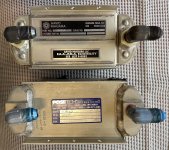
1.jpg

The new oil cooler now cosily installed on the firewall, and equipped with the shutter.
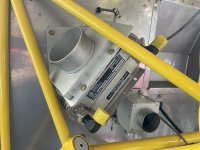
2.jpg

Now I was curious to see how much gunk had formed itself inside the cooler, and gave it a quick treatment with my band saw. I was surprised to find only a pellicle of sludge, much less than expected.
Of course this only covers the inlet/outlet chambers, and not the capillary tubing which is too small for me inspect using simple means.
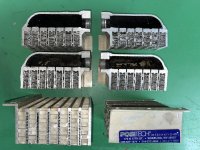
3.jpg
 
Really depends what has passed through it. A flaw in the Lyc design is that oil from the sump goes through the cooler BEFORE the filter. Therefore, if the engine had oil debris issues, the cooler could start to clog up. This is most problematic with chunks of carbon/coked oil. That debris can be pretty large. If you find a lot of carbon chunks in the filter or sump screen, the likelihood of cooler clogging goes up IMHO.
 
I believe the oil pump suction screen stops large debris before the cooler
I glazed my cylinders on my 6, so had a LOT of carbon debris just in 10 hours. I found a good anount of relatively large carbon chunks in the filter; sump screen hadf a huge amount. I believe the holes in the sump screen are around 1/16" or larger. Have no idea on the cooler passage size, but doubt it is a lot bigger.
 
I have a local radiator shop that will do it quite cheaply. They'll do repairs as well. Surprised it was cheaper to buy a new one.
 
Running clean oil and adding AvBlend really helps, and I never go beyond 25-hours between oil changes either. AvBlend breaks-down and dissolve carbon throughout the engine, and it's also great at preventing (eliminating) sticky valves. I also like Aeroshell 15W50 simi-synthetic with it's corrosion and anti-wear additives better than the Phillips 100-percent petroleum base oil -- Camguard or not. I have always used Marvels Mistry oil at every refueling (0.4 oz per gallon), which also helps prevent sickly valves and binding of the fuel selector. Been using this combination for over 20-years in my 9'er and even before that in other airplanes, and the engine is still running like new even on cold start-ups. The compression is still really good (all 88/90), and we even live in wet western Washington.
 
Running clean oil and adding AvBlend really helps, and I never go beyond 25-hours between oil changes either. AvBlend breaks-down and dissolve carbon throughout the engine, and it's also great at preventing (eliminating) sticky valves. I also like Aeroshell 15W50 simi-synthetic with it's corrosion and anti-wear additives better than the Phillips 100-percent petroleum base oil -- Camguard or not. I have always used Marvels Mistry oil at every refueling (0.4 oz per gallon), which also helps prevent sickly valves and binding of the fuel selector. Been using this combination for over 20-years in my 9'er and even before that in other airplanes, and the engine is still running like new even on cold start-ups. The compression is still really good (all 88/90), and we even live in wet western Washington.
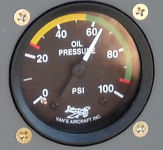
RV-9erA - (thread drift…) what is your oil pressure set to?
 
RV-9erA - (thread drift…) what is your oil pressure set to?
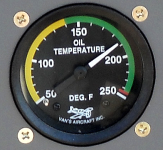
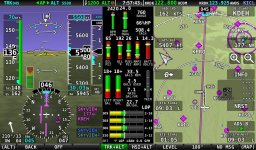
In cruise with an oil temperature of 190 degrees F, we see 65 to 70 PSI.

Lycoming Service Manual for the O-320-D2A states:

"Oil pressure during normal operation typically falls between 55 to 90 psi, with a minimum of 25 psi at idle and a maximum of 115 psi during cold starting and warm-up".
 

Attachments

  • RV9er - Oil Pressure.png
    RV9er - Oil Pressure.png
    263.6 KB · Views: 9
  • RV9er - Oil Temp.png
    RV9er - Oil Temp.png
    323.1 KB · Views: 9
Nice photos. Your cooler appears to contain absolutely no residual oil. Assuming you did not flush it, how did you drain it so completely?
 
In cruise with an oil temperature of 190 degrees F, we see 65 to 70 PSI.

Lycoming Service Manual for the O-320-D2A states:

"Oil pressure during normal operation typically falls between 55 to 90 psi, with a minimum of 25 psi at idle and a maximum of 115 psi during cold starting and warm-up".
When I changed from Van's gauges to EI, oil temp went up 15-20 deg., just sayin.
 
Nice photos. Your cooler appears to contain absolutely no residual oil. Assuming you did not flush it, how did you drain it so completely?
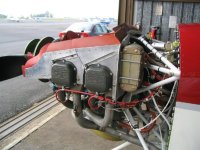
I change my oil every 25-hours and drain it hot, but I have never cleaned my oil cooler. I change and inspect the oil filter and pull the oil suction screen for inspection too, where additional oil will drain out. I do have the oil cooler mounted vertically (see photo below) on the left-rear baffle side with some additional bracing to prevent baffle cracks, which has worked extremely well. I always assumed that this vertical orientation would allow oil to drain-back from the oil cooler (lower side) into the engine on the lower engine oil cooler port, which I think it does.
 

Attachments

  • Oil Cooler Mounting.jpg
    Oil Cooler Mounting.jpg
    103.6 KB · Views: 24
Back
Top