Van's Air Force

The definitive Van's Aircraft support community! Buying, building or flying an RV? Join our exclusive family of mentors and enthusiasts!

Airplane Stand - Brake Pad Change/Tire Service

jmiller007

Well Known Member
Patron
Hey folks - what are y'all using to support your RV when you are doing brake and wheel service?

If you have a recommendation, can you also provide where you bought it from?

Thanks!
 
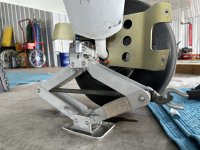
I try to keep it off the wing jack if it is going to be a while. I'm paranoid about the jack punching a hole in the wing. I really like to jack up using the Flyboys peg that fits in behind the assembly with a floor jack or a scissor jack. This website omits the RV14A peg, but they sell it:

The leg can rest on wood blocks if it is going to be a while. Or a stack of tires. Or ..... something not moving.
 
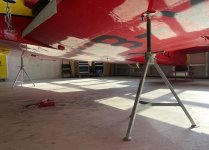
I have a lift I built to jack from the center section. I also have two Jack Stands that sit under the center section. Photo
I have two 4x4 blocks bored the diameter of the gear shaft if the airplane needs to be on the ground.
20230509_153105.jpg
 
Wing jacks. They're cheap, quick to apply, and very effective.


For not-in-hangar use, like a flat at a remote airport, I keep a set of FlyBoy Accessories jack points in my tiedown bag..

2CEB8E1A-FAF3-451C-8746-BB98921B5DFF_1_105_c.jpeg
 
Sure love these little mechanical jacks.
They are light, safe (nipple on top goes into jack point hole), and simple.
Probably cheap too (I just borrowed them), and basically maintenance free. And leak free :)

IMG_6133.jpeg
 
I try to keep it off the wing jack if it is going to be a while. I'm paranoid about the jack punching a hole in the wing. I really like to jack up using the Flyboys peg that fits in behind the assembly with a floor jack or a scissor jack. This website omits the RV14A peg, but they sell it:

The leg can rest on wood blocks if it is going to be a while. Or a stack of tires. Or ..... something not moving.
The RV jack points are awesome. Specially if you get a flat somewhere, any car screw jack will work
 
I try to keep it off the wing jack if it is going to be a while. I'm paranoid about the jack punching a hole in the wing. I really like to jack up using the Flyboys peg that fits in behind the assembly with a floor jack or a scissor jack. This website omits the RV14A peg, but they sell it:

The leg can rest on wood blocks if it is going to be a while. Or a stack of tires. Or ..... something not moving.
I use the Flyboys peg and love it. My left wing has scratches on the bottom due to a near-miss with a wing jack and a well-meaning individual from a few years ago, I much prefer the lower lift point with the Flyboys peg.
 
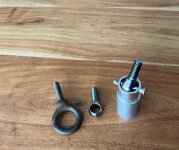
Having lifted several airplanes with wing jacks, always leery of them falling out of their cups, I designed a set of positive-locking jack points/cups which double as compact tie down rings.

Original shown on the left, new “Ti-Down” shown in the middle, and full assembly shown on the right. (Minus of course the wing jack of your choice which the cup fastens to).

Look out for a full product release coming this week, but figured I’d throw a sneak peak out while the topic was being discussed.

IMG_8563.jpeg
 
Last edited:
made this to safely change a RV10 tire out in the strong wind on the ramp in the middle of nowhere
 

Attachments

  • RV jack pad.jpg
    RV jack pad.jpg
    445 KB · Views: 151
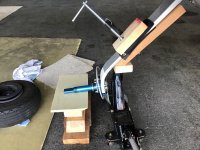
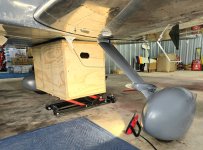
As another whom doesn't trust tiedown ring supporting; I went the ATV jack route and built a box to bridge the distance up to the fuselage. Positioning side to side determines whether just the left or right gear is lifted or centering it lifts the entire plane no problem.20240904_082051.jpg
 
As another whom doesn't trust tiedown ring supporting; I went the ATV jack route and built a box to bridge the distance up to the fuselage. Positioning side to side determines whether just the left or right gear is lifted or centering it lifts the entire plane no problem.
That's clever. Doubles as storage too? Love tools with multiple functions.
 
The only approved method, and as designed, is wing jacks. This isn’t just RV’s, but almost all GA and other aircraft. Google aircraft on jacks and good luck finding one that doesn’t jack from the wing.
On my 6, lifting with the fuselage means “pushing” on the rib and spar flanges, not the spar directly. I’m not willing to do that, even if it can take it.
Proper use of jacks and good jack points and you couldn’t push the aircraft off of them if you tried.
This is the end of this public service announcement…….
 
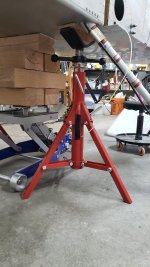
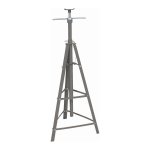
I bought an underhoist safety stand from Harbor Freight, cut it down with a grinder, and drilled new holes for the bottom braces. Then I use a short carriage bolt in the tie down. Not using the part on the very top. Instead I ground it out the top of the threaded part so it accepts the head of the carriage bolt. Works perfect and the best part is the instructions specifically said not for aircraft use :p
 

Attachments

  • 61600_W3.jpg
    61600_W3.jpg
    35.8 KB · Views: 42
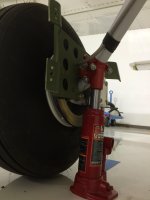
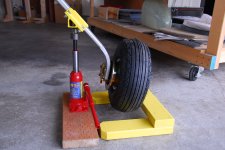
I have a gadget that fits into the hollow axle. The tube is long enough to get the wheel far enough out to place a jack stand under the axle. This gadget isn't homebrew but I don't know who makes it. It is a little flexy but it works. Put my fourth set of new tires and brakes on, Dressler Monsters.
 
I have a gadget that fits into the hollow axle. The tube is long enough to get the wheel far enough out to place a jack stand under the axle. This gadget isn't homebrew but I don't know who makes it. It is a little flexy but it works. Put my fourth set of new tires and brakes on, Dressler Monsters.
 
Having lifted several airplanes with wing jacks, always leery of them falling out of their cups, I designed a set of positive-locking jack points/cups which double as compact tie down rings.

Original shown on the left, new “Ti-Down” shown in the middle, and full assembly shown on the right. (Minus of course the wing jack of your choice which the cup fastens to).

Look out for a full product release coming this week, but figured I’d throw a sneak peak out while the topic was being discussed.

View attachment 82495
I would love to get a pair of the middle one. much nicer than the original bulky eye bolt. I will be watching the website for the release.
 
I would love to get a pair of the middle one. much nicer than the original bulky eye bolt. I will be watching the website for the release.
Thanks Rico, I will share their own post once they're on the site.
 
Harbor Freight - 500 lb hydraulic capacity lift table in my hangar has worked well for me for decades. I place an approximate 3” square rigid foam on the lift table right under the spar, pump the lift table with my foot and lower it with the hand hydraulic release. The lift table has many other uses in the hangar.

Jake Thiessen
 
Harbor Freight - 500 lb hydraulic capacity lift table in my hangar has worked well for me for decades. I place an approximate 3” square rigid foam on the lift table right under the spar, pump the lift table with my foot and lower it with the hand hydraulic release. The lift table has many other uses in the hangar.

Jake Thiessen
Do you have a pic of it setup?
 
The only approved method, and as designed, is wing jacks. This isn’t just RV’s, but almost all GA and other aircraft. Google aircraft on jacks and good luck finding one that doesn’t jack from the wing.
On my 6, lifting with the fuselage means “pushing” on the rib and spar flanges, not the spar directly. I’m not willing to do that, even if it can take it.
Proper use of jacks and good jack points and you couldn’t push the aircraft off of them if you tried.
This is the end of this public service announcement…….
I'd challenge the idea that there is one and only one approved jacking method. There are several that work and several that are bad ideas.

On using wing jacks... That approach isn't without risk. My home field has a repair station that concentrates on composite structures. Anything from 7XX pieces and parts to Cirri and Icon's. You'd be surprised at how many Cirri I've seen there for repairs after being dropped off a jack or jacks and had holes punched all the way through the wing(s). Presumably by professional shops. On a couple of 'em, the jack missed the spar by a gnat's whisker. Damage the spar and you're looking for a new wing.

Anyway, to avoid that, I jack both of my airplanes by the gear. The RV-6 uses the device that inserts into the hollow axle and the RV-10 uses the bolt-on bracket that attaches to the brake caliper. Both jacking methods are rock solid. I rest the axles on wooden blocks once I've jacked the airplane.. I know that even if I screw something up badly (which is never the plan, but...), the only damage is likely to be a crushed brake line or maybe a scraped steel fitting. Something I can fix relatively easily. A hole punched in the wing, 'cause a jack slipped? Worse..spar damage? Big repair. I'm gonna avoid that risk if I can.
 
Hey folks - what are y'all using to support your RV when you are doing brake and wheel service?

If you have a recommendation, can you also provide where you bought it from?

Thanks!

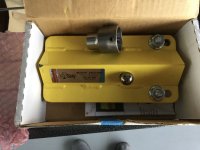
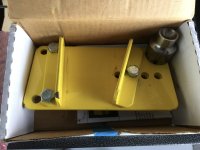
The best RV-12 method is placing the aircraft on the heavy stands as described in the Maintenance Manual. Of course that option is only valid if you are at your home field hangar. Another option might be to use the Bogert Aviation Jack pad which works on flat spring steel gear legs like on the 12:

CTT_3178.jpeg IMG_4058.jpeg IMG_4057.jpeg

The jack pad can be adjusted for angle, and width of the gear leg.
The part number is 30M-FPP and costs about $150. One nice aspect is you can carry this in the plane on a trip, without the heavy bottle jack which can be found anywhere.

The Bogert website also has a video of how to use this jack pad.
 
I'd challenge the idea that there is one and only one approved jacking method. There are several that work and several that are bad ideas.

On using wing jacks... That approach isn't without risk. My home field has a repair station that concentrates on composite structures. Anything from 7XX pieces and parts to Cirri and Icon's. You'd be surprised at how many Cirri I've seen there for repairs after being dropped off a jack or jacks and had holes punched all the way through the wing(s). Presumably by professional shops. On a couple of 'em, the jack missed the spar by a gnat's whisker. Damage the spar and you're looking for a new wing.

Anyway, to avoid that, I jack both of my airplanes by the gear. The RV-6 uses the device that inserts into the hollow axle and the RV-10 uses the bolt-on bracket that attaches to the brake caliper. Both jacking methods are rock solid. I rest the axles on wooden blocks once I've jacked the airplane.. I know that even if I screw something up badly (which is never the plan, but...), the only damage is likely to be a crushed brake line or maybe a scraped steel fitting. Something I can fix relatively easily. A hole punched in the wing, 'cause a jack slipped? Worse..spar damage? Big repair. I'm gonna avoid that risk if I can.
I understand. This has all been beat up before. Unless Vans has changed their position, with all things considered, who knows, it is/was the only approved method according Vans.
Poking holes in the wings has happened but it takes an extremely incompetent person doing something extremely stupid.
Theres no way I’m lifting my 6 on the rib flanges regardless but we all justify what we do, good, bad, or indifferent.
 
As another whom doesn't trust tiedown ring supporting; I went the ATV jack route and built a box to bridge the distance up to the fuselage. Positioning side to side determines whether just the left or right gear is lifted or centering it lifts the entire plane no problem.View attachment 82543

This is what I did. Mine is a motorcycle lift and it works fine. It is at it's limit at 1500 pounds and you dont want to get in the plane while it is in the air but can easily get all 3 wheels off the ground after you figure out exactly where to place the box. I used a piece of pink foam rigid insulation on top of the box for a little cushion but the carpet might even be better! Nice work.
 
Back
Top