Van's Air Force

The definitive Van's Aircraft support community! Buying, building or flying an RV? Join our exclusive family of mentors and enthusiasts!

Need help wiring 3 pos ign switch with starter cutoff please

moespeeds

Well Known Member
Friend
***edited for clarity

Hi guys I’m planning the 3 position switch wiring for my Pmag install.

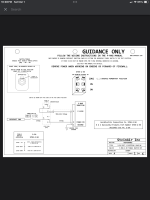
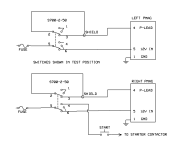
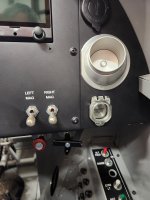
I currently have my 2 slick mag switches wired so the starter button will not be live unless the left mag is on and the right is off. This isolates my left mag as the start mag, and keeps me from accidentally activating the starter in flight. See attached diagram.

I’m going to dual Pmags, with the 3 position switch to allow for testing the power lead to the Pmags. See 2nd diagram.

Is it possible for me to wire this setup like I had it before, where the start button will only activate when the left mag is on and the right mag is off? I liked the added safety of this setup in case I accidentally bump the start switch while working on something, updating a database, etc while the master is hot.

TIA
 

Attachments
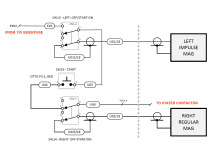
  • starter_schematic.png
    starter_schematic.png
    408.5 KB · Views: 60
  • IMG_0082.png
    IMG_0082.png
    288.8 KB · Views: 61
Last edited:
I cannot see any reason to restrict starting to only one pmag. I am not a fan of your plan. What if the engine dies in flight and the left mag is bad. You are now prevented from using the starter if the right mag is turned on. Granted, not a common thing, but what benefit are you getting from accepting this risk?
 
It seems like the idea defeats the advantage of the P-mags. Both can be energized. More spark. Easier start cold or hot. I'm probably missing something.
 
It seems like the idea defeats the advantage of the P-mags. Both can be energized. More spark. Easier start cold or hot. I'm probably missing something.
I cannot see any reason to restrict starting to only one pmag. I am not a fan of your plan. What if the engine dies in flight and the left mag is bad. You are now prevented from using the starter if the right mag is turned on. Granted, not a common thing, but what benefit are you getting from accepting this risk?
Well to begin with, Pmag doesn't want you powering the mags from the same bus that carries the starter load. Considering I already have a separate wire directly from the battery in the rear up to the left mag, it would be a simple matter to split this off through a breaker & switch for the left mag. I'd power the right mag from the main bus up front, then just use the left mag to start. Running another wire all the way back to the battery in my RV8 is a monumental task for my 6'3, 250 lb frame. I know because I've already done it once. The end result was a slipped disk in my neck and permanent damage.

The arrangement I'm using now came from a best practices article I believe in the Aerolectric book. It isolates the starter from accidentally getting bumped when the master is on, and would disallow starting on the right mag, which shares a bus with the starter and thus could scramble the Pmag according to Pmag. A situation where I'm in the air, and the left mag dies, AND the RPM reduces below 900 rpm where the right mag no longer self generates, AND I for whatever reason kill the main bus that powers the right mag, facilitating an "air start" is beyond unlikely.
 
After reading your post over a couple of times, it seems your goal is not to disable the right PMAG during engine starting, but rather to protect it against low voltage during engine cranking. I don't think PMAG would design its circuits to be at risk of damage if supplied with low voltage. Can you provide a link to PMAG manual and point out the page number and paragraph where that concern is addressed?
Looking at the PMAG manual that I found, https://emagair.com/wp-content/uploads/2017/08/Manual-LC114v28.pdf, it shows the PMAG connected to the main power bus which will definitely drop in voltage during engine start.
If you are still concerned and since you already have a wire going from the battery to the engine compartment, why not power both PMAGS from that same wire? The battery voltage will still drop while cranking the engine, but that separate wire to the engine compartment will not suffer a voltage drop across its length from starter current.
You could give PMAG a call and clarify the wiring requirements. You might be trying to fix a problem that doesn't exist.
 
After reading your post over a couple of times, it seems your goal is not to disable the right PMAG during engine starting, but rather to protect it against low voltage during engine cranking. I don't think PMAG would design its circuits to be at risk of damage if supplied with low voltage. Can you provide a link to PMAG manual and point out the page number and paragraph where that concern is addressed?
Looking at the PMAG manual that I found, https://emagair.com/wp-content/uploads/2017/08/Manual-LC114v28.pdf, it shows the PMAG connected to the main power bus which will definitely drop in voltage during engine start.
If you are still concerned and since you already have a wire going from the battery to the engine compartment, why not power both PMAGS from that same wire? The battery voltage will still drop while cranking the engine, but that separate wire to the engine compartment will not suffer a voltage drop across its length from starter current.
You could give PMAG a call and clarify the wiring requirements. You might be trying to fix a problem that doesn't exist.
The advice to remove the mags from the same bus as the starter came straight from Brad at Pmag. I spoke to him about my wiring plan when I bought them.

I don't want to put both on the wire going to the rear as it'll cause a single failure point for both mags. Brad agreed with that. There is zero issue starting off one mag, been doing it for 200 hours off the surefly that was in there.

I'm pretty sure there is no way to wire these to lockout the right mag during start, so looks like I'll either wire in a starter lockout switch or just live with a hot starter button whenever the master is on.

I've still got a couple days until I get to the switch wiring if anyone knows how I can pull this off.
 
Quoting PMAG's WEBSITE, You have seen our booth demonstration at airs shows where we power the ignition with a 9-volt battery in order to show: How little current the ignition draws.
-

It seems that low voltage is not a concern.
 
Quoting PMAG's WEBSITE, You have seen our booth demonstration at airs shows where we power the ignition with a 9-volt battery in order to show: How little current the ignition draws.
-

It seems that low voltage is not a concern.
You'd have to ask Brad about the why.

I'm only doing what the designer recommended.
 
Just a data point - the 6 cylinder pmag instructions specifically recommend a separate power feed for installations with a rear battery (RV-10) to mitigate the voltage drop on the starter circuit. I don’t believe there is any fear of “scrambling circuits” due to low voltage, just that there is a minimum voltage to fire.

I ran two wires from a rear buss directly to the pmags on my ten. I wired the starter through the strobe lights to avoid an inadvertent start on the ground with the mater on. It wouldn’t avoid the inadvertent hitting of the starter in flight since the strobes would likely be on.

And I didn’t use a three position switch. I just did a two position switch and a separate switch for the test function for each mag. That thee position switch was very expensive.
 
Well to begin with, Pmag doesn't want you powering the mags from the same bus that carries the starter load. Considering I already have a separate wire directly from the battery in the rear up to the left mag, it would be a simple matter to split this off through a breaker & switch for the left mag. I'd power the right mag from the main bus up front, then just use the left mag to start. Running another wire all the way back to the battery in my RV8 is a monumental task for my 6'3, 250 lb frame. I know because I've already done it once. The end result was a slipped disk in my neck and permanent damage.

The arrangement I'm using now came from a best practices article I believe in the Aerolectric book. It isolates the starter from accidentally getting bumped when the master is on, and would disallow starting on the right mag, which shares a bus with the starter and thus could scramble the Pmag according to Pmag. A situation where I'm in the air, and the left mag dies, AND the RPM reduces below 900 rpm where the right mag no longer self generates, AND I for whatever reason kill the main bus that powers the right mag, facilitating an "air start" is beyond unlikely.
Disallowing starting on the right mag only applies when the right mag doesn’t have an impulse coupling. You can safely start on both pmags and engine will fire off easier. That best practice only applies with the equipment that was used when it was created. In a world of changing techn, you need to research best practices to understand the environment they were created in and confirm that they apply in your case. This is like the oil temp has ro be 100* practice . Made sense in 1950 when we only had single weight oil. Senseless waste of fuel with today’s multi viscosity oils.
 
Disallowing starting on the right mag only applies when the right mag doesn’t have an impulse coupling. You can safely start on both pmags and engine will fire off easier. That best practice only applies with the equipment that was used when it was created. In a world of changing techn, you need to research best practices to understand the environment they were created in and confirm that they apply in your case. This is like the oil temp has ro be 100* practice . Made sense in 1950 when we only had single weight oil. Senseless waste of fuel with today’s multi viscosity oils.
Larry please see the reasons why I can't start off the right mag listed above. Has nothing to do with the impulse, plus the added safety of not having a live start button all the time.
 
Well to begin with, Pmag doesn't want you powering the mags from the same bus that carries the starter load. Considering I already have a separate wire directly from the battery in the rear up to the left mag
Sorry, but this makes no sense to me. I get the voltage drop while the starter is engaged, but this happen in the battery and it simply makes no difference which wire either one is on, assuming the wire is sized appropriately to accomodate the loads. If the starters buss wire is under sized then sure, the voltage drop will be greater on that feed. But if it is sized appropriately, there will be no greater or lesser voltage drop with a direct run on the pmag. We talk about different busses, but it is really just one electrical system. Everything in the system ties back to the battery, creating one system. Again, all of that excludes the case of under sized buss feeds.

I was just giving feedback to help. No intention here to change your plan or indicate you are doing it wrong. I just don't see a need to put pmags on dedicated runs back to the battery. If this were really required, we wouldn't have busses, as everything would home run back to the battery. My 10 has one big 2 awg wire from the battery all the way to the firewall. EVERYTHING is branched from this firewall connection, even the sensitive stuff AND the starter. How can this work effectively if separate busses and battery home runs are required.

I just would hate to see you disable the right ignition on starting only to find yourself needing it one day in an emergency. We should only establish limitations when there is a good reason to do so and I didn't see one here. That is just my opinion here and I don't want you to follow it just because I think it. Maybe a better answer is to wire everything normally and just turn on the left pmag switch during startup. then the right pmag is available for starting in emergencies. if my engine dies, I want to be able to hit the start button to get out of trouble. don't want to pull out the poh to figure out which buttons go where to make the starter work.
 
Last edited:
You'd have to take all that up with Brad at E-Mag. I'm just doing what the guy who designed the system told me to. Maybe it's got nothing to do with voltage drop, maybe fluctuation or spikes is the problem? Again, feel free to contact E-Mag if clarification is a big deal.
 
You'd have to take all that up with Brad at E-Mag. I'm just doing what the guy who designed the system told me to. Maybe it's got nothing to do with voltage drop, maybe fluctuation or spikes is the problem? Again, feel free to contact E-Mag if clarification is a big deal.
Moe I think the problem is everyone is trying to help you, and the documentation says one thing and you say another. I'm not saying you're hiding anything, but it may be possible Brad at Emag said one thing and you heard another thing. This is a downside with phone conversations, I'm definitely guilty of it.

My preference for engineering-type information is:
  1. published manuals/data (like the install manual)
  2. first hand from manufacturer
  3. second hand from customer from manufacturer

Based on the manual, one of the benefits of dual Pmags is using both for starts, and it even says "Bus voltage dips sharply when aircraft starter motors are first engaged. Cold temperatures, low battery charge, and long battery cable runs all compound the problem. E-MAG is designed to endure significant voltage dips." right on their website
 
Ok so I spoke to Brad at Emag.

He stressed that indeed, in the case of a rear mounted battery, you do not want the magneto that's starting, on the same buss as the starter. He said this is in the RV10 documentation.

I went over my plan again with him, and he confirmed that's its sound and fully endorsed it. He stated that the Emag most definitely does care about voltage drops/fluctuations on a cranking engine, and while it probably won't be an issue, he strongly recommends you keep it off the starter buss.

I'd also like to point out that out of all these replies, not one person has addressed the original question!
 
He stressed that indeed, in the case of a rear mounted battery, you do not want the magneto that's starting, on the same buss as the starter. He said this is in the RV10 documentation.
I built a 10 and read the documentation. The plans have a 2awg wire going from master contactor next to the battery to starter contactor on the firewall. ALL other connections are downstream from this point. Therefore every device is on the same buss as the starter. FYI, magnetos are not connected to ANY electrical buss, so have to question his guidance here.

Just wanted to correct that error. I will sign off and not bother you any more. Hopefully someone will step in and guide you on how to wire the switch, as I am not comfortasble doing so.
 
Last edited:
I built a 10 and read the documentation. The plans have a 2awg wire going from master contactor next to the battery to starter contactor on the firewall. ALL other connections are downstream from this point. Therefore every device is on the same buss as the starter. FYI, magnetos are not connected to ANY electrical buss, so have to question his guidance here.

Just wanted to correct that error. I will sign off and not bother you any more. Hopefully someone will step in and guide you on how to wire the switch, as I am not comfortasble doing so.

Larry you're always one of the most helpful guys here. I'm not upset with any of you guys, but don't shoot the messenger! I was just reiterating what Brad stressed to me, and reinforced again on our call today. I agree, it would be helpful to have this in the documentation!
 
Moe, ask Brad if the PMAG will be damaged if the power comes from the starter bus.
You wrote above, "while it probably won't be an issue".
I take that to mean that the PMAG will not function on low voltage,
but low voltage is not going to hurt anything either.
Stein's documentation is very confusing when is says, "Power off & ignition on".
The power stays on in the test position according to the schematic.
Below is a sketch of a way to enable the starter only when the right mag is off.
I am just giving you what you asked for, not necessarily recommending it.
 

Attachments

  • PMAG.png
    PMAG.png
    4.5 KB · Views: 22
Those switches and the Stein drawing are somewhat confusing. It took quite a few calls with Brad to get my head around it. The second drawing you posted is correct.
Off position (down), mags are grounded but actually powered. Also, they are in program mode until any rotation is detected. Then they revert to "A" or "B" curve depending on the jumper across pins 2-3. It's important the P-leads are grounded. So when the power is engaged and switch off, they have power.
Middle position has power and P-leads open. Run position.
Momentary (top) position has no power and P-leads open. Test position.

I had a similar issue. AFS-ACM recommended a seprate power feed for each P-mag to eliminate potential point of failure. ACM doesn't have a soft breaker for P-Mags. I ran a dedicated fuse bus off the Master. From the two fuses, power leads come inside to two 3A breakers. This allows me to power them down without shutting down the Master. Example would be working on the instrument panel. From the breakers two wires feed the two switches then power wires go back out to the P-mags.
I also ran two cables from the mags inside for management. Both terminated on female D-sub. Male D-subs are connected with the 2-3 pin "A" curve jumper. I verified they function and programmed both mags to match the "A" curve just in case the males loose connection. I have some drawings that may help. Mine do have dedicated power feeds albeit to the same bus.
Best of luck
 
I appreciate the effort.

That only gets me halfway there. With that configuration, with master on and both mags off, the starter will still engage.

I'm realizing that to wire it the way I had it, where the starter will only engage in the specific configuration of master on, left mag on, right mag off, I would need a 4th pole on the switch.

I think the way I worded my question is confusing. My intention is simply to keep the starter button cold unless I really want to start the airplane. Think beavertail safety on a handgun. It will only fire if the specific condition of the 2 safeties is met, in my case master on, right mag off, left mag on. I was able to do this with the 2 pos 3 pole switch before, but now adding the TEST position leaves me short a pole.

My question had nothing to do with the magnetos themselves, low voltage on start, or the wiring of the pmags. I've edited the question accordingly.

I've also found a flip up cover that should fit my start button. I'll have it later in the week and report back.

Thanks for all the input.
 
Last edited:
There is a simple solution to accidently pressing the start button. Wire two momentary switches in series so that the starter will not engage unless both buttons are pressed simultaneously. One of the buttons could be hidden as a theft deterrent. Then no key will be necessary or forgotten at home.
 
I was interested in the buss voltage drop during startup on my IO360/Pmag equipped RV8 with a rear mounted battery. I measured a 0.2 to 0.3V drop between the buss at the firewall and the master solenoid at the battery with the engine cranking at 70F ambient. Not enough to worry about. The buss voltage never dropped below 11V. The voltage at the battery itself dropped 2V.
 
Last edited:
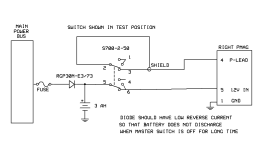
Here is solution to a non-problem. I am not necessarily recommending it.
The small battery supplies current to Pmag during engine cranking.
The Pmag will draw current from the source with the highest voltage.PMAG_bat.png
 
***edited for clarity

Hi guys I’m planning the 3 position switch wiring for my Pmag install.

I currently have my 2 slick mag switches wired so the starter button will not be live unless the left mag is on and the right is off. This isolates my left mag as the start mag, and keeps me from accidentally activating the starter in flight. See attached diagram.

I’m going to dual Pmags, with the 3 position switch to allow for testing the power lead to the Pmags. See 2nd diagram.

Is it possible for me to wire this setup like I had it before, where the start button will only activate when the left mag is on and the right mag is off? I liked the added safety of this setup in case I accidentally bump the start switch while working on something, updating a database, etc while the master is hot.

TIA

I looked at my schematic.
When the switch (2TL1-50) is in "Mom" position, pins 1&2, 4&5 are engaged. 5 is power. You could take the power from pin 4 and run it to one side of the starter switch. You would have to hold that P-mag switch in test position and press start. The P-mag would not have power till released. I may be reading it wrong too.
 
Thinking more about this, I wonder what that mag will do when the engine fires. If RPM is adequate, it should generate and fire. Hmmm.
Not saying it's a good idea, but on paper it should work.
 
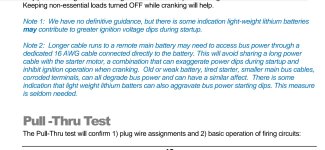
Just as a point of reference, the manual does tell you to keep the power lead off the starter bus if you have an aft mounted battery, in two places.
 

Attachments

  • Screenshot_20250308_163449_Drive.jpg
    Screenshot_20250308_163449_Drive.jpg
    372.6 KB · Views: 10
With all due respect, you asked for advice and you got it. If you were looking for an endorsement of your path forward, I don't think you're going to get it here.
 
With all due respect, you asked for advice and you got it. If you were looking for an endorsement of your path forward, I don't think you're going to get it here.
No need for any endorsement, I was looking for a way to isolate the starter circuit with switchology, as the question states. Since the thread typically drifted into something having nothing to do with the actual question, I felt compelled to add the manual snippet. Hopefully it'll save Brad at Emag the time of answering the question for the next guy.
 
No need for any endorsement, I was looking for a way to isolate the starter circuit with switchology, as the question states. Since the thread typically drifted into something having nothing to do with the actual question, I felt compelled to add the manual snippet. Hopefully it'll save Brad at Emag the time of answering the question for the next guy.

Still something wrong. Most of us rear battery RV8 builders used the recommended 2AWG wire from the battery to the buss which has a theoretical and measured voltage drop of less than 0.3 volts. Plus that the skytech lightweight starter most of us use stalls below 10V anyway.

Maybe it’s a 6 cylinder thing.
 
Moe, are you going to install a lead acid battery or a lithium battery. If lithium with its low internal resistance, then a rear mounted battery might not be an issue because its voltage will not sag much during engine cranking.
 
My eyes have glazed over. I think it all has been said but to beat this dead horse to a pulp.

I recommend you read the eMag installation manual for P-Mags... it was updated and has lots and lots of good info and guidance. Brad give him a call.

As far as the P-mag being on same battery as start battery being an issue, never heard that... P-Mags make spark with battery down to 9 volts. I just glanced at the manual and did not see that 2nd battery needed. A wiring diagram shows P-mag connected to main bus, aka starting battery. You do NOT need backup battery's with P-Mags as most all know, they have their own generator that makes spark on it's own (like a regular magneto) down to 900 RPM or less. Some people with a dead main battery have hand prop started and used a small battery to power P-Mag...

This is as close to a warning in the manual as I found:
Electrical System Condition - E-MAG’s power dip (kick-back) protection guards against severe voltage drops that occur when the starter is first engaged. However,in the event of a compromised electrical system (low battery, long cable runs, corroded terminals, cold engine, etc) bus voltage may not rebound as the starter speeds up (as is normal). A properly designed and functioning electrical system is essential for the system to work properly. If bus voltage stays below safe levels, the power dip safety circuit will do what it is supposed to do – not allow the ignition to fire. Note: Your starter is likely the largest load on the electrical bus. In emergency situations, hand (prop) starting will avoid the starter motor induced voltage drop. Do not attempt a prop start unless you are well versed in this procedure. See Emergency Prop Starting below. [Ref eMag - installation manual for P-Mag]

I think the poster might be confused with EFIS? Yes the Glass can brown out and reboot during start. The P-Mags can make spark using main or starter battery. If you have weak battery or undersized long cable runs... you might have issues and a separate battery bus might be a good thing.

The debate on starting with one or two P-Mags does not really matter. It will start fine with one P-Mag.

You could use a standard MAG L & R Start switch if you like, and start on one P-Mag which is OK, but as others said there is no reason to do this. The P-Mag has retarded timing at low RPM electronically... so they basically both are "impulse" couple mags.

Some people use one P-mag and one regular Magneto... typically non impulse because impulse is a wear and maintenance item. But you could keep your impulse magneto, but again it will start better on one (or two) P-Mags.
 
Last edited:
See my screenshot on post #29 highlighting the section of the E-Mag manual addressing long wiring runs. I do have a lithium battery as well.

All I ever wanted to do was create a condition where accidentally bumping the start button in flight or on the ground would not activate the starter. It never had anything to do with voltage drops, or the wiring of the E-mags themselves. I have no idea how this thread went so far off the rails.
 
Back
Top