Van's Air Force

The definitive Van's Aircraft support community! Buying, building or flying an RV? Join our exclusive family of mentors and enthusiasts!

RV6 elevator trim

FireMedic_2009

Well Known Member
Patron
Hi everyone. I recently got an RV6 flying I bought less than 2 yrs ago. It ground looped 6 yrs ago damaging the left wing tip and prop strike. It has an O-360 with a CS. I’ve got about 6 hrs on it and notice in cruise the trim is about 70% or more nose down and is in neutral position while in the pattern. My question is this normal or should the horizontal stab be shimmed to a higher angle of attack. I used to have a 6A but don’t remember having to trim this much in cruise.

I spoke to someone with a 6 at my airport and he says he has about 40lbs of wt in the cargo area when he’s by himself.

Thanks
 
I don't know how you are measuring "70%" but I can tell you my RV-6 with O-320 and metal fixed prop will have several twists of the trim knob difference between cruise and pattern speed with flaps deployed. I've never measured the actual angles of total trim travel but the RV has a very wide speed envelope and will need considerable trim adjustment at each end of the range. You can move your "70%" by adjusting the trim cable so you will have some up in the pattern and less down at cruise. But I don't think you need to mess with the horiz stab. Incorrect stab incidence will be indicated by the position of the elevator at cruise. It is normal for the -6 to cruise with a little bit of the elevator balance protruding above the upper surface of the horiz stab (slight down elevator). Check the position of the elevator in cruise next time you fly.
 
We're talking Hartzell? Not the lightest FWF setup there. One would think you would need plenty of nose up trim for landing. I do with my 6 with IO-360 and Whirlwind CS. How are you calling neutral trim, trim tab in trail with the elevator or some indication in the cabin?

I used to have a 6A with O-320 and Sensenich. With a lot of baggage and low fuel it got very tail heavy. Not fun at all. I have trouble imagining that many 6s would require ballast aft when solo.

Before I would mess with the angle of incidence, I would level the cockpit rails and check the AOI of both the wing and the tail per the plans and re-weigh the airplane while I was at it.

Ed
 
Have you verified that the elevator trim tab's movement up and down is within spec and that the tab position matches the cockpit indication? For instance, maybe when you're seeing "neutral" trim in the cockpit, the tab is deflected down, which would give you up elevator...
 
I don't know how you are measuring "70%" but I can tell you my RV-6 with O-320 and metal fixed prop will have several twists of the trim knob difference between cruise and pattern speed with flaps deployed. I've never measured the actual angles of total trim travel but the RV has a very wide speed envelope and will need considerable trim adjustment at each end of the range. You can move your "70%" by adjusting the trim cable so you will have some up in the pattern and less down at cruise. But I don't think you need to mess with the horiz stab. Incorrect stab incidence will be indicated by the position of the elevator at cruise. It is normal for the -6 to cruise with a little bit of the elevator balance protruding above the upper surface of the horiz stab (slight down elevator). Check the position of the elevator in cruise next time you fly.
70% of full deflection of the trim tab. I have a Rey Allen servo
 
It probably has a lot more to do with how the trim tab travel is adjusted then what the horizontal stabilizer incidence is.
In general, from in trail neutral, the trim tab travel should be about 1/3 up (nose down) and 2/3 down travel (nose up), of the total travel available.
 
There seems to be some confusion so I’ll try to cover it. Neutral position of the trim tab would be inline with the elevator. Full deflection in either direction is 100% (what the degrees are I don’t know but let’s assume it’s within the specs. Whether it’s 20 or 33 degrees doesn’t really matter since I’m talking about the trim tab and not having trouble completing loops), so 70% nose down would be the trim tab deflected up 70% of the full up travel. It’s approx 70% from the trim position shown on the efis. And yes the center position of the trim tab on the efis matches the neutral/inline position of the trim tab on the elevator.

In flight I wouldn’t know what the position of the elevator is unless I mount a camera.
 
There seems to be some confusion so I’ll try to cover it. Neutral position of the trim tab would be inline with the elevator. Full deflection in either direction is 100% (what the degrees are I don’t know but let’s assume it’s within the specs. Whether it’s 20 or 33 degrees doesn’t really matter since I’m talking about the trim tab and not having trouble completing loops), so 70% nose down would be the trim tab deflected up 70% of the full up travel. It’s approx 70% from the trim position shown on the efis. And yes the center position of the trim tab on the efis matches the neutral/inline position of the trim tab on the elevator.

In flight I wouldn’t know what the position of the elevator is unless I mount a camera.
My previous statement is still the same because I wasn’t talking about degrees either.
I was talking about percent of the total travel range that is available.
Using your description of not speaking about degrees of deflection, whatever the total amount of deflection from fall up to fall down on the tab is, 1/3 of that deflection should be in the up direction and the other 2/3 should be in the down direction, as reference referenced from the neutral / in trail point.
 
I would weigh the aircraft, ensure the cg position is sensible, and check the deflections as Scott suggests, he has a fair amount of experience...
 
The "aerodynamic" clean target when CG is clsest to mid range would have everything "in line", meaning elevators/tabs are neutral, while at cruise speed. Forget T/O and Landing trim. The only way to get this condition is with stabilizer incidence, which can be changed. doesn't take much. As others have mentioned, check your existing W/B. Keep in mind, all your fuel is FWD of the empty CG, so your test will vary with that. My RV-4 is spot on when Im solo and 1/2-full tanks, so that was my benchmark. I need very little trim from T/O to cruise flight and when solo, usually zero trim on landing as well. Add someone in the backseat and all bets are off, and I require slight nose down trim for cruise, when tanks are low and a backseater, quite a bit of down trim. Since the -6 has less C/G change with passenger, I would surmise if your W/B C/G is in range, you may want to do some stabilizer shimming to get close to neutral.
 
Hi everyone. I recently got an RV6 flying I bought less than 2 yrs ago. It ground looped 6 yrs ago damaging the left wing tip and prop strike. It has an O-360 with a CS. I’ve got about 6 hrs on it and notice in cruise the trim is about 70% or more nose down and is in neutral position while in the pattern. My question is this normal or should the horizontal stab be shimmed to a higher angle of attack. I used to have a 6A but don’t remember having to trim this much in cruise.

I spoke to someone with a 6 at my airport and he says he has about 40lbs of wt in the cargo area when he’s by himself.

Thanks
Section 15 of RV6-6A manual.
"Adjustment of the stabilizer incidence angle is recommended if the cruise position of the trim tab is more than 10 degrees up at cruise. The only correction for this is altering the incidence angle by repositioning the forward spar of the
stabilizer up or down. The amount of re-adjustment needed will be determined by trial and error. Add or subtract
spacers (washers) under the bolts which attach the front stabilizer spar to the fuselage. By adjusting one washer
thickness (1/16'') at a time, the desired trim can be attained. Repositioning the stabilizer will require an alteration of
the stabilizer root fairing, so should only be attempted after careful testing to determine the necessity."

Assuming CG is in specification, and you test trim tab position in your desired cruise configuration ( fuel, baggage, passenger) then measure trim the trim tab position on the ground for 10 degrees up or less.
 
Empty wt is 1085 lbs and cg is 69.22”. The prop is a Hartzell. I’ll get back with the degrees of up trim tab in cruise when I go the airport later today. I’ve been flying it solo with about 3/4 - 1/2 fuel.
 
Last edited:
My config is in my signature, similar to yours. My trim is pretty much neutral in cruise. This shot shows its position at about 100 KIAS (flown for formatting with the camera PC-6) and looks like 1.27° ND... I'll let you convert that in %, have fun.

Screenshot 2025-02-21 at 17.18.11.png
 
My config is in my signature, similar to yours. My trim is pretty much neutral in cruise. This shot shows its position at about 100 KIAS (flown for formatting with the camera PC-6) and looks like 1.27° ND... I'll let you convert that in %, have fun.

View attachment 81340
I’m not sure what you mean by “My config is in my signature”? So in cruise the trim is neutral in your plane and at 100kts it’s just a tad nose down at 1.27 deg? It would make more sense to go from a neutral position to nose up but you’re saying you actually have to add a little nose down?
 
The only way to get this condition is with stabilizer incidence, which can be changed. doesn't take much. As others have mentioned, check your existing W/B. Keep in mind, all your fuel is FWD of the empty CG, so your test will vary with that. My RV-4 is spot on when Im solo and 1/2-full tanks, so that was my benchmark. I need very little trim from T/O to cruise flight and when solo, usually zero trim on landing as well. Add someone in the backseat and all bets are off, and I require slight nose down trim for cruise, when tanks are low and a backseater, quite a bit of down trim. Since the -6 has less C/G change with passenger, I would surmise if your W/B C/G is in range, you may want to do some stabilizer shimming to get close to neutral.
My 6A is extatically like that..... O320 Sensenich
 
Ok, I'll help decipher, here's an extract of my signature: O-360-A3A (carb/dual Lightspeed II), MTV-12-B
As for the tab's position let's simplify and say that it is in a neutral position, in cruise, at my standard low cruising speed of 112 KIAS (close enough to Carson speed). Flying faster will require some ND trim, but probably just a few degrees. The only time plenty of trim is required is for landing, flaps full, 60-65 KIAS over the fence. The tab will then be deflected about 15° NU
My indication is just one of those original rectangular display with a moving square moving up or down, so a difficult read as it will stay on one square for a while before jumping to the next.
 
It would make more sense to go from a neutral position to nose up but you’re saying you actually have to add a little nose down?
I think your backwards there. The horizontal stabilizer is pushing down on the tail, making the nose want to go up. In Dans case that push at his cruise speed is matched to his center of gravity. so no elevator trim needed. If he go's faster the stab pushes down with more force. So a little elevator trim nose down is needed to compensate.
 
My RV-6 (O-320 / Constant Speed) had first flight September 1997. It now has over 3,600 hours on the hobbs meter.

I tend to NOT trim when slowing from cruise speed to traffic pattern / landing speed. I tend to do wheel landings and find the little extra back pressure on the stick when landing makes "sticking" the mains on the runway easier.

Flying solo with a little over 1/2 fuel, this is the trim tab setting I would use in cruise flight and was the position I used when landing.

FD690B1E-3BD3-4BCD-8FEE-B5C653587906.jpeg

I have up elevator position just to make taking the photo easier.
 
My RV-6 (O-320 / Constant Speed) had first flight September 1997. It now has over 3,600 hours on the hobbs meter.

I tend to NOT trim when slowing from cruise speed to traffic pattern / landing speed. I tend to do wheel landings and find the little extra back pressure on the stick when landing makes "sticking" the mains on the runway easier.

Flying solo with a little over 1/2 fuel, this is the trim tab setting I would use in cruise flight and was the position I used when landing.

View attachment 81397

I have up elevator position just to make taking the photo easier.
That picture is a nose down trim.
 
That picture is a nose down trim
Agree... tab up = EL down = ND trim (same as I had in my example a few posts above).

Now the OP gave his config, a 360 engine amongst other things, and I'm not sure all you guy's data whilst running a much lighter 320 is relevant... on the same token, my config also sports an RV-8 tail which was standard on the last (@rvbuilder2002 aka Scott gotta know from which SN on?) -6 kits delivered.

There probably also is a weight difference, and related trim, depending on tail type, as well as on a 6 vs 6A, and the type of tailwheel, springs or rod, etc, for tailwheelers.

OTOH the OP mentions 70% (and whatever deflection angle that results in) of the travel one way, which seems pretty hi stacked against what even 320 guys are reporting, and I'm not sure that is in a normal range.

As suggested somewhere above, I'd have a go to check the incidence angle of the wing vs fuselage (ah those handy templates marked and cut outta those shipping crates...), and then the wing vs HS position, no big deal involved.
 
Last edited:
Now the OP gave his config, a 360 engine amongst other things, and I'm not sure all you guy's data whilst running a much lighter 320 is relevant...

IF you look at the TCDS (Type Certificate Data Sheet) for the two engines, there is only 10-pounds different in weight.
 
That picture is a nose down trim.
In any Aircraft with a trim tab for pitch trim, the trimming direction is opposite the movement of the tab.
So if the tab is up from neutral in trail position, that is nose down trim.
If the tab is down relative to neutral in trail position, that is nose up trim
This is true for conventional elevators, or a stabilator.
 
I think your backwards there. The horizontal stabilizer is pushing down on the tail, making the nose want to go up. In Dans case that push at his cruise speed is matched to his center of gravity. so no elevator trim needed. If he go's faster the stab pushes down with more force. So a little elevator trim nose down is needed to compensate.
Dan said his trim tab is neutral in cruise and at a 100 kts he need to add a little nose down trim which doesn’t make sense. The slower he goes he would need to add nose up trim (trim moves down causing the elevator to move up which causes the nose to pitch up).

But is do agree that if he goes faster than his cruise speed he would need to add more nose down
 
Last edited:
So I measured the elevator trim tab angle of full up n down deflection. Full up (nose down) relative to neutral is 37 deg, full down (nose up) relative to neutral is 29 deg. In cruise it appears the trim tab is about 17 deg nose down.

Is 17 deg nose down for cruise speed too much creating unnecessary drag and would it make sense to add washer under the front of the horizontal stab to increase nose down pressure/force resulting in less elevator trim?
 
So I measured the elevator trim tab angle of full up n down deflection. Full up (nose down) relative to neutral is 37 deg, full down (nose up) relative to neutral is 29 deg. In cruise it appears the trim tab is about 17 deg nose down.

Is 17 deg nose down for cruise speed too much creating unnecessary drag and would it make sense to add washer under the front of the horizontal stab to increase nose down pressure/force resulting in less elevator trim?
 
So I measured the elevator trim tab angle of full up n down deflection. Full up (nose down) relative to neutral is 37 deg, full down (nose up) relative to neutral is 29 deg. In cruise it appears the trim tab is about 17 deg nose down.

Is 17 deg nose down for cruise speed too much creating unnecessary drag and would it make sense to add washer under the front of the horizontal stab to increase nose down pressure/force resulting in less elevator trim?
The RV6/6a builder manual recommends the following;
Section 15 of RV6-6A manual.
"Adjustment of the stabilizer incidence angle is recommended if the cruise position of the trim tab is more than 10 degrees up at cruise. The only correction for this is altering the incidence angle by repositioning the forward spar of the
stabilizer up or down. The amount of re-adjustment needed will be determined by trial and error. Add or subtract
spacers (washers) under the bolts which attach the front stabilizer spar to the fuselage. By adjusting one washer
thickness (1/16'') at a time, the desired trim can be attained. Repositioning the stabilizer will require an alteration of
the stabilizer root fairing, so should only be attempted after careful testing to determine the necessity."

If following the builder manual recommendation then yes it makes sense to add washer under front stabilizer spar.
 
Seems like it would still be a good idea to measure the relative incidence of the wing and stab before getting creative. Don't know about y'all, but I like to know what's up before making mods. I've seen several airplanes that were not rigged correctly during assembly.

Ed
 
Seems like it would still be a good idea to measure the relative incidence of the wing and stab before getting creative. Don't know about y'all, but I like to know what's up before making mods. I've seen several airplanes that were not rigged correctly during assembly.

Ed
Hi Ed
Would you measure the wing incidence at the root over the main spar? Is wing incidence the same as angle of attack? Also even if the wing is off how would you fix it? It seems the easiest and simplest is to simply increase the AOA of the horizontal stab but I’m open to ideas
 
AOA is different from incidence. Incidence is the angle of a surface in relation to the fuselage. AOA is the angle of the chord line of a surface to the relative wind. Longerons level at the cockpit then measure the tail and wing with spacers and a level.

Ed
 

Attachments

  • 20250225_175208[1].jpg
    20250225_175208[1].jpg
    2.8 MB · Views: 20
  • 20250225_175242[1].jpg
    20250225_175242[1].jpg
    3.1 MB · Views: 20
Don't forget to level the longerons right to left also. If the wing doesn't level with the correct spacer and longerons level, fore and aft, ignore the longerons and focus on moving the airplane until the wing levels out, then measure the stab. The fuselage won't care. It's along for the ride. The thing that counts is the relative angle of incidence between the wing and tail.

Ed
 
If and when you decide to change it, don't mess with the wing - only the stab. I would change the mount front spacers on the stab as necessary to get it reading correctly relative to wherever the wing is.

Ed
 
Don't forget to level the longerons right to left also. If the wing doesn't level with the correct spacer and longerons level, fore and aft, ignore the longerons and focus on moving the airplane until the wing levels out, then measure the stab. The fuselage won't care. It's along for the ride. The thing that counts is the relative angle of incidence between the wing and tail.

Ed
So what should the relative angle of incidence be between the wing and horizontal stab?
Thanks
 
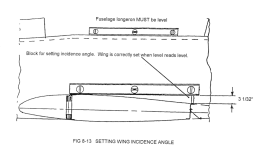
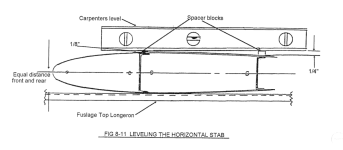
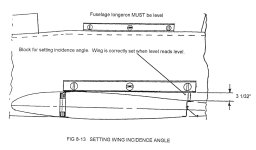
Explained in section 8 of the RV6 builders manual, available on line from Van's with your serial number.

View attachment 81767View attachment 81768
So it shows the incident angle is 0 between the horizontal stab and longeron with the 1/8” and 1/4” spacers shown in fig 8-11. The wing is also at 0 deg incident angle between the longeron with the 3-1/32” spacer at the rear wing spar, fig 8-13, which actually gives the wing a positive 1 deg incident angle. The positive 1 deg angle is the leading edge angled up/higher than the trailing edge of the wing, correct?
Thanks
 
The wing AOI is supposed to be 1degree positive - that is up. The blocks shown in the plans provide this when the fuselage is level and a carpenter's level across the spar and block is center bubble. The wing isn't supposed to be at 0degrees AOI. Do not to use the terms interchangeably. It's confusing. The relative AOI between wing and stab should be 1degree +. The only real way to determine this is by getting the airplane level side to side and the level on the wing with spacer block, center bubble. Then check the stab with the specified blocks. The maunual says that the longerons should be level to do this. Your airplane might or might not be, but if you get the bubble level, and the wings and tail set correctly, the actual position relative to the longerons is moot. Another tip is: don't turn your level around when you move it from the wing to the tail. They are often not that accurate.

Builders don't always do it per plans. I've even seen different AOIs on the wings of the same airplane! Fortunately that builder also used 1/4" bolts on the rear spar attach and I was able to correct it with round file, ream, and the correct AN5 bolts (with proper edge distance) and then reset the tail AOI. That same RV-6 also had very bad wheel alignment. I helped the owner correct both problems after he ran over a taxiway light. It flew and landed much better after fixing it.

Ed
 
A word of caution.

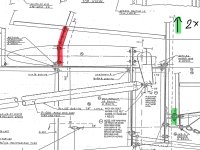
If you end up changing the incidence of the stab (which sounds like you may need to) you will need to fabricate a new stab, to vertical stab front spar, connector plate. As otherwise the vertical stab would be rotated up and aft and it’s rear spar and rudder alignment would be affected.

I’d suggest getting a good digital level and checking everything is according to the plans for wing and stab incidence.

Regards Peter
 
Last edited:
A word of caution.

If you end up changing the incidence of the stab (which sounds like you may need to) you will need to fabricate a new stab, to fin front spar, connector plate. As otherwise the fin would be rotated up and aft and it’s rear spar and rudder alignment would be affected.
I don’t quite understand, “ . . . to fin front spar, connector plate . . . “. Are you referring to the vertical stab as the fin? If the horizontal stab needs to shimmed it should be an 1/8” to 1/4” at most. Couldn’t you adjust the end bearing on the rudder/vert stab and not have to rebuild it or add a doubler to the horizontal stab and match drill the vert stab to the horizontal?
Thanks
 
The wing AOI is supposed to be 1degree positive - that is up. The blocks shown in the plans provide this when the fuselage is level and a carpenter's level across the spar and block is center bubble. The wing isn't supposed to be at 0degrees AOI. Do not to use the terms interchangeably. It's confusing. The relative AOI between wing and stab should be 1degree +.
Yes I agree but with the spacers in place and the level sitting on the wing with the spacers, the level is parallel to the longeron which confirms the wing is at 1 deg AOI to the longeron. I assume Vans used a certain height on the spacer back when there were no digital levels, only a carpenter level.

So I’ll level out the longeron and measure the AOI of the wing and stab to then determine the relative AOI between the two. If the plane was built correctly the level on the wing with the spacers will be at 0 deg (parallel to the longeron) and the level on the horizontal stab with the spacers will be at 0 deg. This would mean the wing is at 1 deg to the stab. I’ll report back soon
 
I don’t quite understand, “ . . . to fin front spar, connector plate . . . “. Are you referring to the vertical stab as the fin? If the horizontal stab needs to shimmed it should be an 1/8” to 1/4” at most. Couldn’t you adjust the end bearing on the rudder/vert stab and not have to rebuild it or add a doubler to the horizontal stab and match drill the vert stab to the horizontal?
Thanks
No, you can't!

For a hinged object that pivots on 3 points to move without any binding, those three points have to be exactly aligned.

If you increase the angle of incidence of the horizontal stab., that will lift the fwd spar of the vertical stab., which will bend the vertical stab rear spar.
This will misalign the 3 hinge points for the rudder.

You really need to get a copy of the construction manual and plans for this airplane that you are working to "maintain", and get familiar with the contents.
Most of the things you have been asking about are detailed within those two documents
 
What if you add a doubler plate to the horizontal stab front spar and match drill the vertical stab to the horizontal stab
 
No, you can't!

For a hinged object that pivots on 3 points to move without any binding, those three points have to be exactly aligned.

If you increase the angle of incidence of the horizontal stab., that will lift the fwd spar of the vertical stab., which will bend the vertical stab rear spar.
This will misalign the 3 hinge points for the rudder.
Moving the vertical stab in the front an 1/8” seems pretty minimal. I understand it would put a very slight flex in the rear spar but you surely can align the pivot points by adjusting the end bearings a couple turns. With all the builds out there I’m sure there are quite a few out there slightly out of alignment a couple turns of the end bearings and/or an ever so slight flex in the rear vertical spar, they can’t all be perfect.
 
Sorry for the confusing terminology Fin = Vertical Stab.
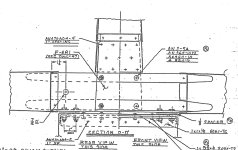
Anyway as I said and Scott confirmed, if you need to adjust the horizontal stab then you’ll need to make a new “vertical stab attachment plate “ for the front spar to horizontal stab joint. Which should be no great task to make from a piece of the correct thickness and grade aluminium. (My -7 plans show this as a F-781, I don’t have -6 plans but it should become apparent)
If you don’t then as Scott pointed out the rudder will bind. As if you were to say, shorten the top most bearing to get the rudder to fit, then yes the bolt would slide in but as soon as you move the rudder 30 degrees to the side the top bearing would now be effectively too short and want to pull the top of the vertical stab sideways.

Regards Peter
 
Moving the vertical stab in the front an 1/8” seems pretty minimal. I understand it would put a very slight flex in the rear spar but you surely can align the pivot points by adjusting the end bearings a couple turns. With all the builds out there I’m sure there are quite a few out there slightly out of alignment a couple turns of the end bearings and/or an ever so slight flex in the rear vertical spar, they can’t all be perfect.
I can not remember the last time someone questioned so much of the info and advice others were providing them here in the forums.

I hope your future with this airplane is safe and successful.
 
I can not remember the last time someone questioned so much of the info and advice others were providing them here in the forums.

I hope your future with this airplane is safe and successful.
Not so much as questioning as learning through questions. I could be totally wrong that movement of an 1/8” is minuscule. Peter from post #43 brought up a good point and I totally agree. It will line up but as soon as you move the rudder side to side it becomes out of alignment and bind. I didn’t think of that. I would have realized it after it was done. Many times people accept something without understanding. I unfortunately am a little different and learn through questioning and getting feedback, so it may seem like I’m arguing but in fact learning through questions. I do appreciate the responses.
 
So I measured the AOI of the wing with the 3-1/32” spacer at the rear spar. I have an angle cube (digital angle level). When you put a level across the main spar of the wing to the rear spar with the spacer it’s supposed to be 0° between the longeron/rail of the cockpit. It was 1.3 deg. The horizontal stab measured at 0.0 deg. This is why I’m having to put in so much nose down.

Therefore I need to increase the AOI of the stab 1.3 deg. I added 3 washers (3/16”) and it increased the AOI to 0.6 deg. I checked for binding of the rudder during movement by hand from side to side and to my surprise it didn’t feel like there was any binding or resistance. I certainly wasn’t expecting that. Of course I disengaged the tail wheel so the rudder would move freely. Before I added the washers I noted the vertical angle at the top of the rudder for reference. After I added the washers the vertical angle decreased by 0.5 deg which means it has a slight bow. I know what some of you all are thinking, this guy is full of it. But there is no resistance/binding at all.

Tomorrow I’ll fly it to see how much it helped
 
Sunday morning, quietly enjoying the digestive process of the excellent brunch we just had, installed in my favorite armchair :)
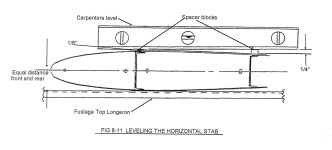
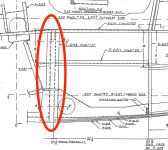
To better illustrate the debate, I picked up the pertinent illustrations from the manual and the plans... these might better explain the potential problems from altering the HS AoI on its own.

IMG_7196.jpegIMG_7197.jpegIMG_7198.jpegIMG_7199.jpeg
 
Sunday night here, we had a glass of wine, or two, so here goes:

Wing final incidence (and sweep) is set during construction by drilling the rear spar bolt holes.

if the wing incidence is out by 1.3 degrees, then this equates to the rear spar bolt hole being offset from "centre" of fork by 0.60 inches (TAN 1.3 dergrees multiplied by 26.485 inches, the distance between front and rear spar). That 0.60" would make,it difficult to achieve correct edge distance for the bolts that attach the rear spars. Also, flaps when retracted may not align properly with belly skin, or the wing chord center line. So it would be very interesting to check the layout of the wing rear spar attach points.
 
Hi Paul
The rear wing spar attachment to the fuselage seems to be centered with proper edge distance which is odd because you would expect the wing spar and fuselage spar to be misaligned by 0.6” as you calculated. I checked the other wing and it is also off by 1.3 deg. I’m not sure how it happened but 1.3 deg is significant but it might be something I have to accept. Increasing the AOI of the horizontal stab any more would put more stress on the rear spar of the stab. I probably will end up removing a washer just to insure there isn’t too much stress on the rear spar. And maybe I should add a thin washer on the lower bolt holes on the rear stab spar to further reduce stress, not sure.

Worse case I only use one washer and live with excessive trim.
 
Back
Top