
On page 24-03 step 10 we I are to c’sink the #27 holes to fit the dimples in the skin. So it is a dimpled aluminum skin fit into a fiberglass c’sink. If these were two aluminum parts nesting and riveted I would c’sink .007” deeper than flush per Section 5. But this is different than a riveted joint. How should this countersink in the wing tip be sized?

Van's Air Force
You are using an out of date browser. It may not display this or other websites correctly.
You should upgrade or use an alternative browser.
You should upgrade or use an alternative browser.
Countersink in fiberglass wing tip for a dimpled skin.
- Thread starter WayneJ
- Start date

I drilled a #27 hole and dimpled for a # 6 screw in a small piece of scrap aluminum. I then c sink the fiberglass skin just enough to accept the above piece of aluminum.
Was actually working on this same step on my 14A wingtips today.
Was actually working on this same step on my 14A wingtips today.
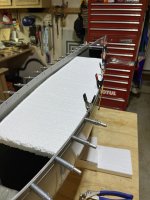
You can also consider taking the roughly 1” edge that you cut off the inside of the wingtip and rebond it back on the inside
of the new edge. Scuff up both mating surfaces, a little resin w/flox. This adds some ridgidity and volume for when you ultimately C/S for the dimples described above. I did this, and am happy with the result. YMMV.
of the new edge. Scuff up both mating surfaces, a little resin w/flox. This adds some ridgidity and volume for when you ultimately C/S for the dimples described above. I did this, and am happy with the result. YMMV.
Attachments
Southern Pete
Well Known Member
On my old -7 build, I epoxy glued aluminum strips inside along edge of the fiberglass. Purpose was to reinforce the nutplates in the glass. Like BAR's idea. Just wondering if anyone does the aluminum strips anymore?You can also consider taking the roughly 1” edge that you cut off the inside of the wingtip and rebond it back on the inside
of the new edge. Scuff up both mating surfaces, a little resin w/flox. This adds some ridgidity and volume for when you ultimately C/S for the dimples described above. I did this, and am happy with the result. YMMV.
I debated on doing an aluminum backing strip and the feedback I got was that it wasn't really necessary so I skipped it. There's enough surface area on the nut plates that I think it's okay without.On my old -7 build, I epoxy glued aluminum strips inside along edge of the fiberglass. Purpose was to reinforce the nutplates in the glass. Like BAR's idea. Just wondering if anyone does the aluminum strips anymore?

I did it and I'd do it again:On my old -7 build, I epoxy glued aluminum strips inside along edge of the fiberglass. Purpose was to reinforce the nutplates in the glass. Like BAR's idea. Just wondering if anyone does the aluminum strips anymore?


I did on the horizontal and vertical tips, with only pull rivets holding the back in those situations.On my old -7 build, I epoxy glued aluminum strips inside along edge of the fiberglass. Purpose was to reinforce the nutplates in the glass. Like BAR's idea. Just wondering if anyone does the aluminum strips anymore?
Hey Matt, How did you make the large countersinks? What kind of tool did you use? I've tried a regular 3 flute piloted cutter but it will likely be too dull to finish the job. Some builders are using a piloted Perma-Grit tool. That would be done without a microstop cage tho. So gaging the depth by eyeballing it?
And more to the point of my original post. How deep to make the countersink. Is it there to clear the dimple so the skin sits flat to the flange? Or is it meant to locate the dimple and lock the assembly as it would in a metal to metal assembly?
I like the idea of using aluminum strips here. Wondering about something else in your pictures. What kind of nut plates are those. They look like maybe the floating type.
And more to the point of my original post. How deep to make the countersink. Is it there to clear the dimple so the skin sits flat to the flange? Or is it meant to locate the dimple and lock the assembly as it would in a metal to metal assembly?
I like the idea of using aluminum strips here. Wondering about something else in your pictures. What kind of nut plates are those. They look like maybe the floating type.

For countersinking in f/g, use the Permagrit 100 degree tool.
Thanks bob but how deep?For countersinking in f/g, use the Permagrit 100 degree tool.
Hey Matt, How did you make the large countersinks? What kind of tool did you use? I've tried a regular 3 flute piloted cutter but it will likely be too dull to finish the job. Some builders are using a piloted Perma-Grit tool. That would be done without a microstop cage tho. So gaging the depth by eyeballing it?
And more to the point of my original post. How deep to make the countersink. Is it there to clear the dimple so the skin sits flat to the flange? Or is it meant to locate the dimple and lock the assembly as it would in a metal to metal assembly?
I like the idea of using aluminum strips here. Wondering about something else in your pictures. What kind of nut plates are those. They look like maybe the floating type.
Yup, exactly, I used the Perma-Grit piloted countersink tool and just went slow. The aluminum strips work great here for keeping the pilot centered. I dimpled a piece of scrap and used it as a gauge to check my countersink depth; it doesn't have to be tremendously precise, I just went for a good fit. And yes, I used floating nutplates so everything would line up.
My full wingtip build sequence is here: https://www.rv7blog.com/category/wings/wingtips/ (newest post will display first)

dnimigon
Well Known Member
What length of rivet did you use on your nutplatesI did it and I'd do it again:

briand
Well Known Member
This guy used hinges.
Mike Bullock's RV-7: Wingtip hinges Nav Antenna Mounted Emp Fairing
Mike Bullock's online builders log of a Van's Aircraft RV-7 experimental aircraft.
www.rvplane.com
Mike Bullock's RV-7: Wingtip lights and trimming
Mike Bullock's online builders log of a Van's Aircraft RV-7 experimental aircraft.
www.rvplane.com

Not a 14, but I had to countersink fiberglass quite often for screws, rivets, dimples, etc.
I bought a Dremel stone and ground the business end to the correct angle by gently running it on a grinder wheel.
It's been used for the entire build. I don't fo full depth. I get close and finish with a few turns of the countersink tool. No dull bits and the stone was cheap.
I bought a Dremel stone and ground the business end to the correct angle by gently running it on a grinder wheel.
It's been used for the entire build. I don't fo full depth. I get close and finish with a few turns of the countersink tool. No dull bits and the stone was cheap.
