Van's Air Force

The definitive Van's Aircraft support community! Buying, building or flying an RV? Join our exclusive family of mentors and enthusiasts!

How to Secure Spark Plug Wires & CHT and EGT Probe Wires

ColoradoSolar

Well Known Member
Patron
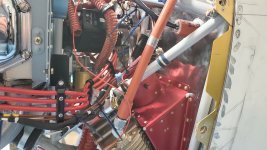
I have tried searching but can't seem to find the right search term. Does anyone have photos of how they secured the lower spark plug wires and the CHT and EGT probe wires?

Thanks.
 
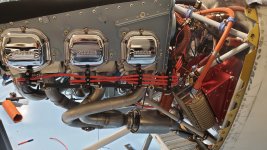
Its common to use a valve cover attached adel clamp for supporting the lower spark plug wires.
I route the EGT sensor wires thru those as well. The CHT ones are loosely wrapped about the starter cable (port side) and the alternator output cable (starboard side).
These choices worked well on my RV-7A over the 10yrs that I owned it.
Lower_spark_plug_wire_routing_portside.jpg
spark_plug_wire_routing.jpg
 
Note that if using auto spark plugs that you can't have the wires touching each other. This is per the pmag instructions.
 
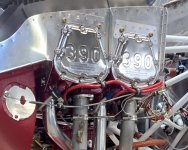
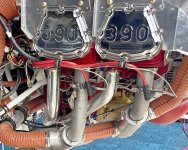
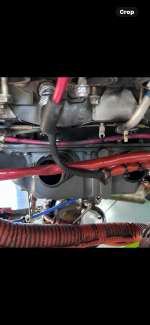
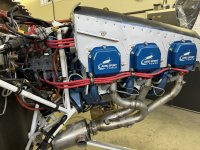
lots of ways to do it. Here's a couple of pix of mine. The aluminum double mounts are from a race car spark plug stand off kit. Nothing special, you can get them on amazon. If you lang them off the valve covers make sure you use washers under your standoffs appropriately so they don't bend the lip on the edge of the valve cover.

Howard is correct that the Pmag instructions specifically say that in order to reduce the potential for inductive misfiring plug wires should be separated. They give a limit of how much they can be touching and I want to say it's a cumulative 6", although my memory is a little fuzzy and I'm not going to look it up now.

Quite a few people have ignored this limit and it seems to have worked out, so your mileage may vary.
 

Attachments

  • IMG_8853.jpeg
    IMG_8853.jpeg
    2.6 MB · Views: 186
  • IMG_8907.jpeg
    IMG_8907.jpeg
    2.6 MB · Views: 186
Concur you need to separate the wires so they aren’t touching each other, at least with the Electroair ignition system. You can do similar to the picture above and have the second plug wire attached to the first with high heat zip tie standoffs or a small piece of rubber tube with the zip tie fed through and around each wire.

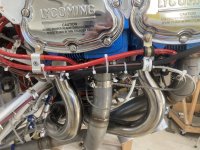
The double adel clamp works fine but I wouldn’t use the metal connector shown above as this may introduce some feedback and potential misfires. I tried that at first and the engine was acting strange at idle with just a slight miss running at idle but never felt it in flight. As soon as I got rid of the metal connector and used the technique pictured below the problem went away. The standoff method below is also easier than trying to clamp two adel clamps together. Different techniques so whatever works best for you……..

Something like this:
 

Attachments

  • IMG_1990.jpeg
    IMG_1990.jpeg
    160.4 KB · Views: 129
Last edited:
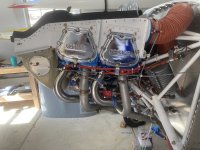
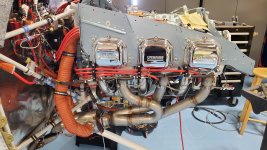
I bundled the CHT/EGT in separate fire sleeves and laid them across the intake tubes. I believe the auto plug wires for EMags can touch, just don’t overlap them.
 

Attachments

  • IMG_6386.png
    IMG_6386.png
    2.7 MB · Views: 106
Here's what the current Emag documentation (version LC 114.33, p22) has regarding a concurrently run plug wire length limit:
-------------
"Do NOT bundle them together which can cause them to be inductively coupled..."
-------------
Although in my installations, they've been unseparated for just the distance thru those respective cylinder 3 and 4 adel clamps; I see now that can be improved upon.

The plans page originally recommended routing EGT wires together with ignition ones. Perhaps since revised or only if a traditional magneto ignition system?
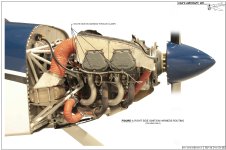
ignition_harness_plans.jpg
 
Avoid bundling EGT/CHT wires with spark plug leads.
+1
About to write that. I have had numerous problems with thermocouple wires near plug wire causing wild swings in temps.

Also, On the 10, i have three plug wires bundled together for over a foot. Not one misfire in 400 hours. That is for standard auto coils and 8mm wires. CDI or thinners insulation may be more sensitive to jumping.
 
I’m running SDS and have no issues with the plug wires touching. The EGT/CHT are bundled behind the intake tubes

K
 

Attachments

  • IMG_9676.jpeg
    IMG_9676.jpeg
    4.7 MB · Views: 112
It amazes how many people just drill holes and end up with EGT probes and wires pointing outwards where they can get damaged. Just stop and think for a minute, if you drill the holes on the inside at about 30 to 45 degrees 'rearwards', then the EGT wires automatically follow the CHT wires and become quite 'self supporting' when bundled together. And out of harms way.

Don
 
Back
Top