Van's Air Force

The definitive Van's Aircraft support community! Buying, building or flying an RV? Join our exclusive family of mentors and enthusiasts!

Two questions regarding wideband O2 sensors

walkman

Well Known Member
I'm strongly considering installing a WBO2 sensor for AFR-based leaning - both LoP and Best Power.

Q1) Does anyone have any experience-based or science-based input (e.g. not WAGs) on whether occasional use of smoke would have any impact on the WBO2 life (I'm going to assume the data would be useless with smoke running). I'd like to place the sensor upstream of the smoke injector but that may not be possible.

Q2) My exhausts are separate each side (2&4, 1&3). I was planning on a single WBO2 sensor, thoughts on if either side would be better placement or whether this is even going to be useful? If installation issues provide me a choice, which side to use e.g. the one with the cylinder that peaks at highest overall gph, lowest overall, some thing else?
 
I'm strongly considering installing a WBO2 sensor for AFR-based leaning - both LoP and Best Power.

Q1) Does anyone have any experience-based or science-based input (e.g. not WAGs) on whether occasional use of smoke would have any impact on the WBO2 life (I'm going to assume the data would be useless with smoke running). I'd like to place the sensor upstream of the smoke injector but that may not be possible.

Q2) My exhausts are separate each side (2&4, 1&3). I was planning on a single WBO2 sensor, thoughts on if either side would be better placement or whether this is even going to be useful? If installation issues provide me a choice, which side to use e.g. the one with the cylinder that peaks at highest overall gph, lowest overall, some thing else?
There are a couple threads discussing A/F Ratio monitoring and airplane applications. Also - I wrote a Kitplanes article a while ago "Adding Direct Air/Fuel Ratio Monitoring",


which you might find useful. It is an extremely powerful technique for setting mixture for various operating regimes. I think you'll find the answers to your questions there, including picking the side of the exhaust.

A couple comment since the article was published some time ago:
  1. If you have a Garmin or Dynon EIS, you can easily add the analog output of the A/R monitor to the display, so no need to locate a display somewhere.
  2. The use of the right sensor, e.g. NGK, is essential to longevity given lead in the fuel.
 
  1. If you have a Garmin or Dynon EIS, you can easily add the analog output of the A/R monitor to the display, so no need to locate a display somewhere.
  2. The use of the right sensor, e.g. NGK, is essential to longevity given lead in the fuel.
Definitely doable, lead seems to be their downfall.

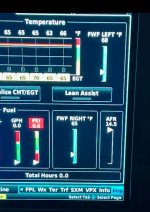
Screenshot 2025-01-31 200236.jpg
 
No one can answer either question?

Surprised but, perhaps that shows how few people are using AFR to lean.
 
No one can answer either question?

Surprised but, perhaps that shows how few people are using AFR to lean.
Used for mapping as they don't last very long. Hopefully lasts long enough to get a correlation between MAP, EGT's and AFR. I replace at condition and lasts (reliable) 15 to 40 hrs. Only 100LL used to date 650 hrs.
 
No one can answer either question?

Surprised but, perhaps that shows how few people are using AFR to lean.
You asked specifically for lifetime in response to smoke and got no replies, but you seem to want to lean this toward the broader question of using it to indicate AFR for leaning. Perhaps it would be helpful to state the question more clearly.

I have been using these "oxygen sensors" for 1800 hours now for leaning, they give good results and are fairly cheap, they do run down when exposed to lead but in my experience I get somewhere around 40-50 hours of 100LL exposure (I run LOP religiously, maybe that extends sensor life?) on a sensor before it dies. I run mostly 93E10 unleaded at home but pick up enough 100LL on long trips to eventually kill them, I consider their cost at $39 to be something I can burn one or two of in a year.
 
I did not reply as you were requesting info regarding smoke effect and I have not used smoke. I installed an AF meter in my 7 over 8 years and 800 hours ago. I have always run 100LL and have never changed or cleaned the sensor. The readings were the same from day 1 till the day I sold the plane last fall. I originally manually leaned the old fashioned peak EGT way and monitored the AF gauge readings and the Dynon display which confirmed leaning to peak or LOP. I mostly run 60-65% power. Once I found the spot on the quadrant for leaning it was very repeatable and was confirmed by the Dynon and the AF gauge. I used the AEM kit from Amazon which uses the Bosch 4.9 Wideband sensor. The sensor was installed as per the instructions for distance from the cylinder and angle off vertical. I have installed the same unit on my recently flying 8 (only 7 hrs so far) and it is working the same as on the 7, although the readings are slightly different but consistent so far. There is no calibration for the sensor for 100LL so I just use them as set out of the box. Both exhaust systems are crossover 2 into one Vetterman. Both were installed on the 2-4 side for space considerations, but I don't think it matters. The 7 was an O-360 PV carbed and the 8 is the same but injected. The reading on the gauge does bounce around a bit which I think is caused by the exhaust pulses but it doesn't bother me. I also make sure the sensor is turned on before starting the engine as per the instructions. Sorry no science information to offer just my experience, which doesn't seem to be what others experience, which I can't explain. FWIW.
 
I did not reply as you were requesting info regarding smoke effect and I have not used smoke. I installed an AF meter in my 7 over 8 years and 800 hours ago. I have always run 100LL and have never changed or cleaned the sensor. The readings were the same from day 1 till the day I sold the plane last fall. I originally manually leaned the old fashioned peak EGT way and monitored the AF gauge readings and the Dynon display which confirmed leaning to peak or LOP. I mostly run 60-65% power. Once I found the spot on the quadrant for leaning it was very repeatable and was confirmed by the Dynon and the AF gauge. I used the AEM kit from Amazon which uses the Bosch 4.9 Wideband sensor. The sensor was installed as per the instructions for distance from the cylinder and angle off vertical. I have installed the same unit on my recently flying 8 (only 7 hrs so far) and it is working the same as on the 7, although the readings are slightly different but consistent so far. There is no calibration for the sensor for 100LL so I just use them as set out of the box. Both exhaust systems are crossover 2 into one Vetterman. Both were installed on the 2-4 side for space considerations, but I don't think it matters. The 7 was an O-360 PV carbed and the 8 is the same but injected. The reading on the gauge does bounce around a bit which I think is caused by the exhaust pulses but it doesn't bother me. I also make sure the sensor is turned on before starting the engine as per the instructions. Sorry no science information to offer just my experience, which doesn't seem to be what others experience, which I can't explain. FWIW.
For 100LL (Every fuel has different AFR values for rich/lean) if you can run LOP and ROP and get values from ~ (10 - 15 AFR) in flight your O2 sensor is PROBABLY working. To date I have not heard of one that works for over 50 hrs. with leaded fuels, but you might be a first. Sure, it gives a reading even if the probe is contaminated but what is the AFR spread LOP-ROP? Most are using a PLX set-up, maybe AEM somehow preserves the same Bosch LSU 4.9 UEGO O2 sensor?
 
Last edited:
For 100LL (Every fuel has different AFR values for rich/lean) if you can run LOP and ROP and get values from ~ (10 - 15 AFR) in flight your O2 sensor is PROBABLY working. To date I have not heard of one that works for over 50 hrs. with leaded fuels, but you might be a first. Sure, it gives a reading even if the probe is contaminated but what is the AFR spread LOP-ROP? Are you using a PLX set-up?
Running full rich the readings will be around 10 and when leaned were around 14.5-15 in the 7 depending on how lean I wanted to get. Can't really give a firm number since as I mentioned they bounce around a bit. The new one in the 8 is reading around 10 rich and 16ish leaned. Not much time in the 8 yet so still learning. I don't know what a PLX set-up is.
 
Running full rich the readings will be around 10 and when leaned were around 14.5-15 in the 7 depending on how lean I wanted to get. Can't really give a firm number since as I mentioned they bounce around a bit. The new one in the 8 is reading around 10 rich and 16ish leaned. Not much time in the 8 yet so still learning. I don't know what a PLX set-up is.
Sounds like it's still working. Let us know how it's performing in the future. Whose EFI system are you using ? (If you are using one)
 
You asked specifically for lifetime in response to smoke and got no replies, but you seem to want to lean this toward the broader question of using it to indicate AFR for leaning. Perhaps it would be helpful to state the question more clearly.

I have been using these "oxygen sensors" for 1800 hours now for leaning, they give good results and are fairly cheap, they do run down when exposed to lead but in my experience I get somewhere around 40-50 hours of 100LL exposure (I run LOP religiously, maybe that extends sensor life?) on a sensor before it dies. I run mostly 93E10 unleaded at home but pick up enough 100LL on long trips to eventually kill them, I consider their cost at $39 to be something I can burn one or two of in a year.
The post was very clear. I asked for specific responses to two specific questions - how smoke might impact life of the sensor, and if it matters which bank of two cylinders I should select for the sensor if I have a choice.
 
The post was very clear. I asked for specific responses to two specific questions - how smoke might impact life of the sensor, and if it matters which bank of two cylinders I should select for the sensor if I have a choice.
These sensors don't really like anything but aromatic hydrocarbons and oxygen and anything that crerates deposits on them is a problem. Their life can be shortened significantly (relative to normal 100-150K mile life) in cars with high oil consumption rates (i.e. burning oil). My suspicion is that injecting smoke oil upstream from these sensors will trash them in very short order. There really is no use case for that application, so no data. Can only say I am pretty sure they are not designed for it.

Larry
 
Last edited:
The post was very clear. I asked for specific responses to two specific questions.

These sensors don't really like anything but aromatic hydrocarbons and oxygen and anything that crerates deposits on them is a problem. Their life can be shortened significantly (relative to normal 100-150K mile life) in cars with high oil consumption rates (i.e. burning oil). My suspicion is that injecting smoke oil upstream from these sensors will trash them in very short order. There really is no use case for that application, so no data. Can only say I am pretty sure they are not designed for it.

Larry
Thanks Larry. That probably shoots down my thoughts of using one then. Given the choice between AFR monitoring and smoke, smoke wins every time :)
 
Not specifically smoke oil as requested, but I’ve run in an AEM (Bosch) on a Hirth 2 stroke using 80/1 conventional and synthetic oil with premium unleaded. Sensor failed around 30 hours. I had no idea what your smoke oil “ratio” is, but it’s gotta be pretty nasty for sensors, I would assume. My fuel injected engine burns very clean (for a 2 stroke).

It was interesting for tuning my fuel injection map, but readings seem to lack consistency at times, which I think may be due to the flow characteristics, etc of the two-stroke. (However I’m a big fan of the O2 sensors on my I0 550N).
 
Sounds like it's still working. Let us know how it's performing in the future. Whose EFI system are you using ? (If you are using one)
I had the same gauge readings at 800 hrs as I did when first installed so it appeared to still be working. I don't own the plane any longer so I will see how the new system in the 8 performs. I have a Precision fuel injection system...not electronic.
 
I have my AFR sensor in the #4 exhaust about 8” from the cylinder exhaust valve. It typically last around 30 hrs on 100LL. I only installed it to map my SDS EFI system, but I put a new one in once a year to make sure everything is still where I want it.

The smoke system that I have (not installed) only has two injectors, so I have three pipes to choose from. I have 4 straight pipes. I don’t recall the injectors needing to be that close to the cylinders. You should have plenty of space for an AFR and two smoke injectors.
 
On another thread, I was reading about the AEM 30-2404 Wideband sensor (but it is a more expensive sensor). I am not aware of anyone using this one yet, but it appears it might be more tolerant of leaded fuel and perhaps smoke too?

Direct link to the post:
 
I have my AFR sensor in the #4 exhaust about 8” from the cylinder exhaust valve. It typically last around 30 hrs on 100LL. I only installed it to map my SDS EFI system, but I put a new one in once a year to make sure everything is still where I want it.

The smoke system that I have (not installed) only has two injectors, so I have three pipes to choose from. I have 4 straight pipes. I don’t recall the injectors needing to be that close to the cylinders. You should have plenty of space for an AFR and two smoke injectors.
Not sure which sensor you have but the Bosch 4.9 I have is supposed to be installed 18" from the exhaust port for proper readings and longevity. Your sensor may be different.
 
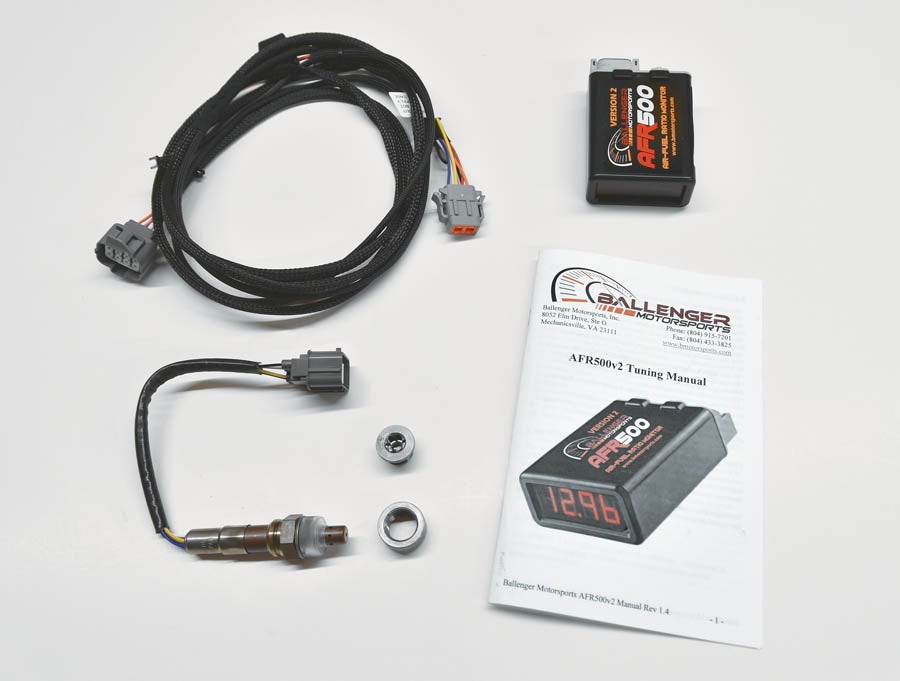
One more time, from post 2, the use of the NGK wideband sensor is essential and has been shown to live, accurately, many hundreds of hours with 100LL. Mine is well over 500 hours now and still works exactly the same. (probably because out of an abundance of caution I bought a spare sensor, which has still not been needed:)). The sensor and module that uses it that I used is from Ballenger Motorsports, and like mentioned before, its analog output integrates nicely with a number of EI Systems.

And which side to put the sensor on is also discussed in the Kitplanes article. From the article "Mine is a two-into-one dual exhaust system, combining cylinders 1 and 3 on the right, and 2 and 4 on the left. Cylinders 1, 3, and 4 peak at nearly the same mixture, while cylinder 2 peaks about 0.5 gallon per hour earlier. I chose to mount the sensor on the cylinder 1 and 3 side." Bottom line is it doesn't matter. EGT numbers in and of themselves are relatively meaningless. I simply chose the side where the EGTs were close and those cylinders were likely running similar mixtures.
 
One more time, from post 2, the use of the NGK wideband sensor is essential
There are many different NGK sensors available, do you have a model number?

Do you know if the O2 sensors put out a standard signal that can be used by any decoding module?? I am using one from AEM which Ross at SDS recommended. It would be great to find an O2 sensor that will work with this unit, and stand up to the 100LL for hundreds of hours.

 
Last edited:
One more time, from post 2, the use of the NGK wideband sensor is essential and has been shown to live, accurately, many hundreds of hours with 100LL. Mine is well over 500 hours now and still works exactly the same. (probably because out of an abundance of caution I bought a spare sensor, which has still not been needed:)). The sensor and module that uses it that I used is from Ballenger Motorsports, and like mentioned before, its analog output integrates nicely with a number of EI Systems.

And which side to put the sensor on is also discussed in the Kitplanes article. From the article "Mine is a two-into-one dual exhaust system, combining cylinders 1 and 3 on the right, and 2 and 4 on the left. Cylinders 1, 3, and 4 peak at nearly the same mixture, while cylinder 2 peaks about 0.5 gallon per hour earlier. I chose to mount the sensor on the cylinder 1 and 3 side." Bottom line is it doesn't matter. EGT numbers in and of themselves are relatively meaningless. I simply chose the side where the EGTs were close and those cylinders were likely running similar mixtures.
You must have a magic sensor; I go through ngk sensors every 30-50 hours. I know when it is fouled as it reads 14.7-14.8 all the time.
 
This is from the SDS manual EM-6. I do not operate SDS but there is no reason why I would not in the future. Ross makes some really nice CNC parts, and I respect his experience and knowledge. I have been operating EFII now for 650 flawless hours but again nothing wrong with SDS. Installed EFII in a new airframe only because what I had is working well and now, I understand EFII. I am helping a friend install SDS in his airframe and ran across this paragraph. My son-in-law works for Honda engineering, and he agrees with Ross's input giving me the same advice many years ago. I have a timer on my PLX system that keeps the unit off for 2 mins after the engine is fired up. Initial O2 sensor gave me a much longer lifespan but the next 3 have been more of the same 20 - 50 hrs.' and then 14.7 all the time. I do have a separate meter that shows the "health" of the sensor and that normally at 10 hrs. shows its gone bad. My only hope was to get lead free gas in the future that is convenient at my airport, still hoping. Getting decent reading for 10 to 20 hours allows one to map the system better and understand the MP/AFR/EGT relationship.

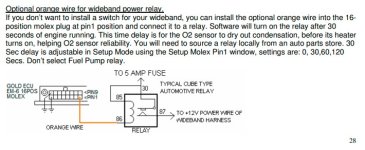
Don't shoot the messenger:

Screenshot 2025-02-17 172338.jpg
 
The info below is from the installation manual on the AEM/Uego system I have. According to Google 100LL has a max lead concentration of .56g/l so in theory the sensor should last around 15,000km if not run rich, hot or on an oil burner. FWIW.

Nominal Service Life:
80,000 km for Unleaded Fuel
50,000 km for Leaded Fuel 0.15g Pb/l
20,000 km for Leaded Fuel 0.40g Pb/l
10,000 km for Leaded Fuel 0.60g Pb/l
Notes:
The sensor contains a ceramic module and should not be subject to mechanical or thermal shock or it may be damaged. The sensor is not designed for operation on leaded fuels, doing so will dramatically shorten sensor life. Long term running in the rich region (Lambda < 0.95) will shorten sensor life. High exhaust temperatures (over 850C) will shorten sensor life. Engine oil consumption at a rate greater than 1 quart per 1,000 miles will shorten sensor life. With the UEGO Sensor installed, do not run the engine without power applied to the gauge.
 
Not sure which sensor you have but the Bosch 4.9 I have is supposed to be installed 18" from the exhaust port for proper readings and longevity. Your sensor may be different.
The NGK one is supposed to be lead tolerant but I've used the Bosch sensors in my Porsche projects and used them WELL further aft than 18". all my Porsche projects are forced induction, and you can't use the WBO2 in the pressurized section of the exhaust.

That said, 18" after of the exhaust port on an RV-8 is well further aft than I'd put it.
 
I have my AFR sensor in the #4 exhaust about 8” from the cylinder exhaust valve. It typically last around 30 hrs on 100LL. I only installed it to map my SDS EFI system, but I put a new one in once a year to make sure everything is still where I want it.

The smoke system that I have (not installed) only has two injectors, so I have three pipes to choose from. I have 4 straight pipes. I don’t recall the injectors needing to be that close to the cylinders. You should have plenty of space for an AFR and two smoke injectors.
I'm not sure measuring AFR of a single cylinder will accomplish much of what I'm trying to do, tbh. Need to bake on that.
 
There are many different NGK sensors available, do you have a model number?

Do you know if the O2 sensors put out a standard signal that can be used by any decoding module?? I am using one from AEM which Ross at SDS recommended. It would be great to find an O2 sensor that will work with this unit, and stand up to the 100LL for hundreds of hours.

AFAIK they all have a linear 0-5v DC output. There's some offset and linear calibration you'd need to do, there's a few spreadsheets out there to help but the math is easy
 
That said, 18" after of the exhaust port on an RV-8 is well further aft than I'd put it.
This from the installation instructions for my sensor...which I do my best to follow. As you see in your turbo case, it should be at least 36" downstream.

"weld-in M18 X 1.5 boss is supplied for sensor installation. Mount the O2 sensor in the exhaust system at least 18 inches downstream from the exhaust port. If you anticipate high EGT's (over 800C), run a turbocharger, run at high RPM for extended periods of time or plan on running leaded race fuel then you must mount the sensor at least 36 inches or more downstream of the exhaust port as all of these can cause the sensor to overheat. On turbocharged engines the UEGO sensor must be installed after the turbo charger, if not, the pressure differential will greatly effect the accuracy of the unit. For accurate readings, the sensor must be mounted before catalytic converters and/or auxiliary air pumps."
 
There are many different NGK sensors available, do you have a model number?

Do you know if the O2 sensors put out a standard signal that can be used by any decoding module?? I am using one from AEM which Ross at SDS recommended. It would be great to find an O2 sensor that will work with this unit, and stand up to the 100LL for hundreds of hours.


This is the sensor I use: https://www.bmotorsports.com/shop/product_info.php/cPath/103_105/products_id/352

If you check that link, they have a fair amount of detail.

They list a number of applications, and I did not see AEM on that list, but they say many more, so you might call them and ask.

In regard to longevity, in response to rocketman1988's comment, I can only say that my experience has been into the 100's of hours as has also been the experience of two others with the same Ballenger electronics and the above mentioned NGK sensor. And there are a number of different NGK wideband sensors. FYI, so as not to just optimistically imagine things, I periodically have correlated the A/F numbers with EGTs as well as fuel flows at power settings.
 
This is the sensor I use: https://www.bmotorsports.com/shop/product_info.php/cPath/103_105/products_id/352

If you check that link, they have a fair amount of detail.

They list a number of applications, and I did not see AEM on that list, but they say many more, so you might call them and ask.

In regard to longevity, in response to rocketman1988's comment, I can only say that my experience has been into the 100's of hours as has also been the experience of two others with the same Ballenger electronics and the above mentioned NGK sensor. And there are a number of different NGK wideband sensors. FYI, so as not to just optimistically imagine things, I periodically have correlated the A/F numbers with EGTs as well as fuel flows at power settings.
Thanks, will look into it.

Appreciate the link. :D
 
This is from the SDS manual EM-6. I do not operate SDS but there is no reason why I would not in the future. Ross makes some really nice CNC parts, and I respect his experience and knowledge. I have been operating EFII now for 650 flawless hours but again nothing wrong with SDS. Installed EFII in a new airframe only because what I had is working well and now, I understand EFII. I am helping a friend install SDS in his airframe and ran across this paragraph. My son-in-law works for Honda engineering, and he agrees with Ross's input giving me the same advice many years ago. I have a timer on my PLX system that keeps the unit off for 2 mins after the engine is fired up. Initial O2 sensor gave me a much longer lifespan but the next 3 have been more of the same 20 - 50 hrs.' and then 14.7 all the time. I do have a separate meter that shows the "health" of the sensor and that normally at 10 hrs. shows its gone bad. My only hope was to get lead free gas in the future that is convenient at my airport, still hoping. Getting decent reading for 10 to 20 hours allows one to map the system better and understand the MP/AFR/EGT relationship.

Don't shoot the messenger:

View attachment 81069

This is the sensor I use: https://www.bmotorsports.com/shop/product_info.php/cPath/103_105/products_id/352

If you check that link, they have a fair amount of detail.

They list a number of applications, and I did not see AEM on that list, but they say many more, so you might call them and ask.

In regard to longevity, in response to rocketman1988's comment, I can only say that my experience has been into the 100's of hours as has also been the experience of two others with the same Ballenger electronics and the above mentioned NGK sensor. And there are a number of different NGK wideband sensors. FYI, so as not to just optimistically imagine things, I periodically have correlated the A/F numbers with EGTs as well as fuel flows at power settings.
Curious if they have an adapter for that sensor to plug into the plx system I have installed. It has the Bosch 4.9 connector on it.

Might have to give that particular sensor a try…
 
Curious if they have an adapter for that sensor to plug into the plx system I have installed. It has the Bosch 4.9 connector on it.

Might have to give that particular sensor a try…
That same link has a tab for adapters and pigtails

ballenger is also my go-to for connectors and pins, they have a really good selection. For my FrankenCIS Porsche project I bought all my connectors there including the COPs, Bosche EV-1 fuel injector connections, and connectorsr for DELCO and all sorts of other stuff. I'm sure they have the necessary connectors to fix you right up.

AFAIK all the WBO2 sensors have a linear output there's just a little calibration needed.
 
No one can answer either question?

Surprised but, perhaps that shows how few people are using AFR to lean.
I'm not surprised. Due to the lead in AVGAS, there are very few who will attempt to use "AFR to lean", and of that small number who do, how many ALSO are operating a "smoke" system? Many of us who fly "alternative engines" use O-2 sensors to optimize mixture settings, and some of my Mazda rotary friends have reported they have had to change out their O-2 sensor after 300-400 hrs. of operation, on a steady diet of AVGAS.

Doug
 
I'm not surprised. Due to the lead in AVGAS, there are very few who will attempt to use "AFR to lean", and of that small number who do, how many ALSO are operating a "smoke" system? Many of us who fly "alternative engines" use O-2 sensors to optimize mixture settings, and some of my Mazda rotary friends have reported they have had to change out their O-2 sensor after 300-400 hrs. of operation, on a steady diet of AVGAS.

Doug
Few might be up to a sample size of 2. I'm guessing that the number of users who have SDS or EFII monitoring this forum is a few hundred yet there has been only one user (airguy) who has reported somewhat positive results using the Bosch LSU sensor when he uses unleaded fuel and lesser results using 100LL. Ross and Robert do seem to agree on one issue and that is we are not going to see more than 50 hrs. of life in a O2 sensor using 100LL. Of course, they both are recommending the Bosch sensor. Seems that if a silver bullet was just to switch to the NGK/NTK sensor they would have evaluated that option. (NGK/NTK sensors has been around for over 10 years) Reading literature on the Japanese sensor some technical bulletins state not to be used with leaded fuels while others indicate to recalibrate every hour if leaded fuel is used. Even that indicates it still works after seeing lead just not 100% accurate. Would love to hear from more users of the NGK/NTK O2 sensor or anyone who has found the proper adapter to use that sensor with our current Bosch connector. Looking at bmotorsports the connectors listed visually look incorrect. I've e-mailed them and waiting for a reply. If I need to replace existing cables, I can just prefer not to stand on my head for a few hours making the change. Has anyone tried this sensor/controller combination with 100LL?

 
Few might be up to a sample size of 2. I'm guessing that the number of users who have SDS or EFII monitoring this forum is a few hundred yet there has been only one user (airguy) who has reported somewhat positive results using the Bosch LSU sensor when he uses unleaded fuel and lesser results using 100LL. Ross and Robert do seem to agree on one issue and that is we are not going to see more than 50 hrs. of life in a O2 sensor using 100LL. Of course, they both are recommending the Bosch sensor. Seems that if a silver bullet was just to switch to the NGK/NTK sensor they would have evaluated that option. (NGK/NTK sensors has been around for over 10 years) Reading literature on the Japanese sensor some technical bulletins state not to be used with leaded fuels while others indicate to recalibrate every hour if leaded fuel is used. Even that indicates it still works after seeing lead just not 100% accurate. Would love to hear from more users of the NGK/NTK O2 sensor or anyone who has found the proper adapter to use that sensor with our current Bosch connector. Looking at bmotorsports the connectors listed visually look incorrect. I've e-mailed them and waiting for a reply. If I need to replace existing cables, I can just prefer not to stand on my head for a few hours making the change. Has anyone tried this sensor/controller combination with 100LL?

I am following but now that I have my map close to what I want, the AFR is in the ‘nice to have’ column now.
 
Few might be up to a sample size of 2. I'm guessing that the number of users who have SDS or EFII monitoring this forum is a few hundred yet there has been only one user (airguy) who has reported somewhat positive results using the Bosch LSU sensor when he uses unleaded fuel and lesser results using 100LL. Ross and Robert do seem to agree on one issue and that is we are not going to see more than 50 hrs. of life in a O2 sensor using 100LL. Of course, they both are recommending the Bosch sensor. Seems that if a silver bullet was just to switch to the NGK/NTK sensor they would have evaluated that option. (NGK/NTK sensors has been around for over 10 years) Reading literature on the Japanese sensor some technical bulletins state not to be used with leaded fuels while others indicate to recalibrate every hour if leaded fuel is used. Even that indicates it still works after seeing lead just not 100% accurate. Would love to hear from more users of the NGK/NTK O2 sensor or anyone who has found the proper adapter to use that sensor with our current Bosch connector. Looking at bmotorsports the connectors listed visually look incorrect. I've e-mailed them and waiting for a reply. If I need to replace existing cables, I can just prefer not to stand on my head for a few hours making the change. Has anyone tried this sensor/controller combination with 100LL?

I installed an sds system on a friends rv7 this summer. I also flew 20 hours in it to break in new cylinders I installed. Ross definitely recommends the ntk over the bosch if using 100ll. Not sure where you are getting your info. At 20 hours, the egt readings were still in lock step with the afr. I used afr for leaning, though I would consistently cross check the egt readings due to the risk with the sensors. I installed the AEM setup. They package it with either the bosch or the ntk sensor and do not think there was any difference in the instrument. The part number is the same and it is a crap shoot as to which sensor will be in the box. We called summit and had a rep go through the boxes to be sure we got one with an ntk sensor. Ntk does say that it is more tolerant of lead, but do not go so far as to endorse its use with lead.
 
I installed an sds system on a friends rv7 this summer. I also flew 20 hours in it to break in new cylinders I installed. Ross definitely recommends the ntk over the bosch if using 100ll. Not sure where you are getting your info. At 20 hours, the egt readings were still in lock step with the afr. I used afr for leaning, though I would consistently cross check the egt readings due to the risk with the sensors. I installed the AEM setup. They package it with either the bosch or the ntk sensor and do not think there was any difference in the instrument. The part number is the same and it is a crap shoot as to which sensor will be in the box. We called summit and had a rep go through the boxes to be sure we got one with an ntk sensor. Ntk does say that it is more tolerant of lead, but do not go so far as to endorse its use with lead.
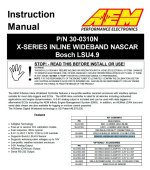
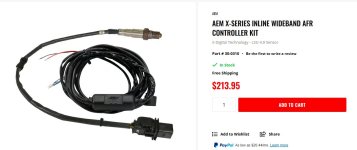
I obviously don't know AEM that well, (Use PLX) but this is the technical data sheets I was looking at. Shows using a Bosch LSU 4.9. This is the part number (AEM 30-0310) SDS calls out in their literature.

Screenshot 2025-02-20 091901.jpgScreenshot 2025-02-20 092800.jpg
 
Last edited:
I obviously don't know AEM that well, (Use PLX) but this is the technical data sheets I was looking at. Shows using a Bosch LSU 4.9. This is the part number (AEM 30-0310) SDS calls out in their literature.

View attachment 81287View attachment 81288
The 30-0300 X series package that you linked works with either the Bosch OR the AEM FAE sensor. The 30-0300 kit is packaged with either of those sensors with the same part #. Sensors have the same connector and use the same comm protocols.

Here is what AEM says about it

While the Bosch 4.9 LSU has excellent light off and response time, its performance tends to diminish rapidly in high performance racing applications where leaded fuels and rich fuel mixtures are more common, as are violent events like 2-step rev limiters in drag racing, high frequency vibrations, and upper rev limiters in drifting and other forms of motorsports. AEM’s goal was to design a sensor capable of surviving for extended periods in these extreme environments, and after five years of development and testing with FAE, the company has validated its new sensor to last longer in harsh environments and have a faster response time than the Bosch 4.9 LSU.

I was wrong; It is not an NTK, Though it is possible NTK is re-branding yhis FAE sensor.

Ross' docs reference the bosch, but if you talk with him, he recommends the new FAE, as it is promiseed to be better with Lead. It was his recommendation that sent me down this path.
 
Last edited:
I received this e-mail from Ballenger this morning:

"Most LSU based widebands do not have the ability to natively use NTK sensors. Unless NTK is explicitly mentioned in your user documentation, I would assume that it is not compatible."

They go on to say that the reference using PLX is something they don't know where it came from and occurred over 10 years ago, they are going to remove any applications that are not Ballenger in their literature.

It appears to use a NTK sensor one must use a Ballenger module. Since it has a 0-5V output should work with EFII or SDS if desired. It appears the AEM sensor can be used in place of the Bosch 4.9 LSU I will try that next.
 
Last edited:
There are a couple threads discussing A/F Ratio monitoring and airplane applications. Also - I wrote a Kitplanes article a while ago "Adding Direct Air/Fuel Ratio Monitoring",


which you might find useful. It is an extremely powerful technique for setting mixture for various operating regimes. I think you'll find the answers to your questions there, including picking the side of the exhaust.

A couple comment since the article was published some time ago:
  1. If you have a Garmin or Dynon EIS, you can easily add the analog output of the A/R monitor to the display, so no need to locate a display somewhere.
  2. The use of the right sensor, e.g. NGK, is essential to longevity given lead in the fuel.
Excellent advice given above. I will also add Denso sensors to the recommended list. FYI, soot from smoke or lead from 100LL will burn off the sensor once you switch back to an unleaded fuel or stop smoking. FYI, NGK's oxygen sensors are called NTK here in the USA.
 
Back
Top