Van's Air Force

The definitive Van's Aircraft support community! Buying, building or flying an RV? Join our exclusive family of mentors and enthusiasts!

Oil sump heater usage

Tankerpilot75

Well Known Member
I’m sure this has been discussed in the past but I’m going to ask the question again. I’ve got the Reiff Hotstrip Oil Sump heater on my engine. Is there any reason why this can’t be left plugged in during the winter months?

Here in Oklahoma the weather in January, February and early March can be 65 degrees one day and -10 degrees the next. I don’t have WiFi at the hanger but do have electricity. In November and early December I arrive an hour and a half early, plug in the heater and allow the oil to heat up a little before engine start. At engine start it was usually above 45 degrees.

Its usually much colder now so I just leave the Reiff heater plugged in all the time, a blanket over the engine cowl, and plugs in the inlets. Engine start now shows the oil temp around 60+ degrees. During preflight when I check oil level the entire engine compartment feels like it’s around 60 to 70 degrees.

I leave my EarthX battery charger also plugged in when not at the hanger. Don’t worry about the electric bill. It’s included in the hanger rental.

I personally believe leaving it plugged in all the time during the colder winter months is better than cycling it off and on. No, I don’t have a dehumidifier. What’s the consensus?
 
Here in North Carolina I do not worry about it. Hangar is 18 steps from the house plus it has a heat pump and WiFi. I can put a WiFi switch on my heater if I want but typically temperature never goes below 40 even with the heat not on. The heat pump in the hangar is connected to a Nest thermostat so I can raise / lower the temperature from anywhere as needed. The dehumidifier in the hangar runs 6 hours a day in the winter and typically 16 to 24 hours a day in the summer.

When I was in PA, I had a cell activated switch on the heater. I found that in the cold southwestern PA (Pittsburgh area / KVVS), turning the sump heater on 2-hours before I wanted to start the engine was perfect. I would typically have 80-degree oil temp when I reached the runup area and was ready to do my runup.

I can remember others reporting that it was best to not leave the engine sump heater on all the time.
 
There are several good videos on the subject by Tanis. They did multiple studies measuring humidity and temps in an engine. I believe they still recommend if you have a sump heater and cylinder heat then leave it on continuously. If you have only the sump heater then turn it on only to preheat only and with the intension to fly.
 
I don't have wifi either, so use a Switcheon to turn on my Rieff pre-heater (sump+cylinder bands) several hours in advance of flying. That Switcheon also starts a Hornet 45 cockpit heater at the same time. All that said, I wouldn't have any concerns leaving that pre-heater running all the time.
 
Jim,

Invest in a cellular Switcheon since you don’t have WiFi. You buy the unit then it’s $50 a year for the service. I don’t have WiFi in my hangar either and Switcheon works perfectly every time. I turn the battery charger and the engine heater on for a couple hours prior if it’s really cold and I plan on flying. Otherwise I don’t turn either one for the same reason as Walt.
 
Jim,

Invest in a cellular Switcheon since you don’t have WiFi. You buy the unit then it’s $50 a year for the service. I don’t have WiFi in my hangar either and Switcheon works perfectly every time. I turn the battery charger and the engine heater on for a couple hours prior if it’s really cold and I plan on flying. Otherwise I don’t turn either one for the same reason as Walt.
+ 1 for Switcheon. I do not have WIFI in my hangar and use Switcheon for a sump heater and a ceramic cockpit heater. Here in Wisconsin I sometimes have to turn it on as much as 6 hours in advance of flying but it works really well. I especially like the fact that I can program it to turn on at a certain day and certain time and also program it to turn off.
Keith
 
Some believe, including Tanis, that there is a benefit in reducing the opportunity for corrosion if you have both a sump heater and cylinder heat and leave them on continuously. Tanis has some data to support this claim.

As far as leaving something plugged in all the time in a hangar how is it any different than leaving something plugged in in a house? I just make sure that I am using the very best equipment to reduce the chance of an electrical issue.
 
Some believe, including Tanis, that there is a benefit in reducing the opportunity for corrosion if you have both a sump heater and cylinder heat and leave them on continuously. Tanis has some data to support this claim.

As far as leaving something plugged in all the time in a hangar how is it any different than leaving something plugged in in a house? I just make sure that I am using the very best equipment to reduce the chance of an electrical issue.
Tanis' data isn't conclusive, but it is persuasive. Keeping the engine warm will prevent or minimize excursions across the dew point, therefor reduce or eliminate condensation, but I doubt that it will help with corrosion much overall if the ambient humidity is often greater than about 40-50%. Adding a dehydrator would help. I don't opt for heat to manage engine humidity, just managing the water inside the engine.

Likewise, I don't worry much about leaving things plugged in inside the hangar, but the above post did prompt me to email the airport administration to ask if the hangars all had GFCIs on the three plugs (all in parallel) in my hangar as recommended by the NEC. I'm assuming that they do, but I don't have access to the circuit breaker panel so can't be sure.
 
I’m sure this has been discussed in the past but I’m going to ask the question again. I’ve got the Reiff Hotstrip Oil Sump heater on my engine. Is there any reason why this can’t be left plugged in during the winter months?

Here in Oklahoma the weather in January, February and early March can be 65 degrees one day and -10 degrees the next. I don’t have WiFi at the hanger but do have electricity. In November and early December I arrive an hour and a half early, plug in the heater and allow the oil to heat up a little before engine start. At engine start it was usually above 45 degrees.

Its usually much colder now so I just leave the Reiff heater plugged in all the time, a blanket over the engine cowl, and plugs in the inlets. Engine start now shows the oil temp around 60+ degrees. During preflight when I check oil level the entire engine compartment feels like it’s around 60 to 70 degrees.

I leave my EarthX battery charger also plugged in when not at the hanger. Don’t worry about the electric bill. It’s included in the hanger rental.

I personally believe leaving it plugged in all the time during the colder winter months is better than cycling it off and on. No, I don’t have a dehumidifier. What’s the consensus?
I would leave it plugged in all winter. The maintenance charger too. The exception would be high output units
 
Tanis' data isn't conclusive, but it is persuasive. Keeping the engine warm will prevent or minimize excursions across the dew point, therefor reduce or eliminate condensation, but I doubt that it will help with corrosion much overall if the ambient humidity is often greater than about 40-50%. Adding a dehydrator would help. I don't opt for heat to manage engine humidity, just managing the water inside the engine.

Likewise, I don't worry much about leaving things plugged in inside the hangar, but the above post did prompt me to email the airport administration to ask if the hangars all had GFCIs on the three plugs (all in parallel) in my hangar as recommended by the NEC. I'm assuming that they do, but I don't have access to the circuit breaker panel so can't be sure.
I would bet that they are not on GFCI breakers. The issue would be that if a GFCI trips, there would need to be someone with access to the electrical service to reset it...causing problems when no-one is available. At my airport they put out many notices every year to make sure that people use a GFCI plug for their hangar accessories...
 
I would bet that they are not on GFCI breakers. The issue would be that if a GFCI trips, there would need to be someone with access to the electrical service to reset it...causing problems when no-one is available. At my airport they put out many notices every year to make sure that people use a GFCI plug for their hangar accessories...
Interesting, I guess I’ve never paid any attention to it, but you’re right… If the GFI trips there won’t be power to the hanger outlets until maintenance can show up. I’ve never been notified one way or the other about GFCIs. The main box for the block of hangers is not available to any of the hangar renters. The motor that lifts the door is on its own 220 circuit and each T- hanger has one 15 amp branch circuit, each with three outlets.
 
Interesting, I guess I’ve never paid any attention to it, but you’re right… If the GFI trips there won’t be power to the hanger outlets until maintenance can show up. I’ve never been notified one way or the other about GFCIs. The main box for the block of hangers is not available to any of the hangar renters. The motor that lifts the door is on its own 220 circuit and each T- hanger has one 15 amp branch circuit, each with three outlets.
I'm with Walt, don't leave stuff plugged in at the hangar unattended.

 
The issue with heaters like that is they also raise the humidity which will condense on the coldest bit of metal inside the engine.

There are outfits that sell gadgets that suck air through descant and pump it into the engine to reduce the internal humidity.

I say turn on your favorite heat source only when you plan on starting the engine when the motor is less than 35 degrees. There is enough data to strongly recommend against starting the engine when it is 32 or below.

For my daily driver, I bought a small space heater to place under the engine and a large fire blanket to fully drape over the prop and cowling. And no I don’t feel comfortable leaving it powered on and unattended.
 
There are outfits that sell gadgets that suck air through descant and pump it into the engine to reduce the internal humidity.
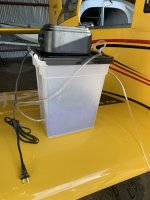
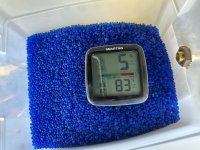
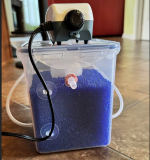
Such a device is simple and cheap to make. Only expensive part, relatively, is the silica gel (a lot cheaper 4 years ago). I use 15 lbs in a closed container and pump the dry air through the engine with an aquarium pump. That much silica...I only need to recharge the stuff every few months when it turns orange. I have no concerns leaving it run 24/7/365 pumping air with 5% relative humidity through the engine's dipstick tube. I only run the pre-heater as needed, turning it on remotely. It's just not practical to only run these items while I'm there.

IMG_8470.jpegIMG_1335.jpeg
 
Last edited:
I'm with Walt, don't leave stuff plugged in at the hangar unattended.

Yeah, that’s just not going to work for a whole lot of people. If I want to fly in the winter, like now, it’s 19 degrees outside. You are saying go to the hangar and plug in the Reiff engine heater and then sit in the hangar until the engine is warm?

I don’t think so.

I prefer to use my Switcheon and start the preheat several HOURS before I go to the airport. Unless you have a heated hangar or never fly when it is cold, you are going to have to leave something plugged in while unattended. Unless, of course, you want to sit with the airplane for hours in a freezing hangar.

…and a data point for your reference to plastic conduit. In our area, commercial buildings require metal conduit.
 
I'm glad your risk tolerance is high enough. Mine isn't.

The post I linked shows an entire hangar row being destroyed. Wonder if re-insurance covers all that.

I never mentioned plastic conduit.

My home airport KGPM had a fire in the flight school hangar with a golf cart charger, left unattended, that destroyed their whole fleet and the hangar. UL listed, commercial code, etc. the airport has conservatively decided to ban remote/unattended electrical devices.

And no, I don't think 30 mins on a heater while you pre-flight/clean up in the hangar is a big deal. Easy for me to say in TX, but I have operated in NM and it wasn't a big deal there either. Of course, I fly a fair amount so maybe that helps.

You do you, as you have so authoritatively declared.
 
I'm glad your risk tolerance is high enough. Mine isn't.

The post I linked shows an entire hangar row being destroyed. Wonder if re-insurance covers all that.

I never mentioned plastic conduit.

My home airport KGPM had a fire in the flight school hangar with a golf cart charger, left unattended, that destroyed their whole fleet and the hangar. UL listed, commercial code, etc. the airport has conservatively decided to ban remote/unattended electrical devices.

And no, I don't think 30 mins on a heater while you pre-flight/clean up in the hangar is a big deal. Easy for me to say in TX, but I have operated in NM and it wasn't a big deal there either. Of course, I fly a fair amount so maybe that helps.

You do you, as you have so authoritatively declared.
So you will sit in a 19 degree hangar for 3 hours while the engine is pre heating? Right, gotcha.

More likely is that you wouldn’t fly.

Anyway, you do you, too…as you have declared.
 
So you will sit in a 19 degree hangar for 3 hours while the engine is pre heating? Right, gotcha.

More likely is that you wouldn’t fly.

Anyway, you do you, too…as you have declared.
30 minutes is not 3 hours.

Please don't burn down anyone's hangar.
 
A data point: We navigate risk. We can manage risk so its not so risky, like a mountain climber who lowers risk by using rope, hardware, gear, helmet and technique instead of Free climbing. The free climber can climb quicker, but its riskier.

So what gets plugged in and how its wired matters. LiFe Batteries are known by fire chiefs everywhere to be very risky. For example, NYC has made it illegal to store an eBike inside due to plethora of fires. But aquarium air pumps and lamps are still okay to use in a NYC apartment.

 
OP....about leaving the heater plugged in. Another data point to consider. Aluminum is an excellent conductor of temperature. That is science, not my opinion. And so I imagine a hangar at night when its 10F. The engine is plugged in and warm. and its constant speed prop is aluminum. The prop will conduct heat away and so that area (the prop hub and front case bearing) wont be as warm. Now, inside the crank case is that moist air from combustion, and the coldest spot has higher risk of condesing that crankcase air (Like a glass of lemonade in the summer). (The following moves from science to opinion) So that may be why some have data showing Prop hubs have had corrosion issues when left plugged in.

To manage that possibility, purge the crankcase air with a blow dryer after you fly, then plug in the dehydrator to keep the crankcase air dry. Maybe fabricate your own insulated prop and spinner covers too so that the conduction of cold is reduced.
 
To manage that possibility, purge the crankcase air with a blow dryer after you fly, then plug in the dehydrator to keep the crankcase air dry. Maybe fabricate your own insulated prop and spinner covers too so that the conduction of cold is reduced.
I want it to be as simple as possible, with as few steps as possible, so I skip the high-volume purging and just hook up the dehydrator as soon as I push the plane back into the hangar. Since the dehydrator is running 24/7/365, I don't worry about condensation in the engine from an aborted pre-heating cycle. As to the prop...mine is a composite MT.
 
I want it to be as simple as possible, with as few steps as possible, so I skip the high-volume purging and just hook up the dehydrator as soon as I push the plane back into the hangar. Since the dehydrator is running 24/7/365, I don't worry about condensation in the engine from an aborted pre-heating cycle. As to the prop...mine is a composite MT.
Thats fine. I like simple too. I want a cart with a power strip, with a hair dryer in improve simple.

I have a closed loop system like I see in the Post #15 photo. I think (stress think....might not be truth) my beads got some contamination on them from contamintaed cranks case air, so consider using a very inexpensive filter. Like one in the Amazon link below. I actually run one on both in air going in and out. Theory is silica dust from the beads might enter the case and cause higher than ideal silica values in an oil analysis.

 
Thats fine. I like simple too. I want a cart with a power strip, with a hair dryer in improve simple.

I have a closed loop system like I see in the Post #15 photo. I think (stress think....might not be truth) my beads got some contamination on them from contamintaed cranks case air, so consider using a very inexpensive filter. Like one in the Amazon link below. I actually run one on both in air going in and out. Theory is silica dust from the beads might enter the case and cause higher than ideal silica values in an oil analysis.

The setup in #15 is mine. It's not closed-loop but it used to be. I have a piece of tubing with a fitting that ran from my oil separator back to the pump air intake. My reasoning was that a closed-loop system would result in fewer bead cycles. It was a nuisance, however, in that I had to get down on my back to hook up it each time, so I stopped doing that. With 15 lbs of silica gel beads, without closed-loop, I have to cook them to "recharge" about four or five times per year...more in the summer, less in the winter. That will vary depending on the airflow output of the pump. I have mine turned down to a pretty low volume. I calibrated it a while back using a condom to make sure there was positive airflow. I have an additional 15 lbs and just exchange them, bring the old ones home to cook in the oven. I been using the same 30 lbs of silica gel beads for 4 years.

Initially, I didn't use a filter on the output line (didn't think of it). Looking back on my Blackstone reports, silica levels were always miniscule, but I saw a post here somewhere about it a year or so ago and I now put a 5 micron beer-keg brewing filter inline when I change the beads because...why not? They're about $2 each.

 
30 minutes is not 3 hours.

Please don't burn down anyone's hangar.
30 minutes? On an engine that is 19 degrees? What are you using to preheat, a gas forge?

I have a Reiff XP system with pads and cylinder bands; 30 minutes at 19 degrees won’t even get you above freezing.

Thermodynamics are the same for everyone so please illuminate everyone about a thirty minute preheat from 19 degrees.
 
30 minutes? On an engine that is 19 degrees? What are you using to preheat, a gas forge?

I have a Reiff XP system with pads and cylinder bands; 30 minutes at 19 degrees won’t even get you above freezing.

Thermodynamics are the same for everyone so please illuminate everyone about a thirty minute preheat from 19 degrees.
I don't know who pissed in your frosted flakes but you are being contentious in several threads.

Further engagement won't be productive.


Maybe I should put my degree credentials in my signature too.

This thread has already gone way off the rails so I'll let the OP to consider things to address:

1: monitor dew point and corrosion with preheat.

2: Lycoming only recommended preheating when below 10F.

3: there is a fire risk that should be mitigated with unattended electric devices. Some airport boards prohibit their use to meet insurance requirements.
 
I have a system very similar to MacCool. Mine only has 5 pounds of beads so I have to cook it more often. About once a month in summer and every 2-3 months in the winter. Mine is a closed loop and I have a filter on the inlet going into the breather tube. I send oil to Blackstone every other change and never had concern of silicone. I got mine from http://www.rbaviation.com/mojave/ I leave it plugged in 24/7. John von Linsowe is the guy who made it. von-flyer on the forum.

As for the heat, I turn my antisplat heater on at least 4 hours before I go to the airport. I also have a small electric heater ducted into the cowling inlet that feeds hot air into the plenum that I turn on at the same time. It works well for me.
 
I have a system very similar to MacCool. Mine only has 5 pounds of beads so I have to cook it more often. About once a month in summer and every 2-3 months in the winter.
I just built one as well, but only with a 3lbs bead capacity. I wonder if this is too small. It is cycling 1 hour on, one hour off. The pump moves twice the volume of the container per minute (5 l/min)

1736745171899.png
 
I just built one as well, but only with a 3lbs bead capacity. I wonder if this is too small. It is cycling 1 hour on, one hour off. The pump moves twice the volume of the container per minute (5 l/min)

Bead volume is drying capacity. Less bead volume means faster moisture saturation by the beads. My bead volume is about a gallon and looks similar to yours.

I want to know the moisture content of my engine crankcase. By making the system closed loop I route air back into a big clear sealed plastic tub. I have my box of beads inside a big tub. The air returns from the engine into the tub. Then the air pump draws the engine return air into the smaller bead box that resides inside the tub. A humidity indicator inside the big tub shows the return air moisture content from the engine crankcase. ( an example is the amazon Thermopro TP50)

A data point I learned is my beads look just like new until the humidity gets to about 33%. So I like my closed loop with humidity indicator and I put them in the dryer before they start to turn color when I see the rise go to 18-20%. Closed loop also recylces the engine dry air so the beads stay dryer much longer.

But hey, what you got works fine. But you might like knowing what the humidity actually is, and you might like a longer time between serving the beads. What you got works though. make the system simple for you.
 

Attachments

  • Screenshot 2025-01-13 at 5.57.41 AM.png
    Screenshot 2025-01-13 at 5.57.41 AM.png
    2.2 MB · Views: 19
Bead volume is drying capacity. Less bead volume means faster moisture saturation by the beads. My bead volume is about a gallon and looks similar to yours.

I want to know the moisture content of my engine crankcase. By making the system closed loop I route air back into a big clear sealed plastic tub. I have my box of beads inside a big tub. The air returns from the engine into the tub. Then the air pump draws the engine return air into the smaller bead box that resides inside the tub. A humidity indicator inside the big tub shows the return air moisture content from the engine crankcase. ( an example is the amazon Thermopro TP50)

A data point I learned is my beads look just like new until the humidity gets to about 33%. So I like my closed loop with humidity indicator and I put them in the dryer before they start to turn color when I see the rise go to 18-20%. Closed loop also recylces the engine dry air so the beads stay dryer much longer.

But hey, what you got works fine. But you might like knowing what the humidity actually is, and you might like a longer time between serving the beads. What you got works though. make the system simple for you.
Can you confirm you are going in the dipstick tube and out the breather? Exhausts are taped over?
 
Back when I had my system set up as closed loop, I monitored the humidity of the air returned from the engine breather and found it to consistently be about 8-10% when the air being pumped in from the bead chamber was 5%. That relationship stayed consistent as the beads got increasingly saturated and I changed out the beads when the returned air was measured at about 25%. I abandoned the return line a couple of years ago (inconvenience of hooking it up after a flight) and now change out the beads when the pumped air in gets to about 20-25%. That’ about 2-4 months depending on time of year. Only advantage of the return line is (theoretically) changing out the beads less often and that was mitigated by just adding more silica to the air chamber.

I’ve never taped over my exhaust. That would be way more inconvenient than I’d want and for my goal, unnecessary.

IMG_0868.jpeg
 
Last edited:
Can you confirm you are going in the dipstick tube and out the breather? Exhausts are taped over?
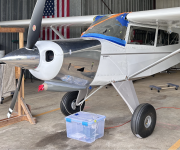
That is correct. What you see is an aircraft being built. Its done now and the exhaust gets plugged along with engine air intake. My breather tube whistle slot is sliced into a flexible silicone rubber tube so its mostly closed up. I doubt any leakage in the closed loop. But if case pressure were to build it would open up and relieve pressure.
 
Back
Top