Van's Air Force

The definitive Van's Aircraft support community! Buying, building or flying an RV? Join our exclusive family of mentors and enthusiasts!

Optimizing engine cooling - how to proceed (RV-4)

Dear Gentlemen,

I am new here and need your opinion to find the right way to optimise the cooling on an RV-4.

Facts:
I've been flying a friend's RV-4 this year. The plane is equipped with an O-320 (150hp) and a Catto 2-blade fixed pitch propeller. It is well built, with the emphasis on light weight and high speed.
In the quest for more speed/less drag, the cooling air intakes were reduced and a plenum was made. The plenum and baffles are really well sealed.
Since then the fast lady has very high CHTs in summer. In winter the temperatures are ok.
Opening the oil cooler has no significant effect on the CHTs and oil temperature.
I have also noticed that even with the cabin heater closed, warm air is still being forced into the cockpit from the front.

The owner now wants to start lowering the temperatures again. There are several ideas and we have done a lot of calculations. The question is which steps to take first.

Options:
  1. Increase the size of the cooling air intakes: Currently the inlets are about twice 65cm²/10.075inches². According to an article by Dave Anders, I have calculated a minimum size of at least twice 75cm²/11.625inches². However, enlarging the inlets is very time consuming, creates more drag and changes the current beautiful appearance of the aircraft. If it can be avoided, it would not be the first choice.
  2. Augmented exhaust cooling: The owner's idea was to tackle this project first. However, this would require extensive modifications to the cowling and exhaust system. The question is whether this will have the desired effect if the air intakes are actually too small.
  3. Cowl flaps: As an alternative or in addition to increased exhaust cooling, cowl flaps could be fitted. The modification is not quite as complex. However, the same question arises as to whether this is of any use if the airflow from the intakes is too low.
  4. Optimise the oil cooler: The oil cooler certainly needs to be optimised. The question is whether this will be enough to bring the temperatures back into the green. Probably not, but it would be the easiest modification.
Any ideas are welcome!
 
Last edited:
Go into the Kitplanes Magazine archives and find the articles by Dave Anders. He spent a ton of time and effort minimizing drag and optimizing cooling on his -4 and documented most of the process there. Take a look. It will be very worthwhile. Also, you might as well use the search function here and look for "Dave Anders". I'm sure his name will pop up with relevant information.
 
Go into the Kitplanes Magazine archives and find the articles by Dave Anders. He spent a ton of time and effort minimizing drag and optimizing cooling on his -4 and documented most of the process there. Take a look. It will be very worthwhile. Also, you might as well use the search function here and look for "Dave Anders". I'm sure his name will pop up with relevant information.
Unfortunately I did not ask clearly. I have read all of Dave Anders' articles and done all the calculations.
According to my calculations, the cooling inlets are currently too small.

However, enlarging the cooling inlets or changing the exhaust system is a big change and requires a lot of work.

So I ask if there are smaller steps that could also lead to success or if it is pointless to improve something if there is not enough air in general.

IMG_1182.jpeg
 
Last edited:
How warm is warm? What are the CHT's you are seeing?
Airguy, thank you for your question. Sometimes it helps to look everything up again.
I only have a little experience on the airplane and the following figures are from the cruise flight:

7°C OAT; 2510rpm/23.3inchHg = 75% power:
360°F CHT; 1440°F EGT, 226°F Oil. ROP

20°C OAT; 2440rpm/22.4inch/Hg = 70% Power:
340°F CHt, 1467°F EGT; Oil ot noted. ROP

20°C OAT,; 2440rpm/20.2inch/Hg = 60% Power:
338°F CHT; 1406° EGT; Oil not noted. Rich

To be honest, the numbers don't look that bad to me. What do you guys think?

But I also asked the owner again what the Problem really is: he reported during Summer (25-30°C OAT), while cruising, the CHT are around 400°F and the oil temp rising to 225°F with Oil cooler fully opened.
According to Lycoming, CHT up to 450°F in continuous operation is fine. The owner does not like anything above 400°F. What are your opinions?
It seems that only the oil cooler is not working properly. So that would probably be the first step, even if the inlet areas on the cowlimg are (too) small overall.
 
Airguy, thank you for your question. Sometimes it helps to look everything up again.
I only have a little experience on the airplane and the following figures are from the cruise flight:

7°C OAT; 2510rpm/23.3inchHg = 75% power:
360°F CHT; 1440°F EGT, 226°F Oil. ROP

20°C OAT; 2440rpm/22.4inch/Hg = 70% Power:
340°F CHt, 1467°F EGT; Oil ot noted. ROP

20°C OAT,; 2440rpm/20.2inch/Hg = 60% Power:
338°F CHT; 1406° EGT; Oil not noted. Rich

To be honest, the numbers don't look that bad to me. What do you guys think?

But I also asked the owner again what the Problem really is: he reported during Summer (25-30°C OAT), while cruising, the CHT are around 400°F and the oil temp rising to 225°F with Oil cooler fully opened.
According to Lycoming, CHT up to 450°F in continuous operation is fine. The owner does not like anything above 400°F. What are your opinions?
It seems that only the oil cooler is not working properly. So that would probably be the first step, even if the inlet areas on the cowlimg are (too) small overall.
Lycoming recommended CHT maximum for cruise, 435 for maximum performance cruise, 400 for long range cruise.
 
Where is the oil cooler? I'm aware most RV coolers on on left side. Right side theoretically has best airflow. Angleing the cooler back 15 degrees has worked for me. Not an RV. I think for thee 4 a cowl flap on each side would be the simplest starting point, considering that enlarging the inlets would be the most time consuming. Does the plenum have a reasonable radius on the top of the aft baffle?
 
But I also asked the owner again what the Problem really is: he reported during Summer (25-30°C OAT), while cruising, the CHT are around 400°F and the oil temp rising to 225°F with Oil cooler fully opened.
Is he running LOP with these temps in the Summer? Generally speaking, "around 400" with high OAT and big power are not out of line - so long as the engine cools off with a reduction in power (such as LOP cruise). The oil temps are an area that needs the first look, however. A transient of 225 is one thing but if they stabilize there, that's an issue.
 
400-410 in climb at full power, I would consider slightly warm but not out of range. LOP in cruise, stable, should be below 400 and ideally below 380 even in summer. Oil should be stable down in the 215 or lower range IMHO.
 
Where is the oil cooler? I'm aware most RV coolers on on left side. Right side theoretically has best airflow. Angleing the cooler back 15 degrees has worked for me. Not an RV. I think for thee 4 a cowl flap on each side would be the simplest starting point, considering that enlarging the inlets would be the most time consuming. Does the plenum have a reasonable radius on the top of the aft baffle?
The oil cooler is on the left-hand side, vertically mounted directly behind the baffles. I've already seen that there are tons of reports here on how to optimize the oil cooler. But let me ask you some questions:
- Can you briefly describe what the 15° tilt does?
- How much is a reasonable radius on top of the aft baffle?
pic.jpg

If you are seeing 20C degree OAT, then there is nothing wrong with 340F CHT. In fact, it's over cooling IMHO
Is he running LOP with these temps in the Summer? Generally speaking, "around 400" with high OAT and big power are not out of line - so long as the engine cools off with a reduction in power (such as LOP cruise). The oil temps are an area that needs the first look, however. A transient of 225 is one thing but if they stabilize there, that's an issue.
To be honest, I'm not sure how the numbers come together for him. My figures look fine to me. Except for the oil, which is too warm.
He always mentions a flight in summer where the CHT and Oil got very hot. "In climb it was barely possible to stay below 400°F, the oil rose to 225°F in cruise". His general feeling seems to be that the engine gets too warm when it is 25-30°C OAT in summer.
Again, for me it looks like the CHT are okay and as @airguy mentioned: If CHT are below 400°F (better around 380°F) in cruise and go only above 400°F for a few minutes on a very hot day in climb, then that should be fine.

1. The first step is probably to optimize the oil cooler, that is out of the question.
2. The second step is to collect my own numbers over the next summer.

But one general question in advance:
- Does a cowl flap make any sense at all if the air intake is perhaps too small? I mean, if not enough air comes in at the top, then no more air can come out at the bottom. Or do the cowl flaps generate a kind of suction that helps to increase the deltaP?
- Any other recommendation than the “EZ Cool Cowl Flap” from antisplataero.com which seems to be sold?
 
Last edited:
My only thought on the cooler angle is that it moves the cooler further away from the cylinder heat. I copied it from a Tailwind that was a consistent winner in SARL Races. 236 statute in the last race a few years ago. Airplane was sold and no longer racing.
Your CHT''s are fine. Oil temp needs some work. No need to increase the inlets in my opinion.
 
Concerning the oil cooler - There are many pitfalls and associated fixes in both airflow management and fluid management. One of the hardest to diagnose is a poorly sealing vernatherm seat. The vernatherm operation is fairly easy to verify on the bench but that still does not assure the port is closed tightly. Fortunately, the installation of a viscosity valve is both easy and effective. That is one thing that can be done in minutes to save you hours and hours of troubleshooting. Hot oil temps and no obvious answer? Throw in a viscosity valve and fly again. If temps come down, you have an oil flow issue.
 
- Does a cowl flap make any sense at all if the air intake is perhaps too small?

Within the practical range, intake size does not really determine how much air passes through the system. Rather, mass flow (pounds of air per second) is (or should be) a function of the exit, designed as the system throttle.

When considering an inlet, the primary interest is how much of the available dynamic pressure is converted to static pressure above the engine. For the same tightly baffled engine, good inlets will net as much as 90%, and bad ones may be a poor as 65%. We can get a high percentage with a small inlet or a large inlet, but the small inlet will require carefully shaped internal ducting, while the large inlet requires none. Respectively, they operate based on internal diffusion or external diffusion...slowing of the freestream (a) inside the cowl, in a diverging duct, or (b) out in front of the inlet.

The secondary interest is external drag. Contrary to popular belief, a large inlet does not automatically mean more drag. The aircraft frontal area remains the same. The issue is how well the air flows out and around the edges of the inlet. If the flow remains attached, in particular in the region just aft of the inlet lips, the large inlet will not cause appreciably greater drag. As compensation, external diffusion is frictionless.

Yes, it is possible to throttle flow at the inlet, but dumb as a box of rocks, because downstream of the engine baffle's pressure drop there will be little remaining pressure, thus exit velocity will be poor. Cooling drag = mass flow x loss of velocity. Design two systems with the same mass flow, one inlet throttled and one exit throttled, and they will cool the same. However, the exit-throttled airplane will be faster because exit velocity will be higher.

An exit throttle works by lowering pressure on the underside of the engine when open. The increase difference between the upper and lower plenums forces more air through the fins. Closing the exit increases lower cowl pressure, so less flow through the fins. It also boosts exit velocity, decreasing cooling drag.

Or do the cowl flaps generate a kind of suction that helps to increase the deltaP?

They can, but that approach is a drag producer. Think low velocity, a large turbulent wake, and additional frontal area. However, it works, and is entirely acceptable if additional cooling overrides an interest in speed. Better to design for high pressure at the inlet end of the system, and treat the exit as a variable area throttle, rather than a flap sticking out into the freestream.
 
I started my own cooling optimization project this week on my RV-4. Quick background, during phase 1 in the 100 degree CA Central Valley (with a new engine not-yet settled) the bottom of the cowl was trimmed a fair bit to get temps under control. Fast forward 75 hours and the engine temps have not only settled, but run quite cold up in the Oregon climate. Both CHT and Oil temp. Additionally, my top speed is a fair bit lower than I expected. I’ve been busy, and enjoying flying to much to tear back into it, but I’m finally getting around to it…

Before tackling other speed mods, I figured I’d start by getting my cooling closer to optimal.

My first step was to close off some exit area to get an idea on where it could be. This was half a WAG, half based on similar aircraft exit areas, and half based on what would conveniently line up with the existing forward floor ribs once a a ramp and cowl flap needed to be attached. With 1 and 1/2 decision made ;) , I chopped and bent up a piece of .040 and fastened it to the motor mount via Adele clamp, and the bottom of the cowl.
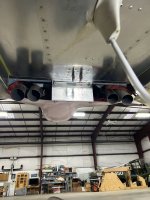
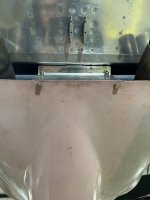
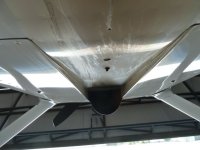
Yes, this is rough, not smooth flowing, and the tufts would be going every direction but aft if they were there…. But i figured it’d give me a second-baseline to improve from.

IMG_8004.jpeg

IMG_8005.jpeg

I got to fly it today, and it worked fairly well for what its job was. Today was 55 degrees F at 4500 ft. Sustaining full power and 2500 rpm got my oil up to 185 and my CHT’s spread 323-350.

Thats about 20 degrees warmer on the CHT, and 5 degrees for the oil. And, TAS airspeed is reading about 4 kts higher (though I should really go fly a couple clovers with/without it back to back for more reliable speed data).

With this in mind, I plan to slightly reduce the area even further, build a more permanent block off with a ramp down the belly (and integral cowl flap), and then try to smooth the airflow inside the cowl with some curved sheet metal baffles around the engine mount tubes, exits, etc.

We’ll see how it goes, but the experimenting is sure fun regardless.
 
Dave Anders. Unfortunately you would need a 4-into-1 to copy it. However, the panels on each side of the center exit appear to be added fairings. I suspect you could easily add a similar single fairing in the center of your outlet, same face area as the blocking plate. It would be interesting to see what it did with that messy wake.

Dave Anders.jpg

I recall Axel working on a decent variable exit for a 4-pipe
 
Should the inlets be the problem - a thought... put a NACA duct on the cowl side and feed the oil cooler with that?
Less destructive than trying to open up the inlets.
 
Should the inlets be the problem - a thought... put a NACA duct on the cowl side and feed the oil cooler with that?
Less destructive than trying to open up the inlets.

NACA ducts are an effective way to let air “in” to an area with lower pressure, but horrible at dynamic collection (scoop). If something needs to vent, then NACA is great. If you need a low drag ram scoop, then a pitot is the king.
 
Dave Anders. Unfortunately you would need a 4-into-1 to copy it…

Based on the success of my Rocket, I was working with another buddy to add an augmentor tube to his -4. Never noticed it before but Dave’s setup is about halfway to my concept. The fairings to either side of the center tube and a new lower firewall would be dropped to fully enclose the 5 inch diameter tube, but that’s the gist of it. Unfortunately the -4 owner moved away so no pictures. I am planning the same on a Tailwind so hopefully I’ll have some test results someday.
 
Dave Anders. Unfortunately you would need a 4-into-1 to copy it. However, the panels on each side of the center exit appear to be added fairings. I suspect you could easily add a similar single fairing in the center of your outlet, same face area as the blocking plate. It would be interesting to see what it did with that messy wake.

I recall Axel working on a decent variable exit for a 4-pipe

I’ve read through Dave’s (and your) relative material, and what you just mentioned to accommodate the 4-pipe is what I plan to do.

I also have been talking with Axel about his solution. I’ll probably add a cowl flap similar to his, but I’m hoping to integrate that into the aforementioned belly-mounted fairing to ease cowl removal.

Not sure how much I’ll be able to ultimately clean the flow around the 4-pipe but there’s surely room to improve what it’s doing now.
 
Old data but still good to visualize. My config is somewhat different now. On the second video you can see how the airflow is affected by closing the cowl flap. the most efficient configuration is when the front opening is approx 1-inch wide. Just that small amount yields an additional 18 inches of exit area. I have an additional fuse fairing that I never installed. Just been too busy to get after it.


I’ve read through Dave’s (and your) relative material, and what you just mentioned to accommodate the 4-pipe is what I plan to do.

I also have been talking with Axel about his solution. I’ll probably add a cowl flap similar to his, but I’m hoping to integrate that into the aforementioned belly-mounted fairing to ease cowl removal.

Not sure how much I’ll be able to ultimately clean the flow around the 4-pipe but there’s surely room to improve what it’s doing now.
No need for a traditional style cowl flap that opens outward. Just make the sides of the center fairing the fixed part. Hinge the tail of the belly (?) part of the fairing and lift the front up to open the same previous opening. (wish I could draw to show what I'm thinking lol)
 
Back
Top