Van's Air Force

The definitive Van's Aircraft support community! Buying, building or flying an RV? Join our exclusive family of mentors and enthusiasts!

Red Cube fuel flow transducer location on RV-4

jull_under

Well Known Member
Patron
Fellow RV-4 drivers, has anyone found a convenient location to mount the red cube.
Pictures would be much appreciated.

Thanks !

 
AS Flightlines can set you up if injected with it attached directly to the spider with bracket, fittings, and hose. If carb, you be waiting till someone else responds. You might still want to call Tom at ASF even if carbed and talk to him. He has a plethora of knowledge on these things.

There is also a thread on where to put a red cube. Just not on a RV-4 specifically.
 
AS Flightlines can set you up if injected with it attached directly to the spider with bracket, fittings, and hose. If carb, you be waiting till someone else responds. You might still want to call Tom at ASF even if carbed and talk to him. He has a plethora of knowledge on these things.

There is also a thread on where to put a red cube. Just not on a RV-4 specifically.
Mine is carb’ed. As you probably know, not much space on the RV-4 to hang anything. This is why I was looking for pics of an RV-4 install.
 
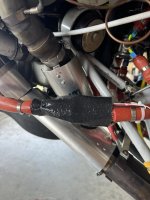
Not a red cube (Fuel scan FS450) but it took a while to get the transducer mounted according to their instructions. The unit is now enclosed with fire sleeve.
 

Attachments

  • 49E3161D-700C-4889-BF85-0163A1494D6B.jpeg
    49E3161D-700C-4889-BF85-0163A1494D6B.jpeg
    623.1 KB · Views: 89
i made a .090 plate to mount it to and mounted that with adel clamps to the lower cross tubes on the engine mount. next time I have the cowl off i will send you a couple of pics.


bob buns
RV-4 N82RB
 
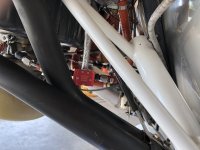
I mounted mine in the tunnel near the battery along with a lot of other stuff. You can see it along the left wall of the tunnel. The electric boost pump is aft of the cube out of sight. Instructions call for it to be mounted after the last fuel,pump, but I couldn’t find room for that. The fuel flow numbers were very accurate in this installation. This was all done on my former RV4 during a rebuild. After the rebuild all those tunnel areas had covers.
 

Attachments

  • IMG_1232.jpeg
    IMG_1232.jpeg
    1.6 MB · Views: 76
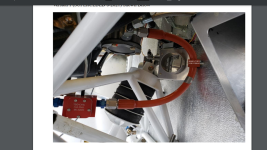
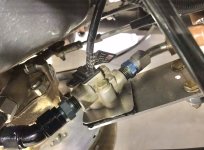
As close to the carb as possible if accuracy is important. Tom S made a couple of different length lines until we got the geometry right. After hooking everything up, the cube and adjacent tubing are wrapped in fire sleeve:

Red Cube 1.jpg

Red Cube 2.jpg

Red Cube 3.jpg

Looks scary close to the exhaust pipes, but there is actually plenty of room (after a few iterations with a patient line fabricator, thanks Tom! :)). It does "hang in space" but the steel fittings and short forward line support everything well. Just one way to skin the cat; and I'm sure you'll get more suggestions.

Cheers,

Vac
 

Attachments

  • Red Cube 1.jpg
    Red Cube 1.jpg
    55.5 KB · Views: 39
Last edited:
i made a .090 plate to mount it to and mounted that with adel clamps to the lower cross tubes on the engine mount. next time I have the cowl off i will send you a couple of pics.


bob buns
RV-4 N82RB
See above
 
See above
We've done them a couple of different ways on carb installs. Normally the transducer is adel clamped to one of th eengine mount tubes near the left lower dynafocal mount. Keep in mind that the cube with 2 straight nipples is 4 inches flare to flare. So that means the discharge side to the carb is pretty short---like 3.75-4 inches. Take the pump to inlet hose and turn it aft towards the firewall, then curve it 180* back to the cube. Similar to our RV10/IO540 install, but obviously shorter discharge hose.

Tom
 

Attachments

  • New RV10 install.png
    New RV10 install.png
    549.1 KB · Views: 73
View attachment 80641

Looks scary close to the exhaust pipes, but there is actually plenty of room (after a few iterations with a patient line fabricator, thanks Tom! :)). It does "hang in space" but the steel fittings and short forward line support everything well. Just one way to skin the cat; and I'm sure you'll get more suggestions.
I think it’s a really bad idea to use rigid tubing (regardless of the type of material used) to support the weight of the transducer and the hose, especially at that location. There is an awful lot of movement and vibration in that area due to the distance from the crankshaft. A rigid line should never be completely unsupported along its length and needs secure attachment points at each end.

The transducer on my airplane is mounted in a similar manner as yours except with a short flexible line on the discharge side of the transducer. Please reconsider your installation.
 
Vac, what's the shielding material you are using to protect the cable from the red Cube? Looks like something I would want to incorporate next time the cowl is off.

And please note my post this morning in the safety forum.

 
Here's how mine is mounted on my -4.... It is wrapped in fire sleeve and has been working flawlessly for the last 10+ years..

ymmv

BrunoRED CUBE 2.jpg
 
Vac, what's the shielding material you are using to protect the cable from the red Cube? Looks like something I would want to incorporate next time the cowl is off.

And please note my post this morning in the safety forum.
Hi Bill,

It's just small diameter fire sleeve. I slipped it over the harness during installation. For an existing installation, some sleeve is available with an adhesive you can just wrap around it. It's been a minute, but I recall it came from the aviation aisle at a local AutoZone or similar establishment.

I read your post. So far, I've been fortunate and haven't had any issues. I pull the fire insulation off the body during annual for inspection and just use safety wire to hold that in place.

Cheers,

Vac
 
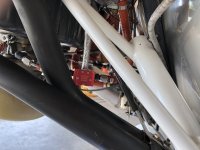
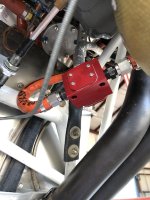
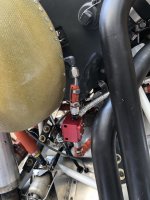
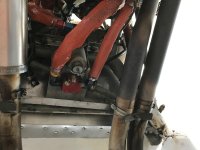
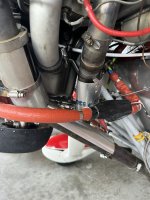
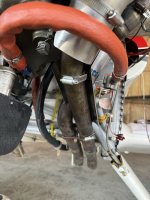
These pictures will give you an idea on how I mounted the flow transducer. I installed a bracket that attaches to the left side of the engine mount that the transducer bolts to. In order to put the transducer as the last thing before the carburetor, I had to have a longer run of hose than I wanted and it also required fabricating a couple of heat shields due routing the fuel hose in close proximity to the exhaust pipes. I have about 30 hours on this setup with no problems. I went from showing that I burned 2 gallons more than actual, to being within 0.1 to 0.2 gallons per fill up. This is an Electronics International fuel computer.
 

Attachments

  • IMG_6534.jpeg
    IMG_6534.jpeg
    3.1 MB · Views: 53
  • IMG_6533.jpeg
    IMG_6533.jpeg
    3.2 MB · Views: 52
  • IMG_6532.jpeg
    IMG_6532.jpeg
    2.9 MB · Views: 51
Back
Top