Van's Air Force

The definitive Van's Aircraft support community! Buying, building or flying an RV? Join our exclusive family of mentors and enthusiasts!

Battery failure

FinnFlyer

Well Known Member
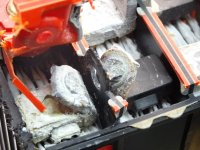
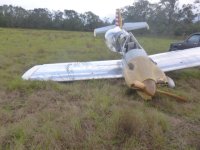
I did an autopsy (cut the lid off) on the PowerSport YTX20L-BS 12V 20Ah AGM battery that failed open, causing total loss of electrical power and engine stoppage (electronic ignition and fuel injection) leading to forced landing and damage to my RV-4 (separate threads elsewhere to come).

Battery was mounted forward of firewall, so failure may be heat and/or vibration related. Battery is designed for sports vehicles, so should be vibration resistant. Could also be a manufacturing defect. Battery was installed 29 Jul 2023. In service for 45 hours with an estimated 50 cycles (starts).

Note that the battery did provide power to start the engine with no problems 10 mins before the failure. Looking at engine monitor log, about halfway into the flight spikes in voltage started to show up and got bigger end bigger. So a somewhat gradual failure.

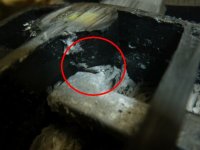
Each of the six cells are interconnected via "bridges". I assume zinc electrodes to lead electrodes. As you can see in the second picture there is a crack in the lead bridge to the second cell.

When I short the crack with a metal pick or connect the two electrodes with wire clips the battery shows full voltage and can easily deliver a 12 amp current. When not shorting the crack, voltage drops to zero with even the lightest load (12V 0.16A fan).

I'll post a separate thread speculating on why the alternator did not continue supplying the needed power.

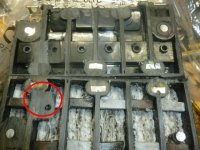
In case you think this is a one-in-a-million case, an autopsy was done in 2016 on an Odyssey PC680 battery with similar failure mode -- again internal cell-to-cell interconnect failure (third picture). Fortunately that guy had magnetos on his Rotax.

My design philosophy was that the battery was the backup for the alternator and the alternator the backup for the battery. In my case that did not work out.

For any engine completely dependent (EFI and/or electronic ignition only) my recommendation is to have a backup battery behind the firewall. Connect the engine bus to either the main battery or the backup battery with a reliable DPDT switch. (Perhaps even with an additional parallel switch). When in normal position, charge the backup battery with a diode from main battery/alternator. When in backup position the engine bus is connected to the backup battery and completely isolated from main battery and alternator (main bus). That will survive a main battery short and also alternator over-voltage event (with a OVP device installed).

EDIT: see https://vansairforce.net/threads/over-voltage-protection-alternator-failure.232015/
 

Attachments
  • BadBattery1.jpg
    BadBattery1.jpg
    68.2 KB · Views: 336
  • BadBattery2.jpg
    BadBattery2.jpg
    35.9 KB · Views: 284
  • 11_Inter-cellconnectorweldfailure.jpg
    11_Inter-cellconnectorweldfailure.jpg
    146.4 KB · Views: 329
  • P1030031.JPG
    P1030031.JPG
    69 KB · Views: 350
Last edited:
At least you got down alright. I'm also surprised the alternator did not continue to put out voltage. Seems everyone is always worried that once the alternator is energized, it may not be able to shut off in an Over Volt situation. First time I have ever heard of an open failure without an over charge/meltdown. Hope your repairs go well.
 
I'm no expert, and I certainly don't mean to Monday morning quarterback, because I don't have all the details, but for anyone else who may not know, you cannot rely on the alternator as a backup for the battery. A sudden loss of the battery can cause voltage spikes that will trip your overvoltage protection and shut down the alternator, leaving you with no power at all. This is because the battery acts as a sort of dampener, absorbing spikes and dips in the alternator output. You could potentially use a large capacitor in parallel with the battery to prevent this, but probably better to just have a second battery.
 
I'm no expert, and I certainly don't mean to Monday morning quarterback, because I don't have all the details, but for anyone else who may not know, you cannot rely on the alternator as a backup for the battery. A sudden loss of the battery can cause voltage spikes that will trip your overvoltage protection and shut down the alternator, leaving you with no power at all. This is because the battery acts as a sort of dampener, absorbing spikes and dips in the alternator output. You could potentially use a large capacitor in parallel with the battery to prevent this, but probably better to just have a second battery.
See https://vansairforce.net/threads/over-voltage-protection-alternator-failure.232015/
 
..... but probably better to just have a second battery.
For my current project, I am planning to use the dual battery installation shown by Nuckolls in his article called "What's All This Battery Isolator Stuff Anyhow?" (1998) with dual electronic ignitions.

In the case where one battery failed suddenly with an 'open', the other battery would continue to keep the alternator happy and the system energized. With one ignition system connected directly to each battery, you would lose one ignition. In the case where one battery fails with a 'short', (can that happen?) I'm not sure but I think it would bring the whole system down.

Perhaps someone can comment on the relative likelihood of a battery failing 'short' compared to 'open'? I'm thinking it is not really possible to have the whole battery internally short. A short in one cell would just make it act like a 10V battery. That might pull enough charge current to pop the alternator breaker?
 
Good details to know, and I as mentioned in your other post, I fly an electrically dependent (fuel pump/flaps) RV-4, so all this data is helpful. I have a backup system that is a simple carry along rechargeable battery ( Noco jump pack) that I plug into the bus for my life support items. I am also deeply considering a Monkworks mini alternator to make that system full circle back-up. I utilize a Powersports AMG battery main battery from Batteries Plus, and have had very good service from them for the last 15 years...however, you have exposed an unseeable failure of any battery. Great to see you survived the ordeal, and hopefully can get the -4 rebuilt.
 
For my current project, I am planning to use the dual battery installation shown by Nuckolls in his article called "What's All This Battery Isolator Stuff Anyhow?" (1998) with dual electronic ignitions.

In the case where one battery failed suddenly with an 'open', the other battery would continue to keep the alternator happy and the system energized. With one ignition system connected directly to each battery, you would lose one ignition. In the case where one battery fails with a 'short', (can that happen?) I'm not sure but I think it would bring the whole system down.

Perhaps someone can comment on the relative likelihood of a battery failing 'short' compared to 'open'? I'm thinking it is not really possible to have the whole battery internally short. A short in one cell would just make it act like a 10V battery. That might pull enough charge current to pop the alternator breaker?
Not in an airplane but I has seen, first hand, a lead acid battery explode due to an internal short. It blew the side of the battery out, showering my uncle with acid. Luckily, we were in a garage and there was an adjacent pool, which he immediately dove into. The battery was not being charged, and the engine was not running...it wouldn't start so he was troubleshooting...
 
Not in an airplane but I has seen, first hand, a lead acid battery explode due to an internal short. It blew the side of the battery out, showering my uncle with acid. Luckily, we were in a garage and there was an adjacent pool, which he immediately dove into. The battery was not being charged, and the engine was not running...it wouldn't start so he was troubleshooting...
AGM doesn't suffer from Hydrogen build up like a vented wet cell lead acid does.
 
AGM doesn't suffer from Hydrogen build up like a vented wet cell lead acid does.
That's true but it was an answer to the question about internal shorts...and I have seen my fair share of vented lead acid batteries in aircraft, though that number has dwindled over the years.
 
I also am electron dependent. I decided not to install OV protection. I have tested turning off both the alternator and the battery, both on the ground an in the initial 40 hr fly-off. Things worked well enough in either case. Something about my installation tends to slowly destroy alternators. I'm not sure if its continuous high RPM or vibration or something else. Over the course of a few hundred hours the voltage slowly increases until I replace the alternator - the $30 refurbished automotive ND 70A kind. For batteries I started with AGM but now use Lithium. Never a problem with any of those. Just a data point.
Hope you get it flying again Finn.
 
For my current project, I am planning to use the dual battery installation shown by Nuckolls in his article called "What's All This Battery Isolator Stuff Anyhow?" (1998) with dual electronic ignitions.

In the case where one battery failed suddenly with an 'open', the other battery would continue to keep the alternator happy and the system energized. With one ignition system connected directly to each battery, you would lose one ignition. In the case where one battery fails with a 'short', (can that happen?) I'm not sure but I think it would bring the whole system down.

Perhaps someone can comment on the relative likelihood of a battery failing 'short' compared to 'open'? I'm thinking it is not really possible to have the whole battery internally short. A short in one cell would just make it act like a 10V battery. That might pull enough charge current to pop the alternator breaker?
That's how I did mine. I used two PC-680s behind two contactors. I wired it so that either or both can run an E-buss and hooked up one Lightspeed to each battery through fuselinks. I'm on two EarthX batteries now and have set up my EFIS to alarm at 13.7V and at low charging amps. Tested in flight by pulling the field breaker. The only gotcha was that if I don't use both batteries to start and have one on the E-buss, it will try and charge the second battery through the E-buss connection and blows the fuse. The batteries pull about 40 amps out of the alternator while taxiing and set off the low volt alarm until I run up and the batteries catch up. That didn't happen with the lead acid batts, but the LiFeO are soo hungry at first. SOP is both batteries on for start and throughout the flight. If the alternator were to fail, switch one off, put the other on E-buss and save it for when the other battery is nearly depleted. Meanwhile, shed loads to make it last.

Not sure about that whole failing short thing. I don't see how that could increase the voltage and cause problems. Much more likely to fail open. That might be hard to notice if there are two of them. Probably pick it up on the next start up if you turn them off one at a time and check for voltage. I'm going to put that into my pre-takeoff checklist. An external short could be a real problem, 'specially if it were before the contactor. Gotta make sure all the fat wires are routed and supported to prevent that.

By the way Rodoc, I think one B&C alternator is worth any number of cheapies. I went through several of the ones Van's used to sell in our 6A before I bit the bullet and bought the right one.

Ed
 
I have a battery on my bench that behaves similar. Full voltage for about an hour, then it goes haywire and suddenly fails to about 6 volts. It takes and charge and lather, rinse, repeat. It never flew. I used it for panel set up.
 
FinnFlyer thanks for sharing as valuable lessons here. There’s a guy here at my airport building an RV with electronic ignition AND electronic fuel injection. Not the way I would go but to each his own. BUT- he has dual electrical buses with two batteries and a backup gear driven alternator. I don’t know his specific electrical schematics but it sounds like he has everything well in hand. Point being that if you have a totally electrically dependent engine then you better have some backup power. I was looking at a Rocket once that was in my price range and looked pretty nice until I found out it had dual electronic ignition with ONE battery, one alternator and no backup power.
 
The alternator not functioning doesn’t surprise me if it is an internally regulated type. If you have a dead battery, and prop start or jump start, there is no field voltage and no power generation.
It would be an interesting test to see if an alternator was operating properly and you pulled your source of remote power would the alternator power its own field? Makes sense it should but….
Never tried it. If I had an alternator laying around, I would hook up a power source, stick it in my drill press, and see.
Regardless, is there is a case for using a permanent magnet alternator, with remote regulator, as a back up in an electrically dependent system?
 
The alternator not functioning doesn’t surprise me if it is an internally regulated type. If you have a dead battery, and prop start or jump start, there is no field voltage and no power generation.
It would be an interesting test to see if an alternator was operating properly and you pulled your source of remote power would the alternator power its own field? Makes sense it should but….
Mine will, but with considerable ripple when loaded.
Never tried it. If I had an alternator laying around, I would hook up a power source, stick it in my drill press, and see.
Regardless, is there is a case for using a permanent magnet alternator, with remote regulator, as a back up in an electrically dependent system?
Sure sounds like it. I understand that with modern rare-earth magnets they have become lighter? Definitely worth looking into.
 
Back
Top