See https://vansairforce.net/threads/battery-failure.232014/ and https://vansairforce.net/threads/over-voltage-protection-alternator-failure.232015/ regarding the electrical failure that caused the engine to stop running.
I usually climb to a "safe" altitude in case of engine failure. November 9th was no exception. Clouds were lifting but I still climbed above the broken-turning-to-scattered clouds, even for the short 18 NM flight from 9FL5 to FL10. About 6 miles from the destination I saw a nice wide and long opening among the clouds and pulled the throttle back for a rapid decent to get below cloud bases. Then everything went dark and the engine quit (EFI and electronic ignition). Well, the Nexus 7 pad running Avare was still on but it looked like it was no longer updating. Trying to locate a grass runway without a GPS is not my strong side so I picked what looked like hay fields and turned towards them. Plenty of altitude and airspeed to reach them. Actually too much, as it turned out.
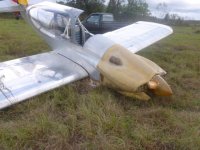
In BFRs we typically turn the engine back on after "we have the field made". Well, I guess it's taken for granted that one then sets up for a proper approach (altitude and airspeed) for a non-event landing. It seems in my case that didn't happen. No flaps (electric). Started side slipping way too late, overshot the first two recently mowed fields (separated by fences) and still too fast over the third (not mowed hay field) with trees at the end of that and the next field that was full of hay bales. I was flying into strong gusting winds from the East but not comfortable that I could clear the trees so I started turning South. Either a gust caught the high wing or I was low enough for gear or low wing to catch the ground and I ground-looped the plane about 50' from the trees and fence. Right gear collapsed back under right wing but plane stayed upright.
No bruises and ELT did not trigger, so must have been rather slow when ground looping.
Perhaps I should have continued straight and let the fence and trees stop it. But then might have turned the plane over and trapped me under the canopy.
Each of the fields were about 1,200', so should have been plenty for an RV-4, even with no flaps.
So the lesson here is to practice random forced landings to the point where you actually could land and stop on the space available. Flying "at a safe altitude" is not enough.
I attached the report I filed with NTSB, in case you're curious.
Finn
I usually climb to a "safe" altitude in case of engine failure. November 9th was no exception. Clouds were lifting but I still climbed above the broken-turning-to-scattered clouds, even for the short 18 NM flight from 9FL5 to FL10. About 6 miles from the destination I saw a nice wide and long opening among the clouds and pulled the throttle back for a rapid decent to get below cloud bases. Then everything went dark and the engine quit (EFI and electronic ignition). Well, the Nexus 7 pad running Avare was still on but it looked like it was no longer updating. Trying to locate a grass runway without a GPS is not my strong side so I picked what looked like hay fields and turned towards them. Plenty of altitude and airspeed to reach them. Actually too much, as it turned out.
In BFRs we typically turn the engine back on after "we have the field made". Well, I guess it's taken for granted that one then sets up for a proper approach (altitude and airspeed) for a non-event landing. It seems in my case that didn't happen. No flaps (electric). Started side slipping way too late, overshot the first two recently mowed fields (separated by fences) and still too fast over the third (not mowed hay field) with trees at the end of that and the next field that was full of hay bales. I was flying into strong gusting winds from the East but not comfortable that I could clear the trees so I started turning South. Either a gust caught the high wing or I was low enough for gear or low wing to catch the ground and I ground-looped the plane about 50' from the trees and fence. Right gear collapsed back under right wing but plane stayed upright.
No bruises and ELT did not trigger, so must have been rather slow when ground looping.
Perhaps I should have continued straight and let the fence and trees stop it. But then might have turned the plane over and trapped me under the canopy.
Each of the fields were about 1,200', so should have been plenty for an RV-4, even with no flaps.
So the lesson here is to practice random forced landings to the point where you actually could land and stop on the space available. Flying "at a safe altitude" is not enough.
I attached the report I filed with NTSB, in case you're curious.
Finn