


Van's Air Force

The definitive Van's Aircraft support community! Buying, building or flying an RV? Join our exclusive family of mentors and enthusiasts!

Anyone able to make Flaps work through VPX and GAD27?

flybill7

Well Known Member
Friend
I'm helping a friend build a RV-10 and we're having no luck getting the flaps to work in our VPX-GAD27 setup. Anybody out there able to get their flaps to work through the GAD27, itself powered by the VPX? Attached is a wiring diagram of our setup. I've verified the flap switch works, and that the GAD27 is receiving power from the VPX (J8-1). We've tested all the grounds and the wire connectivity. Per the VPX and GAD27 instructions it should be working. Out of ideas at this point. Vpx-gad27.jpeg
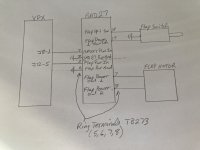
 
Pins J12-5 and J12-6 on the VPX are used to control the flap motor motion, not to provide power to another flap controller. As such, it may be providing +12V or 0V, but you need both J12-5 and J12-6 to define this (ie, they switch depending on which way you move the flap when using the VPX for flap control), but they don't output anything unless the flap switch (when connected to the VPX) commands flap movement.

HOWEVER, you don't want to do this! If you want to supply power from the VPX to the flap motor on the GAD27, just use an output pin on the VPX to supply +12V at all times. But don't use pins J12-5 or J12-6!

There have been previous discussions on using a VPX with a GAD27. In short, use one or the other, but not both.
 
And I'd recommend using the GAD27. We didn't, we use the VPX and only output the flap position to the G3X system. This has one drawback, in that you can't partially retract flaps to position 1 when its fully down. GAD27 supports this partial retraction. Its a small thing, but seems better.
 
And I'd recommend using the GAD27. We didn't, we use the VPX and only output the flap position to the G3X system. This has one drawback, in that you can't partially retract flaps to position 1 when its fully down. GAD27 supports this partial retraction. Its a small thing, but seems better.
If you use the VPX with the flap position sensor, will it send the flap position through the RS232 interface to the G3X then allow you to retract like this?
 
There have been previous discussions on using a VPX with a GAD27. In short, use one or the other, but not both.
Yes, this would be my recommendation as well.

If you use the VPX with the flap position sensor, will it send the flap position through the RS232 interface to the G3X then allow you to retract like this?
No, the GAD 27 does not work like this.
 
Getting to be like our cars, a computer running even the simplest things....

Replaced the battery in my wife's Honda the other day, checked the charging system just to be sure it was working which it did not appear to be doing, reading battery voltage with the car running. A little research and I discovered that the system won't charge the battery unless it's low or there is a 'load' on it, if you want to charge the battery or check the charging system you have to turn the lights on!
Now I have to reprogram the radio and the windows.... OMG!
Definitely don't want my RV to be like this.
 
If you use the VPX with the flap position sensor, will it send the flap position through the RS232 interface to the G3X then allow you to retract like this?
No, with the VPX controlling the flaps the G3X will display the flap position, and the flap will EXTEND to intermediate positions, but retraction is one-touch-all-the-way up. With the GAD27 running the show, the flap can be retracted to intermediate positions as well.
 
No, with the VPX controlling the flaps the G3X will display the flap position, and the flap will EXTEND to intermediate positions, but retraction is one-touch-all-the-way up. With the GAD27 running the show, the flap can be retracted to intermediate positions as well.
Oh, that’s curious. Seems it would just be a software thing on the VPX to control retraction. I don’t have my system set up yet, so haven’t actually tested any of this.

The VPX manual says you can stop retraction by pressing the flap down button. Not a great fix, but it’s something I guess.
 
Last edited:
Oh, that’s curious. Seems it would just be a software thing on the VPX to control retraction. I don’t have my system set up yet, so haven’t actually tested any of this.
Yeah, its just the choice made by VPX when they programmed the logic. In practice it is just fine this way, but seems odd that they don't allow partial retraction to position 1. One note, you can always stop the retraction at any location by bumping the flap-down switch momentarily. So yeah Im making a bigger deal of this than it needs... :)
 
Getting to be like our cars, a computer running even the simplest things....

Replaced the battery in my wife's Honda the other day, checked the charging system just to be sure it was working which it did not appear to be doing, reading battery voltage with the car running. A little research and I discovered that the system won't charge the battery unless it's low or there is a 'load' on it, if you want to charge the battery or check the charging system you have to turn the lights on!
Now I have to reprogram the radio and the windows.... OMG!
Definitely don't want my RV to be like this.
I do not understand the logic behind having a switch, wired to a computer, wired to the motor, with feedback wire to the computer, Just to make a window roll down. Why choose a ton of failure points and added weight vs a wire from switch to motor? The rear window in my truck wont roll down currently because of this nonsense.

I've learned this lesson and my airplane will have none of this.
 
I do not understand the logic behind having a switch, wired to a computer, wired to the motor, with feedback wire to the computer, Just to make a window roll down. Why choose a ton of failure points and added weight vs a wire from switch to motor? The rear window in my truck wont roll down currently because of this nonsense.

I've learned this lesson and my airplane will have none of this.
Experimental is about doing what you like, so I get it.

But let me say this, do you want the flaps to be positional? If so, you are going to have some form of controller with microswitches to stop the flaps where you want them. This mechanical setup isn't any more bulletproof than having a computer do the same switching. In fact, I'd bet the computer controller is more reliable.
 
Experimental is about doing what you like, so I get it.

But let me say this, do you want the flaps to be positional? If so, you are going to have some form of controller with microswitches to stop the flaps where you want them. This mechanical setup isn't any more bulletproof than having a computer do the same switching. In fact, I'd bet the computer controller is more reliable.
Pretty sure a lever with notches is lighter, cheaper, and more reliable than a computer.
 
If you mean a Johnson bar setup, then yup I'd agree! RV's aren't engineered for that approach, so it's a real project.
Earlier rv's were set up that way so to my mind it would be way easier than all that wiring and programming. Most GA electric flaps are "positional" by how long you flip the switch. If your background is tech I can see the computer approach feeling more comfortable. But anecdotally It's not more reliable. Lot's of examples in the automotive world with deploying airbags, stuck throttles, etc. And in the airline world un-commanded rudder deflections, dives and such. RV flaps are pretty delicate, I'd rather be forced to RTB with them stuck in a position from a failed wire or switch than have them deploy at cruise speeds cause a computer went haywire.
 
Earlier rv's were set up that way so to my mind it would be way easier than all that wiring and programming. Most GA electric flaps are "positional" by how long you flip the switch. If your background is tech I can see the computer approach feeling more comfortable. But anecdotally It's not more reliable. Lot's of examples in the automotive world with deploying airbags, stuck throttles, etc. And in the airline world un-commanded rudder deflections, dives and such. RV flaps are pretty delicate, I'd rather be forced to RTB with them stuck in a position from a failed wire or switch than have them deploy at cruise speeds cause a computer went haywire.
I can absolutely respect that also. If you are willing to hold the switch and count seconds for positions, you will have a more reliable setup.
 
When configured properly, the VPX does allow partial deployment and partial retraction to a single position. Mine is configured so the first stop in either direction is neutral flaps. The second stop is 15 degrees and the final stop is full flaps.
When retracting, activating the flap switch will stop the flaps at neutral position (or wherever you set it up to stop). Additional activation is required to fully retract the flaps to the reflex or stowed position.
As previously posted, use the GAD or the VPX, but not both. The VPX flap configuration and setup is called out on pages 56-59 of the IM
 
...
When retracting, activating the flap switch will stop the flaps at neutral position (or wherever you set it up to stop). Additional activation is required to fully retract the flaps to the reflex or stowed position.
...
This behavior is specific to the "in-trail" or 0 position of the flap system. As you noted the VPX does allow a specific "reflex" setting that is negative (for RV-14 and 10 for example). There is no way to tell the VPX to retract the flaps "one position up" however. If you have 30 deg flaps, one bump of the switch will get you to your 0 position, wherever that is set to. The GAD27 is more flexible and each bump can be set to "current position minus one".

As least, this is my experience with my versions of the software. Can't say if they've updated it since...
 
This behavior is specific to the "in-trail" or 0 position of the flap system. As you noted the VPX does allow a specific "reflex" setting that is negative (for RV-14 and 10 for example). There is no way to tell the VPX to retract the flaps "one position up" however. If you have 30 deg flaps, one bump of the switch will get you to your 0 position, wherever that is set to. The GAD27 is more flexible and each bump can be set to "current position minus one".

As least, this is my experience with my versions of the software. Can't say if they've updated it since...
Are you sure that by the VPX only does full retraction? The manual seems to indicate that incremental retraction is possible when set to Position mode. (This is directly from VP support).
 
Are you sure that by the VPX only does full retraction? The manual seems to indicate that incremental retraction is possible when set to Position mode. (This is directly from VP support).

This is how mine behaves. From the manual:

"Position – flaps run down to the next position when the flap switch is pressed. Flaps run all the way up when the flap switch is pressed. A flap position sensor (Ray Allen POS-12) is required for this option. You can set 4 positions – a top, two middle (optional), and a bottom. When you press the flap up switch, the flaps go all the way up unless you press the flap down switch to stop them mid-stream. "
 
This is how mine behaves. From the manual:

"Position – flaps run down to the next position when the flap switch is pressed. Flaps run all the way up when the flap switch is pressed. A flap position sensor (Ray Allen POS-12) is required for this option. You can set 4 positions – a top, two middle (optional), and a bottom. When you press the flap up switch, the flaps go all the way up unless you press the flap down switch to stop them mid-stream. "
Yeah, I read that too, but that's not what VP support implied. I will try to clarify.
 
I set up my VPX to use the reflex position at -15 DEG. First position all the way up. 2nd position is -30 deg and 3rd is -45 deg. Go around takes it from -45 deg to -15 deg one flip up. Then another push once established a decent climb rate. I tried the position mode and preferred the one push -45 to -15 activation. BTW I use -15 most departures (except cross wind component greater than 10 knots). VPX doesn't know if one is a 10,14 or other RV.
 
To close this thread out with a happy ending, we ended up taking Stigaro's advice and using an output pin on the VPX to supply +12V at all times (J10-1 - 10amp). Connected it to the GAD27 ring terminal 5. Flaps now work like a charm using the flap switch. Haven't set up all the gee-whiz stuff yet. Thanks for all the responses!
 
Back
Top
