Van's Air Force

The definitive Van's Aircraft support community! Buying, building or flying an RV? Join our exclusive family of mentors and enthusiasts!

Wire Routing to Subpanel

skelrad

Well Known Member
Friend
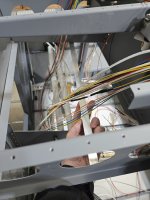
Is there a "standard" (or do/don't) wire routing method to get wires from the firewall area to the subpanel/panel? I'm mostly thinking about wires coming from the fuselage/wings, not from the engine. Unless I'm missing something, the plans seem pretty much silent on anything related to wiring. I think I'm going to mount a piece of angle across the bottom of the two subpanel to firewall ribs to give myself more lateral options for attaching clamps and getting the wiring to the subpanel, vs being confined to only running it along the bottom edge of each rib (?). Any lessons learned with running the wire bundles through holes in the subpanel vs not drilling holes and dropping them underneath the subpanel instead?

The cutting of the monster hole for the center stack seems to be a common question, so I'll go to the search results for that one!
20241125_152413.jpg
 
Is there a "standard" (or do/don't) wire routing method to get wires from the firewall area to the subpanel/panel? I'm mostly thinking about wires coming from the fuselage/wings, not from the engine. Unless I'm missing something, the plans seem pretty much silent on anything related to wiring. I think I'm going to mount a piece of angle across the bottom of the two subpanel to firewall ribs to give myself more lateral options for attaching clamps and getting the wiring to the subpanel, vs being confined to only running it along the bottom edge of each rib (?). Any lessons learned with running the wire bundles through holes in the subpanel vs not drilling holes and dropping them underneath the subpanel instead?

The cutting of the monster hole for the center stack seems to be a common question, so I'll go to the search results for that one!

View attachment 75129

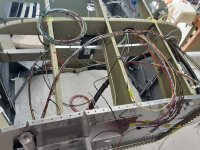
Builders appear to do it various ways, some run a tube through the ribs, though there doesn't seem to be a standard way. I did something similar to what you are proposing and used a flat aluminum bar instead of an angle. It worked out well for supporting and routing wires and I would do it again. YMMV as the saying goes.

20230609_112720.jpg20230614_090425.jpg
 
Last edited by a moderator:
I'm sure my solution breaks the rules, but no additional holes were needed in the Center Section Spar.
Plans call for all the wire aft of the spar to pass through spar snap bushings then route forward through the tunnel cover and up two conduits either side of the firewall recess.
I installed a conduit up the two side stiffeners to the sub panel. They are parallel to the vent tubes. Wires from the wings take the shorter route up to the sub panel. Wires crossing from one side of the sub panel to the other, route through Adel clamps secured to the sub panel ribs. Wires are bundled with heavy duty Velcro and/or waxed lashing string.
Two drop panels are hinged to both sub panel and instrument panel and swing down either way or may be removed by pulling pins. When the panels are secured, it's quite solid.
 
I'm sure my solution breaks the rules, but no additional holes were needed in the Center Section Spar.
Plans call for all the wire aft of the spar to pass through spar snap bushings then route forward through the tunnel cover and up two conduits either side of the firewall recess.
I installed a conduit up the two side stiffeners to the sub panel. They are parallel to the vent tubes. Wires from the wings take the shorter route up to the sub panel. Wires crossing from one side of the sub panel to the other, route through Adel clamps secured to the sub panel ribs. Wires are bundled with heavy duty Velcro and/or waxed lashing string.
Two drop panels are hinged to both sub panel and instrument panel and swing down either way or may be removed by pulling pins. When the panels are secured, it's quite solid.
Larry, can you share a picture of the wiring up the side stiffeners?
Thanks
 
Builders appear to do it various ways, some run a tube through the ribs, though there doesn't seem to be a standard way. I did something similar to what you are proposing and used a flat aluminum bar instead of an angle. It worked out well for supporting and routing wires and I would do it again. YMMV as the saying goes.

View attachment 75131View attachment 75132
Are your wire bundles already twisted like that, or do you twisted them somehow?
 
Are your wire bundles already twisted like that, or do you twisted them somehow?
Not to answer for Paul, but twisting is pretty easy - just anchor one end of the wires to a table or something, then put the other ends in a drill chuck and twist away. Twist them beyond the point where you want them, then hold tight to the end in the drill and unchuck them. They will unwind a bit. Make sure you have a firm hold of them before taking them out of the drill. If you don't, they will spring back and turn into a mess.
 
Are your wire bundles already twisted like that, or do you twisted them somehow?
They were already twisted like that in the Dynon skyview harness kit. But as Brandon has said above, you can twist your own with a drill. Twisting shortens the whole bundle, so wires need to be cut longer if planning to twist.
 
They were already twisted like that in the Dynon skyview harness kit. But as Brandon has said above, you can twist your own with a drill. Twisting shortens the whole bundle, so wires need to be cut longer if planning to twist.
I’ve found a sharp tug on the drill with the freshly twisted wires still in the chuck “sets” the twist and reduces spring back. Make sure the wires are well anchored at the other end!
 
Back
Top