


OK don't get mad. Ha ha. I know this is beat to death, but some schemes, complicated, many alternators, batteries, panel switches, relays. Others on battery and a diode. OK. None of them have a battery charger? What? 
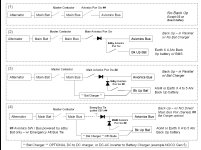
 I will explain but look at my 4 options: (I want opinions and personal experience, but be nice
  )
)
If you think this is dumb idea or beat to death, OK. What did you do. Look it over and think about it before poo-poo'ing it.
1 thru 4:
1) no back up except ships battery. Why not? If the alternator fails that will get you on ground? (G5 has on board battery, handheld Com & iPad's internal battery)
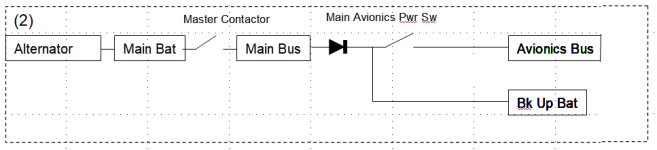
2) parallels ship/backup battery with diodes. Backup battery has BMS (Earth X).
3) parallels ship/backup battery with diode and charger.
4) Serial avionics powered only by standby/avionics battery. Main bus charges backup battery. (Option, emergency bus tie, switch or CB pulled with collar that can be pushed in.)
Notes: I know diodes have 0.7v drop but can be much less if you "oversize" them. Most devices run at 11v or less. Batteries will still charge if input voltage is above it's nominal 100% voltage. The more headroom the more current the battery takes. If too much voltage or prolonged periods of higher voltage, it can damage battery.
Rational and HOW to get a Battery Charger On-Board?
Why battery charger? Airliners use battery chargers to charge the batteries. It is a MEL item, no go without charger working. In our GA world we let the alternator blast the main battery with full rated voltage. May be why batteries don't last, heat, vibration and over charging. I suggest BATTERY CHARGER to isolate the standby battery from overvoltage, keep it charged, under use, while extending battery life.
Finding a DC-DC battery charger? RV's industry makes them. Problem is input voltage has to be higher and they drop-out with low voltage. These could be OK off the shelf solution. A 20 amp unit is $100.
Another cool device, not expensive, works well, DC-DC boost/buck converters that has steady voltage output, regardless on input voltage (within limits). You would adjust output to be at moderate or "trickle charge" rate. This may or may not keep up with all avionics load, if all avionics is powered only by standby battery. So you need to parallel with main bus but that demands (diodes. May be diodes are great, fine, dandy? Opinion or experiences?
Best solution may be using an inverter (12v DC to 110v AC). Inverter doesn't have to be high wattage, small, light, inexpensive. Now that you have 100W or 200W of AC 110V, you can plug in a AC battery chargers, many to chose from with a lot of smarts tailored to AGM, Li-Ion. You can go with bigger inverter and get 110V AC plug in your plane for laptop charging? The 110V AC may be handy for a O2 concentrator for flying at altitudes. These are made for home, not too much and saves filling tanks? .
#2 With a LiFePo4 using internal BMS to regulate the charge seems best. The cost about $180. The AGM may do fine charging via a diode only without a charger direct from main bus. It may under charge or overcharge with out danger, except short battery life. Cost is small so just replace battery every year.
I will explain but look at my 4 options: (I want opinions and personal experience, but be nice )If you think this is dumb idea or beat to death, OK. What did you do. Look it over and think about it before poo-poo'ing it.
1 thru 4:
1) no back up except ships battery. Why not? If the alternator fails that will get you on ground? (G5 has on board battery, handheld Com & iPad's internal battery)
2) parallels ship/backup battery with diodes. Backup battery has BMS (Earth X).
3) parallels ship/backup battery with diode and charger.
4) Serial avionics powered only by standby/avionics battery. Main bus charges backup battery. (Option, emergency bus tie, switch or CB pulled with collar that can be pushed in.)
Notes: I know diodes have 0.7v drop but can be much less if you "oversize" them. Most devices run at 11v or less. Batteries will still charge if input voltage is above it's nominal 100% voltage. The more headroom the more current the battery takes. If too much voltage or prolonged periods of higher voltage, it can damage battery.
My avionics or emergency avionics: 2 EFIS: G5, GRT EFIS (and all their extra items, ARINC429 modules, magnetometers). engine monitor system, Com Radio. Transponder and ADS-B in not on standby bus. Not done a formal analysis, but estimate well under 5 amps, no transponder, VHF Com RX only.
Rational and HOW to get a Battery Charger On-Board?
Why battery charger? Airliners use battery chargers to charge the batteries. It is a MEL item, no go without charger working. In our GA world we let the alternator blast the main battery with full rated voltage. May be why batteries don't last, heat, vibration and over charging. I suggest BATTERY CHARGER to isolate the standby battery from overvoltage, keep it charged, under use, while extending battery life.
Finding a DC-DC battery charger? RV's industry makes them. Problem is input voltage has to be higher and they drop-out with low voltage. These could be OK off the shelf solution. A 20 amp unit is $100.
Another cool device, not expensive, works well, DC-DC boost/buck converters that has steady voltage output, regardless on input voltage (within limits). You would adjust output to be at moderate or "trickle charge" rate. This may or may not keep up with all avionics load, if all avionics is powered only by standby battery. So you need to parallel with main bus but that demands (diodes. May be diodes are great, fine, dandy? Opinion or experiences?
Best solution may be using an inverter (12v DC to 110v AC). Inverter doesn't have to be high wattage, small, light, inexpensive. Now that you have 100W or 200W of AC 110V, you can plug in a AC battery chargers, many to chose from with a lot of smarts tailored to AGM, Li-Ion. You can go with bigger inverter and get 110V AC plug in your plane for laptop charging? The 110V AC may be handy for a O2 concentrator for flying at altitudes. These are made for home, not too much and saves filling tanks? .
#2 With a LiFePo4 using internal BMS to regulate the charge seems best. The cost about $180. The AGM may do fine charging via a diode only without a charger direct from main bus. It may under charge or overcharge with out danger, except short battery life. Cost is small so just replace battery every year.
Last edited:




 Relays can be used for remote control.
