Van's Air Force

The definitive Van's Aircraft support community! Buying, building or flying an RV? Join our exclusive family of mentors and enthusiasts!

Correct Reamer for Lycoming IO-390 exhaust valve guide

M McGraw

Well Known Member
Friend
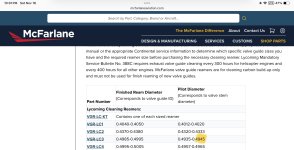
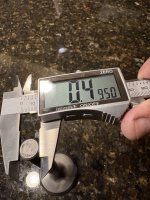
IMG_5230.jpegThere are several threads proposing that the correct reamer for a 1/2” exhaust valve is the McFarland VGR-LC4. I suspect the better choice is the -LC3. My valve stem measures at 0.495 or slightly less depending on location and technique. According to the McFarland chart the LC3 is the better choice with a maximum cut of 0.499. Slightly undersizing the guide. It seems safer to slightly undercut at 0.4995 rather than overcut at 0.5005 as the LC4 does.

IMG_5231.jpeg
 

Attachments

  • IMG_0034.jpeg
    IMG_0034.jpeg
    1.7 MB · Views: 149
Last edited:
What size reamer does Lycoming suggest for the IO390? Does your caliper consistently go to zero when you close it? I believe I have the same caliper and if I close it and zero it and open and close it again, I could get as much as 5 tho on the display.
 
What size reamer does Lycoming suggest for the IO390? Does your caliper consistently go to zero when you close it? I believe I have the same caliper and if I close it and zero it and open and close it again, I could get as much as 5 tho on the display.
I believe 0.4995 which would be the size of the LC3. I can’t find the Lycoming reference I used.

EDIT: I removed my reference to the calipers. The intent of my question was a verification of the correct reamer.
 
Last edited:
I believe 0.4995 which would be the size of the LC3. I can’t find the Lycoming reference I used. The caliper is calibrated and I used more than one caliper.
This is good to know as most people seem to be using the LC4. Thanks for your info, I will do a bit of research to see if I can find any info. Perhaps a call to Lycoming to confirm the reamer size would be good.
 
I believe 0.4995 which would be the size of the LC3. I can’t find the Lycoming reference I used. The caliper is calibrated and I used more than one caliper.
Even using an electronic caliper, whether calibrated or standardized...you will get a much more accurate measurement on a reamer by measuring it with a 0-1" Micrometer, regardless of type or style. Most Digital Mic's today are capable of easily measuring down to .0001 increments, which is closer than we need to worry about.

A much bigger issue with a reamer is the actual size that it cuts at....rather than what any two opposing flutes measure.

Best thing to do, is test on sample bores before actually cutting valve guides, just to know what YOUR reamer is cutting. If it's cutting oversize, they easy to reduce...


S
 
Can anybody point me to a document other than SI-1425A to determine if the IO-390 requires .4995 or .5005?
 
Lycoming SPP1776-5 pdf pg 18.

Good luck
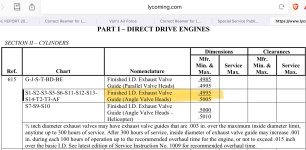
The picture below is from SSP1775-5. I propose the min number of .4995 (LC3) as the better option, so long as the post procedure wobble check is within limits. If the guide continues to build deposits the process can be repeated. If the guide continues to wear, over time using the max (.5005) may reduce time before guide replacement.

IMG_5233.jpeg
 
Last edited:
Side note here...

The wording of McFarland's ad copy (posted above) is misleading.

ScreenHunter_2501 Nov. 17 08.06.jpg

388C does not require exhaust valve guide cleaning. It requires inspection to determine if the guide is too tight or too worn. Further, the 400 hour interval was for an earlier valve guide material. Per SI 1485A, all cylinders produced after March 1, 1998 got an improved guide material, which increased the interval to 1000 hours.

Some users are sticking valves at far less hours. Until we have some clarity as to why, it might be wise to inspect at shorter intervals. It doesn't mean everyone should ream guides at every inspection.
 
I believe 0.4995 which would be the size of the LC3. I can’t find the Lycoming reference I used.

EDIT: I removed my reference to the calipers. The intent of my question was a verification of the correct reamer.
Marvin,
If you still have access to the valve, can you please measure it at the stem and not the tip? Some valves have a slightly smaller head. I saw one video working on a continental engine that he pulled the valve back to the guide by wrapping a safety wire around the head as the head was small enough that the safety wire would still fit to pull it back thru the guide.
 
Marvin,
If you still have access to the valve, can you please measure it at the stem and not the tip? Some valves have a slightly smaller head. I saw one video working on a continental engine that he pulled the valve back to the guide by wrapping a safety wire around the head as the head was small enough that the safety wire would still fit to pull it back thru the guide.
Bavafa,
While I appreciate your interest, I believe the measurements would be less than helpful to the conversation. If you look at the highlighted portion of post #8, Lycoming has answered my question. We simply need to each decide to go to Max or Min. I choose Min then repeat the wobble check and reevaluate. By the way, my interest was academic. I wobble checked all four freshly overhauled cylinders at 0.015. That will be my baseline in compare with at 400 to 1000 hours from now.
 
Bavafa,
While I appreciate your interest, I believe the measurements would be less than helpful to the conversation. If you look at the highlighted portion of post #8, Lycoming has answered my question. We simply need to each decide to go to Max or Min. I choose Min then repeat the wobble check and reevaluate. By the way, my interest was academic. I wobble checked all four freshly overhauled cylinders at 0.015. That will be my baseline in compare with at 400 to 1000 hours from now.
Thanks for the additional info. I also checked the reference guide, page 18, and looks like based on that the LC4 is the correct reamer size. I also understand and appreciate your approach here.
 
There are several threads proposing that the correct reamer for a 1/2” exhaust valve is the McFarland VGR-LC4. I suspect the better choice is the -LC3. My valve stem measures at 0.495 or slightly less depending on location and technique. According to the McFarland chart the LC3 is the better choice with a maximum cut of 0.499. Slightly undersizing the guide. It seems safer to slightly undercut at 0.4995 rather than overcut at 0.5005 as the LC4 does.

Polishing the pins...correct reamer depends on the valve stem diameter, which is why McFarlane offers two sizes.

Valve stem diameter is given as .4955 min, .4965 max.
Clearance is given as .0035min, .0055 max.
LC3 cuts .4985~.4995
LC4 cuts .4995~.5005

So, for new valves...

Fat valve stem: .4965 + .0035 = .5000
Exceeds the LC3 finish diameter of .4985~.4995, thus a .4965 valve requires an LC4

Skinny valve stem: .4955 + .0035 = .4990
In theory, an LC3 is undersize for a .4955 valve, if it resulted in a finished diameter of .4985. At a finished diameter of .4995, clearance is .0005.

On the flip side, .4955 valve in a hole reamed to the LC4 max is still within the .0055 max clearance given by Lycoming
.5005 guide - .4955 stem = .0050

Ahh, but about used valves? Note Marvin's choice is entirely correct, if the stem is worn. The wear limit is .4937. Let's assume an LC3 results in a middle of the range finish of .4990, and the stem is worn to .4945, like Marvin's. Clearance is .0045, smack in the middle of the desired clearance range.

Measure carefully, then pick.

 
I believe DanH has accomplished the goal of this post. I was concerned that an inexperienced owner, like myself, would simply read this forum and purchase an LC4. I was suspicious the answer was more nuanced. With McFarlane charging 1/10th of the Lycoming reamer price I can afford to purchase a better caliper, test cut with an LC3 and wobble test the result or trust the new calipers and go straight to the LC4. I won’t know for a few years as my current valves and guides are new. BTW, the measurement were from an old valve with 1150 hours in service.
 
Ball hone is my go-to tool for cleaning guides. I've done hundreds and don't recall ever having a problem or ever having to do a repeat later on.
Is this the one you recommend?

Brush Research 1/2" (12.7mm) Flex-Hone Cylinder Hone Tool 240 Grit (Silicon Carbide)​

 
Just wondering if anybody here has McFarlane's VGR-LC4 reamer? McFarlane is out of stock with a ship date of February.

I'd be happy to pay a high ransom and freight if I could borrow/rent one for my IO-390 for a few days. Frankly, my exhaust guides may not need cleaning, but I don't want to have everything apart and find that I need to clean the guide and then not have the tool.

It's condition inspection time and I'd like to have everything I need to complete the work.

Thanks,

Fred
 
Just wondering if anybody here has McFarlane's VGR-LC4 reamer? McFarlane is out of stock with a ship date of February.

I'd be happy to pay a high ransom and freight if I could borrow/rent one for my IO-390 for a few days. Frankly, my exhaust guides may not need cleaning, but I don't want to have everything apart and find that I need to clean the guide and then not have the tool.

It's condition inspection time and I'd like to have everything I need to complete the work.

Thanks,

Fred
Ball hones are cheap and easy to find. No risk of cutting way guide material
 
Larry,

Thanks for your reply, I always read your posts with great interest. While ball hones are cheap and easy to find, what makes the McFarlane tool special is the pilot. Given my amateur status when it comes to working on engines, I'm looking for something that's closer to foolproof. After doing the research, I'm of the opinion this is the tool for me.

Having read your posts, there is no doubt in my mind that you are lightyears in front of me when it comes to all things engines. I've learned a lot from your posts and look forward to learning more. However, in this case, I'm going to try to hold out for McFarlane's tool.

Thanks again for replying,

Fred
 
Larry,

Thanks for your reply, I always read your posts with great interest. While ball hones are cheap and easy to find, what makes the McFarlane tool special is the pilot. Given my amateur status when it comes to working on engines, I'm looking for something that's closer to foolproof. After doing the research, I'm of the opinion this is the tool for me.

Having read your posts, there is no doubt in my mind that you are lightyears in front of me when it comes to all things engines. I've learned a lot from your posts and look forward to learning more. However, in this case, I'm going to try to hold out for McFarlane's tool.

Thanks again for replying,

Fred
Thanks. No fault with your logic here. A pilotted reamer is a great thing to help mitigate risks when reaming and much safer than a non pilotted version. However, a ball hone doesn't carry those risks, so no need for a pilot or guide. You just run it through a few times until you see the black turn to a metal color. Even if you go too far, a 320 grit hone just can't remove much material; It is designed for surface finishing and NOT surface removal. Think 320 grit sandpaper vs drill bit. A reamer on the other hand is a CUTTING tool. If not cautious, you can take away material you don't want to. IMHO, a ball hone is a FAR safer way to remove debris from the guide for an amateur.
 
Thanks for your reply, I always read your posts with great interest. While ball hones are cheap and easy to find, what makes the McFarlane tool special is the pilot.
Don't know if you know this but valve guides wear on one side of the guide and on the opposite side on the other. The rocker puts a side load on the valve in operation. The reamer will not clean up these areas and will leave carbon build up depending on how worn the guide is. The pilot does exactly nothing in this case. Ball hone will leave a crosshatch finish and conforms to the wear areas. I have never had a valve stick after using the ball hone to clean the guide. Its a better suited tool for the task and are inexpensive.
 
Thanks. No fault with your logic here. A pilotted reamer is a great thing to help mitigate risks when reaming and much safer than a non pilotted version. However, a ball hone doesn't carry those risks, so no need for a pilot or guide. You just run it through a few times until you see the black turn to a metal color. Even if you go too far, a 320 grit hone just can't remove much material; It is designed for surface finishing and NOT surface removal. Think 320 grit sandpaper vs drill bit. A reamer on the other hand is a CUTTING tool. If not cautious, you can take away material you don't want to. IMHO, a ball hone is a FAR safer way to remove debris from the guide for an amateur.

Can you post a picture or better yet a link to the ball hone you use?
 
Don't know if you know this but valve guides wear on one side of the guide and on the opposite side on the other. The rocker puts a side load on the valve in operation. The reamer will not clean up these areas and will leave carbon build up depending on how worn the guide is. The pilot does exactly nothing in this case. Ball hone will leave a crosshatch finish and conforms to the wear areas. I have never had a valve stick after using the ball hone to clean the guide. Its a better suited tool for the task and are inexpensive.
Bob,

Thanks for the reply, and I understand. However, what McFarlane's tool does is give the proper clearance based on the current size of the valve stem. I want the pilot as it insures the tool is started straight an goes a long way toward eliminating the possibility of cutting into the valve guide itself. I do not want to crosshatch anything, I just want to clean out the carbon for proper clearance.

Thanks again,

Fred
 
Bob,

Thanks for the reply, and I understand. However, what McFarlane's tool does is give the proper clearance based on the current size of the valve stem. I want the pilot as it insures the tool is started straight an goes a long way toward eliminating the possibility of cutting into the valve guide itself.
The pilot starts on the end which is not round, therefore it's impossible for it to ream straight.
 
Bob,

Thanks for the reply, and I understand. However, what McFarlane's tool does is give the proper clearance based on the current size of the valve stem. I want the pilot as it insures the tool is started straight an goes a long way toward eliminating the possibility of cutting into the valve guide itself. I do not want to crosshatch anything, I just want to clean out the carbon for proper clearance.

Thanks again,

Fred
ok. good luck

FYI, you really want a cross hatch in that guide, as it helps to hang on to the oil, thereby reducing wear. Surface tension contact area increases many times over. I know I am not convincing you of anything, but others can get value.
 
Last edited:
Now that we know the tool, how about a short tutorial on how to use it? Any guide/insight on what speed the drill should run? Is there any chance of mishap if the hon's end exists from the other side of the guide inside the cylinder? I have never used a hone but interested to learn and may use it next time I need to clean the guides? I used the McFarlan's reamer and it was pretty straight forward, not so much pulling the valve back into the guide.
 
Now that we know the tool, how about a short tutorial on how to use it? Any guide/insight on what speed the drill should run? Is there any chance of mishap if the hon's end exists from the other side of the guide inside the cylinder? I have never used a hone but interested to learn and may use it next time I need to clean the guides? I used the McFarlan's reamer and it was pretty straight forward, not so much pulling the valve back into the guide.

There's really no way to screw it up.

1. Squirt your favorite penetrating oil (Kroil, PB Blaster, etc.) into the guide.
2. Spray the ball hone with same stuff.
3. Low to medium speed, take a running start into the guide and make three strokes in and out rapidly. The ideas to get around a 30 degree crosshatch. Done. Takes maybe 5 seconds to do this step. Key is to not start or stop with the ball hone in the guide.
4. Clean guide out with penetrating oil.
5. Inspect to make sure you got all the buildup out.
6. Reassemble.

Wouldn't hurt to lap the valve while you're at it. Different subject.
 
Last edited:
Gents,

I appreciate your continued feedback, you make excellent points. I'll take a hard look at the hone. I've only got 125 tach time on the engine but with all the hubbub over sticky valves as early as 150 hours on the IO-390 wanted to get in front of pending problems. Specifically on #2. I also figured that if I take a look at the guides the first couple of condition inspections, it may give me an idea of how fast I'm getting build up.

I may order the hone Rocketbob recommended above and have it on hand.

Thanks again for the additional info.

Fred
 
Gents,

I appreciate your continued feedback, you make excellent points. I'll take a hard look at the hone. I've only got 125 tach time on the engine but with all the hubbub over sticky valves as early as 150 hours on the IO-390 wanted to get in front of pending problems. Specifically on #2. I also figured that if I take a look at the guides the first couple of condition inspections, it may give me an idea of how fast I'm getting build up.

I may order the hone Rocketbob recommended above and have it on hand.

Thanks again for the additional info.

Fred
if no symptoms are present, I would perform the wobble test (moderately precise estimation of clearance) over complete disassembly and visual inspection (highly imprecise, unless using Micrometers and hole gauges). you can use the results to track progression as well as make decisions about remediation.
 
There's really no way to screw it up.

1. Squirt your favorite penetrating oil (Kroil, PB Blaster, etc.) into the guide.
2. Spray the ball hone with same stuff.
3. Low to medium speed, take a running start into the guide and make three strokes in and out rapidly. The ideas to get around a 30 degree crosshatch. Done. Takes maybe 5 seconds to do this step. Key is to not start or stop with the ball hone in the guide.
4. Clean guide out with penetrating oil.
5. Inspect to make sure you got all the buildup out.
6. Reassemble.

Wouldn't hurt to lap the valve while you're at it. Different subject.
You see, this was a great tutorial and I thank you for that. I am going to save this guide as it will one day become handy.
 
"old" thread, still...

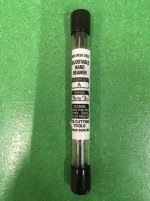
A couple of years ago I was happily surprised that the adjustable reamer I was using for quite a few years on O-360s also works for IO-390s. Adjusting it precisely permits to just remove the crud on the combustion chamber side, without harming any of metal guide itself.

Reamer.JPG
 
There's really no way to screw it up.

1. Squirt your favorite penetrating oil (Kroil, PB Blaster, etc.) into the guide.
2. Spray the ball hone with same stuff.
3. Low to medium speed, take a running start into the guide and make three strokes in and out rapidly. The ideas to get around a 30 degree crosshatch. Done. Takes maybe 5 seconds to do this step. Key is to not start or stop with the ball hone in the guide.
4. Clean guide out with penetrating oil.
5. Inspect to make sure you got all the buildup out.
6. Reassemble.

Wouldn't hurt to lap the valve while you're at it. Different subject.
How does the carbon build up get removed out of the piston?

With the reamer it says to put grease on it so the carbon particles come out with the reamer.
 
Karl,

Assuming you mean out of the cylinder rather than the piston, the grease doesn't serve as a lubricant here, the carbon sticks to the grease on the cutting apparatus. In other words, there shouldn't be any carbon getting into the cylinder. (Google "sticky bomb Private Ryan").

Or, try putting a glob of grease on your finger, now stick your grease covered finger in a pile of dirt....the dirt sticks to the grease.
 
How does the carbon build up get removed out of the piston?

With the reamer it says to put grease on it so the carbon particles come out with the reamer.
Are you refering to what might fall into the cylinder? If so, nothing to worry about. While a reamer will take out chunks, the ball hone produces something like dust. Think byproduct of sanding or grinding vs drill bit shavings. It won't hurt anything in the cylinder. A ball hone uses an abrasion process.
 
Are you refering to what might fall into the cylinder? If so, nothing to worry about. While a reamer will take out chunks, the ball hone produces something like dust. Think byproduct of sanding or grinding vs drill bit shavings. It won't hurt anything in the cylinder. A ball hone uses an abrasion process.
Karl,

Assuming you mean out of the cylinder rather than the piston, the grease doesn't serve as a lubricant here, the carbon sticks to the grease on the cutting apparatus. In other words, there shouldn't be any carbon getting into the cylinder. (Google "sticky bomb Private Ryan").

Or, try putting a glob of grease on your finger, now stick your grease covered finger in a pile of dirt....the dirt sticks to the grease.
Yup, fat fingers, not enough coffee. I do mean what may fall into the cylinder.

Appreciate the update. Looks like the ball hone is the way to go for me when the time comes. Thanks!
 
When I did my O-360, I used the LC3 reamer. For engines like mine with a fair amount of time and what I would presume to be some wear on the valve stem, I figured that there was a possibility of introducing extra valve guide clearance with the larger LC4 reamer that would not be conducive to preserving maximum valve guide life.

If the LC3 reamer doesn't produce adequate clearance (highly unlikely), finishing up with the ball hone would be a great way to open up the final clearances slightly if you are concerned.

I do agree that even with the reduced pilot size of the LC series reamers that is intended to prevent reaming the guide at an angle, or causing an out of round condition, it is likely still possible to do so if ham fisted. My valve was so stuck it required hammering the valve out of the guide, therefore I started with the reamer.

In the future, unless I had a really severe stuck valve like I noted above, I will most likely proceed to the ball hone prior to reaming it. It is less likely to introduce excessive clearance.

When cleaning up afterwards a pistol cleaning rod, patches, and Hoppes #9 solvent work really well. The firearm solvents like Hoppes are quite effective at removing carbon based fouling.
 
Back
Top