Van's Air Force

The definitive Van's Aircraft support community! Buying, building or flying an RV? Join our exclusive family of mentors and enthusiasts!

Elevator aft/up stop adjustment - how much can I grind?

skirting_virga

Well Known Member
Patron
I bought an 8A that I didn't build and it's been a joy to fly. In the course of getting to know the plane better, I've looked at the range of travel of the various control surfaces, which is generally within spec. In doing so, I noticed the up elevator is at the minimum limit and the down elevator is at the maximum limit. Presumably this is due to a tolerance in the relationship of the horns to the elevator ribs, but it seems possible to adjust at the stop.

The builder clearly adjusted it already, but I'd like to know how much filing or grinding away of the stop is acceptable if I wanted to increase the travel. I feel this might help me unload the nosewheel a little more in the rollout when loaded near the forward C of G limit (common). I can't find any detailed discussion of a limit in the plans and don't want to remove any metal without being certain.
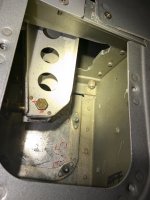
 

Attachments

  • PXL_20240925_185526160.jpg
    PXL_20240925_185526160.jpg
    1.7 MB · Views: 73
My compliments on checking your control travel and stops.

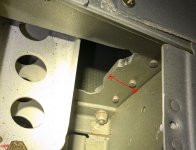
Pretty sure the 812B-1 stop was cut from 1" x 1" x 0.125" angle. Check the dimension marked below. Is it just a fuzz under 1", a "a fuzz"" being the thickness of the F812 bulkhead?

PXL_20240925_185526160.jpg

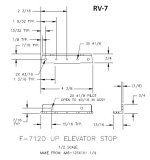
Assuming the full 1" width, I think you may draw guidance regarding minimum width from the -7 plans, as the structures are fundamentally the same. Those plans had the builder making a stop from 1" angle and cutting it down to 3/4" with a bit extra in the center for filing adjustment.

BTW, aluminum grinds poorly. Use a square file.

Usual caveat...if in doubt, call Vans.

ScreenHunter_2494 Nov. 10 08.00.jpg
 
My compliments on checking your control travel and stops.

Pretty sure the 812B-1 stop was cut from 1" x 1" x 0.125" angle. Check the dimension marked below. Is it just a fuzz under 1", a "a fuzz"" being the thickness of the F812 bulkhead?
Thanks for the detailed reply - I will measure next time I'm out at the hangar.
 
1) I wouldn't exceed Van's specs for max travel
2) it is *very* easy to get confused in measuring elevator travel angles.
 
I bought an 8A that I didn't build and it's been a joy to fly. In the course of getting to know the plane better, I've looked at the range of travel of the various control surfaces, which is generally within spec. In doing so, I noticed the up elevator is at the minimum limit and the down elevator is at the maximum limit. Presumably this is due to a tolerance in the relationship of the horns to the elevator ribs, but it seems possible to adjust at the stop.

The builder clearly adjusted it already, but I'd like to know how much filing or grinding away of the stop is acceptable if I wanted to increase the travel. I feel this might help me unload the nosewheel a little more in the rollout when loaded near the forward C of G limit (common). I can't find any detailed discussion of a limit in the plans and don't want to remove any metal without being certain.
The elevator on my RV8 is at minimum UP and maximum DOWN. At the UP limit, the elevator horn is about 1/32 from touching the back skin. In theory, I can grind off the free end of the elevator horn to get an extra few more degrees of travel but the elevator feels fine for the normal flying. I may revisit it when I start to fly aerobatic with the airplane.
 
1) I wouldn't exceed Van's specs for max travel
2) it is *very* easy to get confused in measuring elevator travel angles.
I'm hoping to exceed the minimum spec, not the maximum spec.

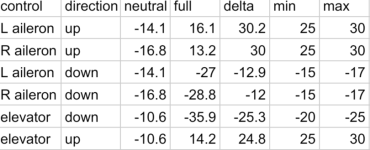
My angular testing is using an electronic accelerometer-based inclinometer as a quick and easy test to see if I'm in the ballpark. I measured neutral, full up, full down, and I generally trust it but would use other methods if I really wanted to make changes.
 
1) I wouldn't exceed Van's specs for max travel
2) it is *very* easy to get confused in measuring elevator travel angles.
for example "neutral"... is that that with the plane level? Or accounting for the plane not level? Or neutral compared to the HSTAB? and the measured angle is usually the top of the elevator skin... but that skin has an angle to the chord of the elevator. See what I mean?
 
for example "neutral"... is that that with the plane level? Or accounting for the plane not level? Or neutral compared to the HSTAB? and the measured angle is usually the top of the elevator skin... but that skin has an angle to the chord of the elevator. See what I mean?
Neutral with the elevator aligned with the hstab. That angle is not zero unless you're going to align the upper elevator skin with a level floor, but if you subtract that angle from the angle at max deflection (up or down), you can derive range accurately, IMO. At least within the margin of error of the measurement apparatus, and solid state accelerometers are fairly sophisticated these days.
 

Attachments

  • Screenshot_20241114-102913.png
    Screenshot_20241114-102913.png
    83.2 KB · Views: 22
My compliments on checking your control travel and stops.

Pretty sure the 812B-1 stop was cut from 1" x 1" x 0.125" angle. Check the dimension marked below. Is it just a fuzz under 1", a "a fuzz"" being the thickness of the F812 bulkhead?

View attachment 73958

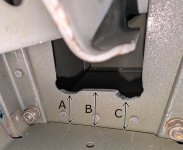
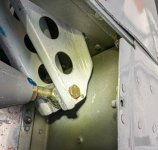
I may have reached the "if in doubt, call Vans" stage of this, but I wanted to follow-up with some measurements, referencing the annotated photo below.

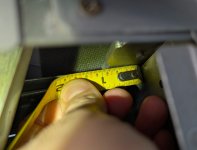
These dimensions are difficult to measure accurately because a caliper does not fit with the elevator horn.

A = 0.84" (this is the most precise of the measurements)
B = ~1.0" (slightly less than 1" as described)
C = ~0.69"

My impression is that C is hogged out more and the contact occurs primarily on A, but I didn't have any modeling clay handy to check it. As you can see from the second picture, the elevator horn does not come too close to contacting the bulkhead in its present condition. Do you think more material removal at A, or A&C is allowable?elevator stop.jpgelevator max travel.jpgA measurement.jpg
 
Last edited by a moderator:
Measuring the angle: wow, you guys are making this way harder than necessary!
The "throw" is simple to measure. It's just a relative measurement, not absolute. (the HS incidence is a whole nuther thing)

  1. Clamp elevator counterweight in neutral position
  2. Set smart level or iphone on top of elevator skin.
  3. Press ZERO (on the iPhone level, just tap the number to set a relative zero)
  4. Move elevator up to stop. Record angle.
  5. Move elevator down to stop. Record angle.
  6. Grind stops as needed and repeat.

if you want to get all fancy, you could do some trig using the distance of the horn pivot to the stop and do a bit of arctan to determine how much to grind to get that much more throw in degrees, but a little "this and that" and you'll get there in no time.
 
  1. Clamp elevator counterweight in neutral position
  2. Set smart level or iphone on top of elevator skin.
  3. Press ZERO (on the iPhone level, just tap the number to set a relative zero)
  4. Move elevator up to stop. Record angle.
  5. Move elevator down to stop. Record angle.
  6. Grind stops as needed and repeat.
This is exactly what I did. I'm on step 6, where I don't know how much more metal I'm allowed to remove. I'm not the builder, but I'm not afraid to modify what's done as long as it's "allowable". My up elevator travel is at the minimum allowable limit of 25°. I would like to move it closer to the maximum (or at least gain some degrees in that direction) for the purpose of more fully stalling the landings and keeping the nosewheel happier on the rollout.

EDIT: and being an 8 with an angle-valve engine and a CS prop, it's all I can do to get the CofG to the forward limit when I fly it solo. I use up to 50# of ballast in the baggage compartment at the moment, so more up elevator would be nice to have.
 
Chris, in my opinion you have more than adequate material available.

What it needs is careful correction and cleanup; the existing cuts are rough, and do not provide a flat landing for the elevator horn point of contact.

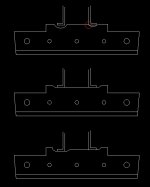
Sketch below, looking down on the stop angle. Not to scale, generic for similar RV models. Top, what you probably have now. It's not critical, but that single concentrated point of contact may wear and add more up travel over time. Middle is a desired result, assuming the elevator horns happen to be symmetrical. There's a pretty good chance they will be offset from each other, for several possible reasons, and not necessarily bad. It just means you need a stop filed like the bottom example.

At this stage of the game you may not be able to correct to match the perfect example. It's ok, not critical. Just work carefully to add the little bit of travel you want by cleaning up a flat landing for at least one horn,

After finished whatever adjustment of the stop, move forward along the control linkages all the way to the forward stick, examining everything for jam, binding, or lack of travel. The stops, up and down, should be at the elevator horns, not at some contact in the linkage. Also look at the rod ends on F-840. They tend to be misadjusted so they bind when the sticks are full left or full right.

Elevator Stop Angle.jpg
 
Chris, in my opinion you have more than adequate material available.

What it needs is careful correction and cleanup; the existing cuts are rough, and do not provide a flat landing for the elevator horn point of contact.

Sketch below, looking down on the stop angle. Not to scale, generic for similar RV models. Top, what you probably have now. It's not critical, but that single concentrated point of contact may wear and add more up travel over time. Middle is a desired result, assuming the elevator horns happen to be symmetrical. There's a pretty good chance they will be offset from each other, for several possible reasons, and not necessarily bad. It just means you need a stop filed like the bottom example.

At this stage of the game you may not be able to correct to match the perfect example. It's ok, not critical. Just work carefully to add the little bit of travel you want by cleaning up a flat landing for at least one horn,

After finished whatever adjustment of the stop, move forward along the control linkages all the way to the forward stick, examining everything for jam, binding, or lack of travel. The stops, up and down, should be at the elevator horns, not at some contact in the linkage. Also look at the rod ends on F-840. They tend to be misadjusted so they bind when the sticks are full left or full right.

View attachment 75228
Thanks for taking the time to illustrate. It sounds like I need to find myself a coarse file and get to work.
 
Do you think more material removal at A, or A&C is allowable?
Yes
There is more than enough margin remaining to get the travel deflection that you want.

BTW, leveling the aircraft and/or measuring deflection in relation to the cord line is not necessary as some have implied.
The difference in the measured result is minuscule and not worth the trouble. That is partially the reason for having a 5 degree tolerance range.
 
Update: I was able to remove some aluminum, carefully, with a die grinder and carbide bur. It's been a long time since I used something like this, and have never used it with aluminum, so I'm reminded that chatter is a constant issue when operating against some curvatures and not others. It took me a while to grind off enough to get about +2° worth of up travel, which is where I'm going to leave it for now (27° up elevator, with 30° being max allowable). I would like to be able to get in there with a hand file, but it's really tight, and I don't have a good view to assess the contour of the stop vs. the shape of the elevator horns. Considering clay or silicone molding putty to check fit.

Some informal testing suggests that I have a slower IAS at touchdown with full aft elevator, but there's no telling what the IAS->CAS conversion would be at that AOA. Truly calm wind days are rare so I can't make an assumption about TAS=GS and go from there to convert to CAS, but I think it is landing a little slower. Mission accomplished, for now.

The difference in IAS at touchdown seems to be from 56kts down to 53kts. I have relatively few landings with my newly-renovated static ports to base the first number on, and relatively few landings after the pitch stop change to base the second number on. Flysto.net and EFIS logs are what I'm using to analyze.

EDIT: Given the spring-style nosegear propensity to dig in and fold on soft surfaces, and the highish landing speeds of the 8A, I consider minimizing touchdown speed to be a matter of safety in an unplanned engine failure. Realistically, I always wanted the 9A for this reason (with the new-style elastomeric nosegear), but 1) a 9A doesn't fit in my present hangar situation and 2) buying a 9A with the new nosegear means I would realistically need to find a plane completed in the last year or two. Unlikely to happen, so I have to do what I can to make the 8A as safe as possible.
 
Last edited:
Some informal testing suggests that I have a slower IAS at touchdown with full aft elevator, but there's no telling what the IAS->CAS conversion would be at that AOA. Truly calm wind days are rare so I can't make an assumption about TAS=GS and go from there to convert to CAS, but I think it is landing a little slower. Mission accomplished, for now.

Are you able to stall it in flight at your most forward CG? If so more elevator travel won't let you land any slower. If not I would try and get the extra few degrees.
 
Are you able to stall it in flight at your most forward CG? If so more elevator travel won't let you land any slower. If not I would try and get the extra few degrees.
That's a good question. Yes, I can certainly stall it in flight. If the tail stalls later than the main wing, it may be possible to stall the wing more deeply, but I suppose this is a question for an aeronautical engineer. The other thought is that if the tail is not fully stalled when the mains touch, I can still use more down-load from the elevator to hold the nosewheel off longer, even though the wing is producing less lift than the plane weighs.
 
I would clarify that the tail should never stall (if it did the nose would drop). But yes, having more elevator travel will mean you can hold the nosewheel off longer.
 
I would clarify that the tail should never stall (if it did the nose would drop). But yes, having more elevator travel will mean you can hold the nosewheel off longer.
I suppose I never gave it much thought, but the nose certainly drops when you perform a stall. I guess this is more likely due to a reduction in lift on the wing and not on the tail, although I suppose it could be portions of both. I don't have the background to do this sort of analysis and I'm sure it's not simple to do, but it occurs to me that the Reynolds number on the airflow over the tail will be lower due to shorter chord, which suggests it could stay attached longer. And I'm way out of my depth.
 
Back
Top