
I am installing a ci-122 VHF antenna and trying to understand why it is doing what it does. I thought the antenna element should have continuity with the center pin of the BNC connector and subsequent coax connected to it. Mine doesn't. I connected my handeld radio to the installed antenna and it appears to radiate, I heard it on another handheld, but am hesitant to connect the expensive comm radio without understanding how this antenna works. Does anyone know if there is an internal impedance matching circuit or something else inside the ci-122 antenna that prevents a continuity reading from the external element to the coax?

Van's Air Force
You are using an out of date browser. It may not display this or other websites correctly.
You should upgrade or use an alternative browser.
You should upgrade or use an alternative browser.
How does the comm antenna work?
- Thread starter BrianG123
- Start date


AZSteve053
Well Known Member
Attached is a Tech Data Sheet for the antenna you're asking about. It appears the radiating element is exposed and unpainted so making a connection directly to it should not be an issue. MANY antenna's, as you have surmised, contain some sort of passive matching that could include capacitive coupling. Your absolute best best is a call to COBHAM with this question.
Hope this helps.
Hope this helps.
Attachments
You cannot measure the impedance of an aerial using a DC ohm meter. The resistance, as you have measured it, may be either a short circuit or an open circuit depending upon the electrical design of the antenna. The antenna have to be mounted on a ground plane before a test with a VSWR meter can be done.
The 50 ohm characteristic impedance of the antenna is at radio frequency.
The ground is one pole and the antenna is the other pole.
Think of a battery, connect a bulb to one pole and it will not light. Connecting the bulb to + and - and it will light up.
Good luck
The 50 ohm characteristic impedance of the antenna is at radio frequency.
The ground is one pole and the antenna is the other pole.
Think of a battery, connect a bulb to one pole and it will not light. Connecting the bulb to + and - and it will light up.
Good luck
An antenna is basically a length of wire that is the correct length to radiate the radio energy into the atmosphere. The only matching is the length of the radiating element, which has to be a compromise so it works from 118 Mhz up to 136 Mhz. There is nothing active in the com radio antennas we use. The only way to blow the radio is to transmit without an antenna attached.

GalinHdz
Well Known Member
A common misconception is that resistance is the same as impedance. IT IS NOT! airguy gave excellent advice with his post and I recommend you follow it.The proper way to test coax/antenna is with a VSWR meter. If you don't have one, or have never used one, call up one of your local HAM radio guys, they'll be happy to help.


Shown below are the common types of VHF antennas used by general aviation aircraft, they are 1/4 wave designs requiring a ground plane.
Antenna 1 is a simple rod type antenna. This antenna is fine for local use, Sunday breakfast, unicom, etc, the antenna performance is generally centered on about 127.5 MHz with performance falling off on both band edges.
VHF com antennas such as Comant, Rami, Drone & Margolin and Delta Pop have an impedance matching network built into the antenna base, the matching network insures good antenna performance across the entire 118 - 136 MHz VHF Com band.
Antenna 2 has a matching network similar to the type used by Comant and RAMI, both will show a DC open when measured with a VOM from the center pin to the barrel of the BNC connector and ~50 ohms impedance at the operating frequency.
Antenna 3 is a shorted stub, grounded element design used by Dorne & Margolin and Delta Pop, a grounded element antenna will have the antenna element at DC ground potential, the BNC center pin to the mounting studs will show a DC short with a VOM and ~50 ohm impedance at the operating frequency.
The Transponder and ADS-B / UAT antennas are a different design and will show a DC open when measured with a VOM on the BNC connector.
Keep in mind the antenna design when measuring the antenna coax for shorts and opens, best to disconnect the coax from the antenna base when making these checks.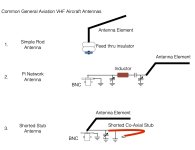
Antenna 1 is a simple rod type antenna. This antenna is fine for local use, Sunday breakfast, unicom, etc, the antenna performance is generally centered on about 127.5 MHz with performance falling off on both band edges.
VHF com antennas such as Comant, Rami, Drone & Margolin and Delta Pop have an impedance matching network built into the antenna base, the matching network insures good antenna performance across the entire 118 - 136 MHz VHF Com band.
Antenna 2 has a matching network similar to the type used by Comant and RAMI, both will show a DC open when measured with a VOM from the center pin to the barrel of the BNC connector and ~50 ohms impedance at the operating frequency.
Antenna 3 is a shorted stub, grounded element design used by Dorne & Margolin and Delta Pop, a grounded element antenna will have the antenna element at DC ground potential, the BNC center pin to the mounting studs will show a DC short with a VOM and ~50 ohm impedance at the operating frequency.
The Transponder and ADS-B / UAT antennas are a different design and will show a DC open when measured with a VOM on the BNC connector.
Keep in mind the antenna design when measuring the antenna coax for shorts and opens, best to disconnect the coax from the antenna base when making these checks.

Hmmmm.... careful with that thinking. With a VSWR of 5 about half of your transmit power is reflected back into the transmitter. That can happen with a bad crimp or a crushed cable. Solid state transmitters can have trouble dissipating reflected power without getting hot and failing.The only way to blow the radio is to transmit without an antenna attached.

Answers are WAY to complicated so far. Comant antennas are rugged. It probably is fine. Test with a VSWR meter or just hook it up and go test it out. If you are getting a good 20 miles range (line of sight), you are good to go. Ground the base to metal.
If you run out of options, I will loan you a VSWR meter. I do this for a living. Let me know. Nick
If you run out of options, I will loan you a VSWR meter. I do this for a living. Let me know. Nick
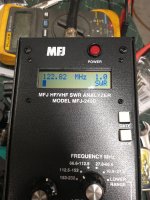
Thanks for all the replies. I really am getting into the educational aspect of this project along the way in my build. I am a ham radio guy but never got past 2 meters or real practical application of theory. I did mount the antenna and use my icom handheld to test it , I left my 2 meter that has airband on the coffee table and my wife could hear it from the garage through brick probably 50 yards away so I'm pretty sure it's good. I was just surprised when I checked the comm antenna and it didn't behave the way the ELT antenna or my 2 meter ht antenna did. Looking at the replies I understand better now how those are the #1 type and common is #2 type so they behave differently with the concept of capacitance matching and how the dc continuity check wouldn't work on that type system. Answering this question was a good excuse to get an swr meter I wanted anyway and learn more about antennas. It's on the way and I'll report results if anyone is interested.

I used the same Comm-122's. I was careful to ensure the mating surfaces were clean of paint. The attachment to the underside of your fuselage needs to be strengthened by a bigger plate inside. There are air loads based on RV's due to speed which could deform your attachment.The proper way to test coax/antenna is with a VSWR meter. If you don't have one, or have never used one, call up one of your local HAM radio guys, they'll be happy to help.
The antenna works by forming a very large grounding plate with your aircraft. Also noted: if you use more than, 1 they need to be separated so they do not interfere with each other. i.e. not in the shadow of the other.
Daddyman
Lucky for you the sun spot cycle is at peak. HF should be fun. Try the upper bands out....
Yes, interested. Thanks.Thanks for all the replies. I really am getting into the educational aspect of this project along the way in my build. I am a ham radio guy but never got past 2 meters or real practical application of theory. I did mount the antenna and use my icom handheld to test it , I left my 2 meter that has airband on the coffee table and my wife could hear it from the garage through brick probably 50 yards away so I'm pretty sure it's good. I was just surprised when I checked the comm antenna and it didn't behave the way the ELT antenna or my 2 meter ht antenna did. Looking at the replies I understand better now how those are the #1 type and common is #2 type so they behave differently with the concept of capacitance matching and how the dc continuity check wouldn't work on that type system. Answering this question was a good excuse to get an swr meter I wanted anyway and learn more about antennas. It's on the way and I'll report results if anyone is interested.
