Van's Air Force

The definitive Van's Aircraft support community! Buying, building or flying an RV? Join our exclusive family of mentors and enthusiasts!

Canopy UHMW Block Failure (Disintegration) Applies to RV6, 7, 8, and 9

jclark

Well Known Member
Benefactor
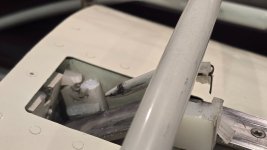
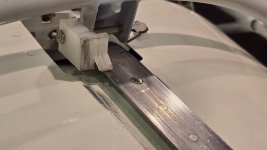
Yesterday, as I attempted to open the sliding canopy on my RV8, it got "stuck/hung up". Upon closer inspection, I realized that the UHNW block on the sliding rail was DISINTEGRATING!!!

It crumbled into several pieces. I could then lift the canopy's rear end up without resistance! I have no idea what might have happened in flight without that block holding the canopy to the rail.

ALSO, the locking block seems to be breaking up.


You may want to check the UHMW canopy blocks on an older RV6, 7, 8, or 9 if you have them.

I already have two sets of the two blocks on order. The aircraft is "NO FLY" for the moment.
 
please post pictures of this.. I'm pretty sure UHMW is chemically resistant.. so thinking ozone/UV?
 
First time I’ve ever read about this failure on VAF. My previous RV-8 first flew in 2001 and now has about 2350 hours on it with no problem ( a buddy owns it and I see it regularly).
First I have heard of this as well (on VAF or otherwise).

How old is the airplane James?
 
"...It crumbled into several pieces. I could then lift the canopy's rear end up without resistance! I have no idea what might have happened in flight without that block holding the canopy to the rail.

ALSO, the locking block seems to be breaking up..."
I don't think that slider block does much in flight. isn't that slider track just held on with screws through the upper skin? The two big ones on the sides that the frame pins nest in when closed hold the whole back 1/2 of the canopy in place. Is that what you mean by locking block? I think it would be a wild ride if those let go...
 
The plane was built in 2011.

It has ALWAYS been parked inside a hangar except for flyins lin SnF.

Pictures later.

It was a ***BIG*** surprise to me as I had just flown it last week.
 
I don't think that slider block does much in flight. isn't that slider track just held on with screws through the upper skin? The two big ones on the sides that the frame pins nest in when closed hold the whole back 1/2 of the canopy in place. Is that what you mean by locking block? I think it would be a wild ride if those let go...
There is a locking pin that goes into another UHMW lock. I cannot say how much the "slider block" helps the "locking block" hold things down in flight.

I don't know what CAUSED the problem. (Could have been someone out to get me that sneaked into the hangar in the middle of the night while having hacked the cameras. ).:):):) I am simply letting everyone know that something happened at least once and so you might want to take a look at yours.
 
First I have heard of this as well (on VAF or otherwise).

How old is the airplane James?
I had not heard of this either. Thus the post.

Again, I don't know WHY it happened.

Maybe the canopy got slid back and slammed so hard they were cracked. (Actually, I keep the canopy closed all the time.) Maybe little green men from Mars. :):sick::sick:

Built in 2011 with not a lot of external exposure. Of course, it does get HOT(!!!) here in South Carolina.
 
There is a locking pin that goes into another UHMW lock. I cannot say how much the "slider block" helps the "locking block" hold things down in flight.

I don't know what CAUSED the problem. (Could have been someone out to get me that sneaked into the hangar in the middle of the night while having hacked the cameras. ).:):):) I am simply letting everyone know that something happened at least once and so you might want to take a look at yours.
The slide block on the rear track is only intended to support the back of the canopy when being opened / closed.
The flight loads imparted on the canopy are meant to be reacted through the pins on each aft corner of the canopy frame, into the UHMW blocks mounted to the aft end of the canopy side rails. If both pins are properly / fully engaging into the blocks when the canopy is closed, there is very minimal flight load imparted into the slide block.
 
I had the same issue on my RV-8 a year or two ago; when trying to open the canopy from the inside it sorta jammed and stuck. My back seater then lifted the canopy and then it slid back. Yep, the slider block had disintegrated! And dang I’m glad it happened on return to home base…

Mine failed after 17 years and 1975 hours. Hangared.
 
The slide block on the rear track is only intended to support the back of the canopy when being opened / closed.
The flight loads imparted on the canopy are meant to be reacted through the pins on each aft corner of the canopy frame, into the UHMW blocks mounted to the aft end of the canopy side rails. If both pins are properly / fully engaging into the blocks when the canopy is closed, there is very minimal flight load imparted into the slide block.
That's what I figured, Scott, but I did not want to speculate here on something like that. I also figured that you would inform us all.

THANKS!!
 
I had the same issue on my RV-8 a year or two ago; when trying to open the canopy from the inside it sorta jammed and stuck. My back seater then lifted the canopy and then it slid back. Yep, the slider block had disintegrated! And dang I’m glad it happened on return to home base…

Mine failed after 17 years and 1975 hours. Hangared.
Well, we are now up to TWO!!

Helps to know that I am not "SPECIAL/UNIQUE" for this matter.
 
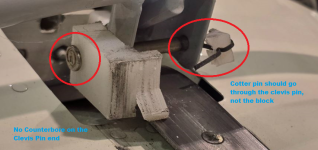
I noticed discrepancy in the 2nd picture compare to the canopy block on my RV8.
There is no counterbore on the head of the clevis pin. The head should be embedded inside the counterbore and the cotter pin end should be exposed on the other side to allow the cotter pin to be inserted through the pin.
In the picture, the cotter pin was drilled through the block 😯
Plus the cotter pin in the picture is HUGE. It should have a tiny cotter pin to hold the clevis pin in place. By drilling a large hole in the block, you may have weaken it.

1730690814693.png

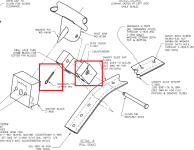
Here is the build instruction for the block:

1730690949878.png
 
Picture as promised.
Sometimes plastic stock can get mixed up. That looks like white or natural Delrin to me. Delrin/Acetal will break like that. If you shave off a sliver of that plastic and hold a flame to it you can smell the smoke and compare it to a known piece of UHMW. Be careful Delrin smell will burn your sinuses badly. Just get a tiny whiff…

I see often people recommend Delrin for parts but it isn’t always a good choice, because it can break just like in your photo. It machine’s fantastic but not alway appropriate for an airplane part.
 
The head should be embedded inside the counterbore and the cotter pin end should be exposed on the other side to allow the cotter pin to be inserted through the pin.
In the picture, the cotter pin was drilled through the block 😯
Plus the cotter pin in the picture is HUGE. It should have a tiny cotter pin to hold the clevis pin in place. By drilling a large hole in the block, you may have weaken it.

Here is the build instruction for the block:​


View attachment 73575
In your second photo the instructions say to drill a cotter pin hole through the UHMW block for cotter pin access.
 
Reply
In your second photo the instructions say to drill a cotter pin hole through the UHMW block for cotter pin access.
On my RV8, when the clevis pin head was seated inside the counterbore, the other end was extended enough for a cotter pin. There was no drilling through the block. The cotter pin was there to keep the clevis from falling out and drilling into the block didn't make any sense to me.
 
You can add a 3rd example. The block from my first -6 broke while I was installing it's canopy on my 2nd -6. By that time it had been sitting in the hangar for close to 15 years with no UV exposure so it was just age. FWIW the original was white (no choice back then) and I got the replacement in black.
 
Thanks everyone for the info on the block and pin.
(As well as the POTENTIAL for the block to have been something different from UHMW.)

I did not build THIS plane, although I removed and replaced everything electrical (the whole panel, electrical system, all switches, and wires).
Yet, I **do** take responsibility (as its current owner) for overlooking this for years.

The build back ***WILL*** be per the plans when I get the new parts.

A request: Let us not have this discussion devolve into who did the canopy, how was that missed, etc. I raised the matter and posted the pictures as a matter of safety for all.
 
I can pretty much guarantee that the part being discussed has never been made from any material other than UHMW.
I am very familiar with Delrin and what its and UHMW’s appearance is when they have been machined.
The photos attached in this thread are clearly of a part made from UHMW.
It is also clear that the clevis pin was installed incorrectly which resulted in the Cotter pin hole being drilled too far in board, which would have definitely weekend the slide block.
The design did originally call for the Cotterpin to be drilled through the block to assure good clearance for the block to enter the pocket on the RV – 8. I think that may have been changed at some point because people had so much difficulty properly locating the hole for the cotter pin, but I am not sure what the RV – 8 plans show now.
This would not be a factor though for the 6, 7, or 9 since they don’t have a clearance issue for the hardware so a bolt and nut is used instead.
 
Thanks everyone for the info on the block and pin.
(As well as the POTENTIAL for the block to have been something different from UHMW.)

I did not build THIS plane, although I removed and replaced everything electrical (the whole panel, electrical system, all switches, and wires).
Yet, I **do** take responsibility (as its current owner) for overlooking this for years.

The build back ***WILL*** be per the plans when I get the new parts.

A request: Let us not have this discussion devolve into who did the canopy, how was that missed, etc. I raised the matter and posted the pictures as a matter of safety for all.
And spreading safety information is one of the biggest benefits of these forums, so thank you for starting the discussion

One of the secondary benefits of these types of discussions, hopefully, is education regarding the inspection of Aircraft.
Being granted a repairman certificate for an experimental amateur built, doesn’t automatically infuse the knowledge and experience of being a good inspector into the Aircraft builder.
Often times while doing condition inspections we focus more on the engine, control system, and other seemingly more important details, while something seemingly more simple like a canopy latch or other canopy parts can be overlooked because the canopy still opens and closes normally, but the condition of some of those parts may have started to degrade.

James, that is not meant to point a finger at you…. Just putting some of my own effort into raising awareness, and it goes for myself as much as anyone, to not assume anything with any single part on an airplane.
The most seemingly insignificant part, in the right situation, can start a cascading chain of events that can eventually lead to a bad day.
 
And spreading safety information is one of the biggest benefits of these forums, so thank you for starting the discussion

One of the secondary benefits of these types of discussions, hopefully, is education regarding the inspection of Aircraft.
Being granted a repairman certificate for an experimental amateur built, doesn’t automatically infuse the knowledge and experience of being a good inspector into the Aircraft builder.
Often times while doing condition inspections we focus more on the engine, control system, and other seemingly more important details, while something seemingly more simple like a canopy latch or other canopy parts can be overlooked because the canopy still opens and closes normally, but the condition of some of those parts may have started to degrade.

James, that is not meant to point a finger at you…. Just putting some of my own effort into raising awareness, and it goes for myself as much as anyone, to not assume anything with any single part on an airplane.
The most seemingly insignificant part, in the right situation, can start a cascading chain of events that can eventually lead to a bad day.
No offense taken at all. We all should be here to learn from each other's experiences.

Thank you for the feedback.
 
Back
Top