Van's Air Force

The definitive Van's Aircraft support community! Buying, building or flying an RV? Join our exclusive family of mentors and enthusiasts!

Anonymous Mode

Webb

Well Known Member
Sponsor
I’m not having my luck on finding the documentation on how to set anonymous mode in the Garmin manuals. I’ve found some info in the GTN750 manual but not what I need. Can someone point me in the right direction or tell me how.

Ideally, I want to display VFR when squawking 1200 and my N number when on a discrete code.

I know it won’t help on controlled fields but makes sense to avoid ADSB gotchas on non controlled fields since 1200 will be the squawk.
 
I know it won’t help on controlled fields but makes sense to avoid ADSB gotchas on non controlled fields since 1200 will be the squawk.
As mentioned above, anonymous mode is only available with 978MHz UATs, not mode S-ES transponders. However, imho many if not most towers do not give you a squawk code, so your adsb can still be anonymous. Of course, you’re suppose to be talking with the tower so you’re not a secret.
 
\However, imho many if not most towers do not give you a squawk code, so your adsb can still be anonymous. Of course, you’re suppose to be talking with the tower so you’re not a secret.
Doesn't matter if they don't give you a code, if they don't you'll be squawking 1200... You're not allowed to fly with it turned off if it's installed.
 
I’m not having my luck on finding the documentation on how to set anonymous mode in the Garmin manuals. I’ve found some info in the GTN750 manual but not what I need. Can someone point me in the right direction or tell me how.

Ideally, I want to display VFR when squawking 1200 and my N number when on a discrete code.

I know it won’t help on controlled fields but makes sense to avoid ADSB gotchas on non controlled fields since 1200 will be the squawk.
That depends on what kind of transponder / ADS-B out equipment you have. If it's 1090ES (like all the modern $$$$ transponders) then you can't do actual anonymous mode. However, if it is approved UAT "out" equipment combined with Mode C you can. When folks ask me how to legally equip for ADS-B and they don't have turbo-charged engines I advise keeping their Mode C and adding a UAT device. Much cheaper and with the privacy of full anonymous mode.
 
Doesn't matter if they don't give you a code, if they don't you'll be squawking 1200... You're not allowed to fly with it turned off if it's installed.
I think you missed the point. UAT anonymous mode only works when squawking 1200. If the tower gives you a different squawk code then the world knows who you are (as well as everyone listening in on tower frequency).
 
Seems not all the tower controllers know about 978 UAT and the anonymous feature... My recent visit to North Las Vegas had me make initial contact with tower as usual, and after sorting out that I was indeed where I said I was and gave me the clearance, he came back with “….be advised, your transponder ID shows you as “PING 4832”…”. I replied yep, I’m in anonymous mode. No further discussion after that.
 
Seems not all the tower controllers know about 978 UAT and the anonymous feature... My recent visit to North Las Vegas had me make initial contact with tower as usual, and after sorting out that I was indeed where I said I was and gave me the clearance, he came back with “….be advised, your transponder ID shows you as “PING 4832”…”. I replied yep, I’m in anonymous mode. No further discussion after that.
But he did correlate communications with you (using your correct N-number, I imagine) and the "anonymous" track. So if that data is recorded, your anonymity just went out the window.
 
But he did correlate communications with you (using your correct N-number, I imagine) and the "anonymous" track. So if that data is recorded, your anonymity just went out the window.
Of course my anonymity was compromised - I reached out to the tower for clearance. Happens every time I contact ATC. It’s necessary for that kind of flying and most importantly, it’s a discrete choice on my part. and in this case, I’m only “tracked” for a brief period of the flight and by a very limited audience.

”Anonymous mode” is not capable of making me disappear from the entire world. I do not intend to overfly a hostile country undetected. But it does provide some barriers to those bored or nefarious types who have access to the internet and could otherwise easily track my movements directly to my home.
 
Anonymous Mode is not designed to make any aircraft invisible. It is always visible. The only real thing anonymous mode does is scrub identifying information from the target. But everybody still sees it and can avoid it and see all the flight parameters. They just can't get your name or home address out of the FAA database in matter of seconds. Otherwise it is practically impossible with the aircraft ID cloaked. If somebody breaks an FAR even if under anonymous mode they can still be violated because the FAA doesn't need the ADS-B identification to know who the airplane is. They have plenty of capability to find a suspect without ADS-B. But Florida can't.
 
Of course my anonymity was compromised - I reached out to the tower for clearance. Happens every time I contact ATC. It’s necessary for that kind of flying and most importantly, it’s a discrete choice on my part. and in this case, I’m only “tracked” for a brief period of the flight and by a very limited audience.
There is no anonymity for *any* of the flight if you switch to a discrete code briefly somewhere along the track. It's pretty obvious that the airplane squawking 1200 switched to 4321 and then back to 1200 when you review the data later.
 
If you have something like a GDL 82 (a UAT device), instructions for setting Anonymous Mode is in the Manual.

Yes, and I would like to again compliment Garmin for revising the software. Initially, the GDL 82 would broadcast the true ID for a few seconds at startup, then switch to anonymous mode. If there was a receiver within range, it was a trivial matter to link the initial squawk to the subsequent flight. The revision eliminated the initial ID squawk.

If you have not already done so, download and run the update.
 
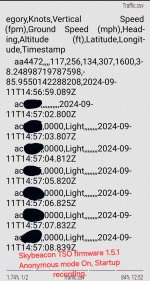
I'll tag on to say, as in the landing fees post, UNLIKE the GDL-82, the "Beacons" line DO still broadcast your ID during startup in Anonymous mode. I just rechecked current firmware and recorded it..

Edited for clarity- this is a "Beacon" product.
 

Attachments

  • Screenshot_20240913_125205.jpg
    Screenshot_20240913_125205.jpg
    973.9 KB · Views: 24
Last edited:
I'll tag on to say, asin the landing fees post, the "beacons" DO still broadcast your ID during startup in Anonymous mode. I just rechecked current firmware and recorded it..

Are you saying you just recorded a valid ID during startup of a GDL-82, or some other device?
 
Which brand and model of ADSB beacon is the data recorded?
Skybeacon TSO on firmware, the last update, 1.5.1 is my screenshot. Use the GDL-82, pin 5 actively switched, as Dan H said, with the current update, if you want to be Anonymous even at initial startup/power on. I cleaned up the above post.
 
Last edited:
You can also go to an FAA website and block your tail number from public display on flight tracking sites like FlightAware, Planefinder, etc:
Yes. But that only removes you from the third-party databases. Your information is still transmitted and available to any physical receiver or other aircraft. So if you are 1090ES out squawking VFR anybody with a $35 raspberry pi "in" receiver can still identify you. As well as Florida and the landing fee vendors. With 978 UAT out under true anonymous mode they cannot ID you unless you squawk a discreet code or they get a photo.
 
Last edited:
On a similar note, when the DHS was flying illegal immigrants in the wee hours of the night out of our home airport here on the border the government cloaked the chartered flights' ADS-B location from the 3rd party vendors, as mentioned by Oly above. However, I was still able to see them with my onboard "in" equipment as they were on 1090ES and my signal was direct communication with the ADS-B towers and other aircraft. I could track them while airborne. Not as far as Martha's Vineyard mind you. But as long as I could.
 
There is no anonymity for *any* of the flight if you switch to a discrete code briefly somewhere along the track. It's pretty obvious that the airplane squawking 1200 switched to 4321 and then back to 1200 when you review the data later.
That has not been the case with my setup. My typical use of flight following picks up a code a few minutes after takeoff and then I terminate 20 some miles from landing. Review of the track on Flight aware does not show my pre or post FF tracks nor my departure or destination airports. Notes usually show “near EDW” and “near PHX” as my departure and destination. And I do not intentionally turn off my transponder or spoof the system in any way. It’s always powered on.

True, there is a lasting record that my tail number was used by someone and went somewhere on that day, but I accept that reduction in privacy as a cost of using the service.
 
“With 978 UAT true anonymous mode they cannot id you unless you squawk a discreet code or they get a photo.”

Not necessarily. There is a good chance they are also recording the CTAF/tower. Thus, radio calls of approaching and landing, with N number included, can also be used for identification and billing. Upon reading Vector website, it becomes clear that they use “data fusion” from many sources to confirm aircraft owner. Of couse, ADSB is the low hanging fruit, and easiest to use for claiming that aircraft N1234, owned by John Doe, landed at KXYZ on given day and time, and owes $XX. If paying by credit card add 5%.
 
“There is a good chance they are also recording the CTAF/tower. Thus, radio calls of approaching and landing, with N number included, can also be used for identification and billing. Upon reading Vector website, it becomes clear that they use “data fusion” from many sources to confirm aircraft owner. Of couse, ADSB is the low hanging fruit, and easiest to use for claiming that aircraft N1234, owned by John Doe, landed at KXYZ on given day and time, and owes $XX. If paying by credit card add 5%.
This is what occurs here. Radio broadcasts at aerodromes are used to bill landing fees.
Predictably that has resulted in people just using bogus callsigns and/or not broadcasting at all at untowered fields.

Recently they’ve taken to using filed flight plans to augment the data. Inexplicably our ANSP gives that data out. Go figure.
So if you file but don’t actually fly, you’ll get a bill! 😡
 
If you want the most available anonymity. The previously mentioned LADD program is a good start but also take advantage the PIA callsign program. PIA provides a new Hex code which is not tied to your registration on the public side of the database, and in conjunction with a participating provider you now have a callsign instead of your N number on the radio and your flight plan. The FAA can correlate the new Hex code they provided to your aircraft. They still know who you are and agencies with a legitimate interest can request from FAA but no one else. John Q is in the dark on your ADSB broadcast and your N number on the radio too.

Form an LLC, for the purpose of removing your name and address from the FAA database which is easily googled.
In most states the LLC members can be found on the google or a search of the state’s corporation website (requires more work than just FAA database queries) its speed bump. So if that’s not enough for you, there are a handful of states that do not disclose the LLC members. Dead end for John Q (hard wall) A new law went in affect this year and does require the disclosure of LLC members in all states including the ones with anonymous members but only to certain Fed agencies (advantage: not public facing). Those anonymous states will remain anonymous to the face of the public. The only way that information is available is through a court order or through a need for an investigation by an agency that has a legitimate interest. Not 100% but let’s be honest the government could always find out what they want anyway. It will however keep John Q Public out of your business. This includes not only ADSB but also those people that love to take photos of your tail number.

One caveat, if you did LADD + PIA and have an LLC in an anonymous state congratulations you’ve gone all out, but you can blow your cover (photo weirdos) if you have a repairman certificate since that is searchable and has your N number tied to it. Doh! 😞 Sadly you’ll need to forgo that repairman cert. Now you need an A&P or have your own A&P certificate to do your conditional inspection. Additional hassle and defeats the advantage of building and having a repairman cert.

Lot’s of work just to fly around without people knowing all your business just because the FAA doesn’t think it should protect your personal information from the public.
 
This is what occurs here. Radio broadcasts at aerodromes are used to bill landing fees.
Predictably that has resulted in people just using bogus callsigns and/or not broadcasting at all at untowered fields.
Unless it is a towered field, I only identify myself on the radio by physical appearance. “White and blue Rocket” is far more meaningful to the existing traffic than an N number. Safety first, after all.
 
If you want the most available anonymity. The previously mentioned LADD program is a good start but also take advantage the PIA callsign program. PIA provides a new Hex code which is not tied to your registration on the public side of the database, and in conjunction with a participating provider you now have a callsign instead of your N number on the radio and your flight plan.

One caveat, if you did LADD + PIA and have an LLC in an anonymous state congratulations you’ve gone all out, but you can blow your cover (photo weirdos) if you have a repairman certificate since that is searchable and has your N number tied to it. Doh! 😞 Sadly you’ll need to forgo that repairman cert. Now you need an A&P or have your own A&P certificate to do your conditional inspection. Additional hassle and defeats the advantage of building and having a repairman cert.

Lot’s of work just to fly around without people knowing all your business just because the FAA doesn’t think it should protect your personal information from the public.
A lot less work to just use Mode C with UAT anonymous mode. A whole lot less, simpler and works.
 
A lot less work to just use Mode C with UAT anonymous mode. A whole lot less, simpler and works.

Every now and then I see targets which have a "VFR" label instead of the tail number. That's the smart money enjoying the freedom of flight! Of course UAT becomes visible once assigned a squawk, but for many this isn't a big issue if most flights are 1200.

I was very surprised when I found out that 1090 ADSB does not support this mode. and never will?
 
Every now and then I see targets which have a "VFR" label instead of the tail number. That's the smart money enjoying the freedom of flight! Of course UAT becomes visible once assigned a squawk, but for many this isn't a big issue if most flights are 1200.

I was very surprised when I found out that 1090 ADSB does not support this mode. and never will?
You got it. It has to be a Mode A/C transponder. Use that with a 978 UAT out unit with one panel-mounted anonymous switch. Woola. No paperwork, cost, LADD, PIA, dependency on a gubmint' system or general PITA.
 
Last edited:
Legal question.

let’s say you had an old transponder laying around due to the fact you upgraded your transponder to one of the newer ADSB in/out transponders and you reinstalled it. Would it be legal to use the older transponder when you wanted to be anonymous?
 
Legal question.

let’s say you had an old transponder laying around due to the fact you upgraded your transponder to one of the newer ADSB in/out transponders and you reinstalled it. Would it be legal to use the older transponder when you wanted to be anonymous?
If you are saying you would turn off the new Mode S transponder and turn on the old Mode A/C one it would not be legal as the ADSB is still installed in the plane. If installed, it must be on per the FARs. If you chose to replace the new Mode S with your original Mode A/C you could legally do that if you remained outside ADSB airspace. If you removed the new Mode S and replaced with your old Mode A/C and added an ADSB UAT you could operate in any airspace you currently can (with the exception of Class A which is 18,000 feet and above) and have the ability to run in anonymous mode when you choose to do so.
 
A lot less work to just use Mode C with UAT anonymous mode. A whole lot less, simpler and works.
True, but to my knowledge UAT solutions were add on equipment to old transponders. New transponders with integrated ADSB to my knowledge only operate 1090 ie Dynon. For new builds with new equipment it’s not an option unless you want a legacy transponder and an add-on ADSB solution with your new avionics suite.
 
If you are saying you would turn off the new Mode S transponder and turn on the old Mode A/C one it would not be legal as the ADSB is still installed in the plane. If installed, it must be on per the FARs. If you chose to replace the new Mode S with your original Mode A/C you could legally do that if you remained outside ADSB airspace. If you removed the new Mode S and replaced with your old Mode A/C and added an ADSB UAT you could operate in any airspace you currently can (with the exception of Class A which is 18,000 feet and above) and have the ability to run in anonymous mode when you choose to do so.
If you were to rack and re-rack 1090 to UAT back to 1090 etc etc, would you need to do the PAPR performance report each time you installed the 1090? Food for thought.
 
True, but to my knowledge UAT solutions were add on equipment to old transponders. New transponders with integrated ADSB to my knowledge only operate 1090 ie Dynon. For new builds with new equipment it’s not an option unless you want a legacy transponder and an add-on ADSB solution with your new avionics suite.
There are hundreds of used GTX 327 Mode C solid-state digital transponders out there that work great. Many of which are already in a panel slated for an upgrade. I contend one should keep their "in" and "out" sources separate for more than a few reasons anyway. Sandia actually sells a brand new Mode C transponder if somebody has just gotta have new. They even sold one for a while that was Mode C with integral UAT out, but I don't see it in their offerings anymore.
 
If you were to rack and re-rack 1090 to UAT back to 1090 etc etc, would you need to do the PAPR performance report each time you installed the 1090? Food for thought.
Not only that, but some contend that if a transponder is removed from it's rack and re-installed it should get a new repair station sign-off. I wouldn't bother but some folks are real sticklers. Also, the FAA has published guidance that an airframe should never have both 978 ADS-B out and 1090 ADS-B out installed even if one were to be as a standby.
 
Last edited:
Also, the FAA has published guidance that an airframe should never have both 978 out and 1090 out installed even if one were to be as a standby
It sounds like there are way too many technical and paperwork hurdles to shoe horn a UAT transmitter to a working 1090 system. I'm just going to enjoy being seen by everybody
:LOL:
 
It sounds like there are way too many technical and paperwork hurdles to shoe horn a UAT transmitter to a working 1090 system. I'm just going to enjoy being seen by
I am new to learning all of this but according to the spec sheet even the 327 transmits on 1090 it just doesn't have the extended squitter.
 
I am new to learning all of this but according to the spec sheet even the 327 transmits on 1090 it just doesn't have the extended squitter.
i think you’d need to add the UAT transmit (978 MHz), coincidentally one just popped up in the classified section
 
I am new to learning all of this but according to the spec sheet even the 327 transmits on 1090 it just doesn't have the extended squitter.
All transponders stand-alone transmit on 1090Mhz. The 327 is a Mode A/C transponder which transmits the A or C data on 1090Mhz. It is interrogated on 1030Mhz. This operation is separate from any ADS-B approved equipment. The 1090 transponder specification should not be confused with1090ES ADS-B transmission used for ADS-B compliance. The 978Mhz comes in with respect to using an approved UAT out. It also comes in with respected to traffic and weather data sent to all aircraft (TIS-B and FIS-B). So on the "in" side most in devices, including those incorporated into a newer 1090ES all-in-one ADS-B transponder receives the FIS-B data over both 1090Mhz and 978Mhz, which is why it is important to signify that your aircraft can receive both frequencies so there will be no missing data on your display. This also affects what type of data you get from ground stations and what type is rebroadcast by other flying aircraft. So it is when referring to ADS-B UAT/978 out that the 978Mhz vs. 1090Mhz ADS-B out differences are highlighted.
 
All transponders stand-alone transmit on 1090Mhz. The 327 is a Mode A/C transponder which transmits the A or C data on 1090Mhz. It is interrogated on 1030Mhz. This operation is separate from any ADS-B approved equipment. The 1090 transponder specification should not be confused with1090ES ADS-B transmission used for ADS-B compliance. The 978Mhz comes in with respect to using an approved UAT out. It also comes in with respected to traffic and weather data sent to all aircraft (TIS-B and FIS-B). So on the "in" side most in devices, including those incorporated into a newer 1090ES all-in-one ADS-B transponder receives the FIS-B data over both 1090Mhz and 978Mhz, which is why it is important to signify that your aircraft can receive both frequencies so there will be no missing data on your display. This also affects what type of data you get from ground stations and what type is rebroadcast by other flying aircraft. So it is when referring to ADS-B UAT/978 out that the 978Mhz vs. 1090Mhz ADS-B out differences are highlighted.
Once again Thank You very much for another lesson. This clears up many questions for me
 
I’m digging back in here after reading and re-reading all of this.

1) my home airport is class G but in a mode C veil
2) I’d like to fly IFR sometimes (ATC services 🙄)
3) I don’t think I could completely avoid Class C or B airports/airspace. I might want to climb to 12k for better winds.

I’m trying to come up with a viable solution for a new build install without losing the advantages of all the integration that’s available from AFS and Dynon

Planning AFS 6600 install manual says it plays nice with the Sandia STX 165R which is mode C. Looks like anything that does GDL 90 protocol can be used for ADSB in.

EchoUAT is discontinued????
GDL 82 I can’t find new.

What other systems can be bought new that do anonymous mode?
 
I’m digging back in here after reading and re-reading all of this.

1) my home airport is class G but in a mode C veil
2) I’d like to fly IFR sometimes (ATC services 🙄)
3) I don’t think I could completely avoid Class C or B airports/airspace. I might want to climb to 12k for better winds.

I’m trying to come up with a viable solution for a new build install without losing the advantages of all the integration that’s available from AFS and Dynon

Planning AFS 6600 install manual says it plays nice with the Sandia STX 165R which is mode C. Looks like anything that does GDL 90 protocol can be used for ADSB in.

EchoUAT is discontinued????
GDL 82 I can’t find new.

What other systems can be bought new that do anonymous mode?
Your mission profile would fit the UAT applicability nicely.

The STX transponder units are great. Sandia makes good stuff (save and except their foray into a small EFIS a few years back). Sandia supplies air data computers to large aircraft and they are considered some of the best. I installed a non-R model STX in a Super Cub and it works great. Don't shy away from a solid-state digital Mode C transponder like the GTX 327. They are rugged and I have never had any problems with them as long as they weren't in a flood. If you plan on using a Garmin navigator like GTN 650/750 you could buy a used GTX 32 or GX 327 transponder and remote control it from the GTN's screen. The only difference between the 32 and 327 is the display is removed from the 32 and the connector and trays are different. They both have all the same remote control ability. So if you wanted remote and couldn't find a GTX 32 you could remote the 327 and the display will just quietly glow wherever it is. I have bought perfect condition used GTX 327's for as low as $250 and new old stock for as much as $800. If you absolutely want new then I would go with the STX. The GTX 32's have been available very cheap on the market. That being said I have noticed more people have started looking for digital Mode C's once they realize they don't need 1090ES units to meet ADS-B rule compliance in the airspace they fly in. Right after the rule went into effect I saw piles of GTX 32's an 327

Sandia also made the STX 360 that was an all-in-one transponder with UAT out. But it has been discontinued and was very expensive. But there may be some on the used market. I would be leery of a rare device. I also like having the transponder and ADS-B systems separate from a maintenance and simplicity

As far as the UAT out is concerned, you can find used Echo UATs and GDL 82's. These units were only recently discontinued. I just bough a used GDL 82 with antenna from Walt that was perfect. If you have a WAAS navigator, which I expect you will if IFR, you don't even need the GA 35 antenna for the GDL 82. There are other UAT out units like the Freeflight Rangr FDL-978 Lite series. I have installed two of those and they are very very well made. I don' t know if Freeflight is still in business but check into it. I often see Echos and GDL 82's for sale online as people move up to 1090ES units for whatever reason, like having turbo charger and wanting to climb up into Class A airspace.

Uavionix still sells the SkyBeacon and TailBeacon with 978 out. Not my favorite if only from a aesthetic angle. Plus with the Uavionix units (includin Echo UAT) anonymous mode must be enabled by an app, not a panel switch. So it's a little more awkward than a dedicated switch.

Another alternative would be the Garmin GDL 88. It provides both in and out and will provide compliant UAT out when coupled with a Mode C transponder. The GDL 88 was discontinued probably 5 years back but it provides for a lot of bang for the buck. It will display traffic and weather on Garmin equipment like the GTNs. If coupled with a Flightstream 110/210 it will provide wifi out for portables. Since you are going AFS the GDL 88 might be too much for what you need.

I am one wordy son of a gun.
 
Your mission profile would fit the UAT applicability nicely.

The STX transponder units are great. Sandia makes good stuff (save and except their foray into a small EFIS a few years back). Sandia supplies air data computers to large aircraft and they are considered some of the best. I installed a non-R model STX in a Super Cub and it works great. Don't shy away from a solid-state digital Mode C transponder like the GTX 327. They are rugged and I have never had any problems with them as long as they weren't in a flood. If you plan on using a Garmin navigator like GTN 650/750 you could buy a used GTX 32 or GX 327 transponder and remote control it from the GTN's screen. The only difference between the 32 and 327 is the display is removed from the 32 and the connector and trays are different. They both have all the same remote control ability. So if you wanted remote and couldn't find a GTX 32 you could remote the 327 and the display will just quietly glow wherever it is. I have bought perfect condition used GTX 327's for as low as $250 and new old stock for as much as $800. If you absolutely want new then I would go with the STX. The GTX 32's have been available very cheap on the market. That being said I have noticed more people have started looking for digital Mode C's once they realize they don't need 1090ES units to meet ADS-B rule compliance in the airspace they fly in. Right after the rule went into effect I saw piles of GTX 32's an 327

Sandia also made the STX 360 that was an all-in-one transponder with UAT out. But it has been discontinued and was very expensive. But there may be some on the used market. I would be leery of a rare device. I also like having the transponder and ADS-B systems separate from a maintenance and simplicity

As far as the UAT out is concerned, you can find used Echo UATs and GDL 82's. These units were only recently discontinued. I just bough a used GDL 82 with antenna from Walt that was perfect. If you have a WAAS navigator, which I expect you will if IFR, you don't even need the GA 35 antenna for the GDL 82. There are other UAT out units like the Freeflight Rangr FDL-978 Lite series. I have installed two of those and they are very very well made. I don' t know if Freeflight is still in business but check into it. I often see Echos and GDL 82's for sale online as people move up to 1090ES units for whatever reason, like having turbo charger and wanting to climb up into Class A airspace.

Uavionix still sells the SkyBeacon and TailBeacon with 978 out. Not my favorite if only from a aesthetic angle. Plus with the Uavionix units (includin Echo UAT) anonymous mode must be enabled by an app, not a panel switch. So it's a little more awkward than a dedicated switch.

Another alternative would be the Garmin GDL 88. It provides both in and out and will provide compliant UAT out when coupled with a Mode C transponder. The GDL 88 was discontinued probably 5 years back but it provides for a lot of bang for the buck. It will display traffic and weather on Garmin equipment like the GTNs. If coupled with a Flightstream 110/210 it will provide wifi out for portables. Since you are going AFS the GDL 88 might be too much for what you need.

I am one wordy son of a gun.
Thanks for the huge write up.

With the exception of the 430s I’m installing, I’m really trying to avoid Garmin altogether. The 430s are non waas only because they are cheap. I intend to upgrade eventually to Avidyne and be 100% Garmin free.

I’m not 100% opposed to a Garmin GDL 82 or 88 since I won’t have to look at it.

I’ll throw all that out there too just to muddy it up some more.
 
Thanks for the huge write up.

With the exception of the 430s I’m installing, I’m really trying to avoid Garmin altogether. The 430s are non waas only because they are cheap. I intend to upgrade eventually to Avidyne and be 100% Garmin free.


Just curious why your goal is "Garmin Free"?

Thanks for the huge write up.

With the exception of the 430s I’m installing, I’m really trying to avoid Garmin altogether. The 430s are non waas only because they are cheap. I intend to upgrade eventually to Avidyne and be 100% Garmin free.

Just curious why your goal is to be "Garmin Free"?
 
Just curious why your goal is to be "Garmin Free"? I don’t care for the way they don’t mix well with other brands components.

I realize there’s a catch to everything and the grass may not be greener but I just don’t like their business model of needing to own 100% of my entire panel if I want it to work right.

I don’t want to contribute to Big G. [ed. Removed one sentence I felt was 'vendor bashing'. v/r,dr], I’m not a big enough fish for them.

Let me rephrase, (see above red pen) I’d be a hard pass on a purchase of a RV Grand Champion unless it was outfitted with AFS or Dynon because I think they have superior support vs other choices.
 
Last edited:
I realize there’s a catch to everything and the grass may not be greener but I just don’t like their business model of needing to own 100% of my entire panel if I want it to work right.

I don’t want to contribute to Big G. I’m not a big enough fish for them.
So, for you, a quick summary: Since you hangar inside a mode C veil, ADSB-out and an altitude encoding transponder are required. If you want all-new avionics, then a mode S-ES transponder route is less expensive (cost difference between new mode C and mode S is not much) for you. If you are willing to go with a used mode C (e.g., 327) transponder, then that plus a UAT is a bit less expensive. If you go with one manufacturer, you are pretty much guaranteed that the system will work. If you ‘mix and match’ you will save some money, but you have to do the homework and make sure everything will work together. This really isn’t as hard as it sounds. For example, my airplane has GRT EFIS displays. A Garmin 430W feeds gps data to the efis and a Trig TT-22 remote mounted mode S-ES transponder (the TT22 can accept Garmin’s proprietary “ADSB+” format). A “SkyRadar” two frequency adsb-in box feeds adsb-in data to the GRT EFIS displays (via USB). It also feeds traffic and wx data to my iPad (running WingX) via WiFi. It all works, seamlessly. And at lower cost than the name brand solutions. BTW, you may wish to re-think getting a non-WAAS 430. It doesn’t meet the ADSB-out specs, so you’ll need another ‘approved’ gps for that.
 
Last edited by a moderator:
So, for you, a quick summary: Since you hangar inside a mode C veil, ADSB-out and an altitude encoding transponder are required. If you want all-new avionics, then a mode S-ES transponder route is less expensive (cost difference between new mode C and mode S is not much) for you. If you are willing to go with a used mode C (e.g., 327) transponder, then that plus a UAT is a bit less expensive. If you go with one manufacturer, you are pretty much guaranteed that the system will work. If you ‘mix and match’ you will save some money, but you have to do the homework and make sure everything will work together. This really isn’t as hard as it sounds. For example, my airplane has GRT EFIS displays. A Garmin 430W feeds gps data to the efis and a Trig TT-22 remote mounted mode S-ES transponder (the TT22 can accept Garmin’s proprietary “ADSB+” format). A “SkyRadar” two frequency adsb-in box feeds adsb-in data to the GRT EFIS displays (via USB). It also feeds traffic and wx data to my iPad (running WingX) via WiFi. It all works, seamlessly. And at lower cost than the name brand solutions. BTW, you may wish to re-think getting a non-WAAS 430. It doesn’t meet the ADSB-out specs, so you’ll need another ‘approved’ gps for that.
I may ditch the Dynon 2020 GPS and get a 430W.

I’d like to have a remote transponder. Sandia 165R is mode C, while I’d rather not Garmin there’s a GTX 32 which seems to be just as inexpensive as the GTX 327.

I’m guessing I could still ADSB in with the Dynon 472 dual band receiver but 🤷🏻‍♂️who knows.

The other outlier with the remote is the anonymous mode and whether or not I can control it through the AFS EFIS or if I need a panel switch
 
I realize there’s a catch to everything and the grass may not be greener but I just don’t like their business model of needing to own 100% of my entire panel if I want it to work right.

I don’t want to contribute to Big G. , I’m not a big enough fish for them.
Mixing and matching avionics has always been a problem. If you enjoy a challenge and the cumbersome operation that is inevitably a result then that’s great. I personally gave up on installing ‘upgrades’ that are a conglomeration of parts with the expectation that they will work together, lots of wasted time and in the end disappointment from customers.

You may not like G for one reason or another but when I deliver an aircraft with a complete G panel customers love it and so do I because everything works seamlessly together. Support is something to consider as well, try calling multiple vendors to sort out issues and you will soon find no one want to deal with you.

For me personally I find the Gamin stuff is intuitive and just works. I did my IFR training in my RV7 after I finally had a panel that I could trust and an autopilot I could count on. When I m on instruments I don’t want to be fussing with setup or configuration issues. I probably would have never got my instrument rating if I hadn’t upgraded to the Garmin panel. I just like stuff to work with no surprises or excessive brain power.
 
Last edited by a moderator:
I realize there’s a catch to everything and the grass may not be greener but I just don’t like their business model of needing to own 100% of my entire panel if I want it to work right.

I don’t want to contribute to Big G. , I’m not a big enough fish for them.
I also have a combination of brands but it all works very well. I have a GRT Sport EX EFIS and a Garmin GPS 175 IFR navigator. It was not a problem to integrate the Garmin (at least the GPS175) with the GRT. The Garmin 175 feeds info to the GRT EFIS which then displays enroute navigation and the approaches and also drives the GRT autopilot with roll steering. My King 76A transponder works well with my ADSB UAT out from Uavionics.

I do not have any panel mount VOR or ILS capabilities but do have an iPad running WingX Pro fed by a iLevil 3AW (actual airspeed, altitude and magnetic heading) which is independent of all other avionics on board. Obviously though, if GPS signal goes down, I would have some issues. I do carry a portable radio with VOR capabilities which would supplement the charts that are displayed on my iPad.
Keith
 
Last edited by a moderator:
I also have a combination of brands but it all works very well. I have a GRT Sport EX EFIS and a Garmin GPS 175 IFR navigator. It was not a problem to integrate the Garmin (at least the GPS175) with the GRT. The Garmin 175 feeds info to the GRT EFIS which then displays enroute navigation and the approaches and also drives the GRT autopilot with roll steering. My King 76A transponder works well with my ADSB UAT out from Uavionics.

I do not have any panel mount VOR or ILS capabilities but do have an iPad running WingX Pro fed by a iLevil 3AW (actual airspeed, altitude and magnetic heading) which is independent of all other avionics on board. Obviously though, if GPS signal goes down, I would have some issues. I do carry a portable radio with VOR capabilities which would supplement the charts that are displayed on my iPad.
Keith
I should clarify that the actual approaches (course reversals and holds etc.) themselves are not displayed on the map page of GRT EFIS but they are displayed on the Garmin175 screen and the GRT EFIS autopilot indicates and follows the approach including glideslope. The GRT map page will show the Garmin175 flight plan just not some of the approach details.
 
Are there any current product offerings that provide 'anonymous' mode?

The Garmin GDL-82 and the Uavionix UAT have both been discontinued.

I'm assuming a mode c transponder is required for anonymous.
 
Back
Top