Van's Air Force

The definitive Van's Aircraft support community! Buying, building or flying an RV? Join our exclusive family of mentors and enthusiasts!

RV-10 Firewall Penetrations

Blizzard

Well Known Member
Friend
I'm trying to get as much done as I can with the avionics wiring and other items in the canoe while it's all relatively accessible. I'm waiting on Spring to finish the cabin top, doors and transparencies. Too cold here. My question is how many firewall penetrations should I plan to make. The Battery cable, Throttle quadrant cables and all the leads for the GEA 24. What else should I plan for? I'm wanting to use the SS eyeballs. Wondering what size to order and how many. What is used for the 3 holes for the engine control cables to pass through? Doesn't seem like enough room between them to use anything other than a snap bushing.
Thanks
 
My RV10 has the following firewall penetration.

2 Heater bypass valves and the cables (per plans)

Cables all through eyeball type fittings located in in the center of the firewall
Throttle cable
Mixture cable
Prop cable
Alternate air cable
Purge valve cable (air flow performance fuel injection system)
I will be adding a cable for an oil cooler air flow butterfly control valve. Not sure where it will go, but it will be fun adding on a flying plane ;-)

Electrical
2 Firewall Pass-Thru like this Pass-Thru Kit One on the right and one on the left corner. (not necessary for the number of wires, but used for ease of routing wire FWF
Blue Sea Systems terminal feed through for main battery feed

My battery is grounded in the tail cone, so no battery negative is required. Engine is grounded to the stud on the forest of tabs on the FWF which is connected to the cabin side forest of tabs. There is also pass thrus for manifold pressure, brake fluid,
 
Eyeballs

Good idea to get as much of these penetrations drilled and ready.
Eyeballs itself I believe can be custom drilled but the pattern for the cut out is the same for all of them. I have four of these installed in the recess (throttle, mixture, governor and purge valve) and several others in locations for wiring, alternate air, etc. Being able to split them and open a large hole to fit cables and wires with connectors attached to them such as BNC connectors and other terminals can greatly simplify your FWF wiring job.
Having a couple more of these installed than you think you need is a good idea as well.
For battery and alternator cables I prefer these bulkhead connectors and you can install these as well
https://www.amazon.com/battery-bulkhead-connector/s?k=battery+bulkhead+connector
Mine came from a marine supply store and look a bit more solid, look around a bit for the best quality.
Lastly, never miss an opportunity to install nut plates.
These are cheap and if you don't need them just fill the hole with a screw.
I put a row of these along to top side of the firewall as well as numerous other places. your heater cables will need one on each side and other hardware I can't think of. In any case, once the cabin top is on and the rudder pedals are installed it will be nearly impossible to buck a rivet on a nut plate behind the firewall.

 
For battery and alternator cables I prefer these bulkhead connectors and you can install these as well
https://www.amazon.com/battery-bulkhead-connector/s?k=battery+bulkhead+connector
Mine came from a marine supply store and look a bit more solid, look around a bit for the best quality.
Sorry for the thread bump but I don’t want to start a new one on a relevant topic.

What are people’s thoughts on these bulkhead connectors? I don’t mean to start a debate, I’m genuinely curious - doesn’t the plastic insulator defeat the intent of the firewall when it is going to melt at a fairly low temperature? Subsequent grounding then of the fat wire to the firewall itself would be an additional concern although perhaps not your biggest issue if facing an engine fire.

It seems that this application is exactly what these bulkhead pass throughs are meant for, but perhaps the risk is more acceptable on a car or boat. Am I missing something about the design of these that provides fire resistance?

I’m seeing them used more and more. I like the look and functionality of the pass through stud, I just can’t get over the idea that it is compromising the firewall.
 
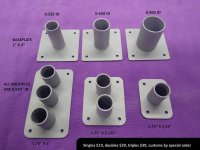
The triple tube penetration is for the RV-10; spacing matches the guide holes in F1001K. Attach with SS pull rivets. Insert cable and rig, then squirt a shot of Firebarrier 2000+ or similar into the annular space. Simple, gas tight, absolutely fireproof.

Penetration Fittings 12-22.jpg

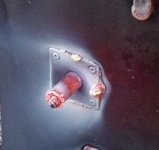
P6010025.jpg

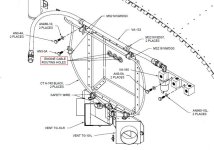
RV10 Penetrations.jpg
 
It's not an issue. Most folks will use the plans locations. If waiting until after the engine is installed, a tubular penetration can be placed at will. Drill a hole to match the ID, position the tube, match drill four holes through the base plate for the SS pop rivets.
 
It's not an issue. Most folks will use the plans locations. If waiting until after the engine is installed, a tubular penetration can be placed at will. Drill a hole to match the ID, position the tube, match drill four holes through the base plate for the SS pop rivets.
Also, you can insert them from the cabin side. Sometimes (not always) that's easier.
 
Back
Top