


Van's Air Force

The definitive Van's Aircraft support community! Buying, building or flying an RV? Join our exclusive family of mentors and enthusiasts!

Bypass for heated air (older RV4)

sophistical

Member
Patron
I purchased a 1990 era RV4 this fall. The plane has a cabin heat valve inside the firewall which is just an open/closed valve so it tries to block the air at the firewall when closed. There is no bypass for the air when the valve is closed; the ram air from the #3 baffle was just dead-headed against this valve and even on hot days it was allowing a little air to leak in. I didn't like this arrangement as it was but I especially don't like it now as I installed the heat muff (temps are getting cool here in the midwest) and that valve, scat tube and my Stein aluminum vent are just cooking from the heated air; especially when it's shut at low altitude on a sunny day. I feel I need a way to vent the heated air out of the ducting when I'm not calling for heat; before it comes into the cabin heat control.

The question is; what's the most elegant way to resolve this in an RV4 with the limited space available. Did changes in later years come up with a better solution?

I've done some digging here but haven't found any solution I love yet and thought I'd ask in case I'm missing a solution that others have already found; I assume this would be a common problem.
  • I know I can restrict the airflow from the source (#3 baffle) as a start which is my first plan of action so I can keep flying and have some heat
  • One thought is to replace the cabin heat box with a firewall side bypass box like Vans Vent -TG10; I don't like the fact that it would dump hot air right near the fuel pump but maybe I'm overthinking that?
    • Maybe a part like ACS 08-04958 has enough material for me to rivet on a 2" aluminum flange on the bypass side to allow me to route un-used air out the bottom?
  • I've seen the 2" Y tube on ACS with a shut off valve and imagine I could install this between the heat muff and the firewall and vent the heated air until I need it. I like this approach but I would have to add another cable to control it and come up with a way to mount the valve to the firewalll or motor mount. Since the air is headed "up" at that point the vented air would require a good length of scat tube routed up and then back down to get it headed the right direction to vent out vs. heating the mags or fuel pump etc.
Any other suggestions or threads that I should read? I really wish I could install one valve that mixed hot or cold air (I have a spare air inlet on the cowl) but I think I'd need 2 air bypass devices for that to work and I don't think I have room for that.

Thanks in advance for any ideas folks can share!
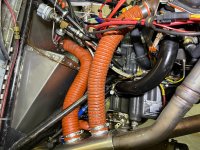
 

Attachments

  • IMG_7918.jpg
    IMG_7918.jpg
    3.2 MB · Views: 52
I purchased a 1990 era RV4 this fall. The plane has a cabin heat valve inside the firewall which is just an open/closed valve so it tries to block the air at the firewall when closed. There is no bypass for the air when the valve is closed; the ram air from the #3 baffle was just dead-headed against this valve and even on hot days it was allowing a little air to leak in. I didn't like this arrangement as it was but I especially don't like it now as I installed the heat muff (temps are getting cool here in the midwest) and that valve, scat tube and my Stein aluminum vent are just cooking from the heated air; especially when it's shut at low altitude on a sunny day. I feel I need a way to vent the heated air out of the ducting when I'm not calling for heat; before it comes into the cabin heat control.

The question is; what's the most elegant way to resolve this in an RV4 with the limited space available. Did changes in later years come up with a better solution?

I've done some digging here but haven't found any solution I love yet and thought I'd ask in case I'm missing a solution that others have already found; I assume this would be a common problem.
  • I know I can restrict the airflow from the source (#3 baffle) as a start which is my first plan of action so I can keep flying and have some heat
  • One thought is to replace the cabin heat box with a firewall side bypass box like Vans Vent -TG10; I don't like the fact that it would dump hot air right near the fuel pump but maybe I'm overthinking that?
    • Maybe a part like ACS 08-04958 has enough material for me to rivet on a 2" aluminum flange on the bypass side to allow me to route un-used air out the bottom?
  • I've seen the 2" Y tube on ACS with a shut off valve and imagine I could install this between the heat muff and the firewall and vent the heated air until I need it. I like this approach but I would have to add another cable to control it and come up with a way to mount the valve to the firewalll or motor mount. Since the air is headed "up" at that point the vented air would require a good length of scat tube routed up and then back down to get it headed the right direction to vent out vs. heating the mags or fuel pump etc.
Any other suggestions or threads that I should read? I really wish I could install one valve that mixed hot or cold air (I have a spare air inlet on the cowl) but I think I'd need 2 air bypass devices for that to work and I don't think I have room for that.

Thanks in advance for any ideas folks can share!
You did't mention your "cold" air source, so ...

Thx - HFS
 
You did't mention your "cold" air source, so ...

Thx - HFS
Great point. There is a spare NACA duct in the lower cowl right next to the heat muff. I could have connected this to the firewall cabin heat box for cool air instead of the #3 baffle location which is “semi cool” air depending on altitude.
 
Great point. There is a spare NACA duct in the lower cowl right next to the heat muff. I could have connected this to the firewall cabin heat box for cool air instead of the #3 baffle location which is “semi cool” air depending on altitude.
Thx
 
I have +1000 hrs in RV-4 I built in late 80's and flew through the 90's, sold. I understand (timing interesting as you in WI and it's getting cold) you want to keep hot air from going into the cabin and making air vents from getting hot (which I don't quite understand**). Assume first RV you just bought recently. I will tell you what I did.

** Usually hot air just comes out behind firewall in cabin and lofts up. Not sure why your Stein vents are getting hot. Sounds like hot air is routed direct to those. So my advice is standard RV-4 set up (as best as I remember, sold the plane over 20 yrs ago). Too much heat was not an issue in Winter. I did a coast to coast flight winter and was able to stay warm with jacket thrown over my shoulder and over the stick to allow hot air from under instrument panel to keep me warm during long XC at altitude in fridge weather. I was solo. The heat was adequate (again freezing temps on ground, flying at +8000') was not enough to warm the whole cabin. I had warm clothes' on, warm stocking cap...

FIX: I have one sure fire way to "fix this". Seasonally remove the heat ducts (assume 2" SCAT, orange flex hose) from baffle to heat muff and from heat muff to firewall heat valve. Block everything off.

You do want some air flow in heat muff even when not using. When you have a standard cabin heat air goes through that heat muff and is vented into the engine bay and out bottom of cowl via the firewall heat valve.

Remove SCAT from exhaust heat muff but best remove exhaust pipe heat muff completely. It is worth while to do so every year to LOOK for damage to muff and pipe. CO2 poising anyone. This should be part of your CONDITION INSPECTION.

Block off air outlet back of baffle #3 cylinder. You may need to use metallic tape and/or make a blocking plate.

Block off Heat valve in firewall,. How? Taking valve off is too much work and likely not practical, typically riveted on. You have that 2" opening where SCAT hose was removed. You might be able to buy off the shelf stainless steel cap. I googled it, seems like they are out their, but fit don't know. You could cut a round metal plant (aluminum, SS, steel) and use SS tape and attach it.. The heat valve "seals" and you might think you don't need it. Again fumes and fire, I would be overly cautious. I would consider a stainless steel cover with tabs folded over around circumference, and attach with. hose clamp, and high temp RTV to seal it for fire and fume safety. It can be removed when you restore your cabin heat system.

SAFETY. By all means keep fire and fume integrity. Yes you will need to make some parts. Once you have them you just put them in, take them out as needed. . CO2 detector is a cheap add-on and big safety bonus.

DONE. Save weight, no heat coming into cockpit. Winter time (coming like freight train in WI) you will need heat. In spring reverse the steps. You can do this job with practice in 2 hours from time taking cowl off to cowl back on (not including making parts first time). I removed mine in summer. I combined these spring and fall events with inspections and oil changes.

PS BTW you know you need to "annual" the plane yearly for safety and legality, called a "condition inspection". As you also know you did not build it, so you will need an A&P (no IA needed) to sign off, but you can do a lion share (or all) of the work with A&P supervision. I suggest you get an RV expert A&P and/or builder/owner who has maintained RV's for a long time to help with hands on with your first "Condition Inspection". There are two book on Van's aircraft RV maintenance and pre-purchase of Van's RV's. You have to know what to look for. Also maintenance is OK for you to do even non consequential modifications called "Minor". By definition "minor" is any change that does NOT effect any major system or airplanes performance and control characteristics. I personally think cabin heat "INOP" and disabling the system is MINOR. BE SURE to put an INOP sticker on your cabin heat control. Start to mess with Prop, Engine, Fuel modifications those are major. The FAA wants to know and you may have to go back into PHASE 1, which is a restricted period, Phase 1 you can look up, and will be FAA defined, typically no passengers, limited geographical area for specified flight time to verify changes (flight test persay). Once you fly off that restriction (if FAA deems needed) you just log it and put plane back into Phase 2. No need to contact FAA again. Seriously you are in WI home of EAA and sure there are smarter people than me to help you, but HELP you should seek out in regards to another few sets of eyes and better ideas. Do you have a POH or AFM with all the limitations? Are the log books right? I have seen too many kit planes 2nd and 3rd hand that don't have even basic ARROW paper work (Airworthiness, Registration, Radio (needed for Int'l Canada, Mexico), Operating Limits and W&B. I would put this bad boy RV-4 on scales. I see RV's with W&B BOW and CG way off. NOTE RV-4 is a delight to fly solo. With 2 up also a delight BUT the stick control in pitch gets very light light light. Landing may not require little to no back pressure to flare and a tad more speed. In my RV-4 case, with girlfriend, baggage, landing I would hold a slight bit forward pressure as I had run out of nose up trim. This was at aft CG limit. Solo no bags different. Respect all the limits and no impromptu aerobatics without extreem caution, reading (a lot of info out there) and preferably get training. To legally do two up aerobatics requires two parachutes (and in class G airspace) and altitude (3000' recommended). The aerobatic weight of the RV-4 is limited. Most RV's are over Van's BOW target, so it is a solo aerobatic plane to stay within aerobatic limits. Remember Van designed this 40 yrs ago for a wood prop, O-320, and a very basic day VFR panel, may be some lights for night. Fat RV's are common....So weigh the plane when you get a chance.
 
You want: https://www.aircraftspruce.com/catalog/eppages/homebuilderscabinheatbox10.php?clickkey=29910
This is an all stainless airbox which allows air to flow through the heat muff. Exhaust manufacturers generally discourage blocking airflow to the heat muff which may damage the exhaust pipe. This airbox allows full airflow through the heat muff and you can divert to the cabin as needed. In your northern winters, it may be marginally adequate to heat the cabin. But some is better than none.
 
** Usually hot air just comes out behind firewall in cabin and lofts up. Not sure why your Stein vents are getting hot. Sounds like hot air is routed direct to those. So my advice is standard RV-4 set up (as best as I remember, sold the plane over 20 yrs ago). Too much heat was not an issue in Winter. I did a coast to coast flight winter and was able to stay warm with jacket thrown over my shoulder and over the stick to allow hot air from under instrument panel to keep me warm during long XC at altitude in fridge weather. I was solo. The heat was adequate (again freezing temps on ground, flying at +8000') was not enough to warm the whole cabin. I had warm clothes' on, warm stocking cap...
Thank for your comments. Inside the cabin my heat box has 2 outlets; one was blocked and the other has scat hose connecting it to a Stein vent. It also doesn't seal all the way so even when it's closed it's allowing enough heated air to come in and back up behind the Stein vent and heat-soak everything. It sounds like the original heat muff in your RV4 may not have put out a lot of heat and may not have had ducting in the cabin. This one has the Vetterman 2 pipe heat muff and it is putting out a lot of heat and it's either heating the cabin or heat soaking the entire system after the heat muff if you try to restrict it at the cabin or firewall.

I did purchase the plane with a pre-buy and a fresh weight and balance so all the paperwork and w&b is sorted. I needed a lighter RV with the ability to fly with my wife and so lots of @&B calculations were done before I even made an offer. I also got a conditional inspection completed so I'm good for about a year there too; I also don't plan anything that should require me to re-enter phase 1.
 
You want: https://www.aircraftspruce.com/catalog/eppages/homebuilderscabinheatbox10.php?clickkey=29910
This is an all stainless airbox which allows air to flow through the heat muff. Exhaust manufacturers generally discourage blocking airflow to the heat muff which may damage the exhaust pipe. This airbox allows full airflow through the heat muff and you can divert to the cabin as needed. In your northern winters, it may be marginally adequate to heat the cabin. But some is better than none.
Thanks Brad, I had seen that airbox and like it .. (that was in my second bullet in my original post) my concern is whether all the bypassed heated air will cause problems with the fuel pump. Maybe there is enough material to add a 2" flange to duct that excess air to the bottom of the cowl. That's what I'm leaning towards at this point anyway.

I feel like most RV4 owners that fly in cold temps would have made a change like this (assuming my installation is the same as the plans) so it would be a well documented "upgrade" but I hadn't stumbled across it yet; this valve we are looking at seems to have been designed for the RV10 so only 20 years old where many RV4s were built before then ..

Again, thanks for the input!
 
Last edited:
Thank for your comments. Inside the cabin my heat box has 2 outlets; one was blocked and the other has scat hose connecting it to a Stein vent. It also doesn't seal all the way so even when it's closed it's allowing enough heated air to come in and back up behind the Stein vent and heat-soak everything. It sounds like the original heat muff in your RV4 may not have put out a lot of heat and may not have had ducting in the cabin. This one has the Vetterman 2 pipe heat muff and it is putting out a lot of heat and it's either heating the cabin or heat soaking the entire system after the heat muff if you try to restrict it at the cabin or firewall.

I did purchase the plane with a pre-buy and a fresh weight and balance so all the paperwork and w&b is sorted. I needed a lighter RV with the ability to fly with my wife and so lots of @&B calculations were done before I even made an offer. I also got a conditional inspection completed so I'm good for about a year there too; I also don't plan anything that should require me to re-enter phase 1.
Got it, disable it FWF in warm months and in winter rejoice you will need it. For short flights no big deal with warm clothes. But a winter 3.5 day cross country coast to coast Seattle to NY flight I took, diverting way way south (mid Texas) to avoid deep artic blast ,flying all day,day after day, heat was an issue in my RV-4. Yes the airbox was not ducted in cabin, just blew it out, which my current RV-7 does as well. Like I said I took my jacket off and made a tent over the stick and all that hot air kept me warm. Back of my neck was cold... needed a flying scarf like a real pilot, Not sure eyeball vents would do much better.

I do get crazy and ride my BMW motorcycle in mild Mid Atlantic winters. albeit mild to WI. Having a full fairing is nice but heated riding gear is the slick set up, which I don't have. There are electrical outlets for electric gear. I want to get at least hot gloves. The grips are heated but that just makes your palms warm. I think RV's could use heated clothes, sock vs cabin heat (or move to Florida). Remember B-17's in WWII were flying in the 25 to 30 thousand feet range, unpressurized and open, about -30F to -60F!

CONGRATS on the RV-4. It is a great flying plane. May be next to the RV-3 one of the best flying of the RV's (which is a high standard as they all are great). Fly Safe.
 
Last edited:
Back
Top
