


Facts up front:
- RV-6A
- Rapco brake discs
- Cleveland 30-9 brake calipers
- Cleveland 66-106 brake linings
So I was down there yesterday troubleshooting a separate issue (chattering brakes after I ignorantly lubed up the anchor bolts with grease), and I noticed that the anchor bolts have a full 3/4" exposed. I don't know much about brakes, but if the purpose of the anchor bolts is to anchor the entire assembly -- provide some stabilizing effect -- it seems that 3/4" is quite a lot of distance. Who knows. So I started digging for some diagrams. Cleveland's manual (AWBCMM0001-12) has only one "example" diagram to explain what typical brake systems look like, but no diagram specific to the 30-9. That diagram shows a torque plate that is symmetrical, so I can't tell if "typically" the flange would point toward the cylinder or the opposite.
The only diagram I can find on Google that might be the 30-9 is the product image on the Aircraft Spruce website (see below). (But where did they get it, if Cleveland manual doesn't have it?? Even the filename of "500x5brake.jpg" doesn't lend a clue) The shape of my components looks exactly like the diagram, so let's assume it's accurate:
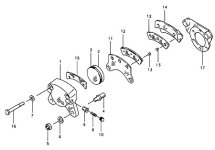
It appears that my torque plate is installed backward. The diagram shows the "flange" of the non-symmetrical torque plate (#17 in the diagram) facing the cylinder (#1); this means that much more of the anchor bolts (#4) are inside the "flange", providing the stabilizing effect.
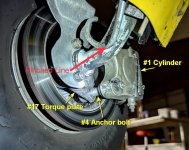
Here's a picture of mine (LH and RH are both like this). My torque plate has the flange facing outboard away from the caliper, leaving a full 3/4" of exposed anchor bolt, and not much of it inside the flange.
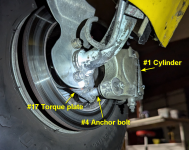
Am I seeing this / understanding this correctly? Should I disassemble and flip it around?
- RV-6A
- Rapco brake discs
- Cleveland 30-9 brake calipers
- Cleveland 66-106 brake linings
So I was down there yesterday troubleshooting a separate issue (chattering brakes after I ignorantly lubed up the anchor bolts with grease), and I noticed that the anchor bolts have a full 3/4" exposed. I don't know much about brakes, but if the purpose of the anchor bolts is to anchor the entire assembly -- provide some stabilizing effect -- it seems that 3/4" is quite a lot of distance. Who knows. So I started digging for some diagrams. Cleveland's manual (AWBCMM0001-12) has only one "example" diagram to explain what typical brake systems look like, but no diagram specific to the 30-9. That diagram shows a torque plate that is symmetrical, so I can't tell if "typically" the flange would point toward the cylinder or the opposite.
The only diagram I can find on Google that might be the 30-9 is the product image on the Aircraft Spruce website (see below). (But where did they get it, if Cleveland manual doesn't have it?? Even the filename of "500x5brake.jpg" doesn't lend a clue) The shape of my components looks exactly like the diagram, so let's assume it's accurate:
It appears that my torque plate is installed backward. The diagram shows the "flange" of the non-symmetrical torque plate (#17 in the diagram) facing the cylinder (#1); this means that much more of the anchor bolts (#4) are inside the "flange", providing the stabilizing effect.
Here's a picture of mine (LH and RH are both like this). My torque plate has the flange facing outboard away from the caliper, leaving a full 3/4" of exposed anchor bolt, and not much of it inside the flange.
Am I seeing this / understanding this correctly? Should I disassemble and flip it around?



 How about a “Technical Information” tab on the main page?……anyone?)
