Van's Air Force

The definitive Van's Aircraft support community! Buying, building or flying an RV? Join our exclusive family of mentors and enthusiasts!

Alternative Cowl for RV6,7 and 9.

Teal

Active Member
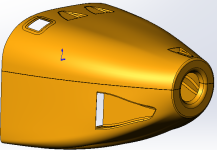
I am making a new cowl for my Yamaha powered RV9 that makes use of NACA inlets and is better shaped to suit my engine install. This cowl might be able to be used for other liquid cooled engine installations. The mold will be pretty pricey and I am wondering if there is any interest within the community for an alternative cowl. 1728963887977.png
 
Dan, Nice informative article by Peter Garrison. However, I would take some of his caveats with a grain of salt. All kinds of aircraft and race car oil coolers (heat exchangers) are fed by NACA ducts, mostly successfully. Of course, it does depend on where they are situated on the vehicle as to how efficient they are, locations of high or increasing pressure gradients obviously work better than locations of low or decreasing pressure gradients.
And, regarding the use of NACA ducts for fuel vents, well, I referred to the following three NACA Research memorandums when designing a fuel vent:
  1. NACA Research Memorandum RM E8A27b (March 29 1948) Investigation of the Aerodynamic and Icing Characteristics of a Recessed Fuel Cell Vent Assembly I-Rear Wall Vent Tube Mounting.
  2. NACA Research Memorandum RM E8B05a (March 30 1948) Investigation of the Aerodynamic and Icing Characteristics of a Recessed Fuel Cell Vent Assembly II-Ramp Floor Vent Tube Mounting.
  3. NACA Research Memorandum RM E8C05 (April 23 1948) Investigation of the Aerodynamic and Icing Characteristics of a Recessed Fuel Cell Vent Assembly III-Rear NACA Flush-Inlet-Type Vent.
Although fuel vents do not have much in the way of flow, the NACA duct provides an area of high pressure on the aft face, and additionally, since they are flush, provides excellent ice resistant pressure source, as well as having low drag.
But one application where NACA ducts are entirely misused is as an exit duct (ogive apex pointing aft). You see these on NASCAR race cars on the rear windows. Yeah, if they only read the literature on NACA ducts.

 
Dan, Nice informative article by Peter Garrison. However, I would take some of his caveats with a grain of salt. All kinds of aircraft and race car oil coolers (heat exchangers) are fed by NACA ducts, mostly successfully. Of course, it does depend on where they are situated on the vehicle as to how efficient they are, locations of high or increasing pressure gradients obviously work better than locations of low or decreasing pressure gradients.
And, regarding the use of NACA ducts for fuel vents, well, I referred to the following three NACA Research memorandums when designing a fuel vent:
  1. NACA Research Memorandum RM E8A27b (March 29 1948) Investigation of the Aerodynamic and Icing Characteristics of a Recessed Fuel Cell Vent Assembly I-Rear Wall Vent Tube Mounting.
  2. NACA Research Memorandum RM E8B05a (March 30 1948) Investigation of the Aerodynamic and Icing Characteristics of a Recessed Fuel Cell Vent Assembly II-Ramp Floor Vent Tube Mounting.
  3. NACA Research Memorandum RM E8C05 (April 23 1948) Investigation of the Aerodynamic and Icing Characteristics of a Recessed Fuel Cell Vent Assembly III-Rear NACA Flush-Inlet-Type Vent.
Although fuel vents do not have much in the way of flow, the NACA duct provides an area of high pressure on the aft face, and additionally, since they are flush, provides excellent ice resistant pressure source, as well as having low drag.
But one application where NACA ducts are entirely misused is as an exit duct (ogive apex pointing aft). You see these on NASCAR race cars on the rear windows. Yeah, if they only read the literature on NACA ducts.

 
Dan, Nice informative article by Peter Garrison. However, I would take some of his caveats with a grain of salt.

True for all of us, including me. See below ;)

All kinds of aircraft and race car oil coolers (heat exchangers) are fed by NACA ducts, mostly successfully. Of course, it does depend on where they are situated on the vehicle as to how efficient they are, locations of high or increasing pressure gradients obviously work better than locations of low or decreasing pressure gradients.

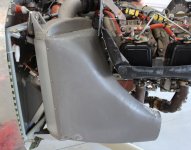
They obviously flow; most RVs have at least one to feed cabin air. However, as Garrison says, a high Vi/Vo inlet needs an internal diffuser if the system is expected to convert a high velocity jet to high pressure over a wide area, like the face of a heat exchanger. I imagine Teal's application will be fine with that caveat, but a good diffuser feeding an exchanger can be difficult to design in the short length of a tractor airplane cowl.

That said, the good enough rule applies. Maybe the space restriction results in a diffuser with so-so performance, like a Cp of 0.6, but if it is good enough to do the job, it's mostly successful. We have a whole lot of early James cowls with 4"D inlets and poor diffusers flying around to prove the point.

Diffuser.jpg
 
I am making a new cowl for my Yamaha powered RV9 that makes use of NACA inlets and is better shaped to suit my engine install. This cowl might be able to be used for other liquid cooled engine installations. The mold will be pretty pricey and I am wondering if there is any interest within the community for an alternative cowl. View attachment 72167
Interesting project. Your shaping looks very specific to fit your engine installation. Would it be more appealing if the shape were more generic to accept non in-line engine configurations? A potential market would be RV Rotax installations which look to be grabbing attention lately. Another thought would be offering the cowl without inlets pre-cut in. As depicted, inlets would favor your specific engine requirements.

Now the off topic folks can get back to their Naca duct discussion…
 
Interesting project. Your shaping looks very specific to fit your engine installation. Would it be more appealing if the shape were more generic to accept non in-line engine configurations? A potential market would be RV Rotax installations which look to be grabbing attention lately. Another thought would be offering the cowl without inlets pre-cut in. As depicted, inlets would favor your specific engine requirements.

Now the off topic folks can get back to their Naca duct discussion…
Thanks for the suggestion. the inlets could be taken out of the mold and offered non cut. My primary goal was to create a custom cowl for my installation not to fit other types of engines. Most likely this Cowl will not work for others but I am OK with that.
 
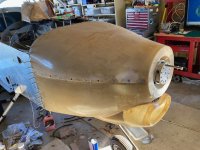
I did a one-off cowl for a unique installation once, a huge amount of work. Installation was a modified 540 with a large supercharger mounted in front of #2 cylinder, associated drive pulleys & plumbing required the prop moved 4” forward. I bagged the engine than encased it in expanding foam. Lots of carving & sealing formed a male mold. I figured getting a smooth surface would involve LOTS of micro, so offset its weight by employing carbon fiber for the lay ups.
Again LOTS of work but was totally flabbergasted how well the final product came out. That was HR2, Race #57.
So I appreciate how much effort is ahead of you.
 
Sam James probably still sells their "Rotary" Cowling, which has been successfully used by many over the yrs.

Doug


1734924603814.jpeg
 
Back
Top