Van's Air Force

The definitive Van's Aircraft support community! Buying, building or flying an RV? Join our exclusive family of mentors and enthusiasts!

RV-7 aileron bearing replacement

BruceW

Well Known Member
Sponsor
At almost 700 hours, the left aileron bearings are loose enough to justify replacement (the outside bearing in particular).
I have ordered the COM-3-5 bearings and the aileron plates, or arms, for replacement.
My plan is to drill out and replace the arms but not the rear spar angles.

Any tips or tricks from others that have done the same ???
Thanks.
 
When you do this, pay particular attention to how the upper surface of the aileron lines up to the plane of the wing. Ideally, the aileron should be just slightly high of a tangent line from the wing skin. But the most important thing is that the relative height is the same at both ends, and the same from left to right aileron. small variations in aileron height are the primary cause of a "heavy wing" characteristic.
The parts are pre-punched but you have some small latitude to tweak the height, within the clearance holes for the rivets. If that is not enough 'adjustment' to get the heights the same, Vans can send you brackets that have not been drilled.
 
Thanks Steve for the reminder. I would assume that using the same pre-punched holes would give the same setting on the arms.
But just in case, I will take measurements before disassembly so I can check at reassembly. And hope I dont need new aileron brackets.
 
Thanks Steve for the reminder. I would assume that using the same pre-punched holes would give the same setting on the arms.
But just in case, I will take measurements before disassembly so I can check at reassembly. And hope I dont need new aileron brackets.
If you search here you can find an old thread here with some close-up pictures to show what the aileron height should be. If you lay a steel ruler on the wing skin extending aft, the aileron should be 0.020--0.050 high - in other words, lifting the ruler up off the wing skin with a slight gap at the edge of the skin. But as I said, it is most important to have the same position everywhere. If its a little low, it's not ideal, but it's ok, as long as its the same amount low everywhere.
 
I've got a RV9 that has a "loose" COM 3-5 on the right outboard aileron. AF has 940 hrs. I've got same 914 A,B and C parts on order to make same repair along with a new 3-5 bearing. I re squeezed the two rivits there close to the 3-5 .and tightened up assy for now. But will replace when parts arrive. See SCSMITH s comments on my post which looks like good advice on the fix. I want to pay attention to the fit of that bearing in the two bracket halves and will also check the aileron position above the wing as noted above. Let me know how your repairs go.
 
OP follow up.
Have everything removed. Plan is to remove the arms but keep the angles in place..
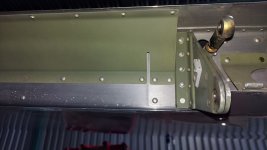
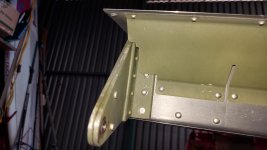
How to replace rivets on the upper portion of the arms? The aileron gap fairing interferes.
Outside arm more than the inside arm.
What have others done?
Maybe drill out and cut off the outside portion of gap fairing, and replace with separate part?
Looks like the gap fairing supports the back of the top skin, so a separate outside part should not be a problem.
Or, keep in place, cur out a portion and pop rivet back a patch?
Thanks in advance.

RV-7 aileron arm-1.jpg

RV-7 aileron arm-2.jpg
 
I think it makes sense to cut out a rectangular piece of the gap fairing, get good rivets in the aileron hinge brackets, then put a patch on the gap fairing with a few pop rivets.
 
I got my Van's parts yesterday ie 914 A,B and C same as you . Plan is to follow your replacement BruceW. Appreciate the post and pics. I noticed that the two sandwich brackets did not fit the 3-5 in od very well. Also there is a bit of space when the brng is sandwiched between.
On my existing there is no space and that's the looseness I have. Looks like the original builder for this part may have over drilled the depth of the hole for that bring. I believe that a tight hole fit up is the way to go on this.

Edit 1/3/25 : Just To clarify this above post, the brng I tried that did not fit into the sandwich very well was the INCORRECT brng. It was a com 3 not the required COM 3-5 . the 3-5 PN is a 5/8 OD brng. I got the correct brng from vans and the installation at later date went well : ie nice tight brng fit into the vans bracket halfs.
 
Last edited:
Are the bearings worn out or is it the bearing hole in the bracket arm which is worn? If it is the bearing itself, I think if you drill out the 2 upper rivets and the 3 lower arm rivets, all of which are accessible, you should be able to pry the bracket open enough to change the bearing on the outer bracket. The inner bracket looks more challenging but you could try the same with whatever rivets you can access both sides. If it is the bracket arm that is worn out then what Steve said....notch the gap seal and patch.
 
I got my Van's parts yesterday ie 914 A,B and C same as you . Plan is to follow your replacement BruceW. Appreciate the post and pics. I noticed that the two sandwich brackets did not fit the 3-5 in od very well. Also there is a bit of space when the brng is sandwiched between.
On my existing there is no space and that's the looseness I have. Looks like the original builder for this part may have over drilled the depth of the hole for that bring. I believe that a tight hole fit up is the way to go on this.
The parts I got from Vans (W-413 and -414 series parts) fit very tight to the OD of the bearing, and the sandwich. Apparently YMMV.
 
Are the bearings worn out or is it the bearing hole in the bracket arm which is worn? If it is the bearing itself, I think if you drill out the 2 upper rivets and the 3 lower arm rivets, all of which are accessible, you should be able to pry the bracket open enough to change the bearing on the outer bracket. The inner bracket looks more challenging but you could try the same with whatever rivets you can access both sides. If it is the bracket arm that is worn out then what Steve said....notch the gap seal and patch.
Its the bracket arm that is loose, not the bearing. I cut out patches of the gap fairing and getting ready to drill out the -4 rivets.
Will take some minor surgery skills to back drill some of the rivets with extra long drill bits. Will take it slow and hope for no major screw ups.
 
Update on my brng replacement to right outboard aileron bracket. Removed the wing tip. Had very good access to bracket and rivit drill out. The gap seal was trimmed to access the top two rivits. All new Van's parts along with 3-5 brng. I did not remove the angle just the 2 bracket halves. The new brng fit tight within the sandwich and I sealed the brng housing in the bracket with hard setting permatex. BE VERY Careful with sealer not to get ANY on inner pivot of 3-5. all reassembled and aligned perfectly with the original angle.
I believe my original brng was allowed to rotate in the bracket and oversized the pocket holes. Be sure to use correct length bolt and thickness washers to keep the bolt tight on the rotational part of the brg .
 
As a matter of interest (condition inspection coming up) how did you detect that there was slop in the bearing assembly?
Figs
 
As a matter of interest (condition inspection coming up) how did you detect that there was slop in the bearing assembly?
Figs
Bruce mentioned it was the bracket that was loose, rather than the bearing inside. It made more sense after he posted this.
 
As a matter of interest (condition inspection coming up) how did you detect that there was slop in the bearing assembly?
Figs
The outboard end of the right Aileron could be moved up and down estimated 1/8 inch. Obviously there was some issue with the brng, bracket or fit between the parts. I did take a close look and determine the lossness was in the bracket at the bearning counter bore. It was all captured and actually flew couple more hours before the parts and time arrived to replace. Others on the forum suggested that could set up aileron flutter at high speed . I am confident that the wear occurred over a period if time and it was around Nov that I discovered it on a normal preflight.
 
I know you guys are already almost done, but i just went through the hinge SB on new wings. The directions for the SB show where you can cut the gap fairing to access the rivets on the inboard bracket.
 
SB16-03-28
Not specifically for new wings, but they sent the parts in my kit so i put it in.
 
What actually is coming "loose" to allow this movement? Is there inadequate structure, or insufficient riveting? Are the rivets coming loose, or is the structure flexing?
 
In my case, it was the recess in the aluminum bracket that wore. Bearing itself was OK. Rivets on the 'bracket sandwich' or to the rear spar were fine, and there was no separation of the sandwich. My speculation is simply vibration of the aileron onto the wing structure (or visa versa) and carrying thru the bearing/bracket. The AL bracket is softer than the bearing so the wear is there . FWIW, my -7 it was only on the left wing.
 
In my case, it was the recess in the aluminum bracket that wore. Bearing itself was OK. Rivets on the 'bracket sandwich' or to the rear spar were fine, and there was no separation of the sandwich. My speculation is simply vibration of the aileron onto the wing structure (or visa versa) and carrying thru the bearing/bracket. The AL bracket is softer than the bearing so the wear is there . FWIW, my -7 it was only on the left wing.
They always have issues with the pocket depth...
It is bending because the material is on the thick side for the CNC punch process.
Then the milling of the pocket gets too deep because the material is not flat on the milling table.
Like this, the bearing has room/play from the beginning in the pocket, and with the years, it is getting much more and much worse.

Is it possible to just drill out the 2 rivets close to the bearing, pry open the two parts, and get the bearing replaced?
 
They always have issues with the pocket depth...
It is bending because the material is on the thick side for the CNC punch process.
Then the milling of the pocket gets too deep because the material is not flat on the milling table.
Like this, the bearing has room/play from the beginning in the pocket, and with the years, it is getting much more and much worse.

Is it possible to just drill out the 2 rivets close to the bearing, pry open the two parts, and get the bearing replaced?
I didn't think much of the 'pry' idea.
Since wear was in the plates, they needed to be replaced.
 
What actually is coming "loose" to allow this movement? Is there inadequate structure, or insufficient riveting? Are the rivets coming loose, or is the structure flexing?
My case I believe the bracket counter bore for the bearing had enlarged due to rotation of the bearing. The outboard end of the right Aileron could be moved up and down estimated 1/8 inch. Obviously there was some issue with the brng, bracket or fit between the parts. All the rivits were tight in both the bracket attach to the spar and bracket to bracket.
The repair indicated that the counter bore in the bracket was worn oversize and the depth was also questionable. All of which was "wear and tear" from service hours. I think the root cause for the wear was that the pivot bolt did not clamp the inner race of the bearing and allowed the outer dia of the bearing to rotate in the bracket. Another thin washer added clamped the bolt assy to the inner race. I also reinstalled the bearing with a VERY SMALL amount of hard setting permatex in the counterbore along with instalation of new bracket and bearing.
 
Back
Top