


Van's Air Force

The definitive Van's Aircraft support community! Buying, building or flying an RV? Join our exclusive family of mentors and enthusiasts!

My Planned RV10 Electrical Design

N787KV

Active Member
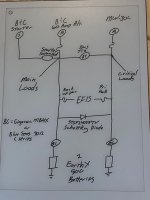
Here's my current RV10 electrical plan. Please note that this drawing is the concept not the exact wiring diagram. The mission, day/night VFR/IFR. The plane, dual Pmags and standard fuel injection. I'm planning two EarthX 900 batteries. The first thing this does is to allow me to ditch the dedicated EFIS backup battery and allows continued operation Nav/Comm in the worst case, not just the EFIS. I also have a backup starting battery as a bonus, which I could have used before. Two alternators with the Monksworkz in standby mode so as to pick up the critical loads automatically and allows me time to load shed the main bus before activating the Bus Tie Contactor if desired. In normal operations, both busses are powered by the main bus. The citical bus recieves it's power via a Schottky diode. Circuit protection will be a hybrid of CBs and fuses. CBs primarily for the avionics and fuses for simple circuits ie. lights, seat heat etc. Starter solenoid has yet to be determined, so I'm open to suggestions. Thanks for your consideration.IMG_4876.jpeg
 
Last edited:
The Achille’s heel is your immediate action for smoke in the cabin. This should be opening of both of your master solenoids. As all the power to keep your avionics powered is now gone, you are blind. Ok for a VFR plane but not for an IFR plane. Easy enough to fix this issue.

Not sure the value of adding the diode.

Fully agree with ditching the now typical plethora of backup batteries.

Carl
 
The Achille’s heel is your immediate action for smoke in the cabin. This should be opening of both of your master solenoids. As all the power to keep your avionics powered is now gone, you are blind. Ok for a VFR plane but not for an IFR plane. Easy enough to fix this issue.

Not sure the value of adding the diode.

Fully agree with ditching the now typical plethora of backup batteries.

Carl
If the MW-30L works as I understand it. I can open both master solenoids and the MW-30 should pickup the critical load. The one back up battery I might consider is for the is for the standby PFD. I'll give the smoke issue some more thought. Thanks Carl.
 
If the MW-30L works as I understand it. I can open both master solenoids and the MW-30 should pickup the critical load. The one back up battery I might consider is for the is for the standby PFD. I'll give the smoke issue some more thought. Thanks Carl.
Assuming a VR can keep an alt or gen on line without the capacitance of a battery is a bad bet. Some like to point out that they tested their system in such a config and it “passed”. All that means is on a certain day under those conditions, the device stayed online. They could easily be one com xmission, flap motor energization, etc away from tripping the power source off-line.
 
The Mz doesn’t need external field excitation like an alternator. It’s a generator.
It is a permanent magnet generator. There are a number of ways to do so, but the device output still needs to be regulated. Willing to learn more about the MWz output regulation approach but standing by my previous comment.
 
The Achille’s heel is your immediate action for smoke in the cabin. This should be opening of both of your master solenoids. As all the power to keep your avionics powered is now gone, you are blind. Ok for a VFR plane but not for an IFR plane. Easy enough to fix this issue.

Not sure the value of adding the diode.

Fully agree with ditching the now typical plethora of backup batteries.

Carl
I've been pondering your smoke in the cockpit scenario. I can only imagine two worst places for this to happen, in a space craft or submarine. What I don't know is what are the top reasons for electrical smoke in the cockpit in small airplanes today and how often it occurs? In my set up, if I opened both masters, the MZ-30L would automatically take up the critical loads. If the source of the smoke was the ML-30L regulator, then yes, the plane would go dark. After seeing the safe guards Bill has built into his regulator, that wouldn't be my first guess as to the source of smoke. That said, it does make the case for a self powered backup PFD.
 
It is a permanent magnet generator. There are a number of ways to do so, but the device output still needs to be regulated. Willing to learn more about the MWz output regulation approach but standing by my previous comment.
I emailed Bill with the exact question about operating in a situation without a battery. The regulator doesn't care. As long as you have good engine RPM, the regulator will produce 14.6 ish volts and up to 15 or 30 amps (RPM dependent). He has some interesting YouTube videos on the operation and design of the MZ-30L.
 
OEMs often make such unofficial statements that their supply equipment can operate without the need for such system capacitance like a battery. Then when you try to get a definitive, on the record statement, the hemming and hawing starts. If any gen or alt OEM will go on the record and positively, definitively state the subject position, I’d welcome such. If anyone here can point to such an existing OEM statement, please share.
 
The Achille’s heel is your immediate action for smoke in the cabin. This should be opening of both of your master solenoids. As all the power to keep your avionics powered is now gone, you are blind. Ok for a VFR plane but not for an IFR plane. Easy enough to fix this issue.

Not sure the value of adding the diode.

Fully agree with ditching the now typical plethora of backup batteries.

Carl
The Diode is there to prevent the main load side from overwhelming MW-30L in case of a main alternator failure.
 
The Diode is there to prevent the main load side from overwhelming MW-30L in case of a main alternator failure.
In normal practice, the MW will put out whatever current it can at the buss voltage it sees. If the load is more than it (or any alternator can meet) buss voltage will drop until current provided to the load meets the output capability.

Think like connecting a 10 amp charger to a low battery. The charger will still put out 10 amps, just at a lower voltage. As the battery charges the voltage increases.

Now if the battery is so bad it presents a short on the buss, then the MW fuses come into play.

Carl
 
In normal practice, the MW will put out whatever current it can at the buss voltage it sees. If the load is more than it (or any alternator can meet) buss voltage will drop until current provided to the load meets the output capability.

Think like connecting a 10 amp charger to a low battery. The charger will still put out 10 amps, just at a lower voltage. As the battery charges the voltage increases.

Now if the battery is so bad it presents a short on the buss, then the MW fuses come into play.

Carl
That makes sense. If the battery does short as described, would there be enough voltage to keep the battery contactor closed or would it open?
 
This ain't the space shuttle or a '787' for gosh sake, it's a freaking sport plane.
The more 'stuff' you add the higher the failure potential. KISS is not just for the wife.

You can 'design' all the redundancy you want into a fancy system, but most failures in EAB are a result of builder errors, especially when it comes to FWF and wiring.
 
despite the concerns of some, you can design an elegant system the accomplishes your goals without being forced to reimplement a tried and true 1950’s architecture. It can be robust, redundant, reliable, and modern. There’s no reason why you can’t borrow concepts and strategies from modern power distribution systems and come up with something well-suited to your intended task and goals for your “sport plane”. You seem like you’re well on your way. Take the main points from the criticisms you will hear and think them through. And then make decisions that suit your goals and needs and budget.
 
despite the concerns of some, you can design an elegant system the accomplishes your goals without being forced to reimplement a tried and true 1950’s architecture. It can be robust, redundant, reliable, and modern. There’s no reason why you can’t borrow concepts and strategies from modern power distribution systems and come up with something well-suited to your intended task and goals for your “sport plane”. You seem like you’re well on your way. Take the main points from the criticisms you will hear and think them through. And then make decisions that suit your goals and needs and budget.
This is why I posted. I want the feedback. Good, bad or indifferent, it gets me thinking in ways I may have missed. My goal is to put together a robust system using proven, reliable equipment that gives me options and increases my odds of not being AOG. That doesn't mean that it need to be complicated, just well thought out and easy to service. So I invite people to rip it apart. Carl already has me working on a few tweaks.
 
Back
Top
