Van's Air Force

The definitive Van's Aircraft support community! Buying, building or flying an RV? Join our exclusive family of mentors and enthusiasts!

Relocate brake master cylinders to back side of pedals?

mstrauss

Well Known Member
Patron
Looking at the rudder pedals setup for the brake master cylinders (RV14), I'm thinking it would be a better if they were mounted on the back side. I have flown in a 14, and can't say the master cylinders or lines were a problem in the front. It's just why risk them getting kicked or pushed when in the front. I propose it would also clean things up having the lines in the back. I know the ControlApproach and Risse Racing solutions place them in the back. I am wondering if anyone has modified the stock pedals to move the master cylinders to the back?
 
Have fun bleeding them, or just checking fluid level.
Thanks for the thought Walt. I could see a benefit for servicing something like an O-ring, but why would you need to get to the master cylinders to bleed the brake lines? Same Q for checking fluid level. There is a remote fluid reservoir on the firewall. Wouldn't you use that?

Is there any truth to the O-ring issues in the master cylinders needing servicing due to side loading from lack of support for the cylinder's actuator? That is, they are supported on only one side.
 
Perhaps I'm wrong (I might very well be), but I was under the impression that "brake master cylinders" referred to the kind of brake cylinder that included their own integral reservoir.

If so, then it's like my C180, which needs at least annual checking and once in a while, bleeding. They are forward of the pedals. And let me assure you, that it's a very annoying PITA to do that. And it's gotten more difficult as I aged. That's even with generous doors on the cockpit and front seats that slide aft for access.

Strongly not recommended!

Dave
 
Master = where force input into the (hyd) system is converted to pressure.

Slave = where the pressure is converted to force and transmitted to the intended devise.

It is independent of reservoir location/type. Convention and nomenclature may have corrupted this a bit.

Surprised the terms haven’t been updated in hyd apps or control loop apps. If they have, someone will surely speak up.
 
Thanks for the thought Walt. I could see a benefit for servicing something like an O-ring, but why would you need to get to the master cylinders to bleed the brake lines? Same Q for checking fluid level. There is a remote fluid reservoir on the firewall. Wouldn't you use that?

Is there any truth to the O-ring issues in the master cylinders needing servicing due to side loading from lack of support for the cylinder's actuator? That is, they are supported on only one side.
Maybe I misunderstood, was thinking the same David Paule above where the reservoir is mounted to the MC.
 
Looking at the rudder pedals setup for the brake master cylinders (RV14), I'm thinking it would be a better if they were mounted on the back side. I have flown in a 14, and can't say the master cylinders or lines were a problem in the front. It's just why risk them getting kicked or pushed when in the front. I propose it would also clean things up having the lines in the back. I know the ControlApproach and Risse Racing solutions place them in the back. I am wondering if anyone has modified the stock pedals to move the master cylinders to the back?
Mike,

I’m not familiar with the RV-14 but I did this to my RV-8 recently. I removed the brake reservoir from the firewall and the lines from the reservoir to the master cylinders. I installed individual brake fluid reservoirs on the back of each brake master cylinders on the bottom (input) side. I didn’t like the plastic brake lines anyway. I also had Aircraft Specialties make me new braided lines to go from the top (output) side to the parking brake then I kept the already installed hard lines from there down to the brakes. In an -8 it’s very easy to access from the front baggage compartment. I modified the front baggage floor with a large access panel for this purpose and just to be able to access other stuff under the panel.

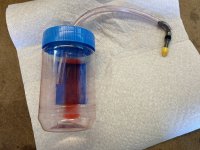
Bleeding brakes is really easy now and less restrictive. I use an old plastic peanut butter jar with a hole in the lid and a tube going to a 90 degree fitting that temporarily replaces the brake reservoir cap for bleeding. One guy looking down in the forward baggage opening and me bleeding the brakes from the bottom. When the bubbles stop I pump a little more then close off the bleeder valve at the brake. No mess, no fuss.

Not sure about the -14 so I’d guess that maybe you have to crawl underneath.

IMG_1014.jpeg
 
Back
Top