Van's Air Force

The definitive Van's Aircraft support community! Buying, building or flying an RV? Join our exclusive family of mentors and enthusiasts!

Tailwheel stinger slop - NAS bolt before taper pins

flyenforfun

Well Known Member
All,

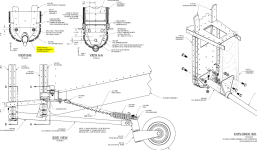
My ~800 hour RV-8 has developed some side to side play in the tailwheel stinger where it mounts in the forward weldment with one vertical bolt. I believe this is an AN4 bolt. Doing some searching on the forum I saw many have gone to a taper pin in this location. Before I dive into the amount of work a taper pin looks like its going to be, I wanted to try a tighter tolerance bolt to see if that can take up the small amount of slop. Can anyone tell me the part number I need for an NAS "X" or NAS "Y" bolt to replace this AN4? I believe the X and Y are 1/64 and 1/32 diameter larger than the AN4, could be wrong there, I just thought I read that in my forum searches. I am far away from my old plans and can't seem to find online what exact AN4 goes in that location.

Thanks in advance for the help.
 
Enlarging the hole for a taper pin is no more work than enlarging it for an over-size bolt.
And (IMO) the taper pin solution is less likely to produce a recurring problem.
I feel that this was a design deficiency. The tail spring mount WD-409 should have been a thicker wall tube, and/or used
two bolts to secure the tail spring.A762654D-508F-4123-985C-FF7E5AE14A65_1_105_c.jpeg
 
Just for information and question to the people with tailwheel airplane, my RV8 fuselage kit was originally delivered in 2019 and it uses the regular AN4 bolt. I have over 80 hours on the airf rame, I probably have more landings in the first 80 hours than other RV8 builders/pilots I know. I am curious to find out how many hours on your airplane that you started to notice the play on the stinger bolt? During the last condition inspection, I found that I had to retorque the nuts and bolts on the tailwheel assembly. They include the stinger bolts, the two bolts that hold the tail wheel fork, and the mounting bolts to the rear fuselage structure. The torque seals were in place but they all needed some additional torque.
 
Just for information and question to the people with tailwheel airplane, my RV8 fuselage kit was originally delivered in 2019 and it uses the regular AN4 bolt. I have over 80 hours on the airf rame, I probably have more landings in the first 80 hours than other RV8 builders/pilots I know. I am curious to find out how many hours on your airplane that you started to notice the play on the stinger bolt? During the last condition inspection, I found that I had to retorque the nuts and bolts on the tailwheel assembly. They include the stinger bolts, the two bolts that hold the tail wheel fork, and the mounting bolts to the rear fuselage structure. The torque seals were in place but they all needed some additional torque.
I first noticed an extremely small amount of play when lifting the tailwheel at 900 hours, I don’t log landings but probably 3000+-? This play is not the normal rotational play that most see. The play is up and down, and can barely be discerned. It is so minor it can’t be measured, just felt.
Early on, within the first 100 hours, I noticed rotational play in the two bolts that hold the tail wheel post to the stinger. I replaced those with close tolerance bolts. I had to press them in. They have been rock solid since.
Hope that helps.
 
I agree with SMRacer that installing an oversized bolt would involve the same reaming process as a taper pin.

If you did insist on an oversized bolt a NAS6604-17X has the same grip length as the existing bolt and is 0.015” oversized. I have no idea where you would find one. Maybe call Genuine Aircraft Hardware. 888-247-2738
 
Last edited:
The problem with the oversized bolts is typical wear isn’t consistent through the sleeve and stinger bore. I got away with it on the two small bolts as the wear was minor and I was able to press the new bolts in. Much smaller bolts and it still took a lot of grunt. Not an option with the main stinger bolt.
If you are able to get an oversized bolt in, you are just delaying the inevitable.
 
AN bolts are not manufactured to a very good standard in my opinion. If you measure the area close to the threads with a micrometer you will find that for a length of 1/8"plus the bolt is substantially under size compared to the rest of the bolt. So if a minimal length bolt is used the area adjacent to the threads is not carrying any load. This can be dealt with by using a bolt that is at least one dash number longer than normally necessary. By doing this both sides of the socket are equally tight and equally sharing the load.
 
As someone just building, would it be a good idea to just start with a taper pin instead of the AN bolt?
 
As someone just building, would it be a good idea to just start with a taper pin instead of the AN bolt?

It's one of those cunumdrums that's a little difficult to answer. At this point in time it's easier to do the work but you'll feel it's probably unnecessary, and let's be honest, you have more important things to do. So you leave it. After 10 years and 500 hours you remember back to the day you thought about putting a taper pin in there and feel happy that you didn't bother because your machine is hanging in there tight and its all good. Then, after 1,000 hours of awesome flying experiences you're laying underneath the aeroplane with the tail lifted off the ground trying to drill through spring steel, hot slithers of metal falling down your neck and cutting fluid dripping on your face in order to insert a taper pin... and you can't really decide whether you should have done this 20 years ago or whether it really was worth leaving it to now. (Yes, I helped a friend do his machine earlier this year.)

:D

I felt the same way with my engine mount. I know its going to crack but it looks perfect now, so should I add some strength before I bolt it on or should I wait until I have 400 hours and find the first crack? Since I've always been pretty competent at the fine art of procrastination I bolted the mount on and will worry about it when it happens. I will just try to avoid being disappointed when I have to deal with it in another two years from now.
 

Post #17 is famous and has the parts and tools you need. It’s not difficult but it takes a lot of turns of the reamer. Reaming from the bottom side doesn’t require the long tap wrench. Using a drill with a very slow speed and wax lube worked well for me.
 

Post #17 is famous and has the parts and tools you need. It’s not difficult but it takes a lot of turns of the reamer. Reaming from the bottom side doesn’t require the long tap wrench. Using a drill with a very slow speed and wax lube worked well for me.
If I can ream from the bottom the job becomes much easier, but the taper pin doesn't offer a cotter option. If the nut comes off the taper pin will just fall out. JD air suggested reaming from the top down. It's a better practice but I'd probably have to remove the tail. Have others done bottom up? What's the option for secondary security on the pin?
 

Post #17 is famous and has the parts and tools you need. It’s not difficult but it takes a lot of turns of the reamer. Reaming from the bottom side doesn’t require the long tap wrench. Using a drill with a very slow speed and wax lube worked well for me.
From that post I need:

AN386-2-9A taper pin (aircraft spruce)

AN975-3 taper pin washer (aircraft spruce)

B&S #2 taper pin reamer


I did find one source for a AN386-2-9 taper pin which is drilled for cotter pin. I'd say that would be a better option for reaming from the bottom up.
 

Readers digest version: put it in from the bottom. That’s an interference fit joint. It will take force to remove it.
 
Last edited:

Readers digest version: put it in from the bottom. That’s an interference fit joint. It will take force to remove it.
Thats the plan now, especially because I acquired a drilled AN386-2-9 taper pin. I also have the AN975-3 taper pin washer. Now I just need to figure out what castle nut goes on there and get the taper pin reamer.
 
Thats the plan now, especially because I acquired a drilled AN386-2-9 taper pin. I also have the AN975-3 taper pin washer. Now I just need to figure out what castle nut goes on there and get the taper pin reamer.
Looks like the AN320-3 shear castle nut according to Aircraft Spruce.
 
Ok so for those who have been there, done that. If you drill form the bottom, you used a -2 pin with a castellated nut? Or just use the -1 with a locknut?
 
Back
Top