Van's Air Force

The definitive Van's Aircraft support community! Buying, building or flying an RV? Join our exclusive family of mentors and enthusiasts!

Turbo Charged fuel nozzles

Fuel nozzles for a turbo charged engine can be used on a normally aspirated engine if induction pressure is higher or almost the same as ambient air pressure.
This is to ensure that the air pressure around the fuel nozzle is higher than in the induction line just before the cylinder.
Fuel atomisation is dependent on a differential air pressure in the fuel nozzles.
Typically you can see this on an engine with a efficient RAM-air intake.

Good luck
 
Last edited:
Fuel nozzles for a turbo charged engine can be used on a normally aspirated engine if induction pressure is higher or almost the same as ambient air pressure.
This is to ensure that the air pressure around the fuel nozzle is higher than in the induction line just before the cylinder.
Fuel atomisation is dependent on a differential air pressure in the fuel nozzles.
Typically you can see this on an engine with a efficient RAM-air intake.

Good luck
"induction pressure is higher"

Do you mean "Induction pressure is lower"?

Upper cowl pressure is normally higher then manifold pressure in a normally aspirated engine. Upper cowl is where the nozzles get the air from.
 
Last edited:
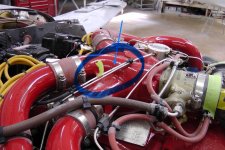
I have done it on my previous Lycoming IO360 and current IO550N (both Lancairs).
The thinking years ago on the Lancair forum was as stated on post #2. Back then, someone with an efficient ram air claimed to see some fuel staining around the nozzles, so many went to the turbo nozzles.

As an aside, on the 550 I had an idle that sounded like a cammed up race car and soot inside one bank’s tailpipe. Finally tracked down that my air supply lines to the rails were too small and the side with longer plumbing wasn’t getting enough air at low rpm to properly atomize the fuel. I increased the size of the air supply lines, and idles very smooth now (albeit a little boring vs the snorting before j.

(Sorry, couldn’t find a picture of the Lycoming installation).
 

Attachments

  • IMG_4534.jpeg
    IMG_4534.jpeg
    925 KB · Views: 16
Last edited:
Here is the data from my flight testing. It shows induction (manifold pressure) materially above upper cowl (plenum) pressure.
I’m not going to say my data is anywhere near laboratory quality and the MAP is measured by the Garmin and the other pressures by digital manometer.
And, obviously a little different cowl, etc than the Vans.

29-Jan 29-Jan
MSL 6500 8500
OAT (F) 60 60
RPM 2660 2400
C FLAPS closed closed
RAM AIR open open
OIL DOOR open open
TAS 258 247
IAS 229 212
GPH 24.5 18.0
MP-Ram ON 25.0 23.0
MP-Ram OFF 23.5 21.6
Ram Air Delta 1.5 1.4
Plenum pressure inHg 16.5 13.2
Lower Cowl pressure inHg 10.9 8.5
Oil Cool exit inHg-Door Open 11.7 9.1
Oil Cool exit inHg- Door Closed 11.0
Cowl Exit Temp F 154
Oil Temp F 230 223
CHT 2 F 376
CHT 4 F 340
Sound dbA 98.7
TAS Verification w 4way GPS run:
GS kts - 360hdg 284
GS kts - 90hdg 284
GS kts - 180hdg 262
GS kts - 270hdg 240

ANOTHER MEASUREMENT
H2O" pressures: cowl flaps open/closed
Plenum:11/17
Exit: 3/11
Ram: 21/25 (pitot tube mounted in center of inlet, ~2" from inlet front.
TAS 231/239 kts
#1 CHT(hottest): 316/334 F
Cowl Exit temp (cf open) 115F
OAt: 32 F
P alt:~6,000
2,500, WOT, Ram air OFF, mixture far rich
 
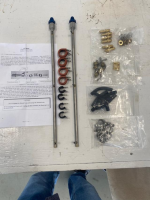
Has anybody fitted turbo charged fuel nozzle to their RV10, I0-540 X. If so what was the reason? please send pics.

I have a complete Air Flow Performance Turbo Charge system I am not using that I used only about 15 hours on the engine and willing to sell for $450 OBO
You may call me at 405-612-9522
1728269431131.png
1728269470820.png
 
Here is the data from my flight testing. It shows induction (manifold pressure) materially above upper cowl (plenum) pressure.
I’m not going to say my data is anywhere near laboratory quality and the MAP is measured by the Garmin and the other pressures by digital manometer.
And, obviously a little different cowl, etc than the Vans.

29-Jan 29-Jan
MSL 6500 8500
OAT (F) 60 60
RPM 2660 2400
C FLAPS closed closed
RAM AIR open open
OIL DOOR open open
TAS 258 247
IAS 229 212
GPH 24.5 18.0
MP-Ram ON 25.0 23.0
MP-Ram OFF 23.5 21.6
Ram Air Delta 1.5 1.4
Plenum pressure inHg 16.5 13.2
Lower Cowl pressure inHg 10.9 8.5
Oil Cool exit inHg-Door Open 11.7 9.1
Oil Cool exit inHg- Door Closed 11.0
Cowl Exit Temp F 154
Oil Temp F 230 223
CHT 2 F 376
CHT 4 F 340
Sound dbA 98.7
TAS Verification w 4way GPS run:
GS kts - 360hdg 284
GS kts - 90hdg 284
GS kts - 180hdg 262
GS kts - 270hdg 240

ANOTHER MEASUREMENT
H2O" pressures: cowl flaps open/closed
Plenum:11/17
Exit: 3/11
Ram: 21/25 (pitot tube mounted in center of inlet, ~2" from inlet front.
TAS 231/239 kts
#1 CHT(hottest): 316/334 F
Cowl Exit temp (cf open) 115F
OAt: 32 F
P alt:~6,000
2,500, WOT, Ram air OFF, mixture far rich
I would think if the manifold pressure is higher then upper cowl pressure, you would be blowing air and fuel out of the bleed air holes.
 
Here is the data from my flight testing.

MP-Ram ON 25.0 23.0
Plenum pressure inHg 16.5 13.2

Clark, what do the dual numbers (i.e. "25.0 23.0") represent?

I would think if the manifold pressure is higher then upper cowl pressure, you would be blowing air and fuel out of the bleed air holes.

It would, but that's not the whole picture. Intake port pressure is not the steady value you see on your MP gauge. There are significant wave effects running up and down each intake pipe.

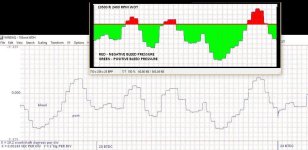
Don Rivera and I were interested in the amplitude and duration of positive and negative pressures (manifold pressure vs bleed air pressure) during the 720 cycle, so I installed turbo shrouds and pitot tube feeds. The first runs recorded average pressures, just bubble rock vs MP gauge stuff. The second runs recorded pressure using a fast differential pressure sensor from Honeywell, feeding a laptop.

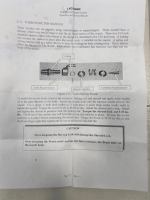
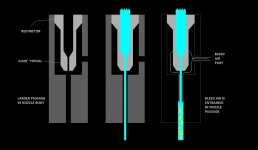
Not everyone understands how the constant flow injection nozzle works. Here's the basics. Standard nozzles merely expose the bleed hole to upper plenum pressure. Turbo nozzles pipe pressure to the bleeds from a higher pressure source. They get their name because they are always installed on turbocharged engines, where MP is routinely higher than plenum pressure.

Constant Flow Nozzle Operation.jpg

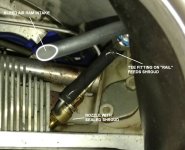
This is a shrouded nozzle and its pitot supply tube. The best reason to use a tube and shrouds is to more or less guarantee all the nozzle bleeds are exposed to the same supply pressure. A turbulent cowl inlet or other airflow oddities may be a problem in some cases. I'm not aware of anyone seriously quantifying the issue.

Components.jpg

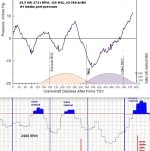
Data snapshot. You're looking at differential pressure tapped at the #1 primer port near the intake valve, and at the end of the bleed air pitot tube. A second data channel identified spark plug firing, which sets a time reference for the intake events. Here red represents deltaP where MP is a little higher than bleed pressure, so in theory, yes, fuel is going backwards out the bleeds. Green is positive bleed pressure, when the nozzle is operating like you see in the first illustration.

At the time, this was a stock 360/390 angle valve horizontal intake and tubes. The graph would change for a different system, depending on the relative degree of pressure recovery at a ram intake and the upper cowl cooling inlets.

overlay.jpg

The plot would also change for a different RPM; wave velocity is based on tube length and diameter, which are fixed, but an RPM shift changes the time periods between valve events. If the designer is doing a good job, the intake port is at high pressure just as the valve opens, and a few waves later, again just as it closes. Some old school guy at Lycoming appears to have done a decent job of it back in the 1960's. It can be improved of course. I was real impressed with data from Bob's Sky Dynamics intake on the Super Six.

Anyway, here's an interesting comparison, a 2731 RPM plot from the old CAFE 4-into-1 reports, and one of my plots taken at 2400 RPM. I've aligned the TDC and BDC points for reference.

ScreenHunter_1907 Sep. 24 13.57.jpg

One last note. Unproven, but I suspect a fast measurement of the bleed pitot tube pressure would show peaks at propeller blade passage, which would also change the deltaP plots.

Sing along now...the thigh bone connected to the knee bone...
 
>Dan H - Clark, what do the dual numbers (i.e. "25.0 23.0") represent?<

Hi Dan, all the supplemental reading I took with the digital manometer SHOULD be in inches of H2O.
The top data set have two columns with different altitude/rpm. The bottom data set is cowl flaps open vs closed.

I build my own carbon baffling, and added cowl flaps, so thought it would be interesting to collect some additional data as best I could.
Interesting was how much the pressure increased in the cowl with the cowl flaps closed (a lot). I had to modify the cowling as it was bulging between fasteners).

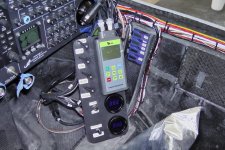
Picture of piccolo tube to measure plenum pressure, and my test rig.
 

Attachments

  • IMG_4537.jpeg
    IMG_4537.jpeg
    243.5 KB · Views: 24
  • IMG_4536.jpeg
    IMG_4536.jpeg
    315.1 KB · Views: 7
Last edited:
Ahhh! Thanks, missed the listing of two altitudes.

Nice work sir.
 
Ahhh! Thanks, missed the listing of two altitudes.

Nice work sir.
Dan, thanks. It’s was super interesting collecting all the data, and all of my cooling and induction are working very well, so I’m happy.
And, I’m c 15 KTAS faster than the “average”, so good to see all the additional work pay off (and actually work).
 
I would think if the manifold pressure is higher then upper cowl pressure, you would be blowing air and fuel out of the bleed air holes.
I don’t think that’s possible in my setup?
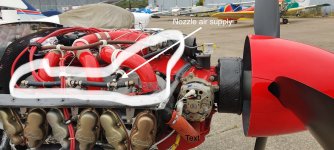
(Turbo nozzles as mentioned in #4 and shown in picture).

(Also, Dan H thanks for posting those v interesting pressure results)
 
I don’t think that’s possible in my setup?

Impossible to say without pressure data from the bleed air feed tubes, i.e. pressure inside the nozzle shrouds.

If the reported numbers are accurate, the setup seriously needs the shrouded nozzles. Without them you would definitely be pushing fuel out the bleeds at various points in the 720 degree 4-stroke cycle, as at 8500 ft you're reporting 13.2" Hg in the plenum and 23" Hg inside the intake port.

That said, I don't understand the reported plenum values. Consider; at 8500 ft, 60F, and 247 KTAS, available dynamic pressure would be 2.1255" Hg. Freestream static pressure would be 21.806" Hg. The total pressure (static + dynamic) would thus be 23.9" Hg.

You're reporting 13.2" Hg in the plenum. What does it reflect? It's far too high to represent coefficient of pressure (Cp), the portion of available dynamic pressure converted to increased plenum static pressure. Cp would be a percentage of the available 2.1255", typically in the 0.6 to 0.9 range.

If 13.2 is actually inches of water (not inches of mercury), measured as deltaP (upper plenum vs freestream static), Cp would be a very low 0.46.

For sure 13.2" Hg or H2O is much too low to represent plenum total pressure.
 
If the reported numbers are accurate, the setup seriously needs the shrouded nozzles. Without them you would definitely be pushing fuel ), measured as deltaP (upper plenum vs freestream static), Cp would be a very low 0.46.

Hi Dan
I guess that I wasn’t clear.
I’ve already got the shrouded (turbo) nozzles. You can see the air rail in post #4 (I highlighted it). I also described the issue with the too small air rail there.

These reading (reproduced below) are in inches of water, using a differential manometer with the other side plumbed into ship static system.

H2O" pressures:
cowl flaps open/closed
Plenum:11/17
Exit: 3/11
Ram: 21/25 (pitot tube mounted in center of inlet, ~2" from inlet front.

Would relatively small inlets 4.0x4.5” oval tend to a lower Cp? What is the Cp on your RV8? Hopefully these look reasonable or I’m firing the data collector.

Thanks,
Clark
 
H2O" pressures: cowl flaps open/closed
Plenum:11/17
Exit: 3/11
TAS 231/239 kts
OAt: 32 F
P alt:~6,000
231 KTAS at 6000 ft and 32F means q (available dynamic pressure) is 29.39" H20. 11 / 29.39 is a Cp of 0.37
239 KTAS at 6000 ft and 32F means q is 31.46" H2O. 17 / 31.46 is a Cp of 0.54

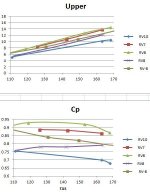
Below are upper plenum pressures and Cp examples as recorded by a variety of RV builders, all using (more or less) the same method and test setup. There are upper plenum Cp maps in NASA CR-3405, figures 43 through 47.

Plenum Pressure and Cp Examples.jpg

Would relatively small inlets 4.0x4.5” oval tend to a lower Cp? What is the Cp on your RV8? Hopefully these look reasonable or I’m firing the data collector.

We're drifting this thread away from the OP's question, so the short answer is yes, small area inlets do worse unless significant care is taken with internal diffusion. Again, CR3405 offers comparisons, as does AIAA 80-1242. The Lancair is fast, thus enjoying the benefits of velocity squared...lots of dynamic pressure, so relatively little of it is still enough to cool.
 
Back
Top