


Van's Air Force

The definitive Van's Aircraft support community! Buying, building or flying an RV? Join our exclusive family of mentors and enthusiasts!

Aft battery ground resistance

dmn056

Well Known Member
Sponsor
I'm installing aft-mounted batteries. There seem to be alternative schools of thought as to whether to ground the battery negative to the fuselage nearby or to run a heavy ground wire forward to a firewall ground. My fuselage components are fully epoxy primed, so I wondered if there would be a high resistance problem using an aft battery ground.

I made up a low resistance test circuit, based on a Bob Nuckolls constant current design, but using Kelvin clips, and tested the fuselage ground return resistance using a Fluke 97 multimeter. It has a 40mV range, with resolution of 0.01mV, and with the Nuckolls 104mA constant current it resolves to 0.096mΩ.
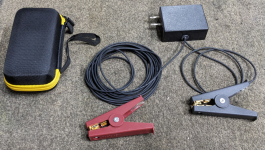
logistics_2024-08-17_02.png

With one clip on the firewall, and the other at various locations on the longerons near the battery box, it consistently measured about 1.7mΩ.
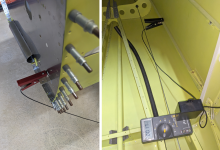
fuselage_2024-08-18_01.png

This compares well with M22759/16 2AWG wire, which has a nominal resistance of about 2.1mΩ over the same distance. So, looks like battery grounding at the lower aft longeron and a main ground on the firewall is the correct solution for me.
 
Last edited:
Great post. I have had a few members on the forum here criticize my aft negative battery ground when I showed picture of it in my EarthX installation thread. I have never had a problem whatsoever and it is great to see your results. I wonder how many people have added a few unnecessary pounds to their RV running a negative battery cable from front to back. Thanks.
 
Aft mounted (RV10) with airframe ground here as well. No issues. I spent too much time unnecessarily second guessing it though.
If it’s good enough for Bob Nuckolls then it’s good enough for me.
Thanks for quantifying it.
 
Resistance and ampacity are 2 different things. Normal operation will work fine. but if your starter lead shorts somehow the battery becomes a welder with the fuselage as the electrode. I'm not arguing one way or another. Like every system on an airplane evaluate yours and determine the risk vs reward.
 
You're not suggesting that a ground run directly to the firewall would isolate the fuselage from becoming involved in a hard ground fault ("the battery becomes a welder") ? - I'm not seeing how one battery-negative return path is any worse than the other in that scenario. Please explain the concern.
 
What will happen to the ground path over time with airframe vibration?

Best not to have the ground path / current go through any riveted joints. In other words the ground path is one continuous piece of metal with jumper wires over any rivet joint or splice.

When making an electrical connection to aluminum, I still like to use "Anti-Oxidant Joint Compound" like NOALOX that would be used with aluminum wires in a house. I still have a 50 year old bottle of a different brand that I have used over the past decades when making connections to aluminum airframes.
 
You're not suggesting that a ground run directly to the firewall would isolate the fuselage from becoming involved in a hard ground fault ("the battery becomes a welder") ? - I'm not seeing how one battery-negative return path is any worse than the other in that scenario. Please explain the concern.
The return path through the fuselage isn't defined, especially if the parts were primed before joining. Electricity usually follows the path of least resistance, in this case it could be several random rivets. Those rivets could become the fuse that blows.

I use words like usually and could because it's still called electrical theory, not electrical fact. That's also why I said it's up to y'all to determine your risk vs reward.
 
When making an electrical connection to aluminum, I still like to use "Anti-Oxidant Joint Compound" like NOALOX that would be used with aluminum wires in a house. I still have a 50 year old bottle of a different brand that I have used over the past decades when making connections to aluminum airframes.

Good call. It's been many years since I wired a house so I forgot about NOALOX for aluminum conductors. That grease seals out normal oxidation that occurs in aluminum connections. Without it, even at a very low current, a tiny arc will form that eventually grows to a fire. I'm sure a few here will remember several homes wired in the 70's catching fire due to aluminum wiring being used throughout.

In an airframe this issue could theoretically lead to corrosion and electrically "smoking" rivets with just a normal amp load.
 
What will happen to the ground path over time with airframe vibration?

Best not to have the ground path / current go through any riveted joints. In other words the ground path is one continuous piece of metal with jumper wires over any rivet joint or splice.

When making an electrical connection to aluminum, I still like to use "Anti-Oxidant Joint Compound" like NOALOX that would be used with aluminum wires in a house. I still have a 50 year old bottle of a different brand that I have used over the past decades when making connections to aluminum airframes.
Is that the same as Dielectric grease?
 
Back
Top
